Robert Leonard

Contemporary Art Writer And Curator

Nobody Puts Baby in a Corner

September 17, 2023


Yesterday, I opened my friend Jacky Redgate’s exhibition Hypnagogia with Mirrors at Wollongong Art Gallery. Curated by the artist, this idiosyncratic show brings together old works, new works, and archival materials, all in conversation with each other and with the shape and history of the building. It’s on until 26 November 2023. This is what I said:


There’s a great moment in the film Casablanca. Fate has brought Rick (Humphrey Bogart) and Ilsa (Ingrid Bergman) together again. Ilsa asks Rick if he recalls the last time they were together, as lovers, that day the German tanks rolled into Paris. ‘I remember every detail’, Rick says. ‘The Germans wore grey, you wore blue.’ 

I love that line. It says so much about how we all experience the world, combining big world-historical events, which matter to everyone, with small events, which matter just to us and ours. In our own psychic world, mass invasion by fascists can be eclipsed by the hue of a lover’s frock. These things define us.

That scene in Casablanca came back to me when I was talking to Jacky Redgate during the development of this show, we’re opening today. 

But first, let me backtrack …

When I first saw Jacky’s work, in the 1980s, I was drawn by its seriousness. Her stunning photographic series Photographer Unknown, Naar Het Schilder-Boeck, and Work-to-Rule seemed cool, conceptual, and calculated, elegant and erudite. They didn’t seem autobiographical or personal. They seemed to speak to a wider-world concerns, to histories, to theories, to ideas. I was seduced by their smarts. In 1991, I organised an exhibition of her work for New Zealand, which emphasised this understanding. 

But, years later, I became aware of another side of her practice, insistently biographical and personal, focused on childhood memories, even touching on a childhood trauma. When she was three, Jacky took a turn and was hospitalised. Her mother recorded her delirious utterances in a diary. These comments became the subject of a series of surreal photographic tableaux. This series looked back to early Jacky works with psychosexual overtones—her 1970s juvenilia—that one might otherwise have assumed she had transcended.

In 2008, I made another show with Jacky at the Institute of Modern Art, Brisbane. Visions from Her Bed included some of the personal stuff, including a creepy early photo of Jacky curled up in a baby’s cot wearing a pig’s-head mask and shiny leggings. The show raised the question of how this personal dimension might have informed Jacky’s later, largely impersonal work. Its title prompted us to imagine all her work as if viewed from the hospital bed of her childhood convalescence.

In 2020, adult and baby Jackys collided spectacularly in Hold On, a photographic series made for Geelong Art Gallery. Jacky’s serious, high modernist abstractions were rudely overrun with dolls and teddy bears, playing doctors and nurses, among other things. Were these new-naughty, kitschy-kiddy works calculated to offend those who loved—and had invested in—adult Jacky? (I think of Guston disappointing his fans, when he unveiled his comic figurative paintings at the Marlborough Gallery in 1970.)

In Hypnagogia with Mirrors, Jacky has curated herself. The show includes familiar work, previously unseen work, and new work. Her childhood story is referenced in works, but also in archives. The show encompasses Jacky’s life and work, adult and baby, the impersonal and the personal, systems and symptoms—all talking to or past one another, asking us to make sense of them.

Jacky has organised these aspects of her work and life—in all their contradiction—into the symmetrical crown structure of the Wollongong Art Gallery. Things on either side mirror one another, as if pointing to similarities and differences. 

To me, it seems, her curatorial process was as much about how to pack a mental suitcase as how to tell a story. It’s as if Jacky is inviting us to rummage through the hemispheres of her brain, where the contents and where they are filed might both be important. Hypnagogia with Mirrors seems to be full of coincidences, juxtapositions, and eureka moments. But is it significance or serendipity? Your call.

The Germans wore grey, you wore blue.

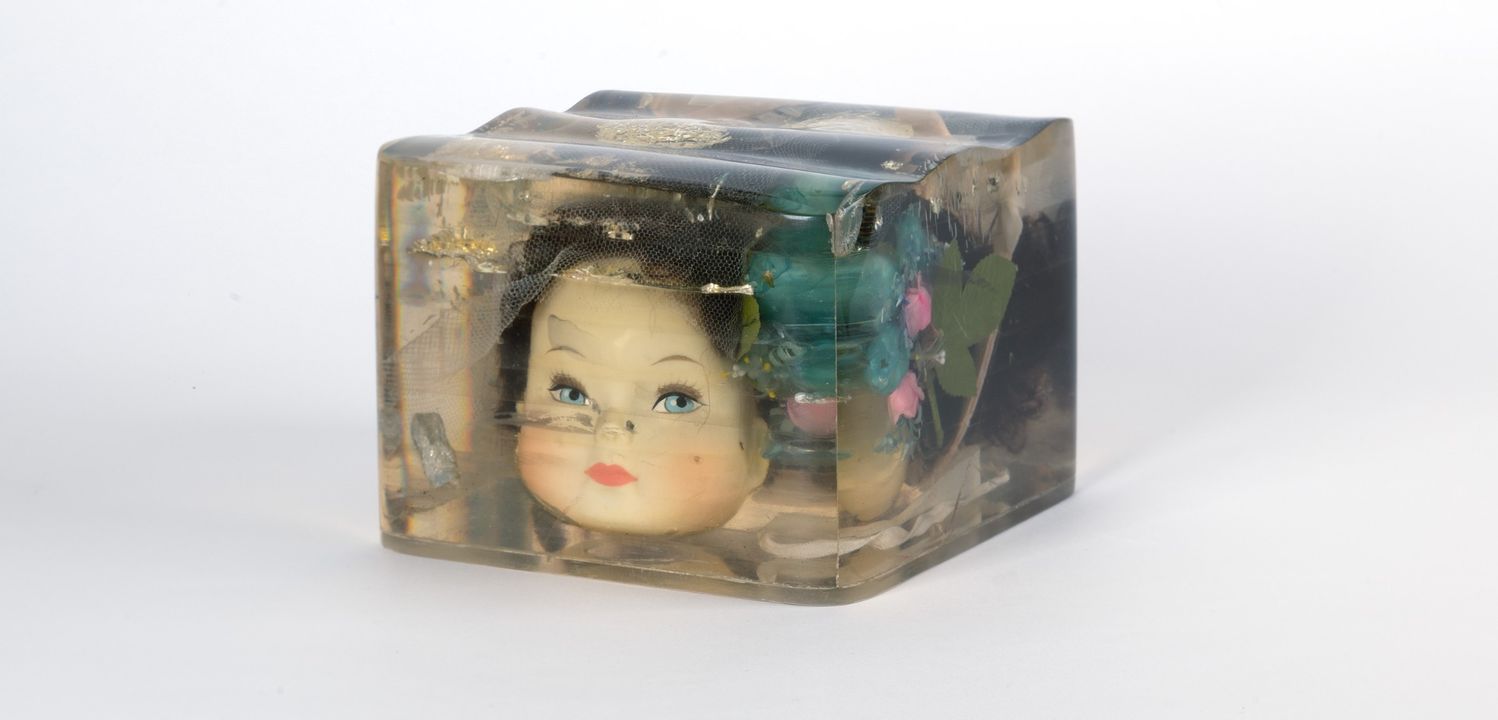
[IMAGE: Jacky Redgate Wedding Wishes 1977]
•
Always Take the Weather with You

March 10, 2023


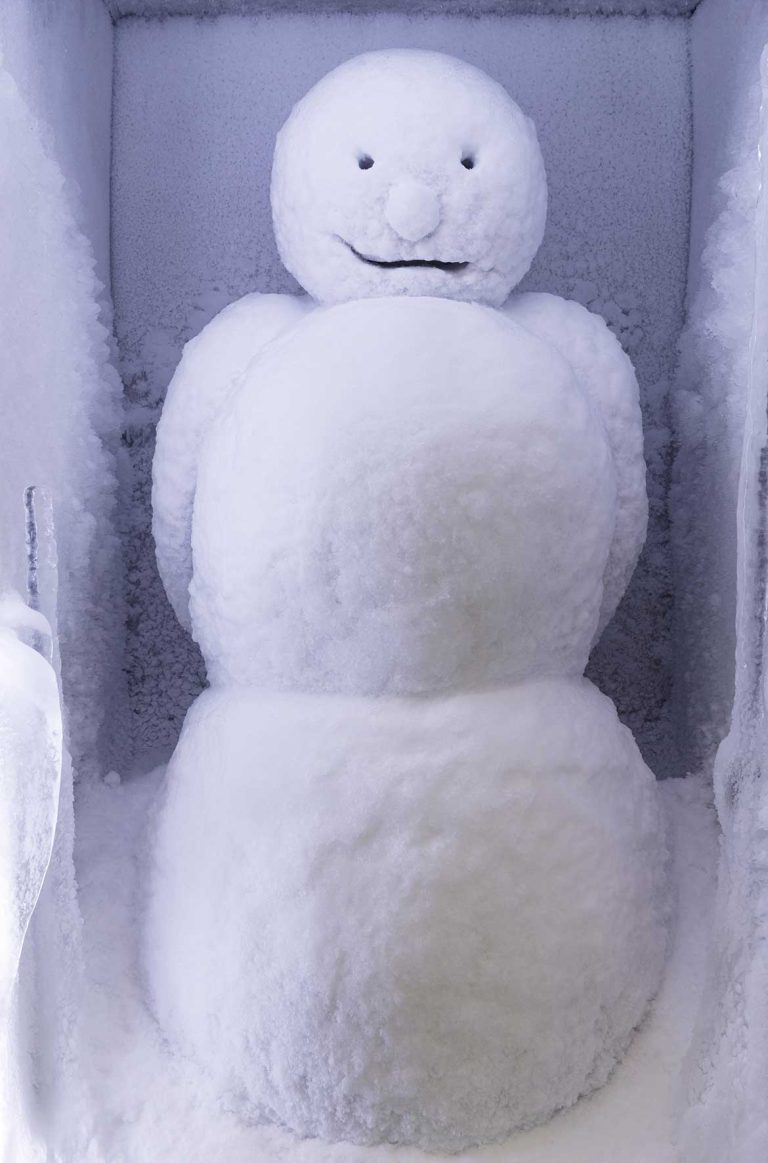
I’ve just arrived in sweaty Brisbane from windy Wellington, and my internal thermostat can’t cope with the heat and humidity. Staggering through the sculpture garden at Queensland Art Gallery, I encounter a work that speaks to my situation—perhaps ridicules it. A glass-fronted freezer contains a bulbous snowman with a quizzical expression. 

Snowman (1987–2019)—by Swiss artists Fischli and Weiss—is a deft gesture that can be endlessly unpacked, this way and that. I can confront it as alien or identify. Is it dead or alive—or, like Schrödinger’s cat, both at once? Is it in cryogenic suspension? Is it wise and kind, like Buddha (a Bodhi tree is planted nearby), or moronic and demonic? 

The Snowman may occupy its own insulated realm, a world apart, and yet Queensland Art Gallery, just metres away, is also a big glazed refrigerator, chilled for the comfort and preservation of people and things. Is the work thumbing its nose at climate change or reminding us that the gallery—indeed, the entire city—is an expensive airconditioner. 

Queensland’s Snowman is one of three. The first is installed outside Germany’s Römerbrücke power plant, whose heat keeps it cool. Another belongs to the Museum of Modern Art, New York. Queensland’s was acquired for the exhibition Water in 2019, where it was installed inside. But I find it more poignant, more funny, outside in the sculpture garden. In a place designed to view sculptures in the round under changing climate conditions, it’s a picture frozen in a frame. 

In the wretched heat, I fantasise about trading places with the snowman—watching people and seasons pass, chilling out, with a self-satisfied grin.


[IMAGE: Fischli and Weiss Snowman 1987–2019]
•

When You Sell Me

March 4, 2023


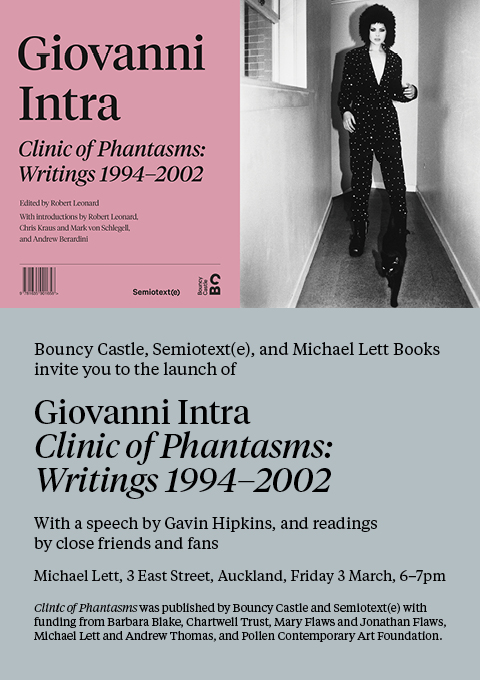
Yesterday, I was in Tāmaki Makaurau/Auckland for the New Zealand launch of Clinic of Phantasms, Giovanni Intra’s collected writings, at Michael Lett’s bookshop. I edited the collection, it was published jointly by my imprint Bouncy Castle and by the venerable LA imprint Semiotext(e), and it was years in the making. The room was full of Intra’s friends and fans. Gavin Hipkins gave a speech, and Kirsty Cameron, Jon Bywater, Ann Shelton, and I read from Intra’s texts.

When I assembled the collection, I was advised to exclude Intra’s juvenilia—when he was ‘finding his voice’—so I left out everything before 1994. The text I chose to read from, ‘When You Sell Me’, wasn’t included in the book. It was written for Stamp in 1990. Pretentious but prescient, it shows the writer Intra was becoming. Here’s the excerpt:


I tingle with joy because I know all my enemies will be pissed off for days and I will glow like jelly and it is all because of you. 

If you choose me I will honour you by chopping off my ear, spitting across the gallery at you, and being a real anarchist. 

I like the space, you like the space, it’s a good space, it would look good in outer space, if I was you I’d send it into outer space. 

You insure everything beyond its value, so that, if it blew up, you would be better off anyway. 

I can’t touch it, they can’t see it, she can’t afford it, they want to buy it, you can’t touch this. 

We used to spend hours looking at encyclopedias and history books, and now we spend hours looking at vital health statistics and pumping cholesterol from our lungs. 

At the opening I wore my tweed coat, my polka dot tie, my green trousers, my armour plated knickers, and I painted my nose red. 

The artist rejects symbolism and borrowing from indigenous cultures, rather he attempts, through a process of reduction and distillation, to penetrate a common level of collective consciousness. 

We know our positions too well. There is enough measured contempt and praise to keep our frustrations and pleasures balanced for a lifetime. 

I’ll do the mail-out, you do the mail-out, she got sent a mail-out, he’s on the mail-out list, let’s hope the mail gets lost in the mail. 

I fuck you and spit at you, you ruin me, you sell me, and this is the best art there ever is. 

Everything would be totally different if the opportunity to sell out actually existed.


Thanks to Michael Lett, Andrew Thomas, Victoria Wynne-Jones, and Samuel Holloway for hosting the launch and to everyone who came. Copies of the book are available at Michael Lett’s bookshop, and soon at better bookstores everywhere.
•

« Previous Page
Next Page »


Who Am I?

I am a contemporary art curator and writer, and Director of the Institute of Modern Art, Brisbane. I have held curatorial posts at Wellington’s National Art Gallery, New Plymouth’s Govett-Brewster Art Gallery, Dunedin Public Art Gallery, Auckland Art Gallery, and, most recently, City Gallery Wellington, and directed Auckland’s Artspace. My shows include Headlands: Thinking through New Zealand Art for Sydney’s Museum of Contemporary Art (1992); Action Replay: Post-Object Art for Artspace, Govett-Brewster Art Gallery, and Auckland Art Gallery (1998); and Mixed-Up Childhood for Auckland Art Gallery (2005). My City Gallery shows include Yvonne Todd: Creamy Psychology (2014), Julian Dashper & Friends (2015), Francis Upritchard: Jealous Saboteurs (2016), Colin McCahon: On Going Out with the Tide (2017), John Stezaker: Lost World (2017), This Is New Zealand (2018), Iconography of Revolt (2018), Semiconductor: The Technological Sublime (2019), Oracles (2020), Zac Langdon-Pole: Containing Multitudes (2020), and Judy Millar: Action Movie (2021). I curated New Zealand representation for Brisbane’s Asia-Pacific Triennial in 1999, the Sao Paulo Biennale in 2002, and the Venice Biennale in 2003 and 2015.

Contact

BouncyCastleLeonard@gmail.com
+61 452252414

This Website

I made this website to offer easy access to my writings. Texts have been edited and tweaked. Where I’ve found mistakes, I’ve corrected them.

.

Selected Writings

2026

  • Jonny Niesche and Mark Pritchard: Sound and Vision (Total Vibration)
  • John Stezaker: Jitter
  • Scott Redford: High Concept 
  • Jarrod van der Ryken: Mirror Rot
  • Florian Habicht Filmmaker
  • Jacky Redgate: The Earth Moved

2025

  • Jarrod van der Ryken
  • Susan King

2024

  • Rebecca Baumann: Apolitical Utopias
  • Miguel Aquilizan: Mutagenesis
  • Sarah Poulgrain: Take Me to the River
  • Ralph Hotere: Taranaki Gate Stations

2023

  • Brent Harris: Hidden Figures
  • Michael Zavros: The Devil’s in the Detail
  • The Last Word
  • Kathy Barry: Within You Without You
  • Anselm Kiefer Has Left the Building
  • Tia Ranginui: My Other’s Other

2022

  • Giovanni Intra: The Light that Burns Twice as Brightly
  • Brett Graham: Art of Forbearance
  • Divergent
  • Brent Wong: Twilight Zone
  • Brett Graham: Ark of Forbearance
  • Bill Hammond: Goods and Services
  • Julian Dashper: Are You Talking to Me?
  • Yvonne Todd and Geoffrey Heath: Mould in the Lens
  • John and Jane
  • Simon Ingram with Terrestrial Assemblages: Machine in the Garden
  • Venice for Beginners
  • Zac Langdon-Pole: Hurry Slowly
  • John Currin: Part of the Problem
  • John Lethbridge: Escape the Flames

2021

  • Robin White: The Tide Turns
  • Telly Tuita: Telly Vision
  • Brett Graham: Written on the Wind
  • Florian Habicht: Everything Is Kapai
  • Andrew Beck: Photography Backwards
  • Judy Millar: Paint, Canvas, Action
  • Julian Dashper: Autumn 1989
  • Yona Lee: Fix and Fit
  • Tia Ranginui: Gonville Gothic
  • In Memory of Bill Hammond 1947–2021
  • Wellness versus Art
  • Susan King: Address Unknown
  • Michael Zavros: Zeus/Zavros

2020

  • Zac Langdon-Pole: Containing Multitudes
  • Isabella Loudon: Concrete Mixer
  • Zac Langdon-Pole: Rabbit Hole
  • Kirsty Lillico: Let Me Tell You About My Mother
  • Steve Carr: Taking the Fun out of Fireworks
  • Explaining Peter Peryer to a Dead Hare
  • Stuart Ringholt: Committing Time
  • John Stezaker: A Ship’s Steering Wheel and a Hangman’s Noose
  • Gavin Hipkins: No Place (Like Home)

2019

  • Brent Harris: Sincere Disconnect
  • Colin McCahon: Numerals
  • City Chief
  • Stanley Kubrick: 2001
  • Patrick Pound: Slender Threads

2018

  • Questioning Revolt
  • The People vs. Kelley Walker
  • Eva Rothschild: The Difference a K Makes
  • Patrick Pound: The Collector’s Shadow
  • Jono Rotman: Our Enduring Image of Strength
  • This Is New Zealand
  • Ian Scott: Enzed Dead Zone

2017

  • Gavin Hipkins: The Revenant
  • John Stezaker: Twice Removed
  • Michael Parekowhai: The Empire of Light
  • Colin McCahon: On Going Out with the Tide

2016

  • Gavin Hipkins: Wives Are Scarce
  • Mikala Dwyer: Psychoplastic
  • Corita Kent: Sister Act
  • Laith McGregor: Ramblin’ Man
  • Francis Upritchard: Adrift in Otherness
  • Fifteen Minutes, Twenty Years Later: Ann Shelton’s Redeye
  • Cindy Sherman: Everything and Its Opposite
  • Julian Dashper: Nothing Personal
  • When Artists Die
  • Bullet Time
  • Michael Zavros: Daddy’s Girl
  • Jacky Redgate: What Ever Happened to Baby Jacky?

2015

  • Julian Dashper & Friends
  • Love Not Given Lightly 
  • City Mission
  • Feel the Love in Venice
  • Simon Denny: Too Much Information
  • Steve Carr: Annabel

2014

  • Yvonne Todd: Cult Appeal
  • Viviane Sassen: Detail in the Shadows
  • Mikala Dwyer: Drawing Down the Moon
  • Promiscuous Collaborator
  • Stuart Ringholt: The Artist Will Be Naked
  • Curnow’s Leverage
  • Simon Starling: Please Explain
  • Ocula Conversation
  • Michael Zavros: What Now?

2013

  • Shane Cotton: The Treachery of Images
  • Geek Moment
  • On Curating
  • Craig Walsh: Elephant in the Room

2012

  • Re-Reading Julian Dashper’s The Big Bang Theory
  • Nostalgia for Intimacy
  • Don Driver 1930–2011

2011

  • Peter Madden: Orgasm and Trauma
  • Damiano Bertoli
  • Judy Millar
  • Unnerved: The New Zealand Project
  • Michael Zavros: Charm Offensive

2010

  • Peter Robinson: Gravitas Lite
  • APT6: Nice Show
  • Scott Redford: It’s Complicated
  • Feminism Never Happened
  • Michael Stevenson: Gift Horse
  • Scott Redford vs. Michael Zavros
  • Taryn Simon’s Known Unknowns

2009

  • Vernon Ah Kee: Your Call
  • Biennale Makers
  • Hamish Keith: The Big Picture
  • Julian Dashper 1960–2009
  • Tomorrow Will Be the Same but Not as This Is
  • Jemima Wyman: The Declaration of Resemblance and Fluid Insurgents

2008

  • Hello Darkness: New Zealand Gothic
  • Vivian Lynn’s Playground Series
  • Archives Become Him: The Giovanni Intra Archive
  • The Dating Show
  • Diena Georgetti: Parallel Existence

2007

  • Katharina Grosse: Mist and Mud
  • Julian Dashper: Mural for a Contemporary House 4
  • Scott Redford: Pop Haiku
  • Grey Water
  • Yvonne Todd: Why Beige?

2006

  • Jim Speers: Outdoor Cinema
  • Curator/Surfer
  • Gordon Walters: Form Becomes Sign
  • Et Al.’s Neo-Brutalist Playground
  • Hany Armanious: Catalogue of Errors

2005

  • Mixed-Up Childhood
  • Yvonne Todd
  • Michael Smither: Print Friendly
  • AES+F: We Are the World, We Are the Children
  • Stella Brennan: History Curator
  • Michael Parekowhai: Kapa Haka Pakaka
  • At the End of New Zealand Art
  • Judy Millar: I … Would Like to Express
  • Ian Scott: Jump Over Girl

2004

  • Mike Parr: Portrait of M and F
  • Shane Cotton: Cultural Surrealist
  • Peter Robinson: The End of the Twentieth Century
  • Et Al., Jacqueline Fraser, Ronnie van Hout, and Daniel Von Sturmer: 2004 Walters Prize
  • Et Al.: Simultaneous Invalidations, Second Attempt
  • Judy Millar: Things Get Worse

2003

  • Terry Urbahn
  • Michael Stevenson: Call Me Immendorff
  • Bill Hammond
  • Michael Parekowhai
  • John Reynolds
  • Michael Stevenson
  • Michael Stevenson: This Is the Trekka
  • Peter Peryer

2002

  • Jim Speers: Everything Is in Two Minds
  • John Reynolds: A City Street. A Sign. Dusk.
  • Gavin Hipkins: The Colony

2001

  • John M. Armleder: Lovers Lane on Full Moon

2000

  • Ava Seymour: I’m So Green
  • Jim Allen: Contact
  • Stephen Bambury: Interview
  • Gavin Hipkins: The Crib
  • Michael Parekowhai: Patriotism
  • Michael Stevenson and Steven Brower: Genealogy

1999

  • Adrian Hall: Bricks in Aspic
  • Gavin Hipkins: The Guide
  • Stephen Bambury: Chakra
  • Patrick Pound: Landscape of Mirrors
  • William Kentridge
  • The End of Improvement: In Defence of Ava Seymour
  • Colin McCahon

1998

  • Te Papa: Papa’s Bag
  • Rudi Fuchs: Some Sun, Some Mist, Some Shadow
  • Gavin Hipkins, Ani O’Neill, Peter Robinson, and Jim Speers: Biennale of Sydney
  • Shane Cotton
  • Action Replay: Curators’ Introduction

1997

  • Ronnie Van Hout: Overimpressed
  • Pacific Sisters: Doing It for Themselves
  • Peter Robinson’s Strategic Plan
  • Dick Frizzell: Self Portrait as a Serious Artiste
  • Richard Killeen: Secret Handshake
  • John Nixon

1996

  • Edgar Roy Brewster: Where the Bee Sucks There Suck I
  • Peter Peryer: Second Nature
  • For Armchair Tourists

1995

  • 3.125% Pure: Peter Robinson Plays the Numbers Game

1994

  • Peter Tyndall
  • Dashper as Photographer
  • Julian Dashper and Michael Parekowhai: Perverse Homages
  • Michael Stevenson: Smokers Please
  • Michael Parekowhai: Kiss the Baby Goodbye

1993

  • Dick Frizzell: Beyond the Pale
  • Michael Smither: To My Father the Printer

1992

  • Sleeve Notes: Julian Dashper’s Greatest Hits
  • Derrick Cherrie: Two Interviews
  • James Ross: Damned Fine Paintings
  • How Far Can Curators Go?
  • Mod Cons
  • Cliff Whiting: Te Po, Te Whaiao, Te Ao Marama (From out of the Darkness, the World of Being, to the World of Light)
  • Making a Scene

1991

  • Merylyn Tweedie: Mixed Emotions
  • Michael Parekowhai: Against Purity
  • Marie Shannon: Something from Nothingness Comes

1990

  • Julian Dashper: Surf
  • Derrick Cherrie: First Impressions

1989

  • Nobodies: Adventures of the Generic Figure

1988

  • You Must Be Barbara Kruger!

Copyright © 2026 · Genesis Framework · WordPress · Log in