Jonny Niesche and Mark Pritchard: Sound and Vision (Total Vibration), ex. cat., Institute of Modern Art and Brisbane Powerhouse, Meanjin/Brisbane, 2026.
–
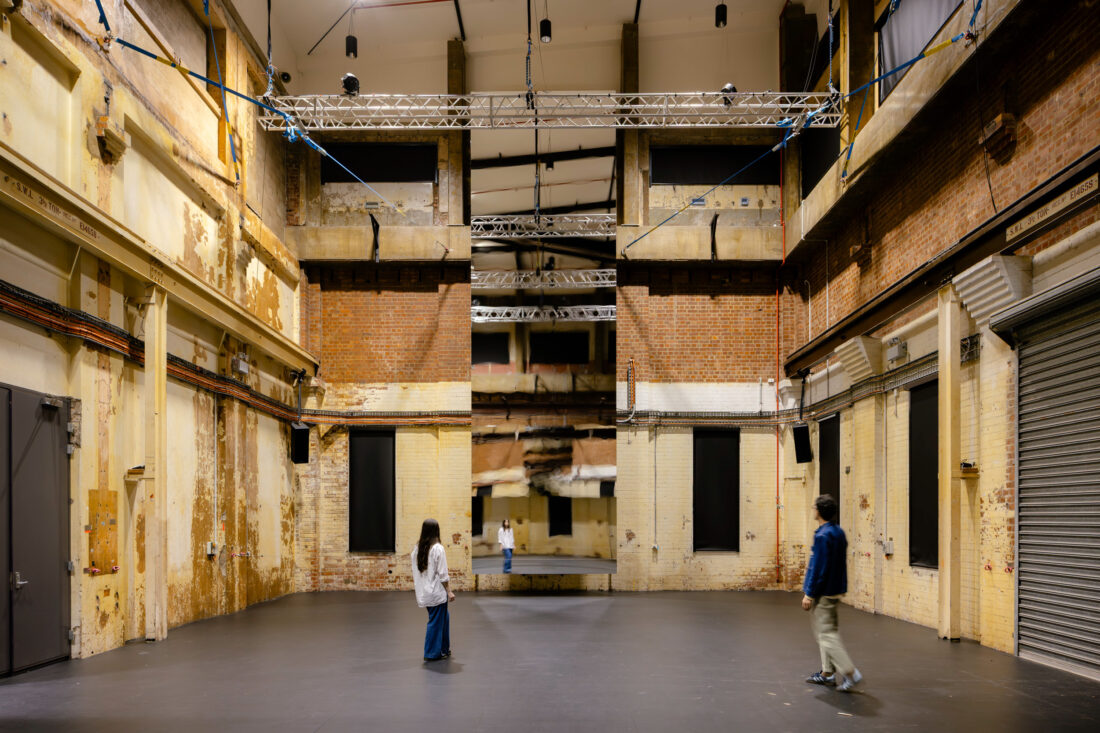
Jonny Niesche’s works are celebrated for their calm, clean, serene, minimalist aesthetic and industrial sheen. Their effects lure and captivate us like moths, while conjuring up precedents and parallels from art history. Created for Night Feast, Sound and Vision (Total Vibration) is a major new site-specific installation, transforming Brisbane Powerhouse’s Stores Studio into a realm of reflection and reverberation. Two massive, flexible mirrors—one horizontal, one vertical—face off across the space, rippling, trembling, and shimmering. They are activated by a soundtrack by Niesche’s longtime collaborator, British electronic musician Mark Pritchard. Niesche is based in Gadigal/Sydney and is represented by 1301SW. Niesche talks to Robert Leonard before installing the work.
Robert Leonard: Many of your works take the place of painting, but operate differently. When you look at a Willem de Kooning painting, your physical body confronts the physical body of the painting—which was also made by a body. Your works are dematerialised and sheer, yet still address us in our bodies.
Jonny Niesche: I consider myself a painter, as I’m always looking through the historical lens of painting. I’m interested in creating works that respond to the senses, to the viewer, and to the environment in which they’re shown, but that differ from our usual, static expectations of paintings. They are made with layers of transparent fabric rather than paint, and this layering creates a moiré effect, a vibration field. They hum as you approach them, responding to your movement. It’s an embodied experience.
How did your Sound and Vision vibrating-mirror works come about?
Before I was an artist, I was a musician, so I think about how sound moves and creates a spatial experience. I’ve also been interested in mirrors. But mirrors are usually heavy and limited in size, so they’re difficult to work with. Even though I loved the idea of big, mirrored surfaces, the material felt prohibitive, until I discovered FlexMirror, a lightweight foil. When you stretch it, it creates a perfect mirror. Because there’s no top glass layer, as in a standard mirror, the reflection is literally on the surface. It seems hyperreal. I had a sample of FlexMirror in the studio. When I banged the edge, the vibration warped the reflection. It was intense and exciting. I saw how I could use it. Because of my music background, the idea of sound waves moving and manipulating a surface came to mind. I did some experiments with a subwoofer to see what vibrating the mirror would do. I instantly thought of Mark Pritchard, an electronic-music legend from the UK who I’ve worked with previously. When I reached out, he was finalising an album with Thom Yorke and too busy to work on anything. But I sent him a video of the mirror anyway and he was in my studio the next day, excited to see what we could dream up.
How did you meet him?
I was a fan first. When I was invited to do the Museum of Contemporary Art’s façade project for Vivid in 2016, I needed a sound element. Mark had just released a beautiful album, Under the Sun, which I had on high rotation. I was chatting with a mate, Vickie, about the Vivid commission. She asked what my top choice of music to accompany the projection would be. I said: Mark Pritchard. I started to say: But he’s English. She laughed. It turned out he lived in Gadigal/Sydney and she knew him. We met up, chatted about the project, and made that work.
Your other works are sedate, calming, and easy on the eye, while the Sound and Vision works seem disorienting and disruptive, entertaining and gimmicky—recalling funhouse mirrors.
That’s interesting. For me, they come from the same place. When you stand back from my paintings, they can appear calm and atmospheric, but when you get up close, there’s an intense visual tension and vibration from the moiré. Some people find them difficult to look at, quite unsettling. My Sound and Vision works have a similar effect, but with bigger vibration fields. The vibration is beautiful, but unnerving, because familiar reality collapses.
Pritchard’s sound physically activates the mirrors, while carrying other associations and setting the mood.
Mark talks a lot about the emotions created and conveyed by music, which I find significant, because I’ve always thought that the most important thing about my paintings is the feelings they create in people. It’s important to me that it’s a real collaboration. Mark brings a crucial element to the work. He’s a master of mood. In each of these works, the sound composition is around eighteen minutes long. The goal is to create something genuinely atmospheric, an aesthetic and emotional journey, not just a wacky mirror effect. If you experience the full piece, you’ll be taken somewhere.
There have been four previous Sound and Vision works, each quite different. How did they evolve?
Each iteration was a response to the space in which it was shown. In the first, Feeling the Way (for Monet), at 1301SW, Gadigal/Sydney, in 2024, the mirror faced a giant curved wall painting, referring to Monet’s curved panoramic Nymphéas murals in the Orangerie in Paris. I liked the idea of amplifying and confounding Monet’s reflective surface. It also referred to the German Zero artists and their shimmering, mercurial surfaces. The second was in my Fat Lava exhibition at Starkwhite, Tāmaki Makaurau/Auckland, in 2025. Instead of the mirrors reflecting a painting, they reflected coloured light. I used my physical dislike of the colour and texture of West German pottery as a way to think about taste and disgust, style and saturation. It was about the feeling of being trapped in an orange Fat Lava–style glaze. The third, Sound and Vision (Mercy Mercy Me), in Budapest’s Light Museum in 2025, pushed colour saturation and leaned into a sense of foreboding, as the curators were meditating on climate collapse. The fourth, Sound and Vision (Reflect What You Are, in Case You Don’t Know), for Sydney Contemporary in 2025, heightened perceptual awareness of the architectural and aesthetic frameworks around us.
Many of your other works are easily apprehended as whole things, but the Sound and Vision works are immersive. They sidestep the classic minimalist gestalt. We’re inside the work.
Exactly right. They are about experiencing what it’s like to be inside one of my paintings. When the mirrors vibrate, whatever is reflected in them melts. When you see yourself in the mirror, your reflection becomes fractured and distorted, like it’s ghosting you. It’s thrilling and unnerving.
The Sound and Vision works seem cinematic, special-eff ectsy. Fat Lava reminded me of the liquid-metal terminator in Terminator 2 and the mercury mirror in Cocteau’s Orpheus. Sound and Vision (Reflect What You Are, in Case You Don’t Know) felt more horror-film-like. I saw myself in the mirror, framed by your paintings, becoming a wraith-like presence. Is your phenomenological enquiry turning psychological?
That work was less about the viewer’s reflection than the reflection of the paintings and the room’s overbearing darkness. Mark and I talk a lot about sound design in horror films. It’s incredible how much you can influence the experience by dimming lights or lighting only the paintings. Colour changes how the sound affects you, too. We create a different mood with each work.
Do you have time for John McCracken, with his sci-fi , alien-informed minimalism?
Of course. McCracken’s super-refined finish-fetish works have been a huge influence on my work. He always makes me think of the monolith in 2001: A Space Odyssey. It’s not a big leap to associate it with David Bowie’s song ‘Space Oddity’—an obsession of mine! Of course, the title Sound and Vision is also from Bowie.
The Sound and Vision works attract us like moths to a flame.
I prioritise intense sensory engagement. I want the viewer to have an extraordinary experience, to clear the noise from their heads for a moment and reflect—no pun intended.
In Sound and Vision (Total Vibration) you have two mirrors facing off against one another, sandwiching the viewer. The mirrors will reflect each another, multiplying the ripples. Do you know exactly what’s going to happen?
I’m excited by the idea of mirrors facing off . It’s an idea I’ve wanted to play with for a long time. It’s the first time there won’t be a painting or lighting intervention. I’m not sure how it will feel in the space, but that’s happened every time and is part of the process. It’s experimental.
Previous Sound and Vision works were installed in white-walled gallery spaces and played on that gallery aesthetic. What’s it like to use the raw warehouse space of the Stores Studio building?
Each Sound and Vision installation has responded to the architecture it was presented in. Until now, I’ve covered wall fixtures and fittings to make the surfaces and their reflections as seamless and minimal as possible. However, the Stores Studio has a high ceiling and a rough-and-ready feel. Covering all the fixtures with sharp clean walls would be strange. Embracing the rawness seemed the best approach and led me to show all the inner workings of the piece, including having the speakers visible. I decided on a pared-back presentation where the sheer scale of the space and of the mirrors are what you experience. It’s exciting to experiment on such a grand scale. It’ll be interesting to see how the audience responds.