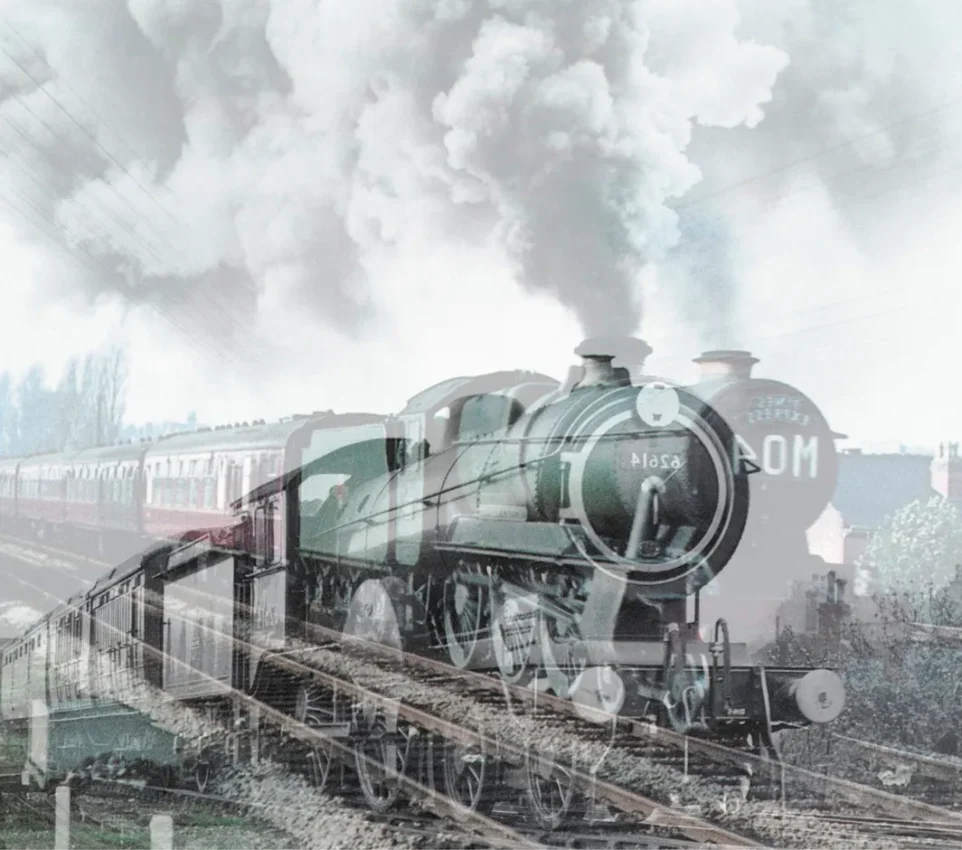
Vault no. 55, 2026.
–
British artist John Stezaker is famous for his collages. He’s been making them for decades. For raw material, he prefers dated photographic images—particularly vintage postcards, film stills, publicity head shots, and book plates. He takes them, turns them, crops them, joins them, sandwiches them, cuts shaped windows into them, removes or repeats a sliver, edits out bodies but leaves their shadows, etcetera. His minimal interventions offer humorous, poignant twists on orphan images. Stezaker’s project bridges conceptualism and surrealism. It has an analytic dimension (coolly exposing the language and logic of collage) and an intuitive, poetic, psychological one (with his dreamy displacements suggesting some lost world, a fanciful parallel reality).
Since 2012, Stezaker has been developing a new line of enquiry, making looped silent films (videos really), collaging collections of found images in time. The loops range from two minutes and thirteen seconds to a mere nine seconds. His first film, Horse (2012), is the longest.
Back in the 1980s, Stezaker acquired a copy of the Stallion Annual, featuring photos of stud racehorses presented in profile for close comparison. When he flicked through, it behaved like a flip book, leaving the impression of a single horse standing still—albeit shuddering with slight variations in build and pose—with the background fluctuating more dramatically. In 2012, he made Horse, compiling, in order, the images of every stallion from every stallion from every Annual from 1984 to 2001—one per frame, twenty-four frames per second. Featuring over 3000 horses, it’s been described as ‘an accelerated genetic history of the racehorse’.
For Stezaker, Horse recalled Edweard Muybridge’s 1878 photographic experiment that anticipated the movies while proving that galloping horses lift all their hooves from the ground (a brief moment of suspension between strides). Except, of course, Horse does the opposite, retaining the jitter, the promise of movement, while leaving the horses with all fours planted firmly to the floor, going nowhere in a hurry. Combining stillness with reverberation, Stezaker called it his ‘reverse Muybridge’.
Since Horse, Stezaker’s films have all followed its MO, presenting collections of found images twenty-four per second, but to very different affects. His second film, Blind (2012), uses old film stills randomly plucked from his collection. Lacking a common motif or composition, they offer no persistent image. But, while Stezaker assumed the result would be a consistent, shimmering blur—hence his title—he was surprised by the vividness of images flashing up in the blink of an eye, becoming scrambled. Visually overloaded, viewers are unable to register all the images. Each time we watch the film, our eyes fish out different images from the soup. Stezaker described it as ‘phenomenological magic’.
Horse and Blind bookend Stezaker’s inquiry; Horse being anchored in a persistent image and Blind offering a visual maelstrom. His next two films reiterate this polarity. Cathedral (2013) compiled postcards of churches, exploiting the way they are habitually photographed from a few angles. It’s like Horse, if more chaotic. Crowd (2013) is a frenetic compilation of film stills of crowd scenes, creating, in the artist’s words, ‘a bristling quality, like a crowd of crowds on the edge of perception’. It’s like Blind.
Film critic Pauline Kael summed up the movie business when she titled her second book Kiss Kiss Bang Bang. Stezaker’s films Kiss (2019–20) and Fight (2022) play on this sex-and-violence dichotomy, compiling film stills of kiss scenes and fight scenes respectively. As luck would have it, kiss stills have similar compositions, catching lovers in profile, staring into each other’s eyes, usually just before their lips touch. It’s a photographic habit, an archetype or cliché. By contrast, fight stills have little in common compositionally, with fighters appearing all over the frame. When Stezaker animated his kiss stills, persistence of vision converted their acceptable implicit passion into frantic, jerky coupling, as if releasing an implicit sexual subtext. And, when he animated his fight stills, they suggested chaos, exactly like a fight, with combatants making mayhem back and forth all over the frame. The effect recalls the famous cartoon ‘fight cloud’ trope, where brawling characters are obscured by a churning dust cloud, with heads, limbs, and weapons occasionally poking out.
Stezaker has made two films using photos of steam trains. Trains and movies are linked. Both are products of industrial modernity—mechanical marvels. Trains move people through real space, taking us to the world, while movies offer virtual tourism, transporting us to elsewheres and elsewhens, real and imagined, bringing worlds to us. The clatter of trains rolling on tracks is echoed in film footage jittering through a projector.
The steam train was a mechanical heir to the horse, trading horses for horsepower. Originally conceived as a sequel to Horse, Train (2012–21) took a while to arrive. It presents around 200 three-quarter portraits of steam trains, the classic view from the embankment. But there’s more variety in the compositions of the images in Train than in Horse, which gives the film a sexy, pulsing, piston-like, jackhammer quality, with the trains apparently shuddering forwards but getting nowhere. In our heads, the motion seems to come from the trains themselves, though it’s an illusion generated by the medium. This loop, recycles, reanimates, and revives passé images, combining a nostalgia for yesteryear with a new throbbing intensity.
Sublime (2021) consists of panoramic, Cinemascope-format slices from the tops of steam-train images. The trains themselves are cut away. All we see are formless clouds of smoke and the tips of the trains’ chimneys. Stezaker animates these amorphous images, making them huff and puff. His smokescape is perhaps a reply to painter John Constable’s cloud studies from the early 1820s. Where Constable omitted land, buildings, and people, to focus our attention on those glorious natural forms, Stezaker excises the trains but leaves in those telltale chimney tips. He updates Constable’s romantic natural sublime (where we are dwarfed by God in nature) to a modern industrial sublime (where we’re overwhelmed by the scale of our own endeavours).
Stezaker’s films exemplify a cinematic primitivism, with their jerky movement harking back to proto-cinematic devices and early films: Horse cites Muybridge, Kiss was inspired by naughty ‘what the butler saw’ arcade machines, and Train nods to one of the first films publicly screened, the Lumieres’s The Arrival of a Train at La Ciotat Station (1896). Ultimately Hollywood would suppress the distracting mechanical jitter that marked the early days of film, leaving it for experimental filmmakers to explore. Stezaker’s films join this tradition.
Tony Conrad’s The Flicker (1966) is an obvious reference point. It alternates opaque and clear film frames at varying frequencies to create hypnotic strobe effects—where we experience shapes and colours that aren’t there—making us aware of both the mechanics of film and our own perceptual machinery. Offering hallucinations and headaches, it comes with a health warning. The Flicker is abstract, but experimental filmmakers, such as Paul Sharits, the Cantrills, and Ken Jacobs—and now Stezaker—would go on to integrate flicker effects with imagery.
Stezaker’s flicker films remind me of the shower scene in Psycho (1960), where Norman Bates slaughters Marion Crane. By using rapid-fire montage, Alfred Hitchcock sidestepped the censor. Individually and collectively, his component shots show next to nothing. It’s the cutting that suggests the violence. But Hitchcock developed the shower sequence for effect, not to offer us a lesson in the language of montage. It was all over before we could register what was up. By contrast, Stezaker’s looping films perform their effects incessantly, letting us enjoy their tricks and realise how they’re performed. It’s movie magic.
[IMAGE: John Stezaker Train 2012–21]