Town Hall, no. 6, 2026.
–
British artist John Stezaker is famous for his collages. He’s been making them for decades. He takes images—often old postcards, film stills, publicity headshots, and book plates—and turns them, crops them, abuts them, sandwiches them, cuts shaped windows into them, removes or repeats a sliver, edits out bodies but leaves their shadows, etcetera. These simple interventions dramatically reroute the ways we read the images, exposing the language and logic of collage. Since 2012 he has also been making flicker films, collaging found images in time: one per frame, twenty-four frames per second. At the Institute of Modern Art earlier this year, he presented his film Train (2012–21). He talks to Robert Leonard about his films and his ongoing interest in trains.
ROBERT LEONARD: How did you come to be making films?
JOHN STEZAKER: Like most things in my work, it has a long history. In 1973 I went to Italy to do a show and started collecting postcards of equestrian statues, with horses on pedestals. When I got home, I thought I’d make a flip book, animating them Eadweard Muybridge–style. But it wasn’t possible, because the horses only had a few positions—all four legs down, one leg up, and occasionally rearing—not enough to animate them.
The statues predated Muybridge, so they were made before we knew how horses actually moved.
Exactly. In the late 1980s I acquired a copy of the Stallion Annual, with photos of stud racehorses in profile. When I flicked through it, it operated like a flip book, with all the horses in the exact same pose but shuddering due to small variations. That stuck with me. Years later, I thought to make a film based on this. But with one shot per frame, one Stallion Annual would only give me a few seconds of film, so I acquired more editions. The resulting film, Horse (2012), includes over 3000 horses. It’s my reverse-Muybridge, simultaneously still and jittery. It does the opposite of what movies are supposed to. It goes nowhere, with a restless stillness.
Horse turns on our habit of repeatedly photographing certain subjects in particular ways. It plays with the repetition and reverberation of archetypal images.
We live in a culture where images belong to types: genres of publicity photograph, of film still, of horse shot, etcetera. How do the images we make as artists—which we consider to be unique—sit against that ground? How do we establish the conditions for image reflection in a culture of incessant multiplicity? Those questions have always been the basis of my work.
Horse set your MO as a filmmaker: one image per frame, twenty-four frames per second. All your films follow this recipe, but with different subjects with markedly different effects.
My next film was Blind (2012). I had a vague idea that I’d use film stills with one person, then two people, then more people, expanding into crowds, but I saw this wasn’t going to work. Then I started taking stills randomly from my collection, but the person who made my films picked up the wrong box of stills, the ones I didn’t want to use. So Blind was doubly blind. I had no idea what it was going to do. I imagined it would be a shimmering blur, an exaggerated form of blindness to image multiplicity. However, what I saw was surprisingly vivid imagery. The next year I made a similar film, Crowd, to explore this mystery further.
In Horse the compositions are near identical, but in Blind different compositions get scrambled in real time, leaving no persistent image.
Blind and Crowd never seem the same. What you see in them constantly changes. It’s phenomenological magic. And the flicker is hypnotic. Coming home on the train, I love that moment when the sun pulses through the trees and the train windows. It takes me into another space. I think my films have a similar liminal, hypnotic power.
Tony Conrad’s film The Flicker (1966)—which consists of alternating opaque and clear frames—must have been a precursor for your flicker films. It came with a warning for epileptics. What was your understanding of it when you saw it?
I remember seeing it, probably in the early 1970s, but I never experienced it properly. Like many people, I felt endangered, so I never gave myself over to it at the time. I should have yielded. You have to submit to works like that for the magic to happen. I had the same response to Brion Gysin and Ian Sommerville’s Dream Machine (1959). Back then I was afraid of mind-altering things. So, with my films, I’m creating something that I myself ordinarily found uncomfortable. Interestingly, the Tate just made a documentary on me and wouldn’t include my films for fear of viewers having seizures.
How do people respond to your films?
Jennifer Higgie from Freize magazine said: I can’t look, it’s going to give me a migraine. Some feel they are being threatened. Others speak of entering into an altered state. Someone said they watched one film over and over to make sure they saw every single image, even though I’m deliberately showing images at speed so viewers can’t consciously receive and register them.
You describe your films as if you’d found them rather than made them.
I don’t think of them as being made by me. What did I do, really? Just collect images of some subject. When they’re compiled, the effect often surprises me. I enjoy watching them. I don’t spend a lot of time going back to my favourite collages, but I relish any opportunity to watch my films over and over.
Train (2012–21) took a long time to arrive.
It was meant as a sequel to Horse but it was executed some time later. It’s compositionally less tight, using similar images of steam trains to describe that same shuddering, reverberating quality, playing with the stillness and motion, singularity and multiplicity. The three-quarters angle is the classic trainspotter’s one, from the embankment. You get the fronts and sides of the trains. There’s the illusion of movement. The trains shudder forward but never go anywhere. I was thinking about the origins of cinema, and particularly the Lumière Brothers’ The Arrival of a Train at La Ciotat Station (1896), one of the first films screened publicly. Horse and Train both feature subjects that move powerfully under their own steam: one muscular, one mechanical—both erotic. On the one hand, there’s stallions, thoroughbred racehorses; on the other, the trains that replaced them—of many horsepower.
Trains and cinemas were always linked. We sit down in both. Trains transport us through real space, while movies transport us virtually to elsewheres and elsewhens.
Their mechanics are related, too. The train was one of the earliest machines to move on its own. To the romantics, it represented the magical possibilities of technology. Film—where the image moves on its own—also represented a new order of magic.
Trainspotting seems like a British obsession.
The steam train was a British invention, a miracle of technology. When an object propels itself, it resembles a living thing, beyond our control. There are different ways of dealing with this magical intrusion into the everyday world. We can treat it as demonic or give it a benign face. Railway portraiture is the benign face, an image of God in the technological era. In Britain, train mythology was dominated by Anglicans. The Railways Series books, with Thomas the Tank Engine, were written by the Reverend Wilbert Awdry, and Eric Treacy, the Bishop of York, was one of the key train photographers.
Steam trains seem to be a source of nostalgia for you.
There’s a nostalgic quality to my work generally. My childhood was at the end of the steam age, with diesel coming in. I remember waiting on the embankment for the steam trains. When they came out of the tunnel, if the driver saw me, there would be a blast of the whistle and puffs of smoke would miraculously appear. That was the closest thing to a sublime experience I can remember from childhood. Steam trains were exciting and terrifying, especially if you got close. We used to put pennies on the tracks and the trains would flatten them until they were razor sharp. We eventually got banned from the embankment, because kids got killed playing there. Later you couldn’t get close to the trains. They were fenced off. And they were boring anyway—no whistles or steam.
There are train images in your collages. In Negotiable Space I (1978) you laid a postcard of a train heading into a tunnel over a film still of a psychoanalyst’s office. It’s as if the train image is bringing some subtext into the open. It’s both euphemistic and exaggerated, like the train going into the tunnel at the end of Hitchcock’s North by Northwest (1959).
I thought of it as a semi-ironic reference to René Magritte’s Time Transfixed (1938), where a tiny steam train comes out of a domestic fireplace. It was my first tentative embrace of surrealism.
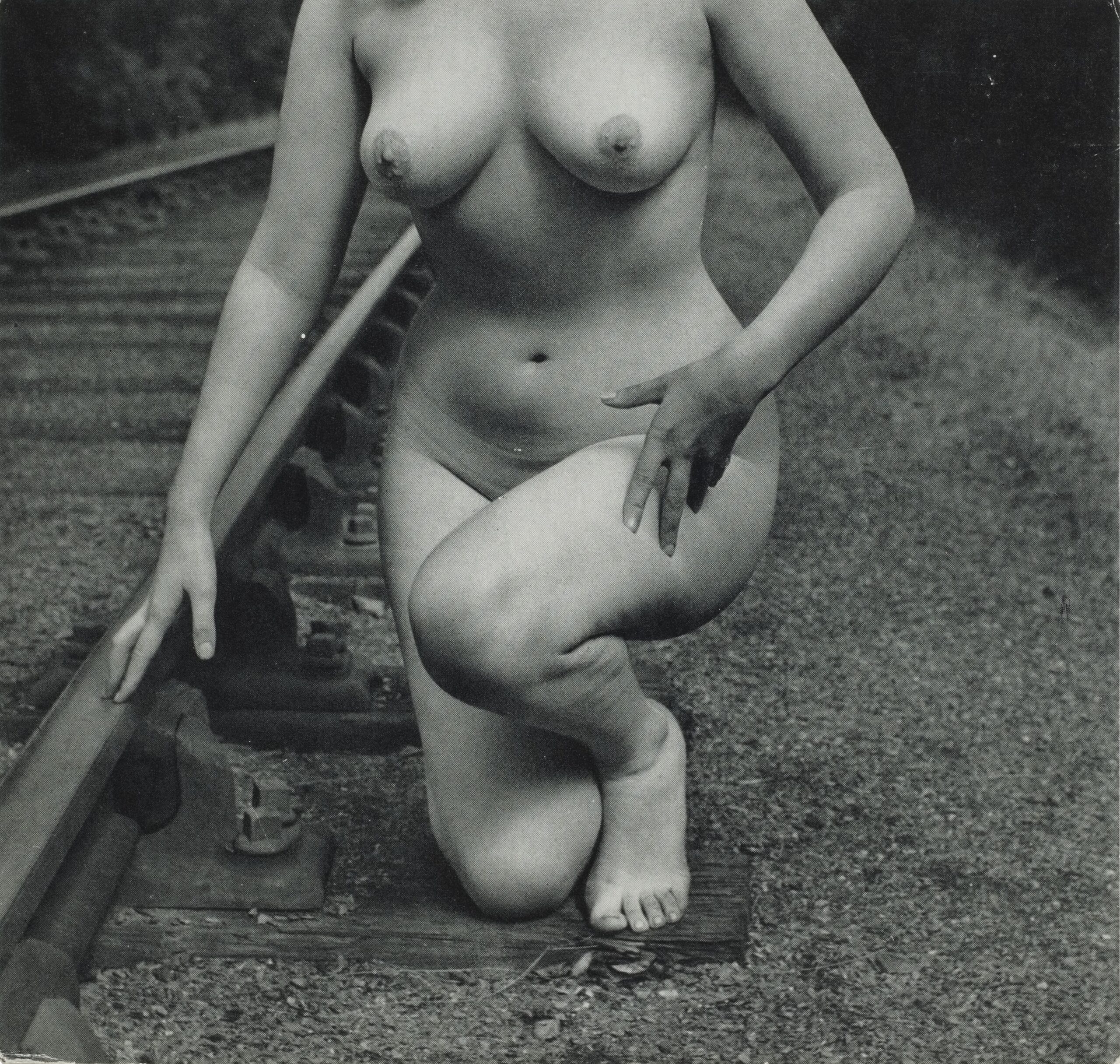
Naturalistic Torso I (Assisted Readymade) (1979) is a found photograph of a nude woman touching a railroad track, cropped at her neck.
There’s a story behind that one. I was in Halifax, Nova Scotia, in 1979, on a visiting lectureship. I was staying in an apartment that belonged to the university. I used to eat at the local tavern, and, because I was paid in large-denomination notes, a gang began to pay attention to me. The next night, I was lying in the bath looking at my headless, naked body, which looked pale as a corpse under the water, and mysteriously I experienced a flash of red. I thought of blood and danger. I ran to the balcony and saw the gang making its way toward my apartment. I ran down the back stairs and escaped to a friend’s house. When I returned, everything was wrecked. I’d just bought some Swedish naturist magazines, and they’d been ripped up. When I opened one, I saw the image of the woman touching the track, now with her head torn off. I found it astonishing. I later tidied up the tear, making it a clean cut. In some ways I regret not keeping the tear and holding on to the violence of its genesis. That work led me into an area of inquiry that was not popular with some feminists, who saw it as objectifying the female body—a property inherent to the image itself and which I hoped the decapitation emphasised. For me the image was more about death than eroticism. I was reading Carl Jung at the time and I saw this headless female figure as being an Earth Mother. It was not only the head that had been removed, but also the horizon and sky. The patriarchal animus (the overworld) was excised, and the feminine anima (underworld) retained. I was thinking about the relationship between the Earth Mother and death.
In the original image, the train track was rather arbitrary. But with the woman’s head removed, it becomes meaningful, suggesting a guillotine. The tear completes the image.
It’s not a nice image, but it’s powerful. I had it on my mantelpiece for years trying to work out why it was so powerful. It reminds me of Marcel Duchamp’s Étant Donnés, his headless-nude diorama in Philadelphia. It seems violent, but there’s no violence depicted. There is, for me, an inexplicable horror in this image that I’ve never been able to reconcile.
It’s like the shower scene in Hitchcock’s Psycho (1960), where the images themselves don’t show much violence, but it’s implied in the cutting, the montage. The horror comes from outside the images, in the treatment of them, the framing.
The violence is in our minds. It’s uncanny. There is an innate violence in the technological image. But I think of the violence of the cuts in my collages as homeopathic and reparative.
For your Sublime series, begun in the 1980s, you separate the top section of train photos—just showing the puff of smoke coming out of their stacks—discarding the rest. Recently you animated these as a film, Sublime (2021–2).
The Sublime images are horizontal. I was thinking ‘Cinemascope’. Out of the puffing away of capitalism, the world was divided in two: a sublime, transcendent world above and slavery below.
Your Lost Tracks collages (1990–2) go the other way, focusing on the lower parts of train images, showing the wheels and tracks. You mirror these sections, like Rorschach blots.
The Lost Tracks are images of the spaceless world we live in—a purgatorial world of control, with no overworld, no escape, no freedom. The best ones are where there are little interferences, interruptions, and glistening details here and there in the vortex. Friction is always the key to my image combinations.
I love your collage Mask CCVII (2016). A postcard of a train track passing out of a tunnel is laid over a woman’s face. It could be horrific—like a hole blown in her head—but I find it dreamy. I keep thinking of that Peter Sarstedt song: ‘Where do you go to my lovely, when you’re alone in your bed? Tell me the thoughts that surround you, I want to look inside your head.’
I remember that song. It stuck in my head, too. In my Masks, landscape postcards are placed over publicity headshots, prompting us to read the postcard scenes as facial features. I wanted to put an end to the series, so I thought I’d knock a hole through a head. So in Mask XXXV (2007) I placed a postcard of a sea arch over a face. There was nothing to look into to find a face. It was just empty. Years later I did the train-tunnel one. But that didn’t end them either. My series don’t always want to end. I’m keen to finish them, but often they haven’t finished with me.
In Mask CCVII the train track suggests that seeing and thinking—ours or the subject’s—take a habitual, predetermined route, yet your work is all about derailing our habits of making and receiving images.
I have a collection of images of derailed and ruined trains, which remind me of the uncanny feeling I had as a young trainspotter in the 1950s exploring the ruins of abandoned trains found on the extremities of goods yards, often covered in bindweed. That was where I became fascinated by the obsolete. In the surrealist magazine Minotaure there’s that wonderful image of an abandoned locomotive overgrown by nature. Roberto Calasso describes myth as seaweed growing on the chains of narrative sequence, but myth’s stillness has to reverberate. What surprised me about my flicker films was how they harnessed both the indelibility of the image and the suspension of the image in the liminal zones of consciousness.
[IMAGE: John Stezaker Naturalistic Torso I (Assisted Readymade) 1979]