With Lucy Latella, Current, no. 3, 2026.
–
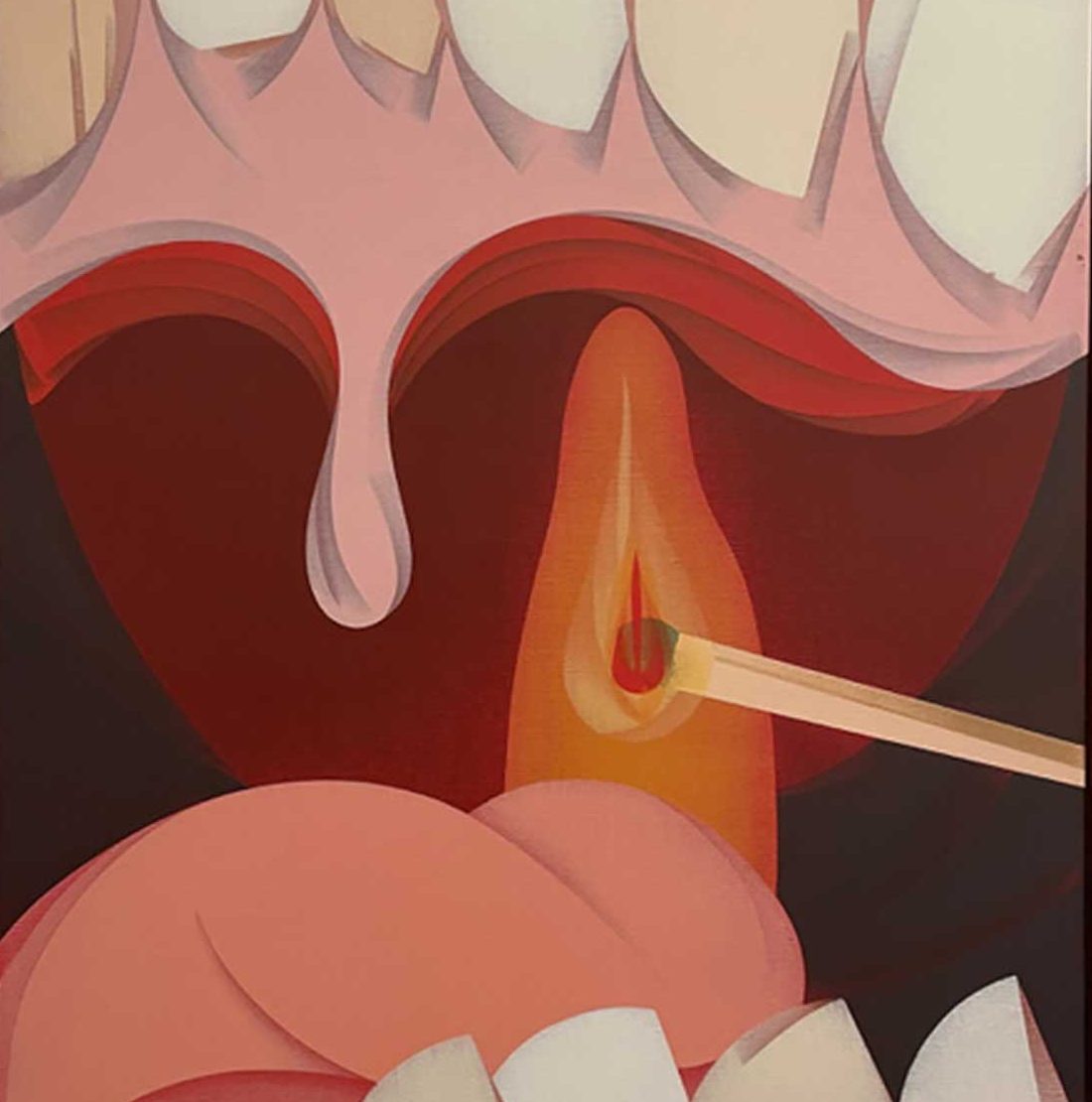
Mitch Cairns’s paintings occupy a space between precision and play: technically rigorous, deeply engaged with painting’s histories, yet animated by humour, absurdity and the everyday life of the artist. Ahead of his upcoming exhibition Artist’s Mouth at the Institute of Modern Art, Meanjin Brisbane, the curators Lucy Latella and Robert Leonard speak with him about his work.
Lucy Latella and Robert Leonard: You went to art school in 2003 with a goal: to be a practising artist.
Mitch Cairns: I turned up for a career-counselling session with my friends but didn’t take it seriously, because I never entertained doing anything other than being an artist. I’d already been told that I wasn’t going to make money, so I forgot about that. I was thfirst person in my family to go to university.
In Sydney at that time, the National Art School (NAS) was the conservative, uncool school.
NAS focused on drawing, which wasn’t cool. Each week we had nine hours of life drawing, observational drawing and experimental drawing. With life drawing, we’d go from five-second and fifteen-second poses to half-hour and hour-and-a-half ones. And in each time-frame bracket we learned to see differently, which I found magical. Drawing is learning how to look, how to record, and it’s the foundation of everything I do. At NAS, we also had an exceptionally thorough but conservative, sequential art history. It started at Ancient Greece but stopped at Warhol. That was good for me. Other art schools weren’t getting Ancient Greece, but they did get from Warhol on.
Your influences?
Number one was Adam Cullen. I began assisting him when I was in third year, and it was amazing to see him working in his studio, because that part of the equation wasn’t given to you at art school. Cullen was an amusing, chaotic person, and he became a good friend. He was approachable, accessible, willing to share. He was someone I could talk to. He was an important influence, less for how he made art, more for what a studio practice looked like.
Number two was Tom Kreisler. In 2007 I stumbled across the Kreisler exhibition at the Govett-Brewster Art Gallery in Ngāmotu New Plymouth. It was the most important show I’d ever seen. I bought the catalogue, which included beautiful writing by his son Aaron. Kreisler’s drawing language, immediacy, humour and vernacular subjects—those things coming together—was terrain I was interested in. It was presented more comprehensively in that exhibition than I’d ever seen before. I’m indebted to his work.
But you went the opposite way, aesthetically.
It was never about Kreisler’s technique, more his lateral thinking. My drawings and my works on paper, especially those with words, lean more to the sketchy immediacy and throwaway nature of his work. My paintings have a different, more finished feel. A lot of the painters I’m attracted to have an immediacy to their mark making: Cullen, Kreisler and Peter Powditch. They work fast, but with precision, drawing maximum resonance from a small amount of visual information.
Was theory important?
At art school, you were meant to read theory. I couldn’t follow it, and wasn’t inclined to spend time working through it. I was more Spike Milligan than Deleuze and Guattari. I collect Milligan books. I like that era of comic delivery. I’m also attracted to funny art, like that hilarious Pierre Bonnard painting of the cat with no neck.
What was it like to win the Archibald in 2017?
It was like a bomb. It certainly helped me to live. My parents stopped asking me if I was interested in teaching to earn a living. The Archibald is the Art Gallery of New South Wales’ most visited show. People care about it because it makes the papers.
It was a portrait of your partner, Agatha Gothe-Snape.
She’s my partner, but also one of my favourite artists. With the exceptions of Peter Powditch and Gerald Murnane, I’ve painted people I know or have been close to, and making the portraits was a way to honour them. I’m proud of all the portraits I’ve entered into the Prize.
Your paintings can be like puzzles, like those cubist paintings where you struggle to see where the girl stops and the mandolin begins.
I went to New Zealand with Agatha and we found ourselves at Puzzling World, a theme park in Wānaka. We were in heaven. It’s amazing. There are all these optical illusions, a huge timber maze and hidden treasures. I think that spirit is in my paintings.
In 2021 your work shifted gear with your painting Coloured Glass (For Roland).
My son Roland came home from school with a see-through cellophane collage. I asked him if I could take it to the studio and make a painting from it. That set in motion my current way of working, with multiple layers of translucent paint.
You made a jump from a flat, cartoony, colouring-in style to old-school layered colour washes.
I’ve become a more technical painter, against my wishes. I don’t want to be seen as a technical painter.
Do you see yourself as an Australian painter?
I’d be more comfortable with ‘Sydney painter’. I’m not trying to keep abreast of developments internationally. I’m more interested in Australian and New Zealand artists than international ones. There’s a perpetual problem of antipodean artists feeling the need to look overseas to advance or be taken seriously.
[IMAGE: Mitch Cairns Artist’s Mouth 2019]