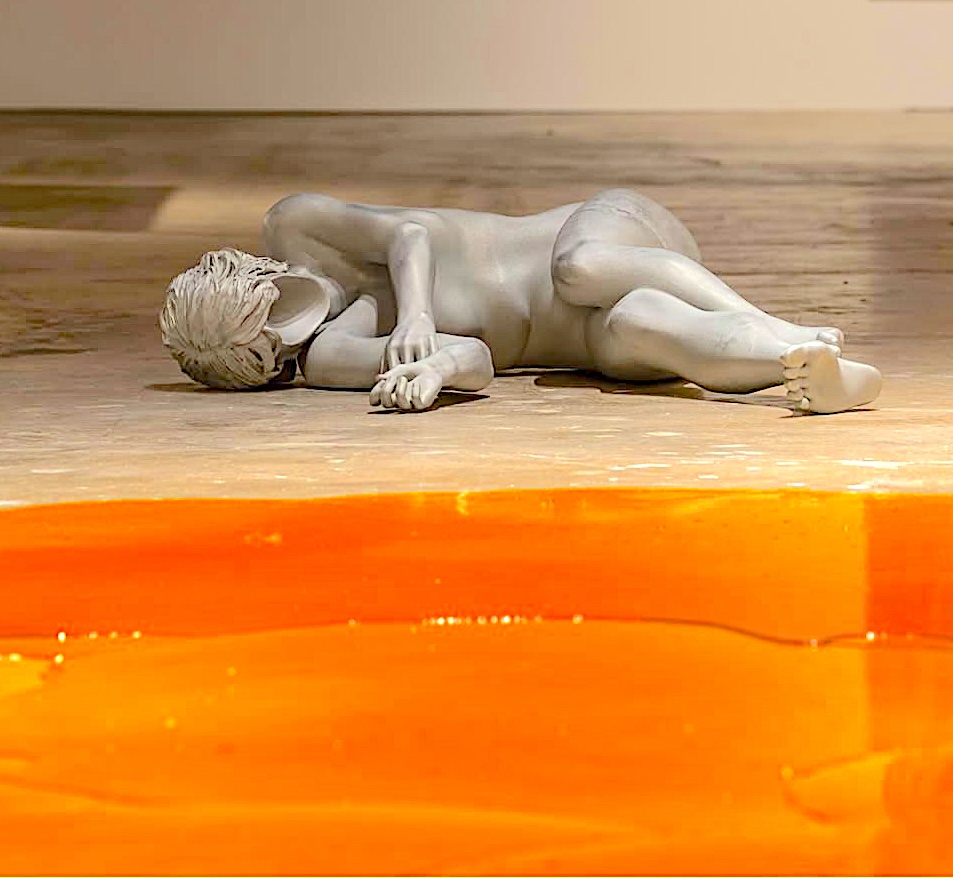
I was just in Gwangju, South Korea, for the opening of the Biennale. You Must Change Your Life featured an impressive lineup of sculptures from Jean Barth’s 2024 Institute of Modern Art show The Clumped Spirit. I thought I knew the sculptures well, but the Biennale changed my mind. At the IMA, the sculptures had been contextualised with other Barth works that fixed them in discussions about transgender identity, about self portraiture, and about the relation between the real and the virtual. However, in Gwangju—separated from those other Barth works and in conversation with works by other artists—those thematics took a back seat. The sculptures no longer referred primarily to transgender identity, self portraiture, and computer-generated processes. Indeed, they looked genuinely antique. Among other things, Barth’s sculptures were inspired by those Pompeii plaster casts, where, thousands of years ago, inhabitants suddenly buried by ash and lava had left their freeze-framed impressions. In Gwangju, this became the primary reference point. Barth’s works appeared in the first hall of the Biennale, ‘Molecules and Me’, alongside works by Goldin + Senneby from Sweden, Kiri Dalena from the Phillipines, and Maya Wantanabe from Peru. For Goldin + Senneby’s Flare Up, buckets of tree resin had been poured onto the gallery floor, setting like the transparent toffee coating on a crème brulee, recalling the amber that once trapped and preserved prehistoric insects (famously referenced by Michael Crichton and Steven Spielberg in Jurassic Park and later by Pierre Huyghe in De-Extinction). This golden pond appeared to approach Barth’s figures, like a slow-moving glacier that may ultimately engulf them and us. In Dalena’s Imprints, a suite of portrait photos, the faces of Phillipines political activists and artists were covered with plaster ‘death masks’, which spoke to Barth’s sculptures, with their scooped-out faces and their nod to Pompeii’s tragic plaster casts. Dalena’s works also played with dualities: individuality and anonymity, remembrance and forgetting, life and death. Wantanabe’s forensic video Liminal scanned material removed from mass graves in Peru, a compost of political repression. For good measure, in the same room, Gwangju artistic director Ho Tzu Nyen and his team also displayed volcanic rocks from Jeju Stone Park, to represent deep-time transformation and nature as co-author and artist. This deft curatorial recontextualising gave Barth’s works a new discursive life, a second wind.
•
I Criticise, Therefore I Am
I recently sat on a panel about art writing and art publishing, which got me thinking. People routinely whinge about the quality of art writing, and, of course, there’s good and bad. But, generally speaking, I like art writing. I like writing it, I like reading it, and I find it genuinely useful, illuminating, and entertaining. But I don’t like how uncritical it has become.
Art is also good and bad, but, these days, art writers seldom have a bad word to say about anything. If you read film criticism, music criticism, literary criticism—even sports criticism—writers are critical. They make judgements because they care. They turn people onto the good and away from the bad, they dissect performances, and they award stars. It’s accepted. It’s part and parcel. That’s why readers read them. But it’s not the case with art writing and that’s a shame. It’s down to two things, I think.
First, of course, there’s the double action: the fall of modernism and the rise of identity politics. With modernism, some art was important because it made earlier art obsolete. Modernism gave art a purpose and art critics a task—to adjudicate over what was new and advanced. Identity politics widened art’s ambit, but discouraged critics from making value judgements about work by others, whose shoes they hadn’t walked a mile in. So we parked the idea of criteria, fearing it was compromised, which indeed it was.
Second—and more important—is the art world’s court culture. Art writers don’t want to rock the boat, because they’re reliant on patronage and access. Film critics can happily trash Megalopolis because they were never going to be invited to dinner with Francis Ford Coppola, were never going to collaborate with him on a screenplay, were never going to need him for a reference. So they freely write for their reader. But art writers want to be invited to the dinners and after parties with artists and dealers. They need their endorsement to write for catalogues and magazines; they need access. So they write for their subjects rather than their readers. Despite the death of the author last century, most art writing is routinely vetted and approved by subjects and stakeholders.
It’s not that writers don’t exercise judgement, but they don’t do so in print explicitly. The critical conversations occur in the bar and the office, not on the page, and that’s a great shame for readers, for the discourse. If things were more open, negative or dissenting views wouldn’t seem like a cause for panic, just par for the course. We’ve become allergic to critique.
Decades ago Jerry Lewis spoke of film critics: ‘I’ve been blasted by the best and they’ve made some very good points. Pauline Kael, she’s never said a good thing about me yet, the dirty old broad. But she’s probably the most qualified critic in the world because she cares about film and those that are involved in it. I wish I could really rap her, but I can’t because she is very competent. She knows what she’s talking about. She’s going to say what she thinks.’
In art writing, if we want more fearless and forthright Pauline Kaels, we just have to get more Jerry Lewis about it.
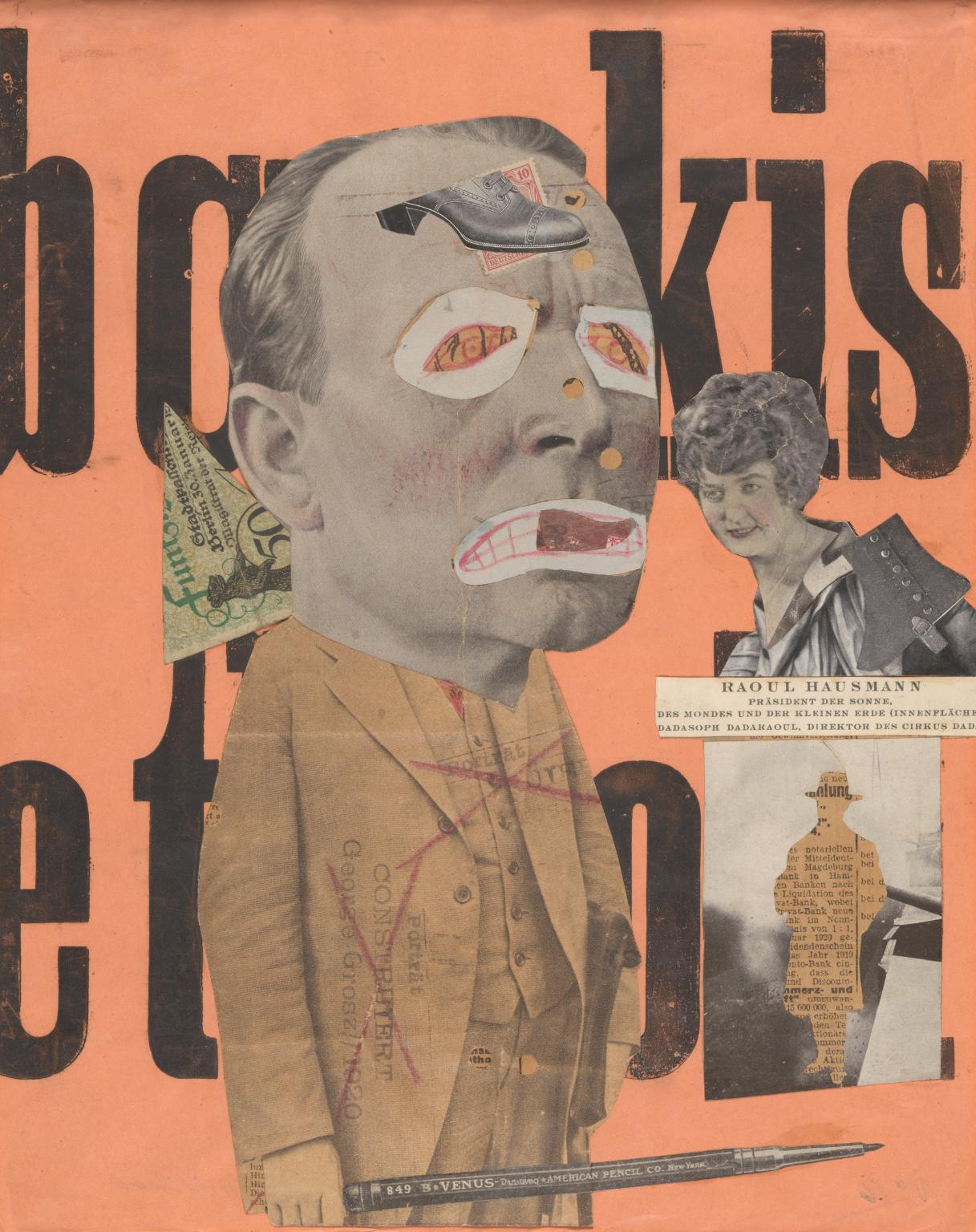
[IMAGE: Raoul Hausmann The Art Critic 1919–20]
•
Snap
Exhibition making is constrained by logistics: space, time, and the laws of physics; contacts, politics, and money. There are artists and lenders to convince, bills to be paid. Status is important in securing work. Artists, galleries, and collections make judgement calls about where their work is placed. Everyone wants to enhance their reputation, their cultural capital.
It’s easy to put works in conversation in a slide lecture or reproduced in a book. It’s another thing to bring them together in a room. Art works tend to be more-or-less unique things, which have to be sourced, transported, insured, invigilated, and returned. Here’s a great example …
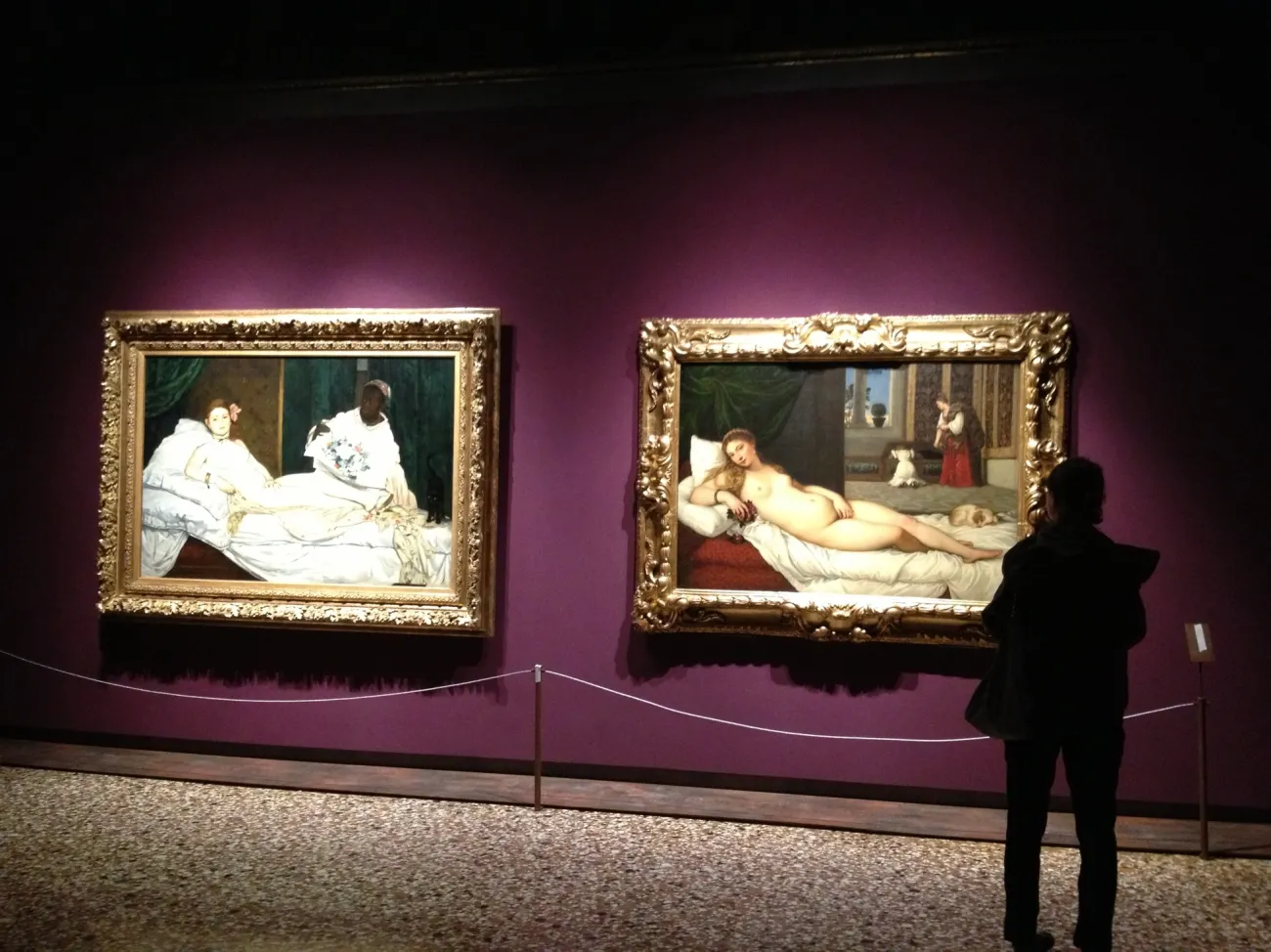
One of art history’s classic cause-and-effects, compare-and-contrasts, is the pairing of Titian’s Venus d’Urbino (1538) from the Uffizi in Florence and Manet’s Olympia (1863) from the Musee D’Orsay in Paris. Manet knew the Titian, though perhaps not in the flesh. He was riffing on it, updating it, 325 years later, replacing a goddess with a prostitute. The point is made in so many slide lectures and art history texts as to have become a cliché. However, the works themselves had never shared a wall.
So it was shocking to step into the exhibition Manet in Venice in the Doge’s Palace in 2013, during the Venice Biennale, and see these two unique works finally brought together in the flesh. As they are roughly the same size and proportions, it looked like the classic two-projector art-history comparison. It looked great, obvious, but as a curator I was too aware of the epic negotiation and complexity involved in making this juxtaposition of priceless works happen.
•
Who Am I?
I am a contemporary art curator and writer, and Director of the Institute of Modern Art, Brisbane. I have held curatorial posts at Wellington’s National Art Gallery, New Plymouth’s Govett-Brewster Art Gallery, Dunedin Public Art Gallery, Auckland Art Gallery, and, most recently, City Gallery Wellington, and directed Auckland’s Artspace. My shows include Headlands: Thinking through New Zealand Art for Sydney’s Museum of Contemporary Art (1992); Action Replay: Post-Object Art for Artspace, Govett-Brewster Art Gallery, and Auckland Art Gallery (1998); and Mixed-Up Childhood for Auckland Art Gallery (2005). My City Gallery shows include Yvonne Todd: Creamy Psychology (2014), Julian Dashper & Friends (2015), Francis Upritchard: Jealous Saboteurs (2016), Colin McCahon: On Going Out with the Tide (2017), John Stezaker: Lost World (2017), This Is New Zealand (2018), Iconography of Revolt (2018), Semiconductor: The Technological Sublime (2019), Oracles (2020), Zac Langdon-Pole: Containing Multitudes (2020), and Judy Millar: Action Movie (2021). I curated New Zealand representation for Brisbane’s Asia-Pacific Triennial in 1999, the Sao Paulo Biennale in 2002, and the Venice Biennale in 2003 and 2015.
Contact
BouncyCastleLeonard@gmail.com
+61 452252414
This Website
I made this website to offer easy access to my writings. Texts have been edited and tweaked. Where I’ve found mistakes, I’ve corrected them.
.