.
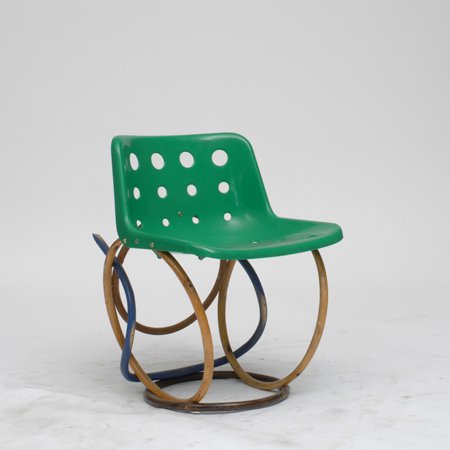
For designers, the chair is an archetypal form—a challenge. Over the years, various designers have sought to create the most efficient chair, the most ergomatic chair, the most elegant chair, the perfect chair, the ur-chair, their signature chair, etcetera. Necessarily, ‘integrity’, in one form or another, has been crucial to their grail quests. But the Italian-born London-based designer Martino Gamper threw integrity to the wind to create his project 100 Chairs in 100 Days a decade ago. He set himself an assignment: to create a chair a day for 100 days, mostly by collaging together bits of discarded and donated chairs. Each chair had to be unique. The project was a prompt to (and test of) his creativity, working within the limitations of the materials to hand and the time available. Gamper wasn’t seeking to make the perfect chair but to create a ‘three-dimensional sketchbook’, a lexicon of alternative ideas. Grafting contrasting, even opposing design logics and languages (with ranging historical and class associations), his hybrids were witty, absurd, conflicted. It was as if Gamper was trying to increase the genetic diversity of the chair, through perverse, experimental cross-breeding. It was the same impulse that gave us the cronut and the cruffin, the Cockapoo and the Labradoodle. At City Gallery Wellington, half the ensemble is on one side of the room, arrayed in rows and columns—a phalanx; the other half is on the other side, all higglety-piggeldty—feral. It’s pitch perfect for this project, where Gamper rules out nothing. Either, or, and both. The opposite is just as good (until 13 August).

Make the Cut
.
We live in a big social world, with lots of other people. Seven billion people. We don’t have time to get to know everyone deeply, to learn of their struggles, their journeys, to give them all the benefit of the doubt. So we batch process them. You could call it profiling, you could call it prejudice, you could call it judging books by their covers, you could call it social triage. The first cut is the deepest.

Strangely Lifelike
.
Last Thursday, as part of City Gallery’s Open Late programme, I chaired a discussion about dolls in art and life. The speakers were artists Yvonne Todd and Ronnie van Hout. We talked a bit about the ‘uncanny valley’, the idea that, as dolls become more and more realistic, they go from being cute to being creepy. I couldn’t resist illustrating the idea with this photo of One Direction posing with their waxworks at Madame Taussauds. Cute and creepy.
Who Am I?
I am a contemporary art curator and writer, and Director of the Institute of Modern Art, Brisbane. I have held curatorial posts at Wellington’s National Art Gallery, New Plymouth’s Govett-Brewster Art Gallery, Dunedin Public Art Gallery, Auckland Art Gallery, and, most recently, City Gallery Wellington, and directed Auckland’s Artspace. My shows include Headlands: Thinking through New Zealand Art for Sydney’s Museum of Contemporary Art (1992); Action Replay: Post-Object Art for Artspace, Govett-Brewster Art Gallery, and Auckland Art Gallery (1998); and Mixed-Up Childhood for Auckland Art Gallery (2005). My City Gallery shows include Yvonne Todd: Creamy Psychology (2014), Julian Dashper & Friends (2015), Francis Upritchard: Jealous Saboteurs (2016), Colin McCahon: On Going Out with the Tide (2017), John Stezaker: Lost World (2017), This Is New Zealand (2018), Iconography of Revolt (2018), Semiconductor: The Technological Sublime (2019), Oracles (2020), Zac Langdon-Pole: Containing Multitudes (2020), and Judy Millar: Action Movie (2021). I curated New Zealand representation for Brisbane’s Asia-Pacific Triennial in 1999, the Sao Paulo Biennale in 2002, and the Venice Biennale in 2003 and 2015.
Contact
BouncyCastleLeonard@gmail.com
+61 452252414
This Website
I made this website to offer easy access to my writings. Texts have been edited and tweaked. Where I’ve found mistakes, I’ve corrected them.
.