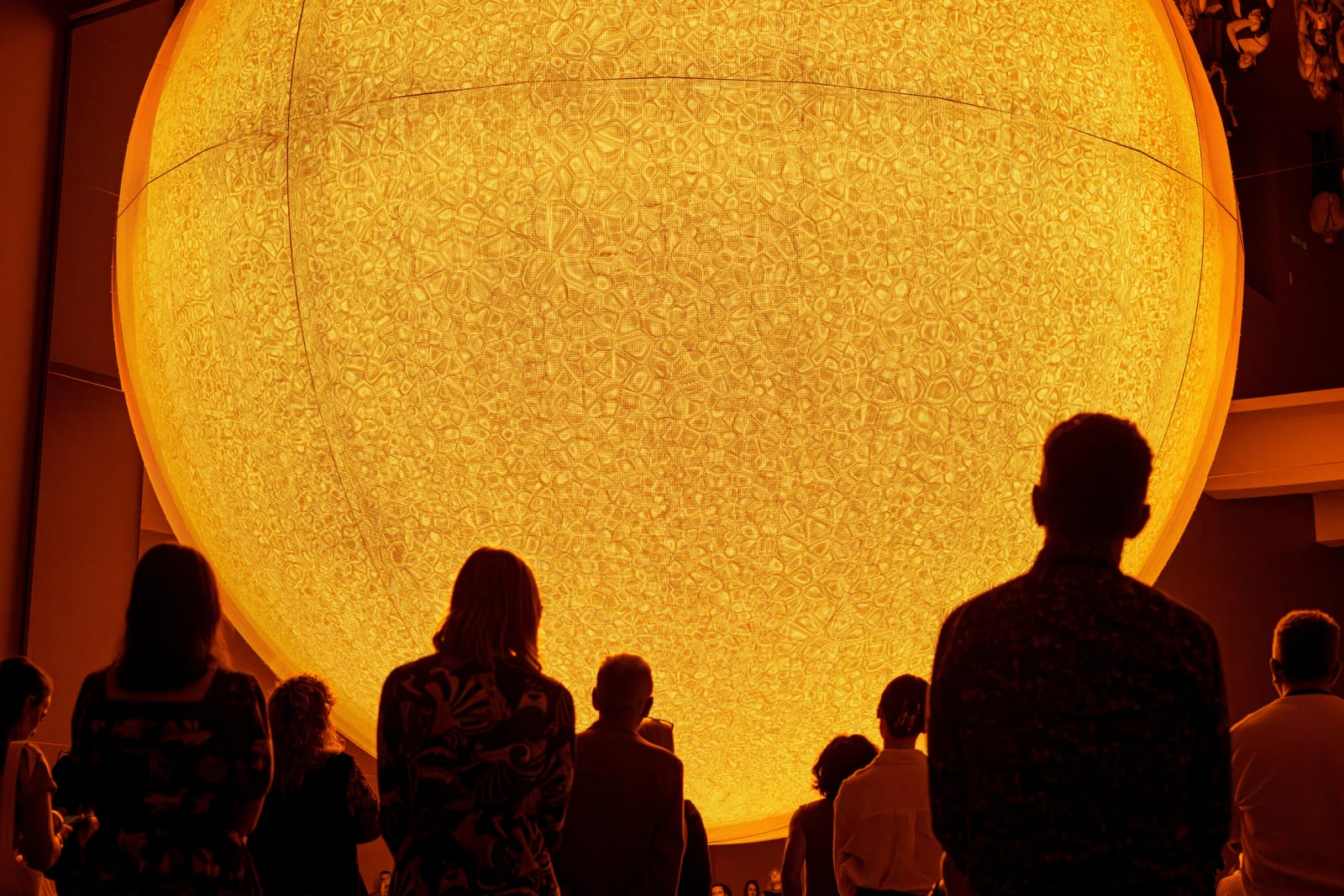
If you haven’t seen Presence—the Olafur Eliasson show at Queensland Art Gallery—go immediately. It’s great to see Eliasson’s works presented with confidence, at scale. Ten out of ten. When I went again the day after Boxing Day, the place was crawling with punters, especially the epic Lego table. I wrote a short account of that work when we showed it in Demented Architecture at City Gallery Wellington in 2015. Click here. Olafur Eliasson: Presence, Gallery of Modern Art, Meanjin/Brisbane, until 12 July.
•
Contemporary Art as a Period Style
In the past, we looked to religion to tell us what to do. In Duccio’s time, our art was all icons and altarpieces. However, we would become increasing secular and enlightened. In 1882 Nietzsche wrote: God is dead and we killed him. Once we killed external authority, we had to invent our own rules, to work out what to do for ourselves, to take responsibility, create our own morality, find our own way. That lead to doubt and disruption, existentialism, and to modern and contemporary art, art based on questions not on answers.
We’re now entering a new epoch. AI. We’re creating superintelligent machines that will think better than we can, that will guide us, make decisions for us, and answer our prayers—that will be close to authoritative. Having long since killed god, we are now effectively creating a new god—one that can create images of us and for us. Will contemporary art survive? Perhaps we won’t need artists to come up with audacious new images and ideas anymore. How could they compete with the abundant creativity of AI? If AI does it better, will it make human endeavour and insight seem superfluous?
If contemporary art doesn’t survive, perhaps contemporary art museums will, not to present new art, but to present contemporary art as a thing of the past—answering to a nostalgia for a time when artists felt compelled to struggle, to create new ideas and images, new forms of thought and feeling—a time when human creativity and agency mattered. Perhaps contemporary art will become like ancient art is for us now, something we want to connect with through our humanity, despite being historically estranged from it.
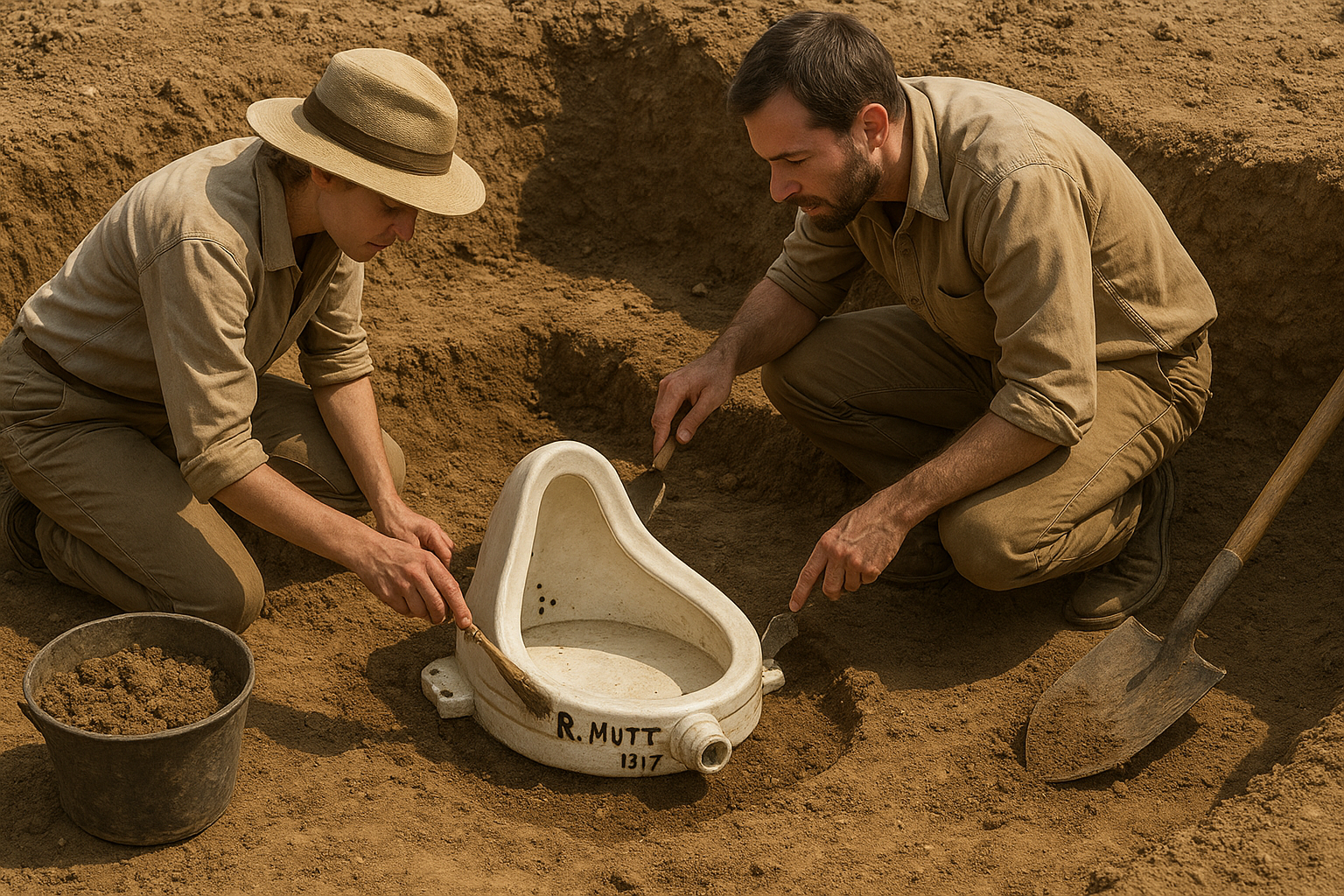
I asked ChatGPT to picture archaeologists excavating Duchamp readymades. It produced the image above. Interestingly it got the date of Fountain wrong, unprompted, making Duchamp a contemporary of Duccio. Was this error or insight?
•
The Sound of One Hand Clapping
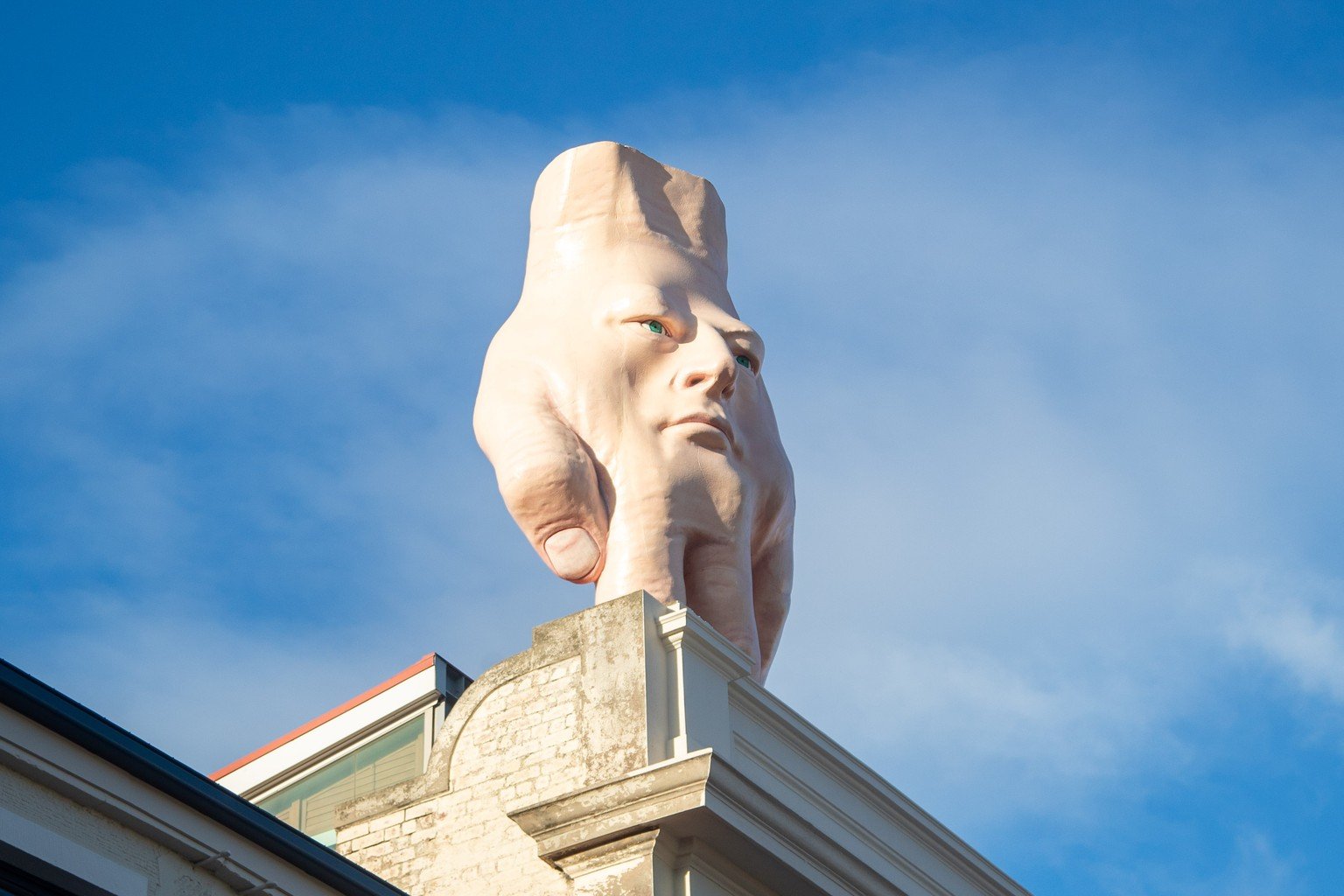
I was just in Nipaluna/Hobart for Dark Mofo, where I happily reunited with an old friend, Ronnie Van Hout’s Quasi, on the roof of Henry Jones Hotel. This six-metre-high public sculpture merges the artist’s unsmiling face with his left hand, standing on its index and ring fingers. This disembodied ‘partial self portrait’ was created in resin and polystyrene using scans made from the artist’s body. Is it a joke about ‘the hand of the artist’ taking on a life of its own? The title suggests something fake, an approximation, but it’s also a nod to Quasimodo, the disfigured, misunderstood romantic hero of Victor Hugo’s novel The Hunchback of Notre-Dame.
Christchurch Art Gallery commissioned Quasi as a temporary public sculpture and installed him on its roof in 2016. From this elevated position, he surveyed the city, still recovering from the 2011 earthquake. He quickly became the talk of the town. Like his namesake, Quasi was misshapen and misunderstood; defended by some, ridiculed and vilified by others. His polarising quality made him the perfect public sculpture—a talking point. Curmudgeonly critic Warren Feeney was the head hater, leading the charge for his removal, publishing ‘Ten Reasons Why Christchurch Art Gallery’s Quasi Must Go’ in The Press. However, in acting like the frightened, vengeful, mistaken Parisians in Hugo’s novel, Feeney and Co. only played into Van Hout’s game of projection, paranoia, and pathos.
In 2019, Quasi found himself homeless, when his Christchurch tenure came to an end, on schedule. When I was Chief Curator at City Gallery Wellington, we opportunistically relocated him to our roof for the cost of the freight, a little engineering, and some helicopter time. In Wellington, he did his job again, prompting waves of fake-news mass-media coverage and social-media speculation. He continued to operate like a Rorschach blot. One local considered him obscene—a naked hand! A kind soul suggested knitting him a glove, to help him survive the Wellington winds. Someone else thought he looked like Trump. A fake interview with Quasi appeared online, and he began appearing in city promotions and ads, and as a mascot for Hopstock 2022, a local craft-beer festival. As people had fun with him, he became a signifier for the capital.
Wellington had its own earthquake in 2016, and the knock-on effect saw Civic Square become a construction site and City Gallery close. Last year, after five years, Quasi was retired. His departure seemed like a terrible loss for the city. But being relocated to Hobart can only add to his itinerant mythos. He seems to activate latent meanings wherever he goes.
•
Who Am I?
I am a contemporary art curator and writer, and Director of the Institute of Modern Art, Brisbane. I have held curatorial posts at Wellington’s National Art Gallery, New Plymouth’s Govett-Brewster Art Gallery, Dunedin Public Art Gallery, Auckland Art Gallery, and, most recently, City Gallery Wellington, and directed Auckland’s Artspace. My shows include Headlands: Thinking through New Zealand Art for Sydney’s Museum of Contemporary Art (1992); Action Replay: Post-Object Art for Artspace, Govett-Brewster Art Gallery, and Auckland Art Gallery (1998); and Mixed-Up Childhood for Auckland Art Gallery (2005). My City Gallery shows include Yvonne Todd: Creamy Psychology (2014), Julian Dashper & Friends (2015), Francis Upritchard: Jealous Saboteurs (2016), Colin McCahon: On Going Out with the Tide (2017), John Stezaker: Lost World (2017), This Is New Zealand (2018), Iconography of Revolt (2018), Semiconductor: The Technological Sublime (2019), Oracles (2020), Zac Langdon-Pole: Containing Multitudes (2020), and Judy Millar: Action Movie (2021). I curated New Zealand representation for Brisbane’s Asia-Pacific Triennial in 1999, the Sao Paulo Biennale in 2002, and the Venice Biennale in 2003 and 2015.
Contact
BouncyCastleLeonard@gmail.com
+61 452252414
This Website
I made this website to offer easy access to my writings. Texts have been edited and tweaked. Where I’ve found mistakes, I’ve corrected them.
.