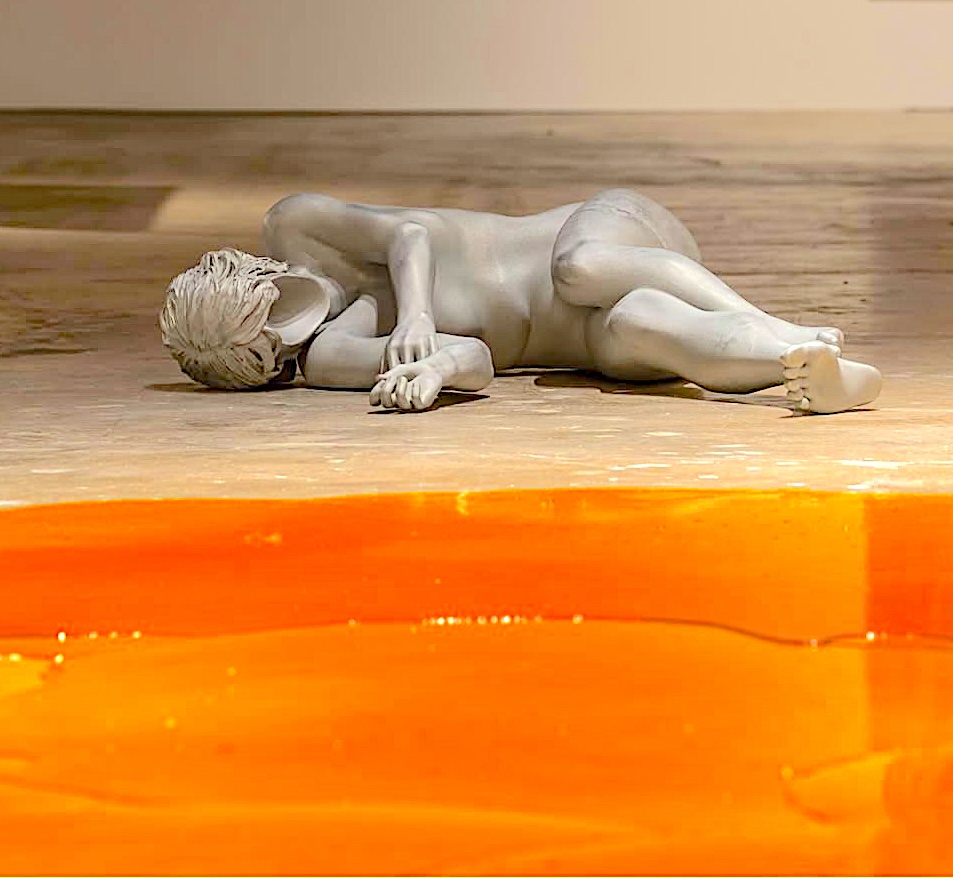
I was just in Gwangju, South Korea, for the opening of the Biennale. You Must Change Your Life featured an impressive lineup of sculptures from Jean Barth’s 2024 Institute of Modern Art show The Clumped Spirit. I thought I knew the sculptures well, but the Biennale changed my mind. At the IMA, the sculptures had been contextualised with other Barth works that fixed them in discussions about transgender identity, about self portraiture, and about the relation between the real and the virtual. However, in Gwangju—separated from those other Barth works and in conversation with works by other artists—those thematics took a back seat. The sculptures no longer referred primarily to transgender identity, self portraiture, and computer-generated processes. Indeed, they looked genuinely antique. Among other things, Barth’s sculptures were inspired by those Pompeii plaster casts, where, thousands of years ago, inhabitants suddenly buried by ash and lava had left their freeze-framed impressions. In Gwangju, this became the primary reference point. Barth’s works appeared in the first hall of the Biennale, ‘Molecules and Me’, alongside works by Goldin + Senneby from Sweden, Kiri Dalena from the Phillipines, and Maya Wantanabe from Peru. For Goldin + Senneby’s Flare Up, buckets of tree resin had been poured onto the gallery floor, setting like the transparent toffee coating on a crème brulee, recalling the amber that once trapped and preserved prehistoric insects (famously referenced by Michael Crichton and Steven Spielberg in Jurassic Park and later by Pierre Huyghe in De-Extinction). This golden pond appeared to approach Barth’s figures, like a slow-moving glacier that may ultimately engulf them and us. In Dalena’s Imprints, a suite of portrait photos, the faces of Phillipines political activists and artists were covered with plaster ‘death masks’, which spoke to Barth’s sculptures, with their scooped-out faces and their nod to Pompeii’s tragic plaster casts. Dalena’s works also played with dualities: individuality and anonymity, remembrance and forgetting, life and death. Wantanabe’s forensic video Liminal scanned material removed from mass graves in Peru, a compost of political repression. For good measure, in the same room, Gwangju artistic director Ho Tzu Nyen and his team also displayed volcanic rocks from Jeju Stone Park, to represent deep-time transformation and nature as co-author and artist. This deft curatorial recontextualising gave Barth’s works a new discursive life, a second wind.
•
I Criticise, Therefore I Am
I recently sat on a panel about art writing and art publishing, which got me thinking. People routinely whinge about the quality of art writing, and, of course, there’s good and bad. But, generally speaking, I like art writing. I like writing it, I like reading it, and I find it genuinely useful, illuminating, and entertaining. But I don’t like how uncritical it has become.
Art is also good and bad, but, these days, art writers seldom have a bad word to say about anything. If you read film criticism, music criticism, literary criticism—even sports criticism—writers are critical. They make judgements because they care. They turn people onto the good and away from the bad, they dissect performances, and they award stars. It’s accepted. It’s part and parcel. That’s why readers read them. But it’s not the case with art writing and that’s a shame. It’s down to two things, I think.
First, of course, there’s the double action: the fall of modernism and the rise of identity politics. With modernism, some art was important because it made earlier art obsolete. Modernism gave art a purpose and art critics a task—to adjudicate over what was new and advanced. Identity politics widened art’s ambit, but discouraged critics from making value judgements about work by others, whose shoes they hadn’t walked a mile in. So we parked the idea of criteria, fearing it was compromised, which indeed it was.
Second—and more important—is the art world’s court culture. Art writers don’t want to rock the boat, because they’re reliant on patronage and access. Film critics can happily trash Megalopolis because they were never going to be invited to dinner with Francis Ford Coppola, were never going to collaborate with him on a screenplay, were never going to need him for a reference. So they freely write for their reader. But art writers want to be invited to the dinners and after parties with artists and dealers. They need their endorsement to write for catalogues and magazines; they need access. So they write for their subjects rather than their readers. Despite the death of the author last century, most art writing is routinely vetted and approved by subjects and stakeholders.
It’s not that writers don’t exercise judgement, but they don’t do so in print explicitly. The critical conversations occur in the bar and the office, not on the page, and that’s a great shame for readers, for the discourse. If things were more open, negative or dissenting views wouldn’t seem like a cause for panic, just par for the course. We’ve become allergic to critique.
Decades ago Jerry Lewis spoke of film critics: ‘I’ve been blasted by the best and they’ve made some very good points. Pauline Kael, she’s never said a good thing about me yet, the dirty old broad. But she’s probably the most qualified critic in the world because she cares about film and those that are involved in it. I wish I could really rap her, but I can’t because she is very competent. She knows what she’s talking about. She’s going to say what she thinks.’
In art writing, if we want more fearless and forthright Pauline Kaels, we just have to get more Jerry Lewis about it.
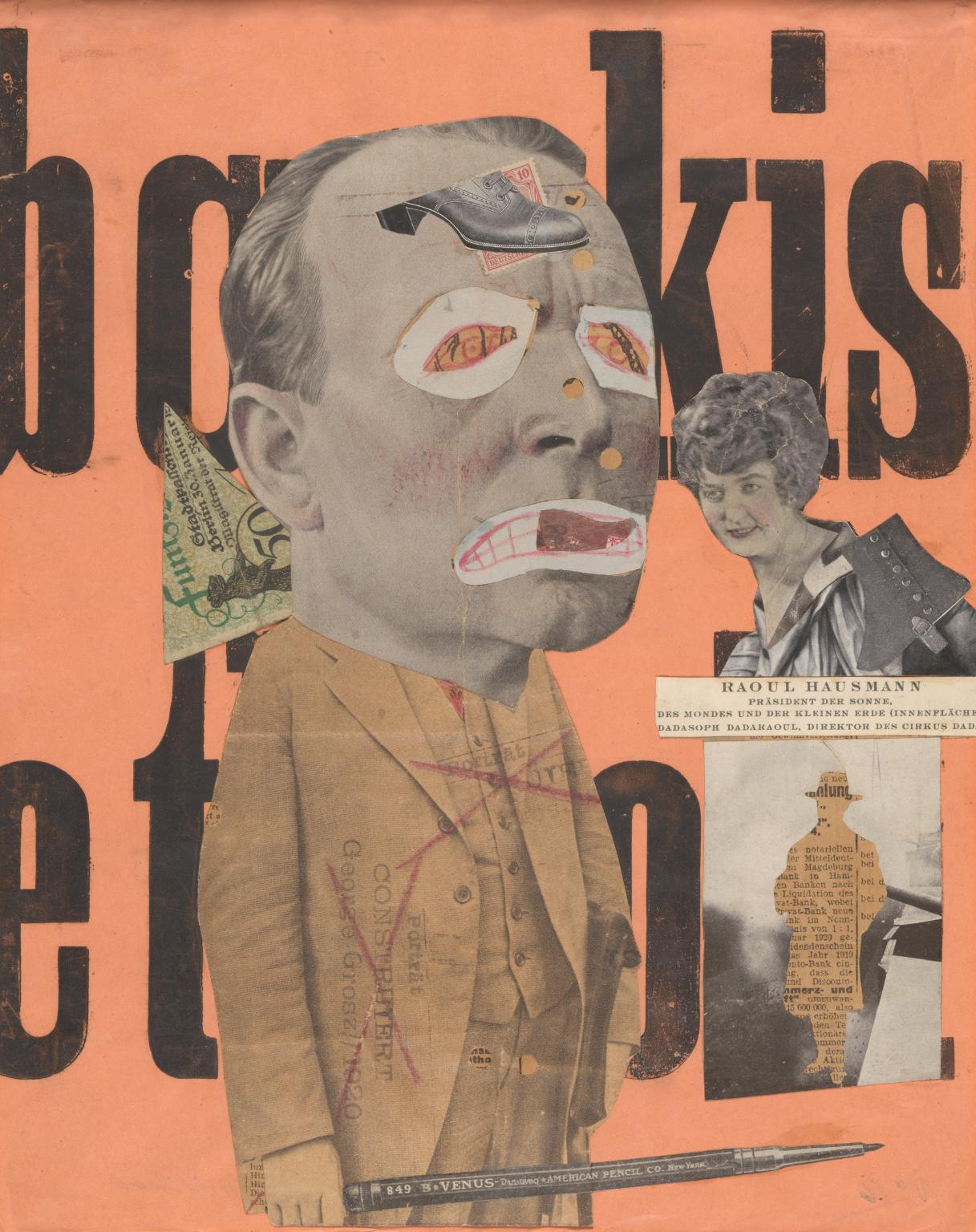
[IMAGE: Raoul Hausmann The Art Critic 1919–20]
•
Snap
Exhibition making is constrained by logistics: space, time, and the laws of physics; contacts, politics, and money. There are artists and lenders to convince, bills to be paid. Status is important in securing work. Artists, galleries, and collections make judgement calls about where their work is placed. Everyone wants to enhance their reputation, their cultural capital.
It’s easy to put works in conversation in a slide lecture or reproduced in a book. It’s another thing to bring them together in a room. Art works tend to be more-or-less unique things, which have to be sourced, transported, insured, invigilated, and returned. Here’s a great example …
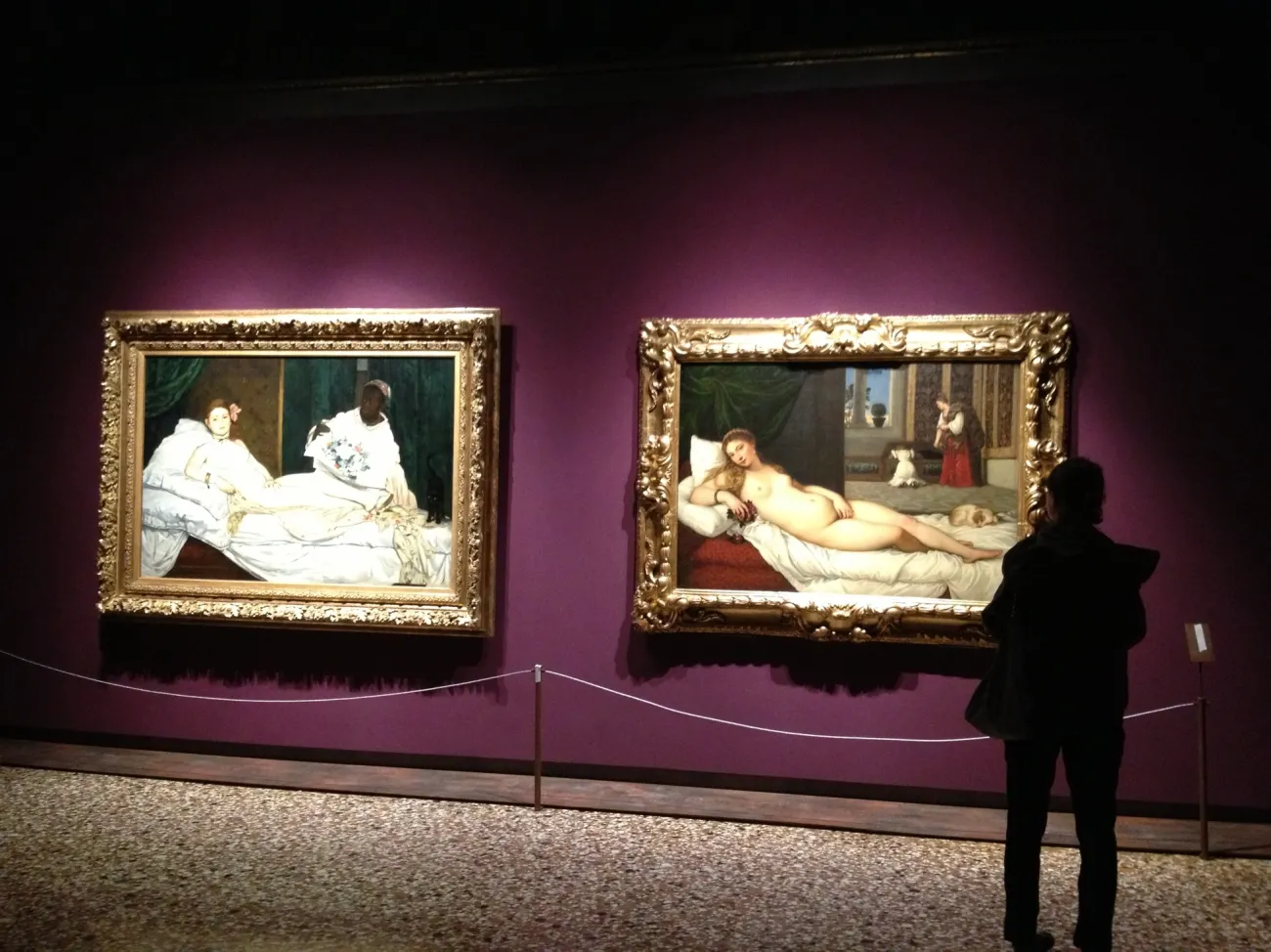
One of art history’s classic cause-and-effects, compare-and-contrasts, is the pairing of Titian’s Venus d’Urbino (1538) from the Uffizi in Florence and Manet’s Olympia (1863) from the Musee D’Orsay in Paris. Manet knew the Titian, though perhaps not in the flesh. He was riffing on it, updating it, 325 years later, replacing a goddess with a prostitute. The point is made in so many slide lectures and art history texts as to have become a cliché. However, the works themselves had never shared a wall.
So it was shocking to step into the exhibition Manet in Venice in the Doge’s Palace in 2013, during the Venice Biennale, and see these two unique works finally brought together in the flesh. As they are roughly the same size and proportions, it looked like the classic two-projector art-history comparison. It looked great, obvious, but as a curator I was too aware of the epic negotiation and complexity involved in making this juxtaposition of priceless works happen.
•
Close Encounters
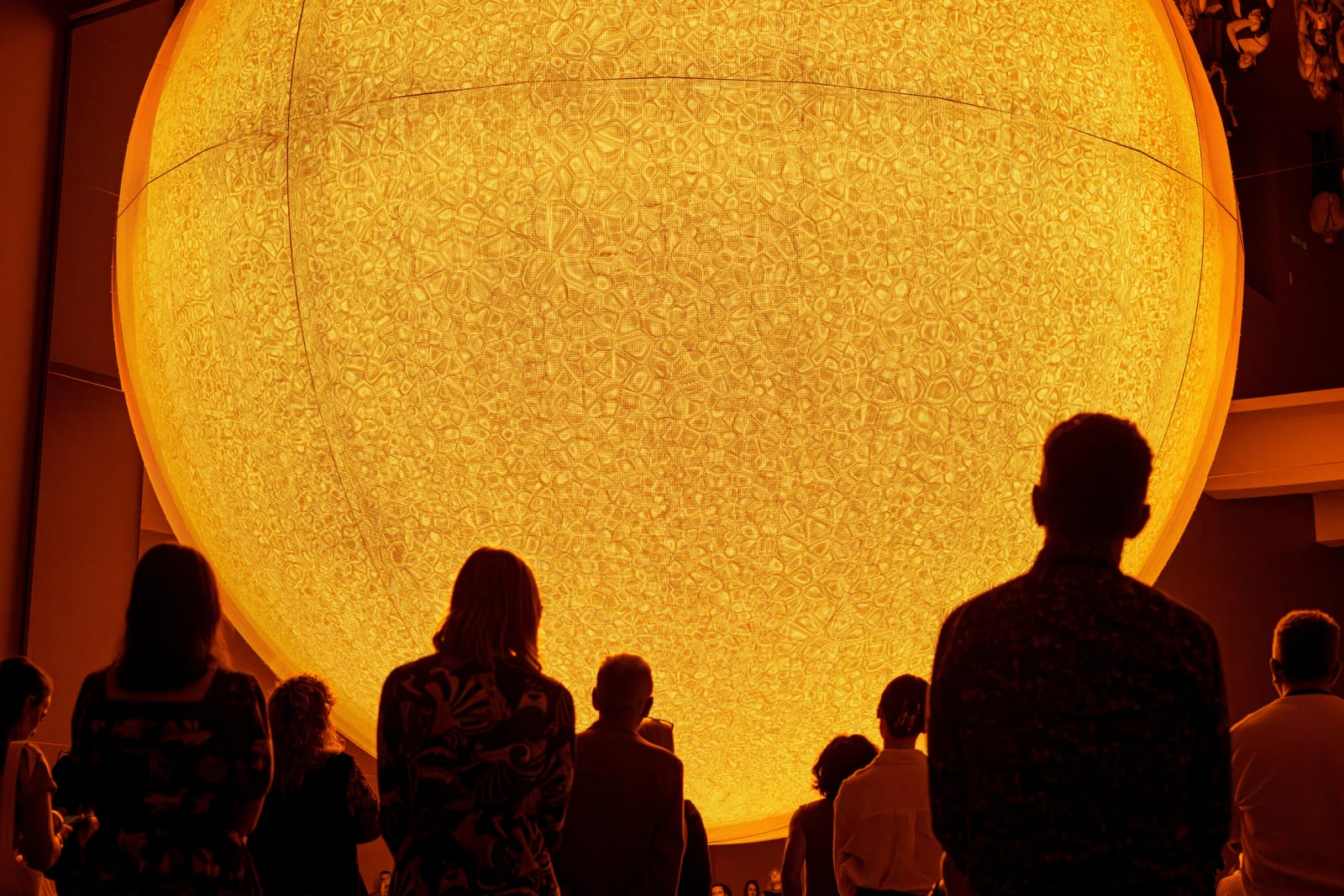
If you haven’t seen Presence—the Olafur Eliasson show at Queensland Art Gallery—go immediately. It’s great to see Eliasson’s works presented with confidence, at scale. Ten out of ten. When I went again the day after Boxing Day, the place was crawling with punters, especially the epic Lego table. I wrote a short account of that work when we showed it in Demented Architecture at City Gallery Wellington in 2015. Click here. Olafur Eliasson: Presence, Gallery of Modern Art, Meanjin/Brisbane, until 12 July.
•
Contemporary Art as a Period Style
In the past, we looked to religion to tell us what to do. In Duccio’s time, our art was all icons and altarpieces. However, we would become increasing secular and enlightened. In 1882 Nietzsche wrote: God is dead and we killed him. Once we killed external authority, we had to invent our own rules, to work out what to do for ourselves, to take responsibility, create our own morality, find our own way. That lead to doubt and disruption, existentialism, and to modern and contemporary art, art based on questions not on answers.
We’re now entering a new epoch. AI. We’re creating superintelligent machines that will think better than we can, that will guide us, make decisions for us, and answer our prayers—that will be close to authoritative. Having long since killed god, we are now effectively creating a new god—one that can create images of us and for us. Will contemporary art survive? Perhaps we won’t need artists to come up with audacious new images and ideas anymore. How could they compete with the abundant creativity of AI? If AI does it better, will it make human endeavour and insight seem superfluous?
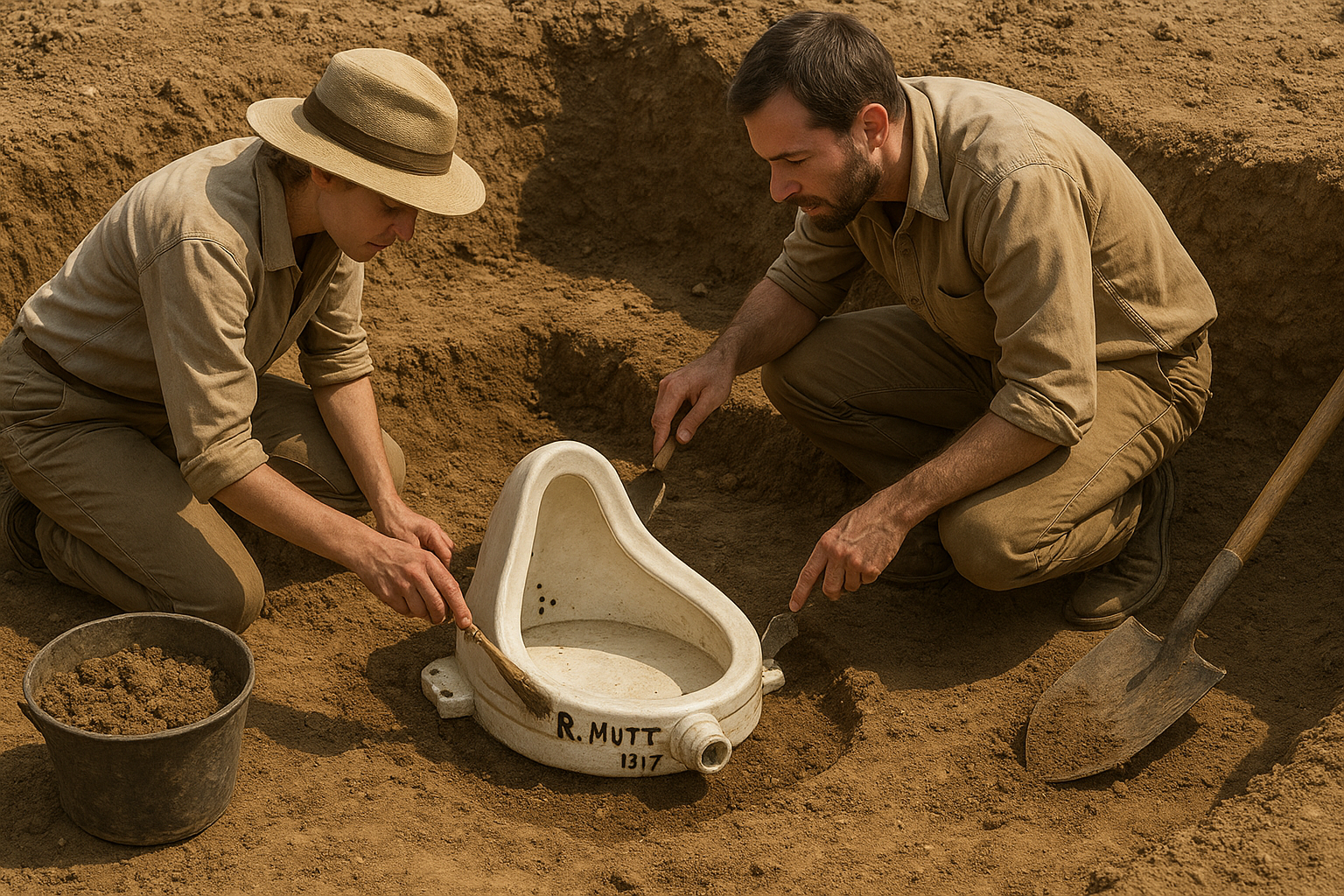
If contemporary art doesn’t survive, perhaps contemporary art museums will, not to present new art, but to present contemporary art as a thing of the past—answering to a nostalgia for a time when artists felt compelled to struggle, to create new ideas and images, new forms of thought and feeling—a time when human creativity and agency mattered. Perhaps contemporary art will become like ancient art is for us now, something we want to connect with through our humanity, despite being historically estranged from it.
I asked ChatGPT to picture archaeologists excavating Duchamp readymades. It produced the image above. Interestingly it got the date of Fountain wrong, unprompted, making Duchamp a contemporary of Duccio. Was this error or insight?
•
The Sound of One Hand Clapping
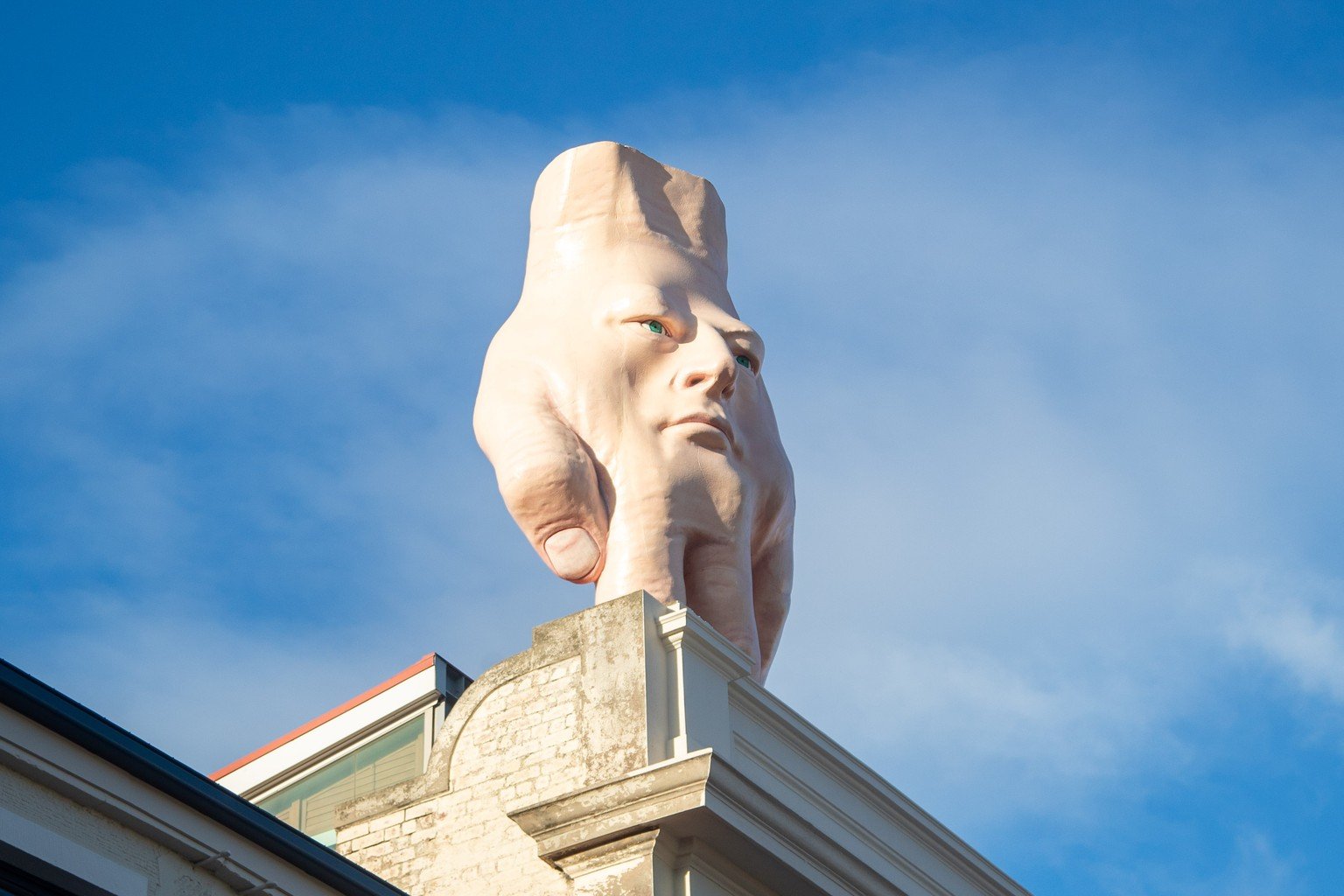
I was just in Nipaluna/Hobart for Dark Mofo, where I happily reunited with an old friend, Ronnie Van Hout’s Quasi, on the roof of Henry Jones Hotel. This six-metre-high public sculpture merges the artist’s unsmiling face with his left hand, standing on its index and ring fingers. This disembodied ‘partial self portrait’ was created in resin and polystyrene using scans made from the artist’s body. Is it a joke about ‘the hand of the artist’ taking on a life of its own? The title suggests something fake, an approximation, but it’s also a nod to Quasimodo, the disfigured, misunderstood romantic hero of Victor Hugo’s novel The Hunchback of Notre-Dame.
Christchurch Art Gallery commissioned Quasi as a temporary public sculpture and installed him on its roof in 2016. From this elevated position, he surveyed the city, still recovering from the 2011 earthquake. He quickly became the talk of the town. Like his namesake, Quasi was misshapen and misunderstood; defended by some, ridiculed and vilified by others. His polarising quality made him the perfect public sculpture—a talking point. Curmudgeonly critic Warren Feeney was the head hater, leading the charge for his removal, publishing ‘Ten Reasons Why Christchurch Art Gallery’s Quasi Must Go’ in The Press. However, in acting like the frightened, vengeful, mistaken Parisians in Hugo’s novel, Feeney and Co. only played into Van Hout’s game of projection, paranoia, and pathos.
In 2019, Quasi found himself homeless, when his Christchurch tenure came to an end, on schedule. When I was Chief Curator at City Gallery Wellington, we opportunistically relocated him to our roof for the cost of the freight, a little engineering, and some helicopter time. In Wellington, he did his job again, prompting waves of fake-news mass-media coverage and social-media speculation. He continued to operate like a Rorschach blot. One local considered him obscene—a naked hand! A kind soul suggested knitting him a glove, to help him survive the Wellington winds. Someone else thought he looked like Trump. A fake interview with Quasi appeared online, and he began appearing in city promotions and ads, and as a mascot for Hopstock 2022, a local craft-beer festival. As people had fun with him, he became a signifier for the capital.
Wellington had its own earthquake in 2016, and the knock-on effect saw Civic Square become a construction site and City Gallery close. Last year, after five years, Quasi was retired. His departure seemed like a terrible loss for the city. But being relocated to Hobart can only add to his itinerant mythos. He seems to activate latent meanings wherever he goes.
•
Muse Unamused
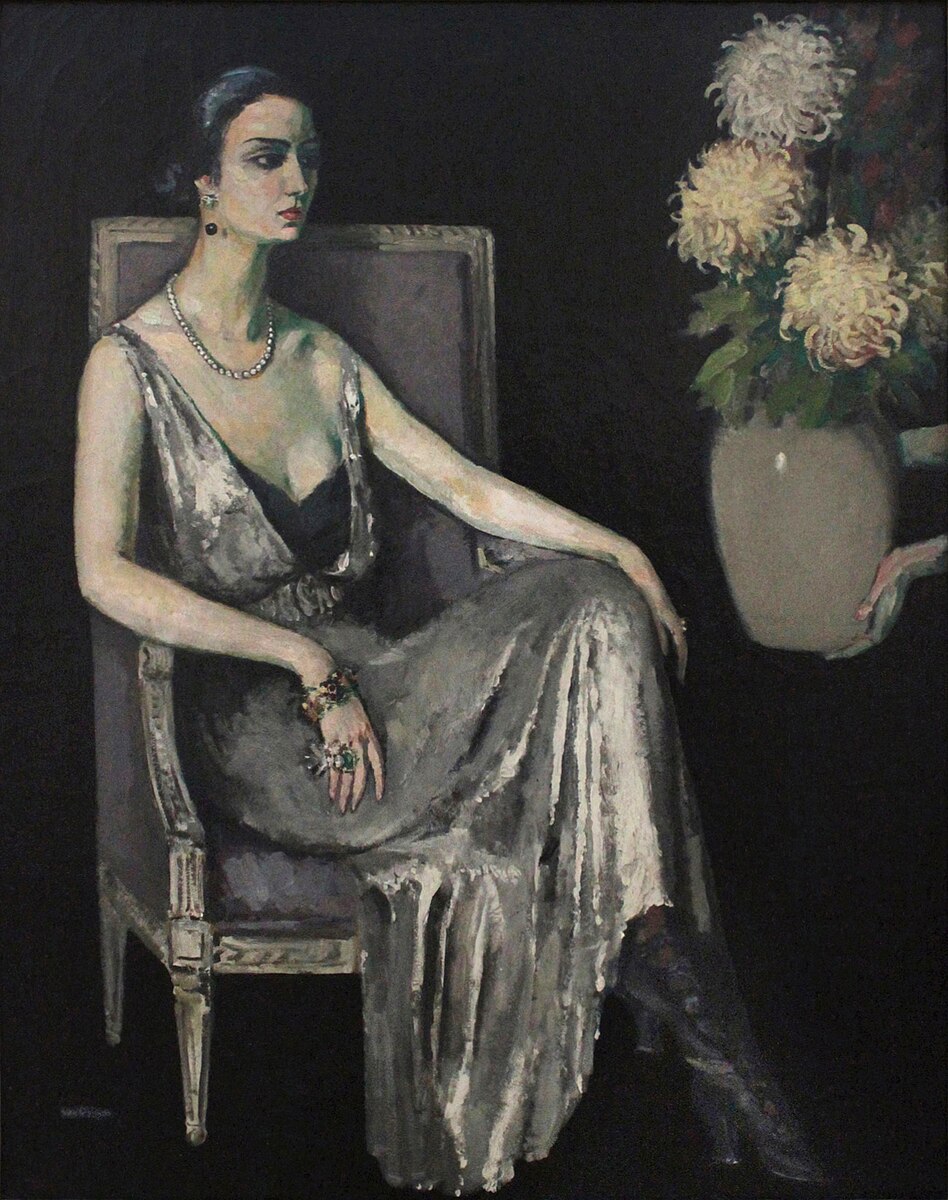
When I’m in Paris—which isn’t often—I like to go to the Musée d’Art Moderne de la Ville de Paris to see one of my favourite pictures: Kees van Dongen’s The Sphinx (1920). It’s not the greatest painting, but the attitude it captures … priceless. Dutch-born, Paris-based, Van Dongen was a fauve. Early on, he painted good-time girls, prostitutes and dancers, florid and flirty, in ripe colours, with big eyes. Later, he became a high-society portraitist, celebrating classy ladies in chilly whites and silvery greys. The Sphinx belongs to this later phase, although I haven’t been able to find anything about the sitter, Renée Maha. When I first saw The Sphinx, it disarmed me. Hands come in from stage left offering a vase of chrysanthemums, only to be greeted with a chilly ‘unamused’ glare from the languid, elongated sitter. Sure, there’s a misogynist element here. The Sphinx was a merciless mythic being with the face of a woman, the body of a lion, and the wings of an eagle, who would kill you and eat you if you couldn’t answer her riddle, solve her enigma. The painting is also a classic example of metonymy. That vase of flowers is like the painting itself, being offered to the ice queen by Van Dongen as the painter-supplicant, seeking her approval. Instead of solving her riddle, he simply reflects it.
•
Ain’t It Hard Keeping It So Hardcore?
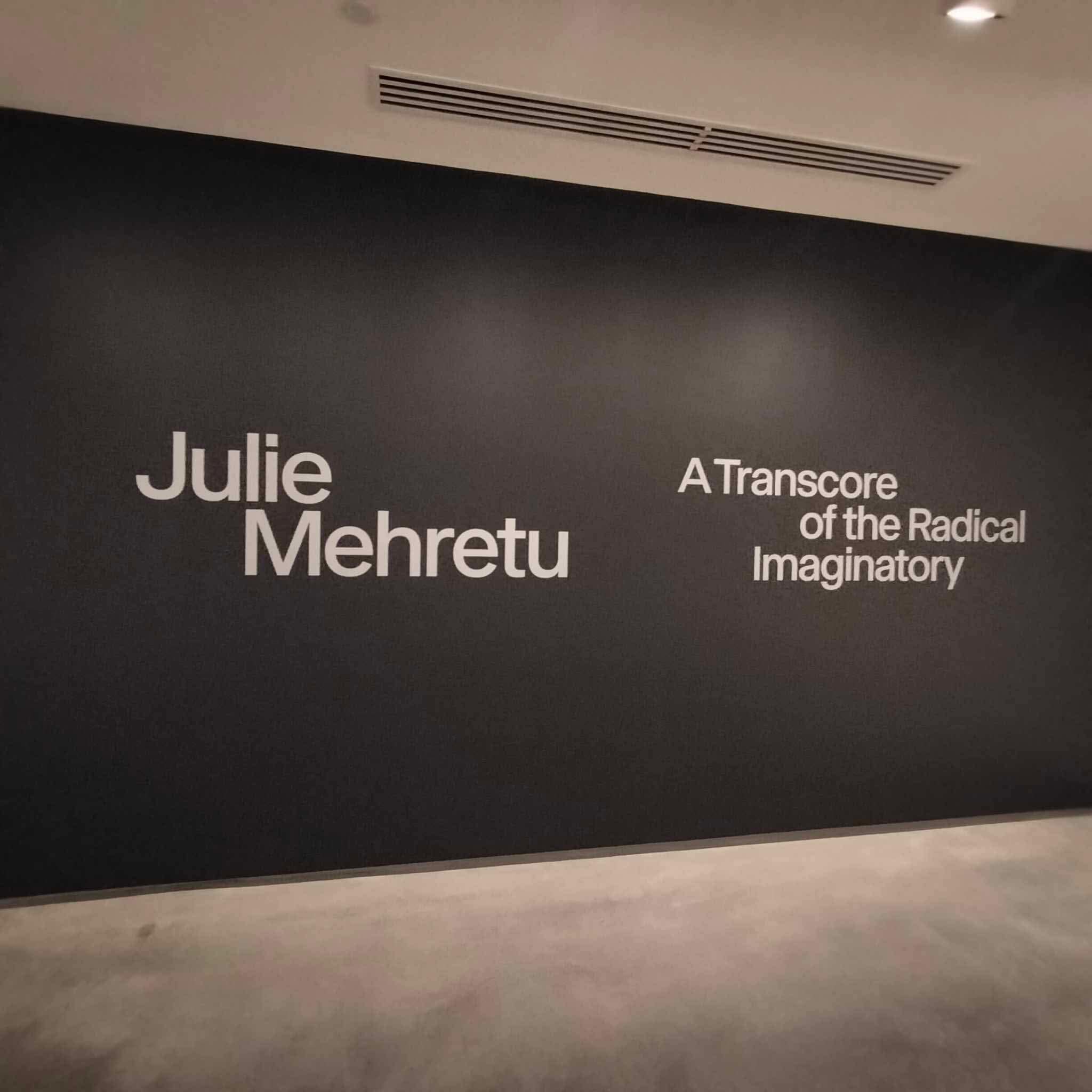
There’s a street poster for the Museum of Contemporary Art’s current Julie Mehretu show just around the corner in James Street. Advertising in Brisbane suggests the show is backed by a sizeable marketing spend. But the title—A Transcore of the Radical Imaginatory—hits an odd note for a museum needing to pull in Circular Quay passers-by and tourists for its pay shows. Were the Marketing and Education Departments asleep at the wheel? I’m a pointyhead art curator yet even I find the title pretentious and off putting. I have no idea what it means. I couldn’t find a definition for ‘transcore’ in any proper dictionary. But it was listed online in the Urban Dictionary as ‘referring to scene guys or any guys that look like girls that try to look and act hardcore’. And ‘imaginatory’ just means ‘imaginary’, it seems. But I’m none the wiser. For their Mehretu show last year, Venice’s Palazzo Grassi went for the innocuous but nevertheless gettable title Ensemble, which at least makes sense, with Mehretu sharing the stage with a bunch of guest-star artist friends. Despite the title, I’m looking forward to Mehretu’s Sydney show, and to seeing Rene Magritte, Angelica Mesiti, and Cao Fei at the Art Gallery of New South Wales. Bumper crop. Lots of reasons to visit Sydney.
•
Zinger
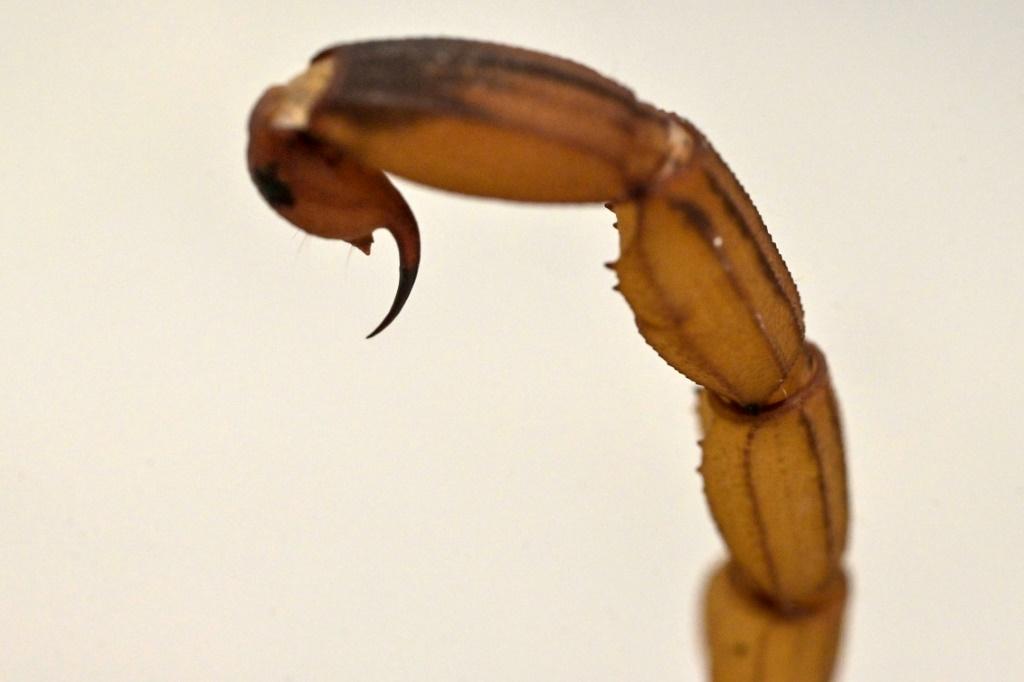
My favourite mean opening for a mean review: ‘One thing you can say for Buzz Spector is that he does his homework. The bummer is he hangs it in galleries and calls it art.’ Lane Relyea, Artforum, May 1992. Can it get any worse?
•
Preppers
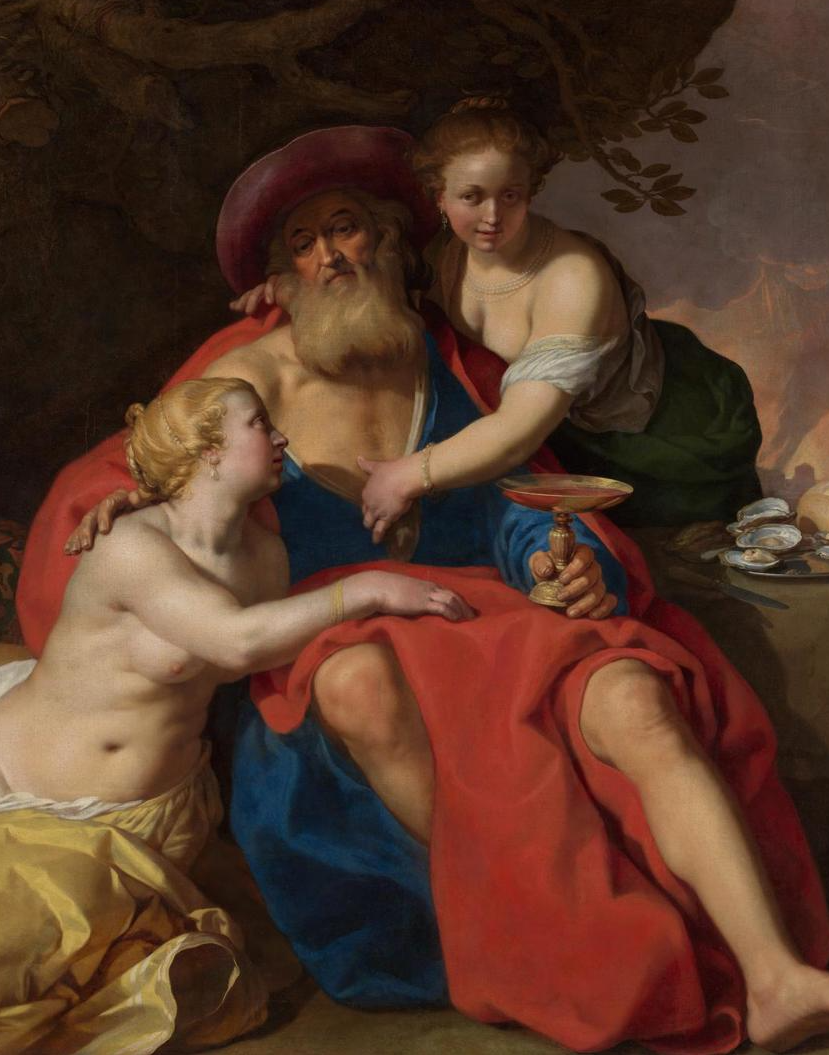
I recently dropped in to London’s National Gallery, where a new acquisition—Abraham Bloemaert’s Lot and His Daughters (1624)—was proudly on display. The label was telling: ‘Genesis recounts how Lot and his family fled the destruction of Sodom, with Lot’s wife turning into a pillar of salt on looking back to the city, seen in the background of this painting. The main scene—a triangle of primary colours—shows Lot’s daughters, believing only they remained alive on earth, taking the desperate measure of seducing their own father in order to perpetuate the human race.’ And there they are, in the artist’s imagination, plying their tired papa with booze, oysters, themselves. Only in the movies.
•