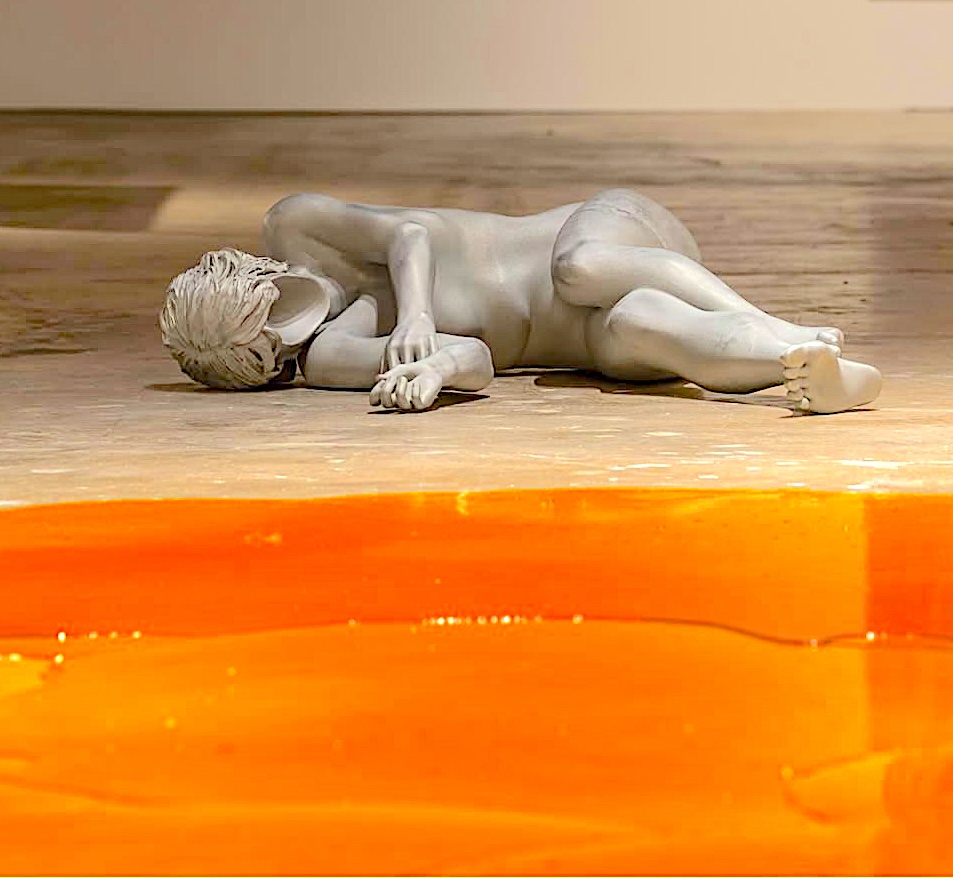
I was just in Gwangju, South Korea, for the opening of the Biennale. You Must Change Your Life featured an impressive lineup of sculptures from Jean Barth’s 2024 Institute of Modern Art show The Clumped Spirit. I thought I knew the sculptures well, but the Biennale changed my mind. At the IMA, the sculptures had been contextualised with other Barth works that fixed them in discussions about transgender identity, about self portraiture, and about the relation between the real and the virtual. However, in Gwangju—separated from those other Barth works and in conversation with works by other artists—those thematics took a back seat. The sculptures no longer referred primarily to transgender identity, self portraiture, and computer-generated processes. Indeed, they looked genuinely antique. Among other things, Barth’s sculptures were inspired by those Pompeii plaster casts, where, thousands of years ago, inhabitants suddenly buried by ash and lava had left their freeze-framed impressions. In Gwangju, this became the primary reference point. Barth’s works appeared in the first hall of the Biennale, ‘Molecules and Me’, alongside works by Goldin + Senneby from Sweden, Kiri Dalena from the Phillipines, and Maya Wantanabe from Peru. For Goldin + Senneby’s Flare Up, buckets of tree resin had been poured onto the gallery floor, setting like the transparent toffee coating on a crème brulee, recalling the amber that once trapped and preserved prehistoric insects (famously referenced by Michael Crichton and Steven Spielberg in Jurassic Park and later by Pierre Huyghe in De-Extinction). This golden pond appeared to approach Barth’s figures, like a slow-moving glacier that may ultimately engulf them and us. In Dalena’s Imprints, a suite of portrait photos, the faces of Phillipines political activists and artists were covered with plaster ‘death masks’, which spoke to Barth’s sculptures, with their scooped-out faces and their nod to Pompeii’s tragic plaster casts. Dalena’s works also played with dualities: individuality and anonymity, remembrance and forgetting, life and death. Wantanabe’s forensic video Liminal scanned material removed from mass graves in Peru, a compost of political repression. For good measure, in the same room, Gwangju artistic director Ho Tzu Nyen and his team also displayed volcanic rocks from Jeju Stone Park, to represent deep-time transformation and nature as co-author and artist. This deft curatorial recontextualising gave Barth’s works a new discursive life, a second wind.
•