Robert Leonard

Contemporary Art Writer And Curator

Rebecca Baumann: Apolitical Utopias

Unpublished.
_


It’s October 2024. Genocide continues in Gaza and the conflict is extending into Lebanon and Iran. War persists in Ukraine, with no sign of letting up. And let’s not get started on Somalia. Trump and Harris are slugging it out in the lead up to the US election, where the future of the free world turns on swing voters in swing states and the weather on election day. The ice caps keep melting and sea levels keep rising—as does the cost of living—while we brace for the next strain of Covid. In the art sector, issues—identity politics, decolonisation, and representation—rule the roost. However, none of this seems even remotely relevant to Rebecca Baumann’s work, to how she makes it or how we consume it. Her art appears effortless, carefree, which—right now—seems unusual.

Writing on Baumann’s work, I feel under pressure to find something smart to say—to offer insight into her art-historical pedigree or her thought processes. But this puts me into a frame of mind entirely at odds with the one the work does. Baumann creates brain-candy, eye-candy moments; bubbles of carefree pleasure, of lightness, of vacuousness even; abstracted experiences that we can all enjoy, rather than ponder or analyse. Watching confetti erupt, pastel smoke billow and dissipate, and coloured cards flip over, there’s no moral, no message, just the pleasure of being there, in the moment. We stop thinking, stop worrying, and take pleasure in these too-brief interludes, these moments within time but outside of it. And why not? 

I’m reminded of the film American Beauty (1999), with Ricky (Wes Bentley) showing Jane (Thora Birch) his video of a plastic bag miraculously dancing in the air, buffeted by air currents and electrostatic energies. Except Ricky drew a metaphysical conclusion: ‘And this bag was like dancing with me. Like a little kid begging me to play with it. For fifteen minutes. And that’s the day I knew there was this entire life behind things, and … this incredibly benevolent force, that wanted me to know there was no reason to be afraid ever.’ Baumann makes similarly addictive pleasure machines, but without Ricky’s misty-eyed metaphysics.

As if to underline her work’s pointlessness, to make a point of it, Baumann is drawn to redundant communications technologies: to flares that don’t demark anything, flip clocks that don’t tell time, signs without directions, printers that spew out colours rather than documents, billboards stripped of enticements, and confetti lacking an occasion. We experience the absence of a message where we expected to find one. She repurposes redundant information technologies, stripping away the message, making the medium the message.

Today, rather than being liberated by tech, we are enslaved to it, and busier than ever, sending and receiving work emails day and night on our devices. We don’t know how to take time out, and yet we gaze on Baumann’s flip-clock works with pleasure not pain. They’re more like autumn leaves falling or lulling lava lamps than punch clocks. They offer a break from the 24/7 hamster wheel, and we love them. I remember one of Baumann’s gallerists telling me that her flip-clock works would ‘sell themselves’ at art fairs. Impulse buyers were transfixed, stupefied, entranced. They could have sold them ten times over—I was told—to the point where Baumann was afraid of being typecast as the flip-clock artist. 

Baumann’s works don’t make us think but invite us to experience and enjoy. Great calculation goes into achieving this, but, as viewers, in the moment, we hardly care, say, that she spent a year developing her smoke machine—our minds simply don’t go there. The work is not really about the process or research (the artist’s end), it’s about the effect (on us). But the delivery needs to be perfect, apparently effortless, and anonymous to achieve this. So Baumann conceals the process, hiding her thinking, her calculations, so we can enjoy not thinking.

Baumann’s work is not about her, not about identity. It’s phenomenological, not psychological. Her intention and inquiry are eclipsed by sheer affect. The work doesn’t place us under any pressure to understand her or care for her, to track her work or thinking back to experiences she may have had or to her cultural roots. Her research may have led her to India, to be doused with colour at the Holi festival, and to Finland, to witness the Northern Lights, and yet the works that sprung from these experiences don’t prompt us to consider these cultures, these natures. It’s just background information, and that’s where it stays. Writers may argue the connection, but the work doesn’t. 

Baumann’s works appear to arrive immaculately, fully formed—no drawings. They seem to emerge directly from her mechanisms and materials (particularly the dichroic film she’s favoured of late), and sometimes from the movement of the sun and clouds, rather than from the movement of her thoughts. She seems to do little or nothing. But that’s her magic. The works’ effects seem intrinsic. It’s like her mechanisms and materials do the heavy lifting, leaving her to be an observer alongside us.

Contemporary art has become causey and allergic to moments of beauty. Today, beauty is trivial and pleasures always guilty. Baumann’s work, however, offers us a kind of wide-eyed bliss. It shunts us back to a time before politics, before we were aware of others or of the issues that divide us. And increasingly she invites us to enjoy share these idyllic moments in public spaces, in social situations where we stand alongside others—neighbours we potentially have little affinity with or worse—enjoying uncommon common delights. She creates little apolitical utopias. 


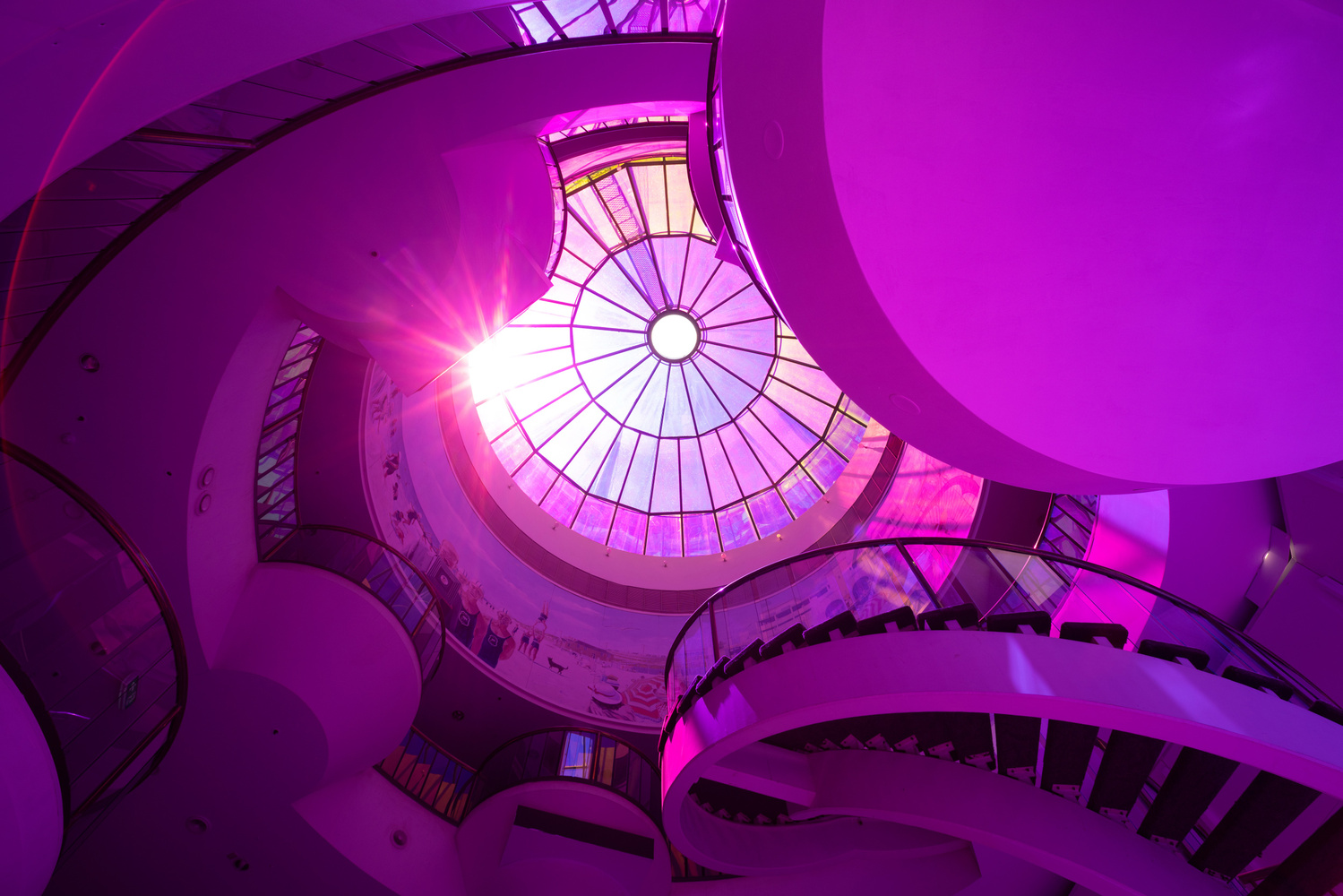
[IMAGE: Rebecca Baumann Light Event 2024, Perth Festival, 2024.]
Miguel Aquilizan: Mutagenesis

Vault, no. 48, 2024.
–


These days everything is sculpture, so every young artist can consider themself a sculptor. And yet, few think sculpturally, spatially—that’d be formalism, old school. Paradoxically, this makes Miguel Aquilizan a breath of fresh air. His creative adventure is palpable in his works themselves, not resting unduly on supplementary wall texts for explanation. His assemblages crackle with mixed messages and intrigues.

Aquilizan is not programmatic. He’s intuitive, improvisational, inventive. Everything comes out of making, out of play in the studio. ‘I use my hands to think, and not my brain’, he says. Aquilizan makes art from anything to hand, grafting made and found: likely and unlikely; the raw and the cooked; metal and timber; plaster, resin, and expanding foam; plastic flowers and a dead tree; furniture and ornaments.

While many of his works have an authoritative scale, they’re also ramshackle and provisional. He prefers the charm of bricolage—that stitched-together Frankenstein’s-monster look—foregrounding the process. However, for all their feral energy and punky attitude, his works echo strategies familiar from the art-history playbook: classical, modern, ‘primitive’; busts on plinths, fragments of figures. Like Brancusi, he fashions elaborate bases, exploring the play between object and plinth. 

Art runs in the family. Aquilizan was born in Manila in the Philippines in 1986 and emigrated to Brisbane with his family in 2006. These days, he splits his time between here and there. His parents are the longstanding international art duo Isabel and Alfredo Aquilizan, famous for their assemblage sculptures addressing precarity and displacement, migration and home. Miguel Aquilizan went to art school in the Philippines, and, like his siblings, works on his parents’ projects. ‘My parents give us freedom and let us play. They use art as an excuse to spend time together’, he explains.

But Aquilizan’s solo practice is different. While his parents’ work is noble, hopeful, and humanistic, his is more unruly, dark, and fashionable. He may work intuitively, but his intuitions are hardly random. They express him, creating a distinctive universe. His surreal mash-ups have a magical quality, with one foot in totemism and animism, the other in science-fiction and the post-human. ‘I like the idea of obscuring and mutating what is familiar, making everything alien’, he observes.

Aquilizan’s exhibit in Platform—the new-artist show at the Institute of Modern Art, Meanjin/Brisbane, earlier this year—was like stepping into a movie set, into some art director’s idea of a sculpture exhibition. It featured eight works, which looked like they could have been made by artists from different places, times, cultures. Despite the diversity, a funereal quality pervaded the ensemble. Amongst the sculptures, Aquilizan interspersed toxic-looking fake plants anchored in lumps of plaster—titled Mutagenesis. Fleurs du mal.

The Platform sculptures were riddled with references to the human body. Like us, Venustasis stood on two legs, which supported a full-length mirror, in which we could see our good selves reflected. The mirror prompted us to orient ourselves to it as the ‘face’ of the sculpture, filling its body with our own. In the centre of the mirror, a piece of fake fruit—split open to suggest a cyclopean eye, a vagina, or both—reversed our gaze while superimposed on our reflection. 

Venustasis may have been bodily, but everything was out of wack. The legs were in the right place, but, where the head should be, there was an arm shape, like a fragment of classical sculpture. Here and there, globes adhered to it, while other parts seemed to have rotted away, leaving cavities encrusted with glittery costume jewels. 

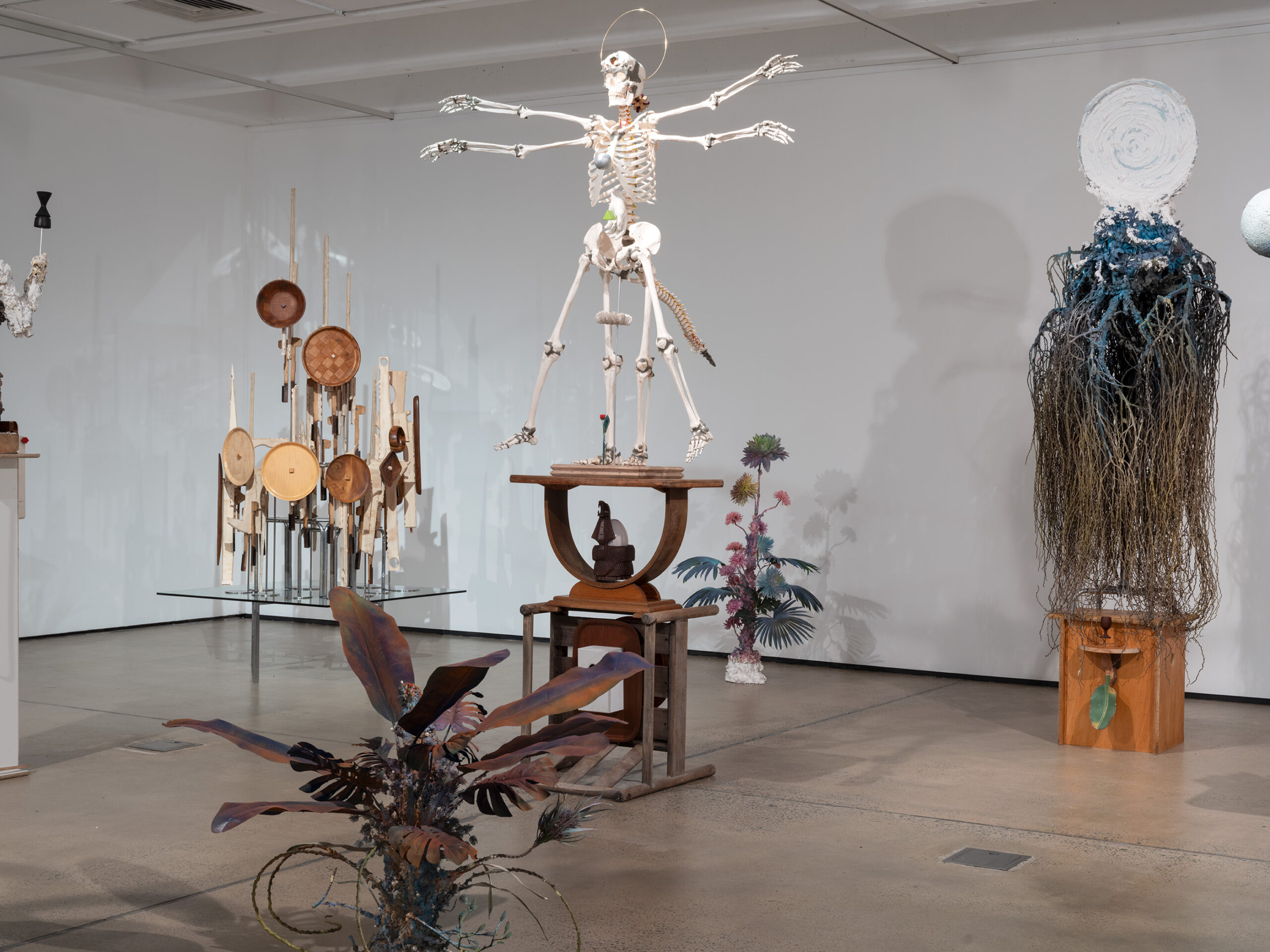
At the heart of the show, Post-Vitruvius responded to Leonardo’s iconic drawing Vitruvian Man, that cliché of ‘Western civilisation’, from half a millennium ago. It depicts a naked man in two superimposed positions within a circle and square, as proof of his ideal nature. We instinctively read the figure as having two arms, two legs—but in different moments. However, it could be misread as a mutant, with limbs proliferating, like some Hindu deity, exceeding human limitations. Aquilizan mobilised the ambiguity, mimicking Leonardo’s figure by combining two life-size plastic-reproduction generic human skeletons to imagine a star-jumping single skeleton with four outstretched legs and four extended arms, repurposing the spare spine as an alien/reptilian tail.

For cultish veneration, the hybrid skeleton was raised on a pedestal made from an upturned chair and an art deco occasional table. The pedestal housed a wooden carving of a poised snake gripping a giant egg, this kitschy objet d’art acquiring a genuine menace in its new context. It looked symbolic, but who knew what it symbolised? The skeleton was studded with several small coloured blocks, suggesting chakras, energy nodes, or similar. A metal halo implied it had transcended death, achieved grace. Should we read Post-Vitruvius as a primordial form of man (we once had tails) or a glimpse of a glorious mutant future? Was it a warning (to not to imagine ourselves divine) or a throwaway joke (a touch of ghost-train gothic)?

For Sentinel, cubisty plywood constructions—with cheap wooden bowls attached like radio dishes—were gathered on a modernist glass coffee table, suggesting a low-tech representation of high-tech cell towers or similar. I was reminded of the Papua New Guinea cargo cult seen in the 1962 documentary Mondo Cane. Suddenly exposed to new technology, they created—in bamboo—a religious shrine in the form of an airplane.

While Aquilizan’s works can touch on grand themes, they’re mediated through his permissive mix-and-match fashion sensibility. (This makes sense when you encounter Aquilizan—in his Rick Owens pants and platforms, with his distinctive hairdos and stunning tattoos.) I’m reminded of Jean Paul Gaultier in the 1990s, colliding cultural frames and citations for the sake of creating a cool look. I suspect that, for Aquilizan, cultural copyright and authenticity aren’t pressing concerns, and everything is fair game for appropriation and play. He has much in common with sculptors like David Altmejd, Huma Bhabha, and Francis Upritchard.

That said, there is one clear dimension of cultural specificity. Aquilizan relates his love of found materials and his recycling approach to his homeland, with its culture of poverty and precarity. In the Philippines, he says, things are never thrown away, but endlessly repurposed and reanimated. Aquilizan supports his practice by foraging for materials—he’s a magpie, an op-shopper, and has been working as a deceased-estate cleaner. When his shows come down, he doesn’t store his works for posterity, but returns them to the studio, to cannibalise them to make new works for new shows. 

Aquilizan’s work is in a constant state of recycling and reiteration, never standing still. In the last week of Platform, he worked with workshop participants to cover his sculpture Prospero with fake flowers. It was as if the menacing, faceless, rocky wraith had spontaneously bloomed, transforming hollow man into flower child. For me, it recalled Hugh Jackman fatally overcome by floral abundance after drinking sap from the Tree of Life in The Fountain (2006) and Florence Pugh encased in flowers at the end of Midsommar (2019). 

Aquilizan’s works wear their speculations lightly. If his work is about or for anything, it’s metamorphosis—the spirit of creating and evolving, of ferment and flux. At a time when art school preps young artists to overthink and overexplain, Aquilizan ringfences a space for play.


[IMAGE: Miguel Aquilizan in Platform, Institute of Modern Art, Brisbane, 2024.]

Sarah Poulgrain: Take Me to the River

Platform 2024, ex. cat. (Brisbane: Institute of Modern Art, 2024).
_


In Brisbane’s artist-run initiative (ARI) community, Sarah Poulgrain is a humble dynamo who frequently collaborates with and enables fellow artists. In the past, their work has been less about producing things, more about learning and sharing skills—from welding to weaving, chair making to hat making—building community in the process. It goes against the grain. These days, commercial outsourcing, rather than doing it yourself, is a mark of professionalism for artists.

Poulgrain lives and works in a former bike-wrecker’s workshop in Woolloongabba, doubtless in violation of any number of council regulations. Poulgrain moved there in 2017 with artist friends Hailey Atkins and Anya Swan. They fixed up the place, building walls and installing utilities, picking up skills along the way. It wasn’t easy. For ages, they managed without hot water. Poulgrain is the only one remaining from the original trio, having watched a string of flatmates come and go. The building is also home to the ARI Wreckers Artspace. It occupies a ground-floor shop space, but projects routinely expand to take in other parts of the building, as required. It enables young-and-restless artists at grassroots level. It prides itself on its flexibility, offering them an opportunity to experiment, and to show or not, as they wish. Even as an alternative, it’s alternative.

Poulgrain’s situation is precarious. After experiencing debilitating floods and perpetually faced with the prospect of losing their home to gentrification, Poulgrain had a brainwave: build an ark and escape. Like their current space, it would be part residence, part exhibition space, but it would rise with the tides and they couldn’t ever be evicted by landlord or council—fingers crossed. In the beginning, Poulgrain dubbed it Dreamboat, but, now, as it becomes a reality, it’s simply Houseboat.

The project took a village. Marilena Hewitt drafted the plans. Atkins and Swan developed novel paper-pulp walls; Tyza Hart and Bree Meyers made bathroom tiles and Dan Kolencik the bathroom sink; Dana Lawrie helped with the leadlight canopy; Georgia Morgan fashioned fittings and hooks; permaculture specialists Alrey Batol and Swan developed blackwater and greywater systems; and Leen Rieth wove rugs and spun ropes. These collaborators helped in their own ways, adding their aesthetics and sensibilities into the mix. Charlie Hillhouse recorded the process on video.

With Houseboat nearing completion, the Institute of Modern Art (IMA) invited Poulgrain to unveil it—or at least the ARI half—in Platform, before it hits the water. The boat was designed to pack down, so Poulgrain could easily assemble and disassemble it within the IMA. It looks like a rudimentary shed, with bare joinery, no insulation, clad and roofed with corrugated plastic—not unlike the corrugated-iron-clad Wreckers itself. Its big glass sliding door came from a demolition yard. Its charm is its no-nonsense practicality, its no-aesthetic aesthetic. I’m reminded of Noah’s Ark—or, rather, how we tend to picture it. It’s blocky, not pointy; less a vehicle to navigate the waterways, more a barge, with limited manoeuvrability, although Poulgrain does plan to attach a couple of outboard motors. 

In Platform, Poulgrain launched their ARI with its first show, comprising works already part of the project. There are Batol’s novel cookers, Rieth’s bespoke rug-cum-welcome-mat, and Hillhouse’s videos documenting the construction. (With those videos playing inside the boat, I’m reminded of Robert Morris’s self-referential Box with the Sound of Its Own Making from 1961.) Outside, a mud-horizon wall painting recalls the effect of those floods in Woolloongabba. A painting—of the leadlight structure Poulgrain created with Lawrie for the absent residence half—is one of eight documenting the key collaborations that made Houseboat possible.

I’m decades older than Poulgrain. As much as their project looks to the future, it takes me back to my New Zealand childhood—before deregulation, globalisation, and free trade—when we had limited access to goods and DIY skills were common. We grew our own food in our veggie patch. Mum sewed our clothes. Dad crafted our toys in his workshop. Our clothes and toys weren’t sophisticated; they were certainly more basic than one might buy in a store today.

For me, Poulgrain revives this bygone ethos, but with a twist. In my parents’ day, DIY was practical and cost effective, but, these days, it isn’t. Why go to the bother? Why waste all that precious time making things yourself—reinventing the wheel—when mass-produced things are so cheap to buy? Surely, only for the perverse pleasure of the impracticality. Which is why I wonder where Poulgrain really fits on the pragmatist–dreamer spectrum? Is practicality just a cover story for the dreamer?

Poulgrain’s project has many reference points. I think of Soviet productivism, The Whole Earth Catalogue, the DIY domes of Colorado’s Drop City, and designer artists such as Andrea Zittel and Superflex. But Poulgrain doesn’t need my art history. Their project grew out of their needs, not as a commentary on art history (although it comments on art institutions). It is what it is.

It is political. The scenes around Wreckers and the IMA are close, somewhat aligned, somewhat antagonistic. At the IMA, we may envy the grassroots freedom, fun, and friendship of ARIs; they may envy our funding and visibility. When Poulgrain places their ARI within the IMA, it’s a clash. It’s pointedly a show within a show, a platform within a platform, an alternative within an alternative. Is Houseboat co-opted by the IMA’s logic, or vice versa?

Houseboat is not dogmatic. The project may echo those of survivalists—preparing for natural or social disasters, the end of the world as we know it; creating bunkers, stockpiling supplies, acquiring survival skills—but it has developed out of mundane immediate questions, not apocalyptic paranoia. And, unlike libertarian seasteaders—those right-wing pioneers who would found their own islands in the middle of nowhere to escape the jurisdiction of existing nation states—Poulgrain holds down a public-service job and happily accepts support from government arts agencies. Creative Australia and Arts Queensland have both invested in Houseboat.

Houseboat is measured. It tempers pessimism with hope. It will serve the artist as a private residence and their community as a gallery. In the face of climate crisis and gentrification, it asserts self-sufficiency and collectivism. It combines stock solutions from Bunnings with experimental ones (those paper-pulp walls). It’s a thing, a big thing, but also amorphous, a social experiment. It may be an escape pod for one, but it envisages a flotilla of like minds, fellow dreamers and refuseniks, escaping onto the river.


[IMAGE: Sarah Poulgrain Houseboat (Gallery Side) 2024, Platform, Institute of Modern Art, Brisbane, 2024.]

Ralph Hotere: Taranaki Gate Stations

Anything Could Happen, ex. cat. (Auckland: Sculpture on the Gulf, 2024).
_

.
It’s been called ‘one of the strangest pieces of religious art imagined in this country’. For the Easter 1981 show Stations of the Cross: An Exhibition Based on the Passion of Christ at Ngāmotu/New Plymouth’s Govett-Brewster Art Gallery, Ralph Hotere made a modest proposal.

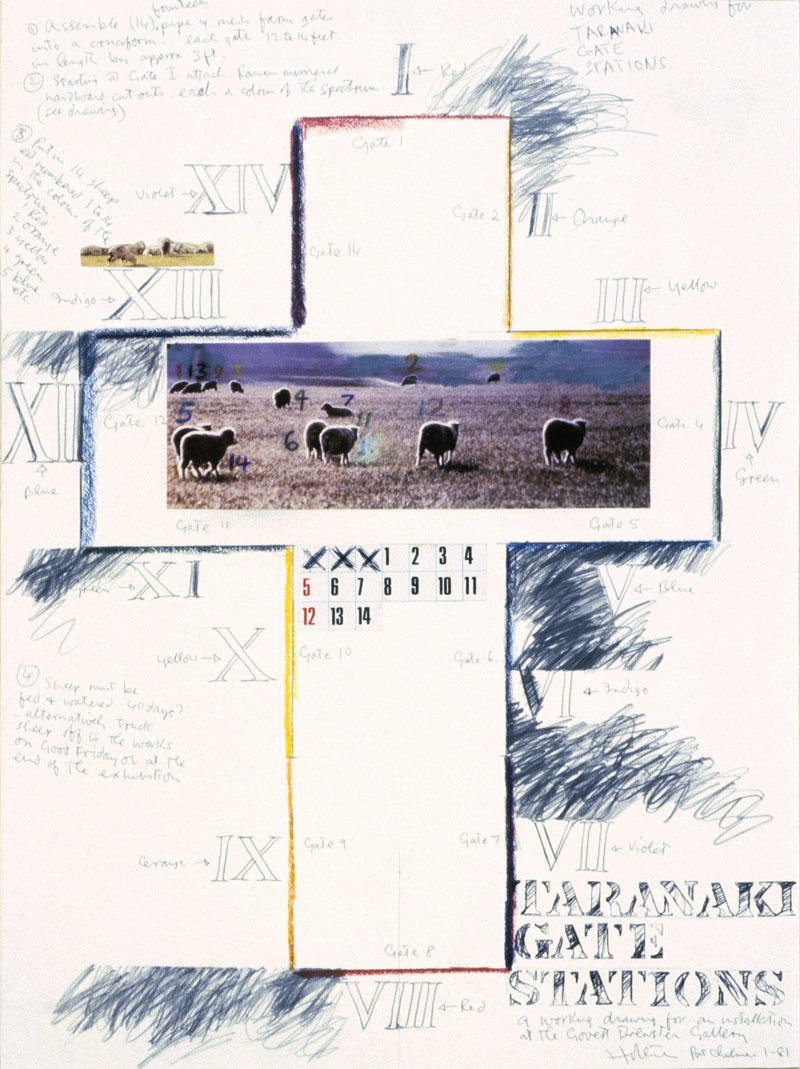
For his work Taranaki Gate Stations, Hotere asked the Gallery to construct a crucifix-shaped pen using fourteen standard pipe-and-mesh farm-fence units, to place fourteen sheep in it, and to feed and water them for forty days. ‘Alternatively truck sheep off to the works on Good Friday or at the end of the exhibition’, he suggested. The gates were to be marked with Roman numerals (I–XIV) and the sheep painted with Arabic ones (1–14), both in a spectrum of fourteen colours.

The gallery didn’t realise the proposal, but included Hotere’s two collage drawings outlining it in the show and acquired them for its collection. In its audacity, Hotere’s idea stood in stark contrast to the other works in the show, which were more conventional paintings and sculptures, more standard depictions of the subject.

Hotere’s proposal still seems surprising and cheeky, and out of step with his place in the art-history books, the art market, and the popular imagination. It belongs less to the New Zealand painting mainstream, with which he is identified, more to post-object art. It’s the kind of work that might have been made by a Jim Allen or a Bruce Barber, for Auckland City Art Gallery’s Project Programme, a Mildura Sculpture Triennial, or an ANZART. It looks forward ten years to Hotere’s collaborative installations with Bill Culbert (begun in 1991) and his No. 8 installations (1992), made with New Zealand’s favourite fencing wire—neither of which seem anywhere near as edgy.

How should we read the work?

Hotere was Catholic, but the idea seems less religious and redemptive, more realistic and pessimistic.

Is it a nod to Parihaka in Taranaki, whose passive resisters erected their fences as fast as the colonial government pulled them down? In 1881, one hundred years earlier, the village was invaded, and many of its people were rounded up and imprisoned.

Is it a riff on the work of Hotere’s friend Colin McCahon, who engaged with the Stations of the Cross theme extensively in the 1960s and 1970s? (Hotere owned McCahon’s 1974 Stations canvas Walk with Me 1.) Does Hotere take McCahon’s ‘gate’ metaphor literally?

Perhaps Taranaki Gate Stations was an expression of Hotere’s own desire not to be fenced in, typecast artistically.

Interestingly, in a subsequent third collage drawing for a ‘second version’ of the idea, Hotere stirs in topical references to the Springbok Tour. The Stations show ran from 11 March to 20 April 1981; the Springbok Tour occurred in July, August, and September. As it is dated simply 1981, we can’t know if this third collage drawing was produced in anticipation of the Tour or in full knowledge of the divisive protests it prompted. It makes no reference to the protests as such.

This third drawing incorporates a photo, attributed to the Otago Daily Times, showing rugby players playing in a field alongside a similar number of sheep, with Hotere’s crucifix pen sketched in around them. An annotation proposes a ‘happening’, requiring the sheep to be decanted and the pen used for a seven-a-side game between the All Blacks and Springboks—a cage fight: ‘ALL BLACKS V SPRINGBOKS 14 players (a seven a side happening) players enclosed in 14 steel meshed gates—OR BARBED WIRE no spectators—a safety precaution (sheep, if well behaved, might be allowed to view the game)’.

Nothing quite computes. Is Hotere making an analogy between the gentle folk at Parikaha (building their righteous fences) and black South Africans forcibly cooped up in their bantustans (behind bad ones)? If so, why would he have All Blacks and Springboks compete together within this pen?

Perhaps Hotere wilfully mixes his metaphor, offering a puzzle without a solution, just to make us think. Even the reference to ‘Taranaki gates’ is wobbly. The term refers to cheap, crude, DIY-style wire-and-post gates, not the more expensive mesh-and pipe fence/gate units stipulated in the first two collage drawings. However, the third drawing says a wire-and-post version could be an alternative, and even includes a marginal illustration of a unit—with barbed wire.

Did Hotere intend for the work to be made or was the proposal just a provocation, a joke? It certainly reads like a conceptual-art ‘instruction’ piece that the gallery could realise on the artist’s behalf. The specifications are practical and precise, with materials and measurements. But, even if the instructions are clear, they are incomplete. They don’t say if the work is to be installed inside the Gallery (it wouldn’t fit) or outside (possible, but where?).

With the kind permission of the Hotere Foundation Trust, we’re finally realising Taranaki Gate Stations—or our idea of it—forty-three years later, after apartheid ended in 1994 and after the Parihaka apology of 2017. We’re presenting it out of curiosity, to add a historical dimension to the show and to surprise audiences. While we have followed Hotere’s instructions to the letter, we are aware that we are realising his work in a different place and time, and in different company. It can only ever be after Hotere, our imagining what he imagined.

Copyright © 2026 · Genesis Framework · WordPress · Log in