Robert Leonard

Contemporary Art Writer And Curator

Gavin Hipkins: Wives Are Scarce

www.circuit.org.nz/blog/gavin-hipkins-wives-are-scarce.


Robert Leonard talks to Gavin Hipkins about his latest film, 
New World (2016). It was made for Circuit’s screening programme This Is Not Film-Making, which premiered at City Gallery Wellington on 9 September 2016. The interview is based on a discussion held at the Circuit symposium, Phantom Typologies, at City Gallery the following day.
.
Robert Leonard: You made New World to a brief: to make a short film in response to Julian Dashper’s writings.1
.
Gavin Hipkins: This is the second time Circuit has commissioned a group of filmmakers to respond to an artist’s writings. Last year, it was to Joanna Margaret Paul’s poems, now it’s to Julian’s writings. When I heard about the project, I wanted to be part of it. I thought I’d be a good match. I met the curator George Clark in Auckland in November last year. We visited my Starkwhite exhibition of Block Paintings, which recall Julian’s generic-abstract works.

The commissioned artists had four months to come up with something. I worked through a couple of ideas early on, but rejected them. I thought of filming Julian’s studio in Waterview, Auckland, as a stalker movie, like the surveillance scenes in David Lynch’s Lost Highway (1997) or Michael Haneke’s Hidden (2005). I also thought about referring to Julian’s 1994 work Future Call, where a phone is ringing but no one is answering. But this idea—or any reference to a fax machine—seemed obvious. I assumed one of the other commissioned artists would refer to Future Call—and Daniel Malone did.

Julian’s writings include lots of lists. He was focused on the fragment. Some of his writing is about his travels in America. He loved American modernism, cowboy boots, and country music. He wrote on his visits to New York and Chicago, but also to Texas—to Marfa (where he had a residency) and Houston (visiting the Rothko Chapel). So I thought I’d make a work about Texas—a place I’ve never been—and to structure it as a sequence of fragments.
.
For Dashper, the USA was the centre and New Zealand the periphery, but he could also identify them.
.

Julian used to have a mantra—‘here is here and there is there’—referring to the distance between New York and Auckland, but he also alluded to a shared can-do attitude that evolved out of the pioneering spirit. This attitude turned its back on the Old World and its stuffy class values, promising a more egalitarian nation state.
.
The USA and New Zealand are colonial settler cultures—new worlds. Both relate to what you’ve called a ‘frontier thesis’.
.

I’ve long been interested in the ways that nations mythologise their identities and shape their histories. I explored this in Folklore: The New Zealanders, the exhibition I curated at Artspace, Auckland, in 1998. Later, while studying in Vancouver, I travelled through the Pacific Northwest taking wilderness-themed photos for The Next Cabin (2000–2). That project was informed by a new frontier thesis—the Republic of Cascadia independence movement.
.
Do we need to read New World in relation to Dashper?
 What difference does the commission context provide?
.
New World
 is a product of a specific commission, but it is also in conversation with my other works and recurring motifs. The references to Julian are oblique. In the context of George’s curated programme, the film will be read in relation to Julian, but this reading doesn’t need to be exclusive.
.
New World 
is a deconstructed western, a collage western, a meta-western. What drew you to the genre? What westerns did you look at to prepare? Why make a western—this western—now?
.
I saw Jim Jarmusch’s masterpiece Dead Man (1995) at the cinema when it came out and felt a profound sense of dread, of loss and mourning. It took me years to return to it and to fully appreciate its more absurdist moments. At this year’s Film Festival, I saw the restored version of Marlon Brando’s One-Eyed Jacks (1961). I sat near the front to soak up its filmic lushness. I lent back and listened closely to the soundtrack. While developing New World, I made lists of westerns, like Julian’s inventories. While working on it, I listened to America’s song ‘A Horse with No Name’ (1971) over and over. It starts with a banal description of the landscape—‘plants and birds and rocks and things’—then takes the listener on a metaphysical journey to a dead river bed. Now is an important time to look at American mythology, which is so amplified by the media in this year’s presidential campaigns. The most powerful nation on Earth … the global consequences … and all that.
.
Your film’s narrative backbone is provided by lines of text on coloured backgrounds—intertitles. I assume they are quotes. Where do they come from?
.
They’re taken from a report by Edward Smith encouraging immigration to North-East Texas. It was published in London in 1849.2 I love the descriptive nature of the writing. It’s poetic without trying to be. It offers practical advice (what tools to take, the best time of year to travel, etc.) and speculates on what will become of this place, its politics and peoples. I took excerpts but retained the original sequence. There’s mention of animals, women, and slaves—in that order. The report has a prophetic quality. In hindsight, we know the civil war and the abolition of slavery are on the horizon.
.
Your film has a deconstructed, bare-bones structure. It consists of repeated contrasting elements that remain more or less distinct. There are intertitles. There are simple flag-like abstractions, recalling Josef Albers, Don Judd, and Dashper. There are treated graphic and photographic images, some of which have a rather oblique relation to the western theme. (These include images that have 
been rendered as embroidered patches, then scanned and digitally treated.) Plus, there are soundtrack elements. Your film scrambles different time frames—texts from the distant past and photos from the recent past resonate with one another.
.

The text is from 1849. The plates are from a book, American Pictures Drawn with Pen and Pencil, from 1876. The photos are solarised snippets from issues of National Geographic and Penthouse from the early 1980s (print culture). And there’s aerial footage of Texas from Google Earth from now (Internet culture).

The magazine images—which include shots of cowboy boots and a whisky advertisement—speak to the mythologised landscape and pioneering times, evoking a nostalgia for breaking in the land and its peoples. National Geographic articles take a focused look at communities and their ways of life in a wholesome journalistic manner. The farmer represented at the start of the film stands in for all farmers. The Penthouse model with her eyes closed can represent the love interest—a staple subplot of the western genre.

I’m interested in the transfer of meaning across time, in how the past shapes today’s ideologies: theories of race, the desires of the leisure class, the juggernaut of consumer society. And all this set against a mythologised and gendered landscape backdrop that’s there to be tamed.
.
Many of the photographic images have been digitally manipulated to recall treatments from the time of wet photography: overexposure, fogging, solarisation.
.

The film scrambles elements of pre-digital and digital photography. It nods to the rephotography of Richard Prince, which originated in the late 1970s, in the threshold moment before print culture died out, before digital imaging and the Internet. (Of course, Prince also addressed the western, via print, via the Marlboro Man.) My own conversation with this moment involves going back to mash up some modernist, avantgarde photography with the legacies of a post-war print culture.
.
In the film, the photos are presented as static images, except for several aerial views, where you track across the image as if tracking across an actual landscape. These God’s-eye views separate the film into chapters or movements.
.

Today, Google Earth is a powerful tool for accessing places we have never been. It was a way for me to look around Texas without going there. The aerial footage follows Smith’s 1849 journey, from Red River into the Texas heartland. Google Earth offers a sense of movement in real time, so that it’s easy to forget you’re looking at a still photograph. In the film, the aerial passages function as structural markers that pop us back into the historical present—this era of surveillance. The aerial visual mapping complements the nineteenth-century textual mapping in the intertitles.
.
Religious images and references keep cropping up in your work. What is the role of the religious in your work generally and in New World specifically?
.

There’s certainly an undercurrent of Christianity in my work. My mother is Catholic and my father an atheist, so I grew up in this place of ongoing ideological conflict—not always dramatic conflict though, frequently comical. Dealing with that tension has been important for my work. When I was 22, I spent six formative months travelling in South-East Asia and India, and I’ve returned to India twice for extended periods since then. After I completed my BFA at Elam, I spent a year studying India’s religions and literary traditions, so, in my work, there’s a touch of hippiedom and its flirtation with Eastern philosophies. In New World, religion in an age of colonial expansion is portrayed as brutal and hypocritical. There’s a passage that sums it up: ‘Wives are scarce. Girls are being married before they reach their fifteenth year. The Sabbath is much respected.’
.
Like the Victorian-period male accounts you use in other films, this text seems to stand in for your own enquiry as an artist. What’s at stake in this?
.
The texts I use (some factual, some fictional) are often travelogues and often involve encountering the Other. In my film Erewhon (2014), Samuel Butler’s protagonist discovers a generic people, a hybrid form of the Other, and describes them as things—exquisite objects. To stand in for them, I used images of exotic flowers.

You ask: what’s at stake? I think what’s at risk is perpetuating Victorian theories of race and class today. I connect with that colonial history through my own English, Irish, and Scottish ancestry. In 1884, the Hipkins side emigrated to New Zealand from Birmingham. The movements of my extended family from Great Britain is fairly easy to trace. Since making New World, I’ve discovered that the Hipkins family who emigrated to Virginia were slaveholders.

The nineteenth century feels very close to us today. As Walter Benjamin proved, it’s the foundation of our modernity.
.
Sometimes you seem to identify with power, even to romanticise authority.
.

My use of both pictorialist and arch-modernist aesthetics continues to run the risk of being romantic and fetishistic. Yet, for me, calling on these styles encourages a deeper understanding of languages of style and power, and my work inverts their legacies through both miniaturising and monumentalising. For example, with The Trench (1998), Le Corbusier’s colossal, posthumously realised Open Hand sculpture is turned ephemeral through this small, clunky slide projection; whereas, with the recent Block Paintings (2015), children’s humble wooden toy blocks are stacked, photographed, and enlarged to become imposing militant designs or hard-edged abstract paintings.
.
Years ago, I described you as a cryptofascist.
.
They were wrong to kick Lars von Trier out of Cannes in 2011. When he said he was a Nazi, he meant we’re all Nazis. He was acknowledging the fascist and racist in himself as a starting point for self criticism, not celebrating it.
.
Early on, you made artist-type videos for galleries, but, around 2010, you started to make proper films, films that could be shown in cinemas. You transitioned into this new mode of production and distribution. You shot a few films in a conventional way, using actors (The Master 2010, This Fine Island 2012, and The Dam (O) 2013), but your more recent films seem to have rejected this approach, being more based in the language and aesthetic of your still photography. New World is epic, but I imagine it was made on a tiny budget. How do the economics of filmmaking relate to its visual economy?
.
When I started making films in 2010, I was disillusioned with the limits of art-world pathways—curator and dealer hierarchies. I was interested in other means of distribution. Respected festivals make open calls for filmmakers to submit their work. Of course, there are still hierarchies, but the increased potential of reaching audiences excited me, especially internationally.

My first three films relied on more-or-less conventional scripting, shooting, and editing. In the process, I learnt a lot from professionals and I was grateful for their input. But, I soon recognised that my work could become generic. The idiosyncrasies generated when small and large decisions are made by me as an individual artist get flattened out in a broader, collaborative environment. So, I took more control at all stages, including shooting and editing. It feels like a good balance at the moment. I still work with a small team, including Ben Sinclair, who did beautiful job on the sound for New World.

As you note, the move to smaller productions is also determined by resourcing. I am looking for a more sustainable and fluid model of production, so I can keep getting my ideas out there. My film work and my photographic work are now more closely aligned. There’s an evolving space between moving and still, shifting and static.
.
[IMAGE: Gavin Hipkins New World 2016]


  1. Dashper’s writings were posthumously collected in This Is not Writing (Auckland: Clouds and Michael Lett, 2010).
  2. Account of a journey through north-eastern Texas, undertaken in 1849, for the purposes of emigration. Embodied in a report: to which are appended letters and verbal communications, from eminent individuals; lists of temperature; of prices of land, produce, and articles of merchandize … and the recently adopted constitution of Texas, with maps from the last authentic survey.
Mikala Dwyer: Psychoplastic

Soft Core, ex. cat. (Sydney: Casula Powerhouse, 2017).


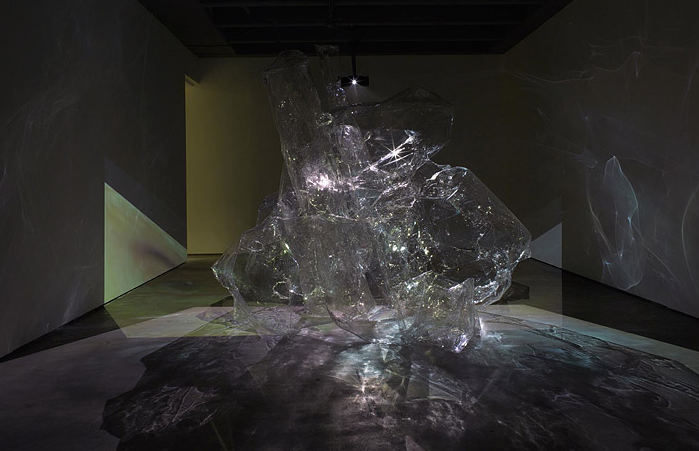
The Empty Sculptures are barely there but they are in our way. In 2002, Mikala Dwyer began making these glistening globules, these see-through bubble-baubles, and she shows no sign of stopping. They’ve become a staple in her practice, part of her repertoire—a standard.

Dwyer makes them from sheets of a clear plastic used in vacuum forming. In that process, the plastic is heated and sucked down over a mould. It cools and goes rigid, holding its new shape. Forms can be made swiftly, repeatedly. However, Dwyer’s process is rather more primitive and protracted—she foregoes the mould. She softens the plastic using a heat gun and bends it by hand. She can heat areas of the sheet selectively, so some parts are pliable while others hold firm. She fuses the molten plastic to itself, conjuring three dimensions from two, typically (but not always) sealing up volumes of air. The material is unwieldy, wobbly, and has to be wrestled with—you can only make what it will let you make. Results are unrepeatable. Dwyer says: ‘I hate working with it. It’s disgusting. But I constantly find new possibilities for it.’

Space hungry but insubstantial, the Empty Sculptures can be a pain to store and ship but can be made in situ—and floor loadings are never an issue. Like Fred Sandback’s string lines, they offer a nifty, practical solution for taming gaping exhibition spaces on a tight budget, countering horror vacui. They are space sponges.

Dwyer has made Empty Sculptures in different shapes and sizes, offering them as individuals and in clusters, and in diverse scenarios. One floated on a swamp in an upstate New York sculpture park. A cumulus chandelier of them is suspended over the bar in that swanky Melbourne eatery, Vue de Monde, fifty-five storeys up, where the air is thin.

The Empty Sculptures take on different characters in different circumstances. As we see them—and see through them—they disappear into the whiteness of white-cube galleries, into the busyness of abandoned industrial spaces, and into the lush greenery of nature. Sometimes Dwyer presents them on their own; sometimes she has them conversing and fucking with other materials, forms, and tropes. She’s even used them as planters for a hanging garden.

Dwyer is committed to being non-committal, neither this nor that. She is forever poised over binaries, escaping them, defined by them. The Empty Sculptures have an in-between quality: bulky/weightless, abject/hygienic, primitive/plastic. They may be crudely made but they can look translucent and sublime—like some CGI-type special effect. Despite being fixed and stationary, they sometimes seem to be in motion, morphing, becoming, hatching—liquid. They suggest boulders but are quite the opposite: being hollow (all skin), synthetic, transparent, and as light as a feather. (They strike me as odd inclusions in a show called Soft Core. They are surely more Rigid Crust or Hard Cell.)

The Empty Sculptures are inchoate, suggestive. They recall art forms, from primitive standing stones to refined biomorphic modernist sculptures (some are punctured with holes, flaunting their Hepworth-Moore pedigree). They also recall products of nature: boulders, ice, bubbles, cells. And we can project our thoughts onto them, as we see faces in clouds or in fire. They could be scrying tools—mystic portals.

Indeed, Dwyer described her installation, A Shape of Thought (2007/12), as ‘hauntological’—Jacques Derrida’s contradiction-in-terms conflating being (ontology) and non-being (haunting). In a darkened room, Dwyer emphasised her Empty Sculptures’s spooky potential by projecting videos of eyes—hers and her father’s—onto them. These projections partly passed through the blobs (and through one another) onto the floor, and partly reflected off them, leaving luminous trails on the walls. It’s as though the puffed-up sculptures were ectoplasm, manifesting at the junction of opposed psyches—symptoms of a relationship, indexes of daddy-daughter stuff. Were we to attend to their forms and effects, as we might divine deep truths from patterns of tea leaves? And, if we did, would we really discover the shapes of the Dwyers’s thoughts, or just those of our own?

Interpretation abhors a vacuum.

[IMAGE: Mikala Dwyer A Shape of Thought 2007/12]

Corita Kent: Sister Act

Sister Corita’s Summer of Love, ex. cat. (Wellington and New Plymouth: City Gallery Wellington and Govett-Brewster Art Gallery, 2016).


.
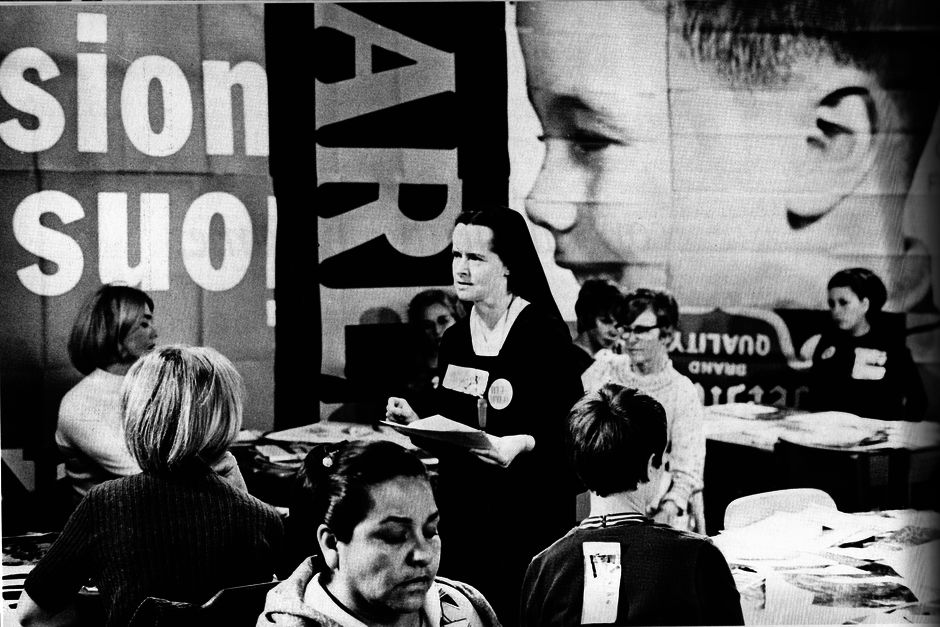
In the 1960s, nuns were out and about, playing guitars and singing songs, riding motorbikes and attending to the flock. The Encyclopedia of Bad Taste devotes a two-page entry to the ‘perky nun’.1 It opens with a Belgian Dominican, Sister Luc-Gabrielle, who became world famous with her 1963 hit song ‘Dominique’, spawning numerous imitators (including the Singing Nuns of Jesus and Mary). Debbie Reynolds played a role based on her in the 1966 movie, The Singing Nun. The Encyclopedia’s authors go on to explore the ubiquity of playful, modern nuns in other 1960s American movies, citing Lilies of the Field (1963), The Trouble with Angels (1966), and Change of Habit (1969), in which Mary Tyler Moore plays sexy Sister Michelle, whose vows are tested by a dashing Dr. Elvis. Of course, wholesome Sally Field, fresh from Gidget, would become the ultimate perky nun, as Sister Bertrille in the television series, The Flying Nun (1967–70).

Underpinning the perky-nun phenomena was something less laughable—massive reform in the Roman Catholic Church. In the late 1950s, the new Pope, John XXIII, saw that his Church was out of touch with its communities. It was time for the Church to open its windows and let in some fresh air, as he put it. From 1962 to 1965, the Roman Catholic Church convened the Second Vatican Council (a.k.a. Vatican II), seeking to become more relevant, to renew and renovate itself. As a result, mass came to be performed in the vernacular, rather than in Latin, with priests facing the congregation. Elaborate regalia was downplayed, Catholics were permitted to pray with non-Catholic Christians, and friendship with non-Christian believers was encouraged. Plus, priests and nuns were prompted to venture out, to engage with their communities.

Surprisingly, the Encyclopedia fails to mention the most famous nun artist, Sister Corita Kent. It could have—she was certainly a celebrity. Based in a progressive, liberal order, the Immaculate Heart of Mary, in Los Angeles, Kent was a poster girl for Vatican II. During the 1960s, she became renowned for her dynamic, brightly-coloured, text-based screenprints, whose forms, colours, and words expressed themes of hope and kindness, peace and love, and social justice. She also wrote and designed books, art-directed festivities, and produced a mural for the Vatican pavilion at the 1964 New York World’s Fair. (The Fair’s theme was ‘Peace through Understanding’, and the Vatican pavilion’s theme was ‘The Church Is Christ Living in the World’.2) In 1966, the LA Times chose Kent as one of their ‘Women of the Year’, and, in 1967, Harper’s Bazaar included her in their ‘100 American Women of Accomplishment’. She also appeared on the cover of the 25 December 1967 issue of Newsweek under the banner ‘The Nun: Going Modern’.3 Several films were made about her.

For her works, Kent drew inspiring words from scripture, from writers and thinkers, from poems and pop-song lyrics, and especially from road signs, commercial packaging, and advertising. She piggybacked on the visual immediacy and urgency of commercial messages, often ventriloquising her right-on thinking through appropriated advertising copy—those madman inventions designed to worm their way into our heads ‘like liquid gets into this chalk’.4 For Kent, Pepsi’s tag line ‘Come Alive!’ suggested the Resurrection and a prompt to get a life. Wonder Bread stood in for the Host. The line, ‘A Man You Can Lean On’, came from a Klopman fabrics ad, and ‘See the Man Who Can Save You the Most’ from Chevrolet. Kent also used road signs as metaphors for spiritual guidance—‘Turn’ and ‘One Way’, of course. Exemplifying Vatican II’s imperative to speak in the common language of the people, Kent’s work presented a world of profound religious significance lurking beneath the fleeting secular surfaces of the everyday.

In the past, there have been many attempts to update Christianity, to make it relevant, to express its sentiments in a more familiar, contemporary idiom, to make what was historical seem timeless. In the renaissance, painters rendered Christian stories as if they were happening in the here and now. In the 1920s, English painter Stanley Spencer imagined the Resurrection occurring in his local village of Cookham, and, in the 1940s, Colin McCahon relocated the Christian story to New Zealand’s back blocks, adding speech bubbles from a Rinso packet. In the 1960s, Kent found God in the supermarket and on the interchange.

With her feel-good thoughts, Kent embodied her times, furnishing bumper-sticker homilies for the Age of Aquarius. Her work promoted the civil-rights movement, protested American involvement in the wars in South-East Asia, and lamented the assassination of prominent American political figures, including Martin Luther King and, those Catholic martyrs, the Kennedys. Her project was timely. It coevolved with American pop art and the counterculture, and anticipated the Jesus Movement—a brand of evangelical hippie Christianity whose preachers wore blue jeans and spoke street.

Kent’s prints operated in a space between the hygienic authority of hard-edged corporate branding and the funky organicism of late 1960s, West Coast, art-nouveau-inspired counterculture posters. Although her graphic treatments recalled advertisements, their hand-drawn, distorted, distressed, fractured letter forms looked less Swiss-corporate, more ‘personal’. Kent played up their less-than-perfect, handmade quality, flaunting drips and smears, inconsistencies and registration slips. Her faux-informal, ‘higglety-pigglety’5 typography was often based on her photos of bent and crumpled signs and on her found-text collages. Her prints also featured her spiky handwriting, with its quirky capitalisation, suggesting intimate communication (letters and commonplace books).

Kent didn’t operate in an art vacuum. She was a magpie and networker. While her work often feigned a direct, naive, childlike quality, it was steeped in art and graphic-arts history—she had an MA in art history. In her work, we can see the influence of Matisse’s cutouts, abstract expressionism, Saul Bass’s graphics, Charles and Ray Eames’s folksy modernism, and Andy Warhol—she caught and was inspired by his breakthrough Campbell’s Soup can show at LA’s Ferus Gallery in 1962. Her art classes at Immaculate Heart College became a mecca for the avantgarde, with eminent visitors like film director Alfred Hitchcock, composer John Cage, and geodesic-dome prophet Buckminster Fuller.

Kent’s art may have been easy on the eye and gentle on my mind, but it was smart graphically. Take her multi-panel work, Circus Alphabet (1968). With a panel for each letter of the alphabet, each panel does something different, riffing on a basic idea, building novelty. Kent contrasts and scrambles graphic and typographic techniques past and present, mixing found imagery (derived from antique sources) and text (in different typefaces alluding to different printing technologies), translating them all into the pop-graphic economy of colour-separated screenprinting. Circus Alphabet was both timely and retro. Its appropriation of vintage circus imagery was keyed to then-current counterculture nostalgia. It was made the year after the Beatles released Sgt. Pepper’s Lonely Hearts Club Band—which famously included the song ‘Being for the Benefit of Mr. Kite’, which was based on a Victorian-period circus poster—and its eye-popping, fluoro colour scheme was similarly psychedelic.

Some consider Kent an unsung heroine of pop art. Currently, there’s a campaign to squeeze her into the pop-art pantheon. This has been the agenda of several recent shows, notably 2015’s Corita Kent and the Language of Pop.6 However, for all this, Kent represents something of a dilemma. At first glance, her work looks like pop art—and the documentation of the Mary’s Day festivities she art directed may remind us of happenings (hippie be-ins, more like)—but, in her time, she was remote from the pop-art discussion, being understood and distributed more as a graphic designer. At the time, she was not included in books on pop art, although she certainly is now. Corita Kent pop artist belongs to a new idea of pop. She is a product of revisionism.

Actually, at the time, Kent’s work ran against the grain of pop. It was an anomaly. Pop art started out as aggressively secular, a response to abstract expressionism’s quasi-religious and humanist pretensions. Pop artists embraced commercial imagery to escape abstract expressionism’s gravity and mystique—it was lite, but with a purpose. In the 1950s, Robert Rauschenberg and Jasper Johns had satirised and evacuated the expressionist brushstroke, putting it in inverted commas, mocking its claims to immediacy. But, it has been argued that pop art only really began when Warhol finally ‘dropped the drip’ around 1962.7 Yet, even after he did—and while clearly under his influence—Kent kept leaning back, the other way. Her hand-cut and hand-painted letters asserted a personal, informal, warm-fuzzy humanism—an expressive ‘brushstroke’ logic.

Even after Roy Lichtenstein gutted the brushstroke in his Brushstrokes works of 1965–6, Kent continued to reiterate brushstroke logic as shorthand for unmediated creativity, spontaneity, and freedom, personal expression and love. In the 1970s, after leaving the order, the brushstrokes became explicit. In 1971, she created Rainbow Swash, a public work on a giant gas tank in Boston. Seemingly blind to her support’s toxic, industrial function, she decorated it with a rainbow of colour brushstrokes. No irony.8

Irony was irrelevant to Kent, but crucial for pop. The 1960s was a time of both excitement and paranoia about advertising and consumerism. This ambivalence found its ultimate expression in James Rosenquist’s massive wrap-around painting F-111 (1964–5), in which ad images were set into an image of the F-111, the US’s new tactical fighter and bomber plane destined for Vietnam, partly camouflaging it.9 Textbook irony. The 1960s were complicated. While anxiety about consumerism underpinned the counterculture (drop out), it was itself a product of middle-class affluence (only some could afford to drop out)—and Madison Avenue moved quickly to understand and exploit the hippies as a market. But Kent was not so interested in complexity. She suppressed the contradiction between secular advertising and her religious message, even though this was and remains the source of her work’s frisson for audiences.

Kent was agreeable. She is seen as an activist, but her politics were limited: war is bad, love one another, be nice, ‘today is the first day of the rest of your life’. Beyond rubber-stamping causes, her work offered little analysis or argument. While making Catholicism palatable, she steered away from thorny matters, like birth control and abortion, gay rights, or what to do about capitalism.10 Perhaps her work anticipated slacktivism, our current habit of branding ourselves with righteous issues rather than actually doing anything about them: buy the button badge or poster, like it on Facebook.

The tendency to frame Kent as a political activist leans on the hostility she endured from LA’s super-conservative Archbishop, Cardinal James Francis McIntyre. A Vatican II resister and stick-in-the-mud, he wouldn’t get with Catholicism’s new-and-improved programme. He was no fan of the Immaculate Heart of Mary in general or of Kent in particular. Indeed, he castigated the good sister for daring to compare the Virgin to a ripe tomato in her famous print, The Juiciest Tomato of All (1964), and resented her visibility and popularity. Cardinal McIntyre suppressed the Immaculate Heart order. In 1967, after they began promoting liberalism and abandoned the habit and compulsory daily prayer, he barred them from teaching. He is blamed for Kent’s leaving the order in 1968. Because of him, she occupies an ambiguous position. We’re able to cast her as epitomising a sea change in the Catholic Church and as a radical within it—whichever we prefer.

Kent’s works may be upbeat and friendly, but they’re also righteous—full of moral imperatives. Her bright colours and simple forms speak to the child in us, instructing us in charity and hope, peace and love, keeping us on the straight and narrow. Not everyone took kindly to her Sunday-school rainbows. For some of the artists who followed, her work was pure—pure cheese. One LA artist certainly thought so. Mike Kelley had been raised a Catholic in a working-class Detroit family, and Kent’s images were among the first things he had seen and thought of as art. In 1987, the year after Kent died, he made a series of handmade felt banners that included various Kent pastiches: Trash Picker (a vibrant, happy-clappy patchwork, bearing the pathetic legend, ‘I Am Useless to the Culture but God Loves Me’), The Escaped Bird (a childish, abject School-of-Paris bird accompanied by the word ‘Joy’), and Let’s Talk (a cookies jar, with the injunction ‘Let’s Talk About Disobeying’). Ever the contrarian, Kelley cast Kent’s messages as saccharine, asinine, and a tad sinister.11

Kelley and Kent were oil and water. Kent doesn’t relate to the suspicious, conflicted, cynical, agonistic (aka ‘critical’) attitude we typically associate with contemporary art. And she doesn’t easily fit into pop, so much as sit alongside it. Now, forcibly inserting her into the pop-art canon makes pop art itself seem different. Her work offers an oblique vantage point for considering pop art and its legacy. For instance, it draws attention to religious subtexts in the work of canonical, supposedly secular pop artists—her contemporaries. Take Warhol, a Ruthenian Catholic, a committed church goer. Kent reminds us of the icon-like quality of his Marilyns; of his religious preoccupation with sanctity, death, and disaster; and of his late The Last Supper works (1986–7). In The Last Suppers, Warhol collages a Dove soap logo (suggesting the Holy Spirit) and a body-building ad slogan, ‘Be a SOMEBODY with a BODY’ (suggesting the Incarnation), into Leonardo’s masterpiece—a classic Kent move. Similarly, with lapsed-Catholic Ed Ruscha, also from the City of Angels, Kent’s proximity alerts us to his preference for visions of miraculous light and for painting loaded religious words (including ‘Gospel’, ‘Faith’, ‘Mercy’, ‘Purity’, ‘Sin’, and ‘The End’). Etcetera.

In the beginning, pop art and abstract expressionism were polar opposites. However, as we increasingly engage with pop art independently of its formative issues with abstract expressionism, this oppositional characterisation loses its grip. These days, we increasingly enjoy pop art’s belied quasi-religious edge, as artists conjure with the auratic power of mass-media images and the magical animism of commodity fetishism. Suddenly, pop and religion don’t seem necessarily antithetical. Kent’s pre-critical, affirmative approach also resonates with Jeff Koons’s neo-pop, post-critical, people-pleasing work. Koons compared his topiary Puppy (1992) to ‘the Sacred Heart of Jesus’.12

In New Zealand, we see such magical thinking at loose in the work of artists negotiating pop’s legacy. For instance, Michael Parekowhai’s early word sculpture, ‘Everyone Will Live Quietly’ Micah 4:4 (1990), discovers the sacred in the profane. The then-young Maori artist spells out the name of the Old Testament prophet Micah four times in block letters, like a trademark, and titles it with an optimistic quote from Micah’s brief book. (Chapter 4, verse 4—get it?) The letters are laminated with a common Formica that resembles sacred pounamu. Like many of Parekowhai’s early works, this piece suggests the way post-contact Maori read their own thinking into the products of a dominant culture, particularly the Bible, making them their own. The parallel with Kent is clear, but reversed. She imposes enduring Christian import on the secular world, whereas Maori projected their urgent needs onto the Bible.

In the mid-1990s, Jim Speers similarly celebrated poetic-religious-transcendent possibilities persisting in corporate liveries and advertising lightboxes. His lightbox installation, Honeywell (1998), resembles a disassembled computer-company shop sign. Speers turns a found company trademark—to which we would normally not give a second glance—into a utopian haiku. Split into three units, regularly spaced across the floor, Honeywell combines 1960s secular pop (appropriated trademarks) and 1960s secular minimalism (equally spaced, industrially fabricated boxes) to create a quasi-religious beacon—a lighthouse.

But, the antipodean artist who best exemplifies the conflation of religion and pop is an Australian. Scott Redford was born on the Gold Coast, a famously trashy, culture-free zone—a shameless mash-up of LA, Vegas, and Miami aesthetics and lifestyles. Since the turn of the millennium, Redford has embraced the Coast’s slick aesthetic, imagining the residents of Surfers Paradise to be already living in the promised land, albeit oblivious of the fact. He’s made surfboard crosses and has emblazoned surfboards with impossibly futuristic, portentous dates; he’s made paintings using surfboard-making materials and techniques, where commercial logos become mystic talismans; and he’s made photographs of surfers carrying a surfboard cross and pointing to heaven in the manner of Leonardo da Vinci’s John the Baptist (1513–6). For Redford, the local surfers have replaced Galilee fishermen. Maybe it’s a joke, maybe not. For a moment, Redford asks us to consider his birthplace as a singularity—the marriage, conflation, or collapse of spirituality and capitalism, post-modernism and eschatology. Redemption.

God is everywhere: Kent finds him in the supermarket, Redford at the beach. And he is inescapable. It seems, the closer you get to the secular, the more you eliminate religion, the more religion raises its head.

Kent’s legacy also operates outside of art, in those contemporary forms of American Christian propaganda that have learnt from advertising and pop culture in order to compete with it, to turn us on to God instead of godless materialism. This is particularly visible in the use of computer-generated animated type in Christian evangelical videos, to make religious messages dramatic and infectious; to criticise us, to motivate us. These videos promote all manner of messages across the denominational and political spectrums. The church has become a ‘video ministry’—a videodrome.

Some of the videos are sophisticated, some mawkish. One King Productions’ hectoring Fan or Follower (c. 2011) is based on a stirring sermon from Pastor Darrell Schaeffer of Ohio’s One Way Church.13 It has the urgency and cadence of a disaster-movie trailer. As we hear the pastor and Co. inciting us to be not simply Christ’s fan but his follower, we also read the words—seeing reinforces hearing. Presented in a straight-up serif typeface, white on black, the words quiver, as though we are watching them in a state of rapture. As the diatribe builds to a crescendo, the tremulous words expand and explode in light as if in some cosmic cataclysm, leaving just one word on screen, the self-evident conclusion—‘Follower’.

Equally orgasmic is Revolution (2014).14 Director James Grochowalski, a motion-graphics designer for Central Christian Church in Las Vegas, calls his music clip an ‘inspirational mini-movie’. Based on the book of Romans, it asks ‘how we can be the hands and feet of Jesus in this hurting world’, and argues that ‘we shouldn’t just stand by and wait for change, we should be the change’. It features computer-generated block letters combined with geometric and flaming graphics, edited to generic electronic dance music. It is catalogued at Sermoncentral.com: ‘Tags: Change, Evangelize, Changed Life, Revolution, Be the Church; Audience: Teens, Adults; Genre: Emotional, Powerful, Reflective; Style: Progressive.’ Grochowalski says his videos are mostly played either at the beginning of services, to kick off the worship, or to set the stage immediately before the pastor speaks. Stirring stuff.

Like Kent’s prints, video sermons seek to make Christianity contemporary, vital, and viral. They use the latest techniques of persuasion to tell us what we need to know—and why wouldn’t they? I must say, I am split. I am not a Christian, but I see no good reason for Christianity not to advertise itself like any and every other belief system or product, to plead its case in the free market of ideas. But, I don’t buy it. I also know that Christianity, like all the great religions, is a man-made thing. It originates long, long ago, in a place far, far away, when the issues were different—a time before the enlightenment, before science, before feminism, before Wonder Bread, before pop, before the pill, before we put someone on the Moon—and it speaks to the needs of those times, not to now. In the rush to update it, to make it contemporary, to make the mummies dance, that is lost—history collapses.

On the other hand, the Christian arts of Kent in her day and the video ministers of today are also a reminder that we can never escape history, that the church art of the Western tradition was always already advertising before advertising, and that, even in the most cynical work of the most sceptical pop and post-pop artists, religiosity lingers, like background microwave radiation from the Big Bang. Kent’s work reminds me of all this because it does and doesn’t fit into art history. Kent may not have made pop art at the time, but her legacy is remaking pop art now.


  1. (New York: Harper Collins, 1990), 243–4.
  2. The World’s Fair was not completely tolerant and inclusive. Andy Warhol’s mural on the exterior of the New York state pavilion, The Thirteen Most Wanted Men, was painted over.
  3. Susan Dackerman, ‘Corita Kent and the Language of Pop’, in Corita Kent and the Language of Pop (Cambridge, MA: Harvard Art Museums, 2015), 16.
  4. For non-antipodeans, I should explain. This was Mrs. Marsh’s inevitable refrain on Australian ads for Colgate toothpaste in the 1970s and 1980s. Colgate toothpaste gets into your teeth ‘like liquid gets into this chalk’.
  5. Karen Carson in Someday Is Now: The Art of Corita Kent, ed. Michael Duncan and Ian Berry (New York: Prestel, 2013), 126.
  6. Corita Kent and the Language of Pop (2015), Harvard Art Museums, Cambridge, MA, and San Antonio Museum of Art.
  7. There’s a great story. Early on, Warhol did two paintings of a Coke bottle, one in a flat commercial-art style, the other a more painterly treatment, a nod to abstract expressionism. He asked filmmaker Emile De Antonio which was best. De Antonio went for the first. He said, ‘I think that helped Andy make up his mind … that was almost the birth of Pop.’ Warhol dropped the drip, negating both the hand of the artist and the transcendental status of art, consigning ‘handpainted pop’ to the past. See Benjamin Buchloch, ‘Andy Warhol’s One-Dimensional Art: 1956–1966’, in Annette Michelson ed., October Files 2: Andy Warhol (Cambridge MA: MIT Press, 2001): 39, fn22.
  8. The brushstroke has become a graphic-design cliché, regularly reiterated in arts-organisation and arts-festival logos as shorthand for childish creativity, expression, freedom, and happiness, at a time when contemporary art has largely lost faith in these values.
  9. The F-111 was then new. It would not enter service until 1967.
  10. By contrast, in 1967, prompted by the Church’s failure to fully implement the spirit of Vatican II, Luc-Gabrielle, who had already left the convent, released, under her new stage name Luc Dominique, her song ‘Glory Be to God for the Golden Pill’, defending contraception.
  11. See Cary Levine, Pay for Your Pleasures: Mike Kelley, Paul McCarthy, Raymond Pettibon (Chicago: University of Chicago Press, 2013).
  12. See The Jeff Koons Handbook (London: Anthony d’Offay Gallery, 1992), 160; and Koons’s interview with Anthony Haden Guest, in Jeff Koons (Munich: Taschen, 1992), 33. See also Veit Loers, ‘Puppy, the Sacred Heart of Jesus’, Parkett, no. 50/51, 1997.
  13. www.youtube.com/watch?v=tiB6tCiVfu4.
  14. https://vimeo.com/101875301.

Laith McGregor: Ramblin’ Man

Laith McGregor: S-O-M-E-O-N-E (Melbourne: Perimeter Editions, 2016).


.
I came to Laith McGregor’s work in 2008, when we chose him for The New Fresh Cut, a new-artists show at the Institute of Modern Art, Brisbane. He was making elegant ballpoint-pen drawings of absurdly bearded men. Beards are a longstanding signifier of male authority and male vanity. In recent years, hipsters have embraced them, and McGregor’s exaggerations engage and caricature the fashion. His examples range from dandy to hippie to trucker—from ‘the unbridled masculinity of a full naval beard’ to ‘the narcissism of the goatee’.1 His beards are so lush that they engulf their owners. Sometimes they suggest huge hairy testicles onto which men’s heads and feet have been appended, almost as if an afterthought. In this, his images recall earlier caricatures of male fashion victims (whose impractical style made everyday life difficult) and of priapic men (whose engorged member-ship literally got in their way).

McGregor does many things with his big-beard idea. Beards are shared by Victorian gentlemen (Hex 2008), by a Victorian gentleman and a turbaned Middle Eastern one (Untitled 2008), and by a modern man and an ape (I’m Not Here 2008), each time suggesting what they have in common. Beards evolve into gems (Untitled 2008). They form patterns: here, a willow pattern (Dreamin’ About a Place I’ll Never See 2007); there, Frank-Stellaesque geometry (Black Lagoon Shining 2009). Some blimp-like beards bear slogans: ‘Oldman Take a Look at My Life I’m A Lot Like You’ (Young 2008), or, the more surreal, ‘Like One Hundred Whales through Water’ (100 Whales 2008). Sometimes the beards are not drawn in, but left blank, perhaps implying that beards themselves are a form of erasure (Untitled (Swami) 2011).

Beards are intrinsically duplicitous—closeted gay guys treat women as ‘beards’, to conceal their hearts’ desires. McGregor’s beard works are certainly ambiguous. His daggy blue biro and his whimsical metaphors operate in counterpoint, playing on the way beards symbolise both ‘masculine’ authority and ‘feminine’ preening. His beards could be read as signs of excessive masculinity or as symptoms of overcompensation for its lack. McGregor’s beards are also about drawing itself. Drawing a beard over acres of paper is akin to growing one—it takes time. McGregor makes this explicit in two performances for video. In Maturing (2007), he takes a biro and draws hairs onto his boyishly bare face, until it is obscured. In Matured (2009), he shaves off a real beard, then sticks the hair back onto his face.

When an artist intrigues me, I want to get to the bottom of their project, to find some underlying coherence. McGregor presented a challenge. So much of the work was about the beard, and, with it, masculinity and duplicity. The beard seemed to offer a through line—at least, I wanted it to—but the upshot was unclear. With their René-Magritte-like image play, some works offered succinct paradoxes centred on the beard and appeared to elaborate on one another; others struck me as cul-de-sacs and red herrings. Then, other works, produced at the same time, had nothing to do with ‘the beard’ at all. For each work that made sense to me, another made no sense, sending me off in an unexpected direction, or no direction at all. Did that experience indicate the limitations of the work, or, rather, the limitations of my expectations? I wasn’t sure.

Then, just as I imagined some interpretive resolution was around the corner, McGregor shifted gear. In 2011, he unveiled a major new work that took a different route. At Melbourne’s West Space, he presented a big drawing on a functioning ping-pong table. He’d made the drawing over the course of a year, during a residency at Melbourne’s Gertrude Contemporary. One side is dominated by a larger-than-life self portrait, the other by a matching ape face—both hirsute. The ape’s eyes are open but blank; McGregor’s are covered with bottle tops, like coins left on the eyes of a corpse to pay the ferryman. Perhaps it had something to do with evolution. McGregor filled in the surrounding spaces with random images and annotations, adding a bit each day, using a variety of styles and drawing tools, until he’d finally consumed the available space. While the beard works tease out visual paradoxes and non sequiturs, Pong-Ping Paradise is a mountain of minutiae (albeit a stylish one), a hoarding.

Providing bats and balls, McGregor invites viewers to enjoy his handiwork while playing the game. Players (viewers) have to take sides—ape or man? Pong-Ping Paradise cross-references distinct activities—making the drawing, viewing the drawing, playing the game—and the times they take. The all-over quality of the drawing is linked to the back-and-forth of the game, the bouncing ball making its own links. The work echoes Marcel Duchamp’s vandalistic idea of a ‘reverse readymade’—that is, deploying an artwork for some non-art purpose (‘use a Rembrandt as an ironing board’)—and Erik Satie’s ambient ‘furniture music’ (not wanting his audience to pay so much attention). But, really, why put in all this effort, add in all this detail, only then to ask us to neglect it?

How should we characterise McGregor’s compulsive drawing? It could be ‘graphomania’, a mental condition whose sufferers write rambling nonsense (it’s a key genre of outsider art). However, I prefer to think of McGregor not as deranged but as wayward. In New Zealand, we have another term—‘pencil-case art’. It refers to the way errant school boys once customised their pencil cases, defacing them with images and texts, accumulated with no overall plan, until the entire surface is full. Skilful renderings, obscene caricatures, and rock-band mastheads clash and coalesce. Pencil-case art is associated with McGregor’s preferred medium, the ballpoint pen—the standard-issue biro with which boys were expected to pursue their worthy studies. Uneraseable, unforgiving, its colour recalls blue tattoos, a more adult but equally wayward genre.

The Pong-Ping Paradise idea grew epic with S-O-M-E-O-N-E (2012). It’s the Sistine Chapel ceiling of pencil-case art. McGregor calls this four-by-one-and-a-half-metre drawing ‘a beast’. He worked on it for the best part of a year while travelling. He carried it, rolled up, from Melbourne to New York to Berlin to Barcelona (for a lengthy residency) to Bangkok to Bali and back to Melbourne again, adding to it almost daily. In the mornings he would work on it, then spend his afternoons and evenings engaged in flânerie, soaking up local colour, collecting images and texts to use the next day.

To anchor his composition, McGregor based sections on details from an already fragmented image—Pablo Picasso’s cubistic anti-war painting of 1937, Guernica. He chose it partly to acknowledge Spain, where he was doing his residency, and partly to reference the general political unrest then current in Spain and elsewhere. (Paradoxically, Guernica’s familiar disorder adds some coherence to McGregor’s work.) Apart from that, he had no preconceived ideas, no plan. He said he laid down ‘thoughts, ideas, dreams, sketches, ramblings, doodles, quotes, basically anything that came to me at that moment, without editing anything’.2 The beast grew organically, intuitively, aimlessly, like a beard. It’s a time capsule—a diary, a mind map, a brain dump. The medium description is telling: ‘pencil, fibre-tipped pen, ballpoint pen, adhesive tape, torn dollar note, stickers, stamp, and coffee on paper’.

Like Pong-Ping Paradise, S-O-M-E-O-N-E is exhibited horizontally, prone, on a table, so you can approach it from all sides, just as the artist did in making it. There’s no right way up, no correct orientation. This image miscellany is organised into cubist shards, with information packed tight into every nook and cranny, generating a faceted, jewel-like effect. You can pick through it for things you like (or don’t like), focusing on details, or you can stand back and enjoy the mosaic effect. S-O-M-E-O-N-E’s components may be random and sometimes vulgar, but its consistent density is easy on the eye.

McGregor characterises his work as ‘automatic drawing’, implying that it might betray some unconscious intent. And yet this drawing is less about trawling personal psychic depths than clearing the short-term memory buffer. Besides, there’s too much information, too much evidence, to meaningfully analyse. You can’t possibly read it all. What you pick out of the morass probably says as much about you as it does about the artist. McGregor himself can’t remember where half the stuff came from. Having forgotten it, he now approaches much of the material like us, as a stranger. The title reflects this, suggesting the work reflects not the artist specifically, but, more vaguely, ‘someone’.

There’s an anecdote behind it. McGregor remembers that, for a joke, his aunt called her dog Someone, transforming non-identity into a proper name. As a child, he called out for … ‘Someone!’

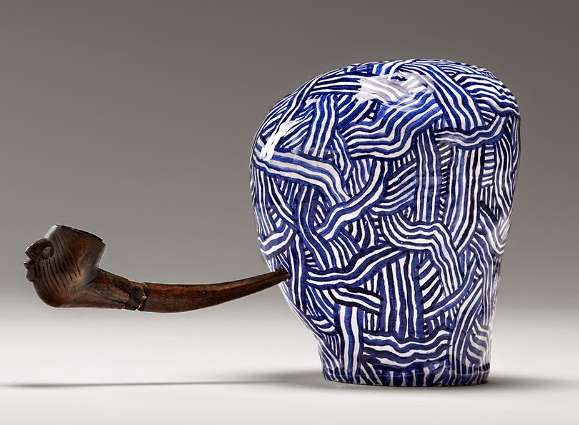
McGregor plays with ideas about identity. A big part of the human brain is dedicated to face recognition. We are primed to see faces in anything and everything—they call it pareidolia. A suite of ceramic sculptures McGregor made in 2013–4 exploits this. A glazed ceramic lump perched on an inverted glass bottle suggests a head (Semblance 2013). Depressions in other lumps suggest eyes (Nassau 2014) and eyes and a mouth (Istanbul 2014). Crude facial features are painted on a lump, combining sculptural and graphic cues for a head (Cote D’Azur 2013). A tiny, realistic, found head peeks out of an orifice in another half-baked head blob (Peekaboo 2013). My favourite work in the group, Woodsman (2013), could almost be a primitivist parody of Ah Xian—the Chinese-Australian artist famed for his porcelain portrait busts with miscellaneous decorative finishes. Here, the basic blob is covered with a regular blue-glazed pattern, suggesting an abstracted torrent of water. The pattern voids any sense of a head or a face, but McGregor inserts a pipe into the lump, forcing the issue. And there’s another twist: the pipe’s bowl is itself carved in the shape of head. So the primary, nondescript, abstracted blob head smokes a pipe, a secondary head, that is, paradoxically, more realistic, more plausible.

The pipes and hats that recur throughout McGregor’s work are nods to Magritte, but also to McGregor’s grandfathers—one a pipe smoker, the other a magician. The artist also fancies himself as something of a conjurer, playing his visual shell games with heads and faces. He has many more sculptures on this theme. He recycles slags of leftover clay into pipe-smoking gargoyle faces (Old Salt 2013). He adds glass eyes to a painter’s toolbox (The Painter 2014) and sticks a pipe into a plank of wood (Father Time 2014) to anthropmorphise them. He cuts circular eye holes in Balinese boat sails to suggest stylised faces (Untitled 2015). Etcetera.

McGregor traces his interest in fugitive, inchoate, distorted, lumpy faces back to his repeated childhood encounters with an apparition, an ‘imaginary friend’ he called Waterface. His face was always moving, morphing into different characters. To the young boy, it looked like moving water. Waterface was distinctive in having no distinguishing features; his unique identity consisted in not having one. In McGregor’s video Waterface (2009), we hear phonecalls he made with his mum and dad, where they recount their memories of the imaginary relationship. For the artist, Waterface ‘has become the ghost of everyone, in everyone, a figure who stands somewhere between the real and the subconscious’.3 Knowing his unknowable friend ‘forced him to question identity, masculinity, and the mask … the subconscious, notions of the self, and the complexities of what it means to be human’.4 McGregor sees his work as a search for Waterface, or for what this elusive figure meant to him at a young and tender age. But, perhaps, like most grail quests, it is more about the quest than the grail. It is less about finding Waterface than about what McGregor—and we—might learn along the way. Waterface is a MacGuffin.

While some of McGregor’s works summon faces out of next to nothing, others are concerned with disfiguring them—defacing. In a suite of prints from 2013, the artist subjected his own image to a variety of treatments. All ten prints are based on a single image, a pencil rendering of the artist, complete with a Jesus beard, made by a Bangkok street artist from a photo. McGregor riffed on this base image using a variety of graphic strategies and techniques. In Animal, his face is graffitied with classic humiliating appendages: a pipe, glasses, big ears, an old-lady necklace, and cleavage. In Heavy, it is veiled with a delicate tracery of fine blue lines, suggesting a thicket or a watery cataract, covering all but his eyes. In OK, the contraction ‘OK’ is written repeatedly over the face as a veil of language (but is it ‘OK’, or the opposite, ‘KO’, for knock-out?). These Days offers a misregistered colour-separated version of the image, perhaps suggesting that the artist is dazed (knocked out?) or tripping. In Rootdown, a sad-face emoticon is superimposed onto the artist’s face, sandwiching the crude ideogram and the fussy realistic rendering. Etcetera.

But what is the purpose of all this graphic malarkey, which goes everywhere and nowhere? Does it make anything of its ostensible subject, the artist? Are these self portraits or is the artist’s image just an excuse for graphic fun and games? Do we find McGregor in the initial image (made by another) or only in his corrections to and attacks upon it?

In those prints, McGregor took an image of himself and treated it differently, but, in a series of portraits from 2014–5, he takes images of different people and treats them similarly. McGregor engaged anonymous street artists—in Bangkok and beyond—to render mugshots of himself and his wife Kylee, and of their friends and various Australian art-world luminaries who had entered his studio life, including prominent collectors and a prominent art-museum director. The street artists improved on the original snaps, adding a bit of idealising glamour. An old trick. Although the original images are mediated through their faraway eyes, there is nothing exotic in the renderings—they are generic. They could have been produced anywhere.

Outsourcing the hard part, McGregor does the fun part. He goes to work on the images with pen, pencil, and eraser, adding veils of images and text, covering those poor street artists’ patient renderings with his own anarchic graffittos—more adolescent pencil-case art. He tacks on a Donald Duck head, Homer Simpson’s mouth, clown-makeup eyes, vampire fangs, Pinocchio’s nose, a snake’s forked tongue, angry puffs of smoke from the ears, tattoos, a nose drip and drool.​ He grafts a grimace from a Balinese mask onto a portrait of Melbourne collector Terry Wu. Plus there’s writing. McGregor adds slogans and gobbledygook, often in emphatic all-caps lettering, running words together in a continuous stream. His kooky hand lettering recalls psychedelic-period Head Comix. It’s ‘the bright and the cretinous all jumbled up together’, explains John Hurrell.5

These defaced works bear comparison with other anti-authoritarian works: Marcel Duchamp’s moustachioed and obscenely captioned Mona Lisa variant, L.H.O.O.Q. (1919),6 with Robert Rauschenberg’s Erased De Kooning Drawing (1953), and with the Chapman Brothers’s ‘improved’ Goya etchings, Insult to Injury (2003).

In McGregor’s one-sided collaborations, has the art-school-trained contemporary artist mangled and undone the patient handiwork of over-skilled but under-qualified street artists or enhanced it? And what do these works say about portraiture? With his additions, McGregor isn’t responding to his sitters as individuals but doing his own thing regardless. Every sitter is subjected to more or less the same treatment, including the artist himself—and his better half. ‘It rains on the just and unjust alike.’ Most portraiture is flattery, but is that the case here? Was Art Gallery of South Australia Director Nick Mitzevich charmed by his portrait? Was he supposed to run out and buy it for the Gallery collection or his own collection, his office or his closet? And if not, who else would want it: someone who adored him or someone who wanted him brought down a notch or two—perhaps someone who themselves wanted to deface his official presidential image?7

McGregor’s work wanders—it’s ‘all over the place’.8 He’s a ramblin’ man. Travel has become key to his work. McGregor lived in Bali (where his wife is from) for the best part of a year in 2014 and 2015. He produced a hundred-or-so works on paper, recording and responding to his experiences of local life, refracted through his outsider eyes. Like Pong-Ping Paradise and S-O-M-E-O-N-E, the Bali drawings net random observations. Each precisely dated sheet reflects a day in the life. It may be a diary, an autobiographical accumulation, but it doesn’t tell a story—there’s no overarching narrative. Everything is fragmented and decontextualised. The jumbled effect resembles ‘thought patterns’, McGregor suggests. Some images are pointedly Balinese—referring to Hinduism, to wood carvings, to anthropology (he was reading Margaret Mead). Indeed, some are clichés, reflecting Bali’s commodified authenticity—those hundreds of identical traditional masks carved for tourists. Other images we strain to connect to the place. One whole sheet reproduces the New York Times masthead. (Why? It was the only English-language newspaper available in Ubud, so McGregor read it every day. But who knows this, without being told?). One figure looks to me like it might come from The Simpsons, but was actually copied from an old painting addressing the Dutch occupation (Dutch Oven 2014).

McGregor is a virtuoso draftsman. The Bali drawings demonstrate his graphic flair. Images rendered in finicky detail in blue Fine Point share the stage with others made with broad strokes of watercolour, suggesting a world in which realistic forms and expressionist ones might cohabit and interact. The images are like notes to self, aides-memoire. But, when you make notes for yourself, you’re reminding yourself of things you have already experienced; to others, lacking your memories, the same notes make no such sense. McGregor plays on this. He sketches things he has seen, but we now see them out of context. He may have been a visitor in Bali (rendering things he didn’t always understand), but we become tourists in his sketchbook (we are doubly distanced from his original subjects).

McGregor plays on the random sketchbook aesthetic self consciously, with doodles and odd scraps collaged in. One sheet looks like he used it to test his watercolours, with dabs of this and that blue—but the effect is beautiful (Head Face 2015). Is the informality genuine (a by-product of the practicalities of capturing impressions on the fly) or a stylish conceit (done with the effect in mind)? Does McGregor let us into the intimate world of the artist’s daily production or simply signify ‘the intimate world of the artist’s daily production’? Is the work revealing or concealing?

Oddly, the way I’ve described McGregor’s work makes it sound a bit like that of an older Australian artist who also combines portraiture (particularly self-portraiture) with ‘automatic drawing’—Mike Parr. The 2016 Biennale of Sydney guidebook argues that a Parr work ‘represents a myriad of quickly sketched notes to and of the self. The artist describes it as “unconstrained  in every respect … a quagmire of drawings, notes, doodles, performance scripts, etcetera, and all this stuff is juxtaposed as some sort of stream of consciousness that is only intermittently clear even to myself”.’9 It adds: ‘the artist depicts his own face as a distended cipher … renderings vary wildly … Parr describes the mutability and instability of the works as “a crucial aspect of their meaning because it calls into question the look of the work in relation to the dilemmas surrounding the … self-portrait”.’10

Sound familiar? And yet, in affect, these two artists couldn’t be more different. Parr is an existentialist-expressionist hero, an id monster, full of Sturm und Drang. He’s Mr. Serious. Meanwhile, McGregor eschews gravitas. He’s Mr. Why So Serious? At the Biennale, Parr exhibited a collection of studio drawing boards featuring attempted self-portraits—a visual diary affording us insight into the profound depths of his authenticity, as it unfolded over more than a decade. By contrast, McGregor’s self portraits are fun, and his Bali drawings are a faux-sketchbook that ultimately provides little insight into himself or his location, holding both, charmingly, at bay. At the Biennale, Parr torched $750,000 worth of his self-portrait prints, expressing disregard for his collectors (and, somehow, also his concerns over global warming). By contrast, McGregor treats collectors and gallery directors like friends and family, subjecting them to the same celebrity-roast indignities to which he happily subjects himself. Parr is all about the Truth—he doubts, therefore he is. But McGregor is not so fraught. Is McGregor Parr’s undoing? Or is Parr Waterface? Seriously.
.
[IMAGE: Laith McGregor Woodsman 2013]


  1. https://theroadleadstor.wordpress.com/2010/08/22/laith-mcgregor/.
  2. www.ngv.vic.gov.au/melbourne-now-countdown-day-84/.
  3. www.portrait.gov.au/magazines/45/observation-point-367.
  4. Email to the author, June 2016.
  5. http://eyecontactsite.com/2015/06/extending-drawing.
  6. This Duchamp work could also be a precedent for McGregor’s beard drawings. Duchamp putting a moustache and goatee on the Mona Lisa was a slight on Leonardo’s sexuality, acknowledging that he may have preferred his beautiful woman to have been a man. When read aloud, the acronym title suggests an obscene remark in French—‘elle a chaud au cul’—implying sodomy.
  7. Actually, the Mitzevich portrait was bought by Mitzevich fan, Dr. Dick Quan.
  8. McGregor is itinerant. He has worked out of a variety of studios in different places, different countries. Changing opportunities and constraints underpins his use of different mediums, approaches, and scales.
  9. Bree Richards, ‘Mike Parr’, 20th Biennale of Sydney: The Guide (Sydney: Biennale of Sydney, 2016), 275.
  10. Ibid.

Francis Upritchard: Adrift in Otherness

Francis Upritchard: Jealous Saboteurs (Melbourne and Wellington: Monash University Museum of Art and City Gallery Wellington, 2016).


Late last century, my pals and I gorged ourselves on post-colonialism. It was our thing. We loved that hand-on-heart, heart-on-sleeve identity art. We chewed on it in our sleep. It made us feel culpable, and yet we couldn’t get enough. We cited Edward Said and Gayatri Spivak. We critiqued orientalism and Eurocentrism. We loved those Others (always capitalised) for their authenticity, and we radiated guilt over how we’d framed them in the past. We were suspicious of those who claimed to speak of them or for them, but also of those who failed to mention them. But then, at the dawn of a new century, one of our own, Pakeha New Zealander Francis Upritchard, entered the fray.1
.
Upritchard had relocated to London in 1998. I saw her Traveller’s Collection there when it debuted at Kate MacGarry in 2003 and was bamboozled. Upritchard had repurposed an old three-tier work table as a sarcophagus-cum-curio-cupboard. In it, she stowed a pint-sized mummy, canopic jars, ceramic monkey heads with real teeth, Maori-looking artefacts (carved from human bones, someone imagined), and other mysterious, talismanic knick-knacks. These treasures seemed organised precisely and they looked good together, but they were also all wrong. The mummy was a fantasy—a ‘Scooby-Doo mummy’, the artist said. On closer inspection, the canopic jars were repurposed West German ceramics, to which the artist had added matching animal-head lids, painting them to blend in with the bases. And the faux-Maori items were displayed in velvet-lined boxes for no apparent reason. And what were they doing there, alongside a mummy, when ancient Egyptian culture and Maori culture are separated by 16,000 kilometres and many millennia?

Traveller’s Collection looked like something some unknowing but imaginative kids had created on a wet Sunday (children, of course, being another brand of Other). Upritchard was scrambling the ancient Egyptian and the Maori as if post-colonialism had never happened and everything was peachy. How could she have got a kaumatua (Maori elder) to sign off on this? And who was the ‘traveller’ referred to in the title? Was it the mummy, making this collection their stuff—everything they needed to take into the afterlife? Or was the traveller someone else entirely, making the mummy an object in their collection and perhaps explaining the work’s Wunderkammer randomness?

Egypt has long captivated the West, but Egyptomania spiked after the discovery of Tut’s tomb in 1922. It’s not a problem to turn old Egypt into style—who cares? It was aeons ago and living Egyptians hardly feel any personal connection to their super-ancient ancestors. It’s thousands of years out of copyright—fair game.2 But Maori stuff is another matter and Upritchard knew it. As a Pakeha New Zealander, it was provocative and presumptuous for her to conflate Egyptian stuff, so long debased, with Maori taonga (treasures), connected to living people—her ex-neighbours—and of profound concern to them. Was she being knowingly offensive? Was the problem her politics or her lack of them? Was she able to make such works only from the distance of London, having put oceans between herself and the local cultural-appropriation debate?3

Upritchard went on to produce numerous faux-Maori objects, but her examples would have looked wrong alongside the real things. The artist later confessed that she had been inspired by seeing wonky tiki in London’s Wellcome Collection. Back in the day, these had been made by European sailors, working from partial impressions and faulty memories, who subjected the tiki to a visual version of that incidental translation and generational decay that, in less enlightened times, we called ‘Chinese Whispers’. Was Upritchard presuming to refer to Maori objects (as they were) or to an existing tradition of Pakeha knock-offs?

For anyone versed in New Zealand art, it was hard not to read Upritchard’s faux-Maori objects in relation to Dick Frizzell’s Tiki show at Auckland’s Gow Langsford Gallery in 1992. In it, he had rendered tiki in various modern-art styles. The work was confusing and provocative because it suggested both Pakeha appropriations of Maori images and post-contact Maori art. But, there was a huge difference. Frizzell’s show was knowing—designed to offend. He wanted to bring down sensitive Maori and pious modernists in one fell swoop. Upritchard’s work came with no such argument—its polemic lay in not having one. That left us wondering.
.
Around this time, Upritchard also made sculptures of severed heads. Some she presented on display stands, others as is. In the New Zealand context, these heads recalled Maori preserved, tattooed heads (toi moko). Before the Pakeha, Maori had preserved heads, but, after, they became a commodity to trade for muskets, enabling Maori to kill one another more effectively. Slaves were tattooed and harvested to feed the grisly new art market. In recent times, Maori complicity in the trade has been downplayed and toi moko now symbolise evil colonialism. All agree, it is imperative to get them off display in museums and to repatriate them to relevant iwi (tribes).

But are Upritchard’s heads even like toi moko? Isn’t that jumping to conclusions? They are fair skinned and not a bit tattooed—Pakeha heads, perhaps. There’s even a campy, hipster quality to some of them, with their dapper moustaches. Was Upritchard trying to make toi moko but got it wrong, like those sailors of yore with their tiki variants? Or, was she prompting us Pakeha to imagine our own heads as objets d’art in a table-turning gesture? Or, might these heads hail from another time entirely, some other colonial misadventure—or the Terror? Upritchard’s intentions were unclear: all possibilities remained in play.4
.
Museums are in the business of framing cultures of distant times and places, rather than the here and now, so our thinking about museums and our thinking about the Other are intertwined. In the past, museums have happily colonised Others’ values with their own. But, today, enlightened museums counter past sins, going out of their way to empower the Other, to employ their categories and values. New Zealand’s national museum in Wellington, Te Papa—‘our place’—was built on this noble principle, placing Maori in charge of their taonga. These days, old museums seem quaint, even laughable. The usual example is Oxford’s Pitt Rivers Museum. It groups artefacts according to their forms and uses, rather than their cultural origin, overlaying its own master narrative. When its approach became disreputable, that museum became a source of information on the framing culture as much as on the cultures framed.5 Paradoxically, the old museum has itself became Other—a portal to a bewildering value system, its own.

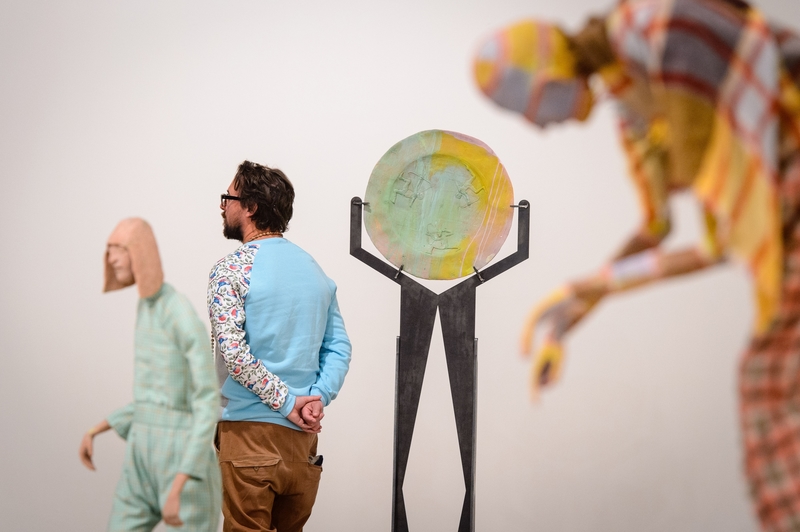
Upritchard references old-fangled museology. Channelling her inner savage, she has created fanciful faux-primitive artefacts. She has repurposed pool cues, tennis rackets, golf clubs and cricket bats as totemic fetishes, adding animal heads. She has fashioned necklaces from cigarette butts, as if misunderstanding these discarded remainders as possessing talismanic power. For Jealous Saboteurs (2003), she transformed old hockey sticks into crocodiles, splitting the sticks to make mouths and adding eyes and teeth made from golf tees and cut-up knitting needles. The sticks are shown on wire cradles, mimicking museum displays. How are we to read them? As the creative output of innocent children, playfully turning their hockey sticks into fantasy primitive objects?6 (Tessa Laird called them ‘sacred sticks for private-school girls’.7) Or, should we read them as if they were primitives’ appropriations of the colonial culture, mixing it with their own, attributing to it a totemic character?8 And, perhaps there is some insight in equating colonial sport with crocodiles.

We are now used to artists interrogating the museum. In 1992, Fred Wilson exemplified this with his show Mining the Museum, where he augmented the displays of the Maryland Historical Society to highlight its suppression of black history. Into a cabinet-making display, he added a whipping post. By contrast, Upritchard prefers to indulge in a reverie of exoticism—one fixated as much on a quaint museum culture as on the Other cultures it once presumed to frame. For her, a better precedent would be Eduardo Paolozzi’s 1985 show Lost Magic Kingdoms at the British Museum’s Museum of Mankind. Inspired by Pitt Rivers Museum, the senior pop artist created fanciful installations incorporating ‘leftover’ artefacts: Eskimo ivories, Aboriginal bark paintings, a reaping knife, a Peruvian pottery trumpet, an elephant mask from Cameroon, rawhide playing cards, a camel saddle, and, apparently, ‘some Maori household gods’.

Although Upritchard has little time for institutional critique, her works have been curated—perhaps perversely—into several shows that indulged in it. Jealous Saboteurs featured in Pasifika Styles at the University of Cambridge Museum of Archaeology and Anthropology in 2006. Curated by Rosanna Raymond and Amiria Salmond, the show saw contemporary Maori and Pacific Island artists placing their works into conversation with its ethnographic collections—reclaiming the museum, as it were. Upritchard—the Pakeha appropriator—blended in. Also, in 2008, one of Upritchard’s cigarette necklaces featured in Martian Museum of Terrestrial Art at London’s Barbican Art Gallery. Curated by Francesco Manacorda and Lydia Yee, the show offered a view of contemporary art from the perspective of an imagined Martian anthropologist. But that necklace was an odd inclusion, as it looked less like a Western art object than a cargo cultist’s one, itself already misreading things Western—mistaking cigarette butts for gems. Cargo cultists and Martian anthropologists can get it wrong.
.
She started with the cultural Other, but Upritchard went on to explore other forms of Otherness. She made sculptures of monkeys and sloths from old fur coats sourced from charity stores. Animals are our Others too, being like us but not. We see ourselves in them and distinguish ourselves from them. We are more likely to identify with those we share qualities with, linking ourselves to monkeys, say, rather than snakes. (Upritchard has also done snakes.) Identifying with animals makes some sense (we share most of our DNA with our fellow primates and can know much about ourselves by studying them), but we can also wilfully project our own ideas and feelings onto animals (anthropomorphising them). Disney has made an industry of it. While we attribute human insights and emotions to animals, their gaze remains enigmatic. We can’t know what’s going on in their heads.

Upritchard’s choice of monkeys and sloths is telling. They are not only exotic as animals, they are exotic among animals. Mostly, we see them in zoos and on the Discovery Channel. They live in Other places, where Other people have a more direct relationship with them, incorporating these animals into their own distinct cultural systems. They are doubly Othered; they are our Other’s Other.

More or less life-size, Upritchard’s monkeys and sloths suggest living animals and taxidermied ones. The monkeys typically sit, sometimes alone, sometimes in couples, looking thoughtful. Some sloths stretch out, impossibly attenuated, perhaps wanting to have their tummies stroked, asking us to connect, as if the gallery has become a petting zoo. Or, are they dead, and unable to protect their underbellies? Some are trapped in vitrines. Upritchard plays on the way sloths are like us. They are named after a human characteristic—a deadly sin, in fact. Her sloths’ hands and feet are made from elegant women’s gloves and they wear Karl Fritsch rings, inviting us to relate to their humanity. However, they also have inscrutable, blank, dead, alien eyes.

Upritchard’s monkeys and sloths mess with the culture/ nature divide. Animals may have been killed to make stylish coats, but she transforms now end-of-life coats back into animals in some perverse restoration. And, by perching her wise-looking monkeys on exotic carpets, suggesting the status they may hold in Other cultures, Upritchard frustrates our desire to preserve some distinction between culture and nature, us and them, self and Other.
.
Some of us think the grass is greener on the Other’s side. In the 1960s and 1970s, hippies expressed their contempt for the toxic here and now by adopting the manners of Other people from less materialistic cultures and/or happier times. They pretended to be Other people. Turning their backs on the rat race, they dropped out, many defecting to the country. In New Zealand, Taranaki was one place they went. Upritchard was born there, in its regional centre, New Plymouth. She remembers it nostalgically and fancifully as ‘a hippie town [where] everyone makes pottery. They’ve got their own sheep, do their own yarn, and grow their own vegetables.’9 Returning home, for a residency at the Govett-Brewster Art Gallery, she created Rainwob I (2007), a faux-pastoral idyll.

Rainwob I featured an ensemble of small, handmade sculptures —mostly figures. The figures—some one-coloured, others rainbow- hued—included a centaur, a dreamer, and a masturbating sheriff. Upritchard described such subjects as ‘stoner crap hippie dudes’.10 There was also Zippy House, a dwelling (part flying saucer, part clam shell, recalling Matti Suuronen’s iconic 1960s Futuro House); a bit of frazzled dead tree, also rainbow coloured; and a trio of lamps, with face-shaped ceramic shades with glowing slit eyes. All these items were installed on an expansive white modernist plinth, a landscape—a plateau. Into one end, Upritchard built in a seat, draped with a grey squab and old sheepskin rugs. It was odd: if you sat in the seat, you became part of the sculpture, but couldn’t see it, looking out instead on an empty wall—as blank as the expansive white plinth itself.

With Upritchard’s scene, it was hard to establish a timeframe. ‘Is she from 73BC or 1973?’, wrote Justin Paton, of one figure.11 Indeed, Upritchard famously based her figures on both fifteenth-century wooden sculptures of Morris dancers by Erasmus Grasser and photos of revellers at a Glastonbury festival. Her figures could be sages or mythic beings from ancient times or hippies and revellers from recent times—or even from the future, when the world begins again. Then or now, here or there, us or them?

But there was another level of ambiguity, of mixed messaging: where does the real world (the scale and world of the viewer) end and the represented one (the scale and world of the art) begin? Were we to see the figures as individuals, as self-contained works that just happened to be sitting on that plinth (making it incidental) or as an installation where the plinth is a landscape or scenario that the figures share (making the spaces between them part of it)? It was a hard question to answer. On the one hand, the figures were more or less the same scale. On the other, the Zippy House seemed too small for the figures to occupy and the implied scale of the tree fragment wasn’t clear. And what about the three actual-size lamps? Were we to read them as part of the world of the figures or as part of the world of the viewer, the real world? Perhaps they were there to illuminate the figures—not that they did. And what of the sheepskin seating? It implied that we might engage in the scenario, be in the same world as the figures. Or, with our back to the action, did it?

Plinths under sculptures are like frames around paintings, insulating the depicted world from the real world, from us. They simplify matters—border control. Upritchard doesn’t like plinths. In Rainwob I, she frustrated plinth logic by turning the plinth into a piece of furniture—a seat for the viewer. She added a further twist with Save Yourself, her project for the 2009 Venice Biennale. It elaborated on Rainwob territory, with figures suggesting sages, hippies, and dancers.12 But, instead of presenting them on a white plinth, she used three large bespoke tables, in different styles and colours. While they functioned like plinths, the tables carried associations of real-world uses, being like dinner tables, work tables, and reading tables. Upritchard’s plinth-tables belonged partly to the scale/world of her figures and partly to the scale/world of the viewer, drawing attention to the threshold between the real and the represented.13

In addition, there was the venue. Save Yourself was installed in three rooms in the Palazzo Mangilli Valmarana, a neo-Palladian villa with opulent furnishings that had seen better days. It was classy or vulgar, depending on your taste. In the Venice Biennale, artists often show in such old interiors—they have few options. Sometimes their projects address those spaces, sometimes the spaces are beside the point—viewers need to quickly sort out which is which. But Upritchard’s show kept both possibilities in play. Although they were in very different styles, Upritchard’s tables echoed the proportions of the Palazzo’s tarnished mirrors. Some of the figures faced the mirrors, as if posing in them, suggesting that the mirrors and the room might exist for them as well—but did that imply the room now or in its heyday? Were we supposed to see the figures on the tables as the works, the figures and the tables as the works (with us standing outside), or the figures, the tables, and the rooms as the work (with us sandwiched in between, somehow). Later, the project was re-presented in a single mirror-free white-cube space at Te Papa, to utterly different effect, only adding to the confusion as to what Upritchard might have meant in the first place.

Following Venice, the interplay between Upritchard’s figures and objects, the furniture, the exhibition space, and the viewer would become even more convoluted and tricky. In her In die Höhle, at Vienna’s Secession in 2010, sculptures were presented on made, found, and adapted items of furniture (a table, a sideboard, wardrobes, seats, etc.), all set in conversation and counterpoint with the space itself. The Secession building is also laden with history, and features, among other things, Gustav Klimt’s famous Beethoven Frieze (1902), whose golden aesthetic and obscure mythic subjects (elegant, naked gorgons and a winged gorilla) chimed, perhaps communed, with Upritchard’s own figures. But to what end? Connections without conclusions.
.
In recent years, Upritchard has been making larger single figures. They are bigger than dolls or puppets, but not life size, not our size. Increased scale permits greater detail in expression and gesture—the figures are more affective. They suggest, more or less, different ethnicities, roles, and characters: harlequins and crusaders, pilgrims and tourists, jockeys and monks, yogis and hippies, wise men and nincompoops. Some figures are naked, some clothed; some naturalistically coloured, others fauvist. Clothes and colour schemes suggest roles, but the codes are Greek to us. The figures strike curious, plaintive, melancholy poses, with eyes blank, closed, or averted. There’s no consistent register and nothing feels definitive.

In earlier times, Upritchard presented figures grouped together on plinths and on items of furniture, but the new figures are displayed as individuals on steel stands designed by her husband, Italian furniture designer Martino Gamper. The stands match but are different heights, perhaps implying something; for instance the rank of their subjects in relation to one another and to us. Now, we walk among the figures. It’s as though we are now on the plinth or tabletop with them, and yet they are still separated from us, insulated, each raised up on its own tabletop. On the one hand, they are individuals on individual tabletops; on the other hand, they are all collectively separate from us, on matching tabletops, implicated in a separate system. Air gapped yet linked. It’s the same question as before, phrased differently.
.
I can’t help but think that Upritchard’s interest in Otherness is a New Zealand thing. On the one hand, she has left the country behind, becoming an international artist. On the other, she returns here to work and show, and knowledge of her origins informs the reception of her work. In New Zealand, we aren’t allowed to forget our Otherness—we are identified with distance and we identify with distance. Our place is not only remote, it is also the site of an actual cultural Otherness—Maori culture. Plus, now, in the wake of the Lord of the Rings films, it is also the site of a fictional Otherness—Middle-Earth.14 (Paradoxically, European tourists come here to get in touch with their own cultural origins: our elsewhere becoming their elsewhen. The long-haul flight as time machine.)

Upritchard’s work is generally seen as gloriously apolitical, but she calls it ‘slippery politics’. As right-thinking post-colonialists, we may be concerned about the presumptions of a dominant culture that happily frames the Other in its own terms, for its own purposes—that takes advantage. But Upritchard’s work is not this. In it, different aspects and dimensions of Otherness are sandwiched and scrambled, making it hard to know whether we should look at her works as if they were representations of the Other, the Other’s own representations, or something else again. In 2009, curator Heather Galbraith was spot on when she observed that in Upritchard’s work ‘there is no dominant culture’.15 We are cast adrift in Otherness, with no way home.


  1. Pakeha are non-Maori New Zealanders.
  2. Although those who bought into the idea of Tut’s Curse betrayed a guilty-conscience anxiety that perhaps the dead themselves had taken offence.
  3. She later observed: ‘Leaving really helped me get away from just making art about New Zealand. Then again, it let me make art about New Zealand as well, because there were a lot of things that [in New Zealand] you couldn’t really touch, like the shrunken heads.’ Quoted in Philip Matthews, ‘Scary but Funny’, The Press, 30 January 2008.
  4. Interestingly, Frances Larson reports: ‘Europeans in New Zealand were sometimes killed so that their heads could be tattooed and then sold back to their own unsuspecting countrymen. There are stories of the very same trading agents who had been sent from Australia to scout out the best heads being murdered so that their heads could be preserved and traded back again as “Maori Warriors”.’ Severed: A History of Heads Lost and Heads Found (London: Granta Books, 2014), 27.
  5. This was deftly expressed in the title of the museum-studies anthology Exhibiting Cultures, where ‘exhibiting’ could be a verb or an adjective, a reference to the cultures being exhibited or those doing the exhibiting. Ivan Karp and Steven Lavine (eds.), Exhibiting Cultures: The Poetics and Politics of Museum Display, (Washington: Smithsonian Institution Press, 1991).
  6. There is more to be said about Upritchard’s relation to children as Other. When she started making her Egyptian and Maori faux-artefacts, she was teaching them art. Megan Dunn reports: ‘She … got her class to draw hieroglyphic scrolls from memory. Upritchard loved the pictures because they were “all fucked up and wrong but really right as well”.’ (‘Mummy Dearest’, Pavement, February–March 2003: 54.) One could imagine that Upritchard’s works were made for children or by them. Seeing her works together in Jealous Saboteurs reminded one viewer of a children’s encyclopedia: first there was the universe with the planets, then the landscape took shape, then came dinosaurs, monkeys, and sloths, then people, the Egyptians, the Maori, etcetera.
  7. Tessa Laird, ‘Dr. Deans, I Presume’, New Zealand Listener, 4 November 2006: 44.
  8. They could be seen as analogous to Papuans worshiping airplane effigies and wearing Kellogg’s cereal boxes as hats. On the one hand, such strange things make us think that the Other has the wrong idea of us. On the other hand, perhaps they got it right, discovering something true about our relationship to these matters. A photo of a man wearing a Kellogg’s cereal box was reproduced in Thomas McEvilley’s tipping-point critique of MOMA’s Primitivism show (‘Doctor, Lawyer, Indian Chief’, Artforum, November 1984: 59). An airplane effigy appeared in the shockumentary, Mondo Cane (1962), a pioneering example of tabloid anthropology.
  9. Quoted in Coline Milliard, ‘Hippie Happening’, Modern Painters, September 2011: 55.
  10. Quoted in Philip Matthews, ‘Scary but Funny’, The Press, 30 January 2008.
  11. Justin Paton, ‘Mixed Feelings: Francis Upritchard’s 1970s Show’, Art and Australia, vol. 46, no. 1, Spring 2008, 96.
  12. Upritchard famously said: ‘I want to create a visionary landscape, which refers to the hallucinatory works of the medieval painters Hieronymus Bosch and Pieter Bruegel, and simultaneously draws on the utopian rhetoric of post-1960s counterculture, high-modernist futurism and the warped dreams of survivalists, millenarians and social exiles.’
  13. Again, there were found lamps with ceramic shades fashioned by the artist. It wasn’t clear whether they belonged to the scale of the real world of the viewer or to the scale of the depicted world of the figures.
  14. Wellington Airport has a sign, ‘Middle of Middle-Earth’. And you can now visit Hobbiton. It’s fictional and real, ancient and new.
  15. Heather Galbraith, ‘Psychic Pushing’, Francis Upritchard: Save Yourself (New Plymouth: Govett-Brewster Art Gallery, 2009), 27.

Fifteen Minutes, Twenty Years Later: Ann Shelton’s Redeye

Unpublished.


.
I first met Ann Shelton at Wellington City Art Gallery in 1992. I was there with artist Giovanni Intra, installing his Blood Mobile in the new-artists show Shadow of Style.1 They were chums. Shelton was a press photographer. She was working at the Dominion Post to pay the bills and documenting the lives and times of local glue sniffers in serious black-and-white in her spare time—working towards a show.2 But Auckland and art school were calling.

In 1993, she quit her day job, moved to the big smoke, and embarked on a BFA at Elam. In Auckland, Shelton and Intra became an item. They lived in a flat in Grafton, where he wrote his MFA dissertation, ‘Subculture: Bataille, Big Toe, Dead Doll’. But, Karangahape Road would become the centre of their universe. K Road was the old red-light district—a magnet for drag queens, loafers, and party animals, as well as people with real problems. Shelton wined and dined at Verona, partied at the Staircase, and hung out at Teststrip, the artist-run space operated by Intra and Co., which relocated to K Road.3 Shelton herself soon moved into a flat above a K Road butcher’s shop, where she lived with her girlfriend, photographer Fiona Amundsen.

Via stints recording the gay/queer scene and surveying public-toilet graffiti, Shelton’s focus shifted from documenting Others (those Wellington ‘street adults’) to documenting her self, her friends, and their hectic party life. In 1995, she embarked on the work that would become her 1997 photobook Redeye. This ‘diary’, as she called it, features a selection of sixty-four photographs in which she immortalises her fellow artists and flatmates, friends and lovers; her home, haunts, and hobbies.4 A time capsule, it now seems to sum up the K Road ethos, standing in for that milieu and moment.

The Redeye photos are snapshots—intimate, tightly cropped, in your face. They were made on slide film using a plastic Olympus camera. Shelton favoured the flash, guaranteeing a flat, gaudy, saturated-colour look. The book’s title refers, in part, to the red, strung-out, alien-eyes effect produced by such cheap cameras, where the flash is located too close to the lens. The book offers numerous examples.5 Flicking through it feels like ploughing through a shoebox of disordered snaps, where characters turn up repeatedly in different hairdos and outfits. It would feel rather different if it was published now, in our age of selfies and Instagram, when we are used to people making their private snaps available to the world.

Shelton’s crew fancied themselves Warholesque superstars and flaming creatures, walking on the wild side. In the book, punk collagist Ava Seymour appears often, looking absolutely fabulous. With big hair and eyelashes, in a boa or body-hugging leopard skin (or with an inflatable sex doll), she’s Tura Satana, Vampira, and Poison Ivy, Peg Bundy and Divine, rolled into one. She dresses like a man in drag, exaggerating her femaleness, as though her gender did not go without saying. By contrast, her gender-bending partner, Kim Elizabeth ‘Swampy’ Swanson—singer in garage-punk band Bandy Candy and the Cocksuckers—passes as a he. In one image, dressed as a bloke, she lights a fag and manspreads, resting a brown beer bottle between her legs. In another, she wears a t-shirt explaining ‘penis’, while sculling a Heineken. Ironic feminism!

Girls will be boys and boys will be girls, and everything in between. The drag queen Booby Tuesday also appears repeatedly. In one shot, he’s getting ready, half dressed, wigless, falsies hanging out. In another, transformation complete, he proffers his mini-skirted arse in front of a sign that explains ‘After Hours Enquiries’ and lists a phone number. Artist Joyce Campbell is also shown in an unladylike pose, albeit in flattering black Lycra, in the ring, flipping fellow girl-wrestler La Rissa, in red Lycra—very Faster, Pussycat! Kill! Kill! Meanwhile, artist David Scott effects a limp wrist.

It was a queer old world. Artist David Townsend appears excessively attired, in white face paint with bright red lips, like a geisha. He looks like a younger incarnation of the Mystery Man from David Lynch’s Lost Highway, which hadn’t come out yet. In another shot, he is filthy, making a devil-horns gesture, smeared in his own blood, having earlier taken to his shaven head with a staple gun as part of a look-at-me masochistic performance at the Ambassador Theatre, Point Chev.—artist Peter Roche’s place. Remembered for his self-harm performances in the 1970s, Roche is the subject of another image, trashing an armful of live fluoro tubes during a performance at Teststrip.

Not everyone was an extremist. Actually, an odd cast was caught in Shelton’s net. There’s Amundsen (now famed for her conceptual photography). The shot of her with her pants around her ankles, perhaps passed out, seems improbable—she always seemed too demure, too serious. And there’s video artist Lisa Reihana (whose work Native Portraits would become a Te Papa favourite) and photographer Haru Sameshima (as Rim Books, Redeye’s publisher), both made up for a Monica magazine photo shoot.6

There are shots of art works that don’t look like art works, because only bits are shown or we can’t see the context. The glowing circuit boards are part of a Roche sculpture. The shiny panels are not disco or hairdresser decor but a Denise Kum installation at Auckland Art Gallery’s New Gallery. The ‘Super Stormy’ sign is a work by Michael Stevenson at Teststrip and the missing louver windows are part of a work by then-emerging Dion Workman at 23a Gallery. Also, peppered amongst the racy and risqué images are banal, obscure ones: an anonymous glazed K Road office building, a nondescript corridor, red PO boxes, and a random detail from a mural. Not to mention ‘crime-scene’ images: marker-pen graffiti on a car, vomit in a urinal, and sauna showers. We can only suspect that—to those in the know—these images are radioactive with happy memories. Meaningful, if you were there; meaningless, if you weren’t. Or, perhaps the point is: you weren’t there.

Designwise, Redeye stood out. Designer Bepen Bhana opted for glossy stock and a distinctive A5 landscape format; any portrait-format shots were simply run sideways. Shelton’s lurid images were bled—no aesthetic white space—and text pages were printed on green! There was no explanatory essay. The captions were consolidated on a single page at the back, like an index, making it a chore to consult them, especially as only some pages were numbered. They were little help. As Shelton admitted, they ‘don’t really tell you very much’.7 There was no real order to the images, but there were telling juxtapositions: a Seymour sculpture (a plucked, headless chook, wearing a pearl necklace, with a red apple stuffed up its bum) faced off against Seymour herself (dressed in red).

Redeye was indulgent. As much as Shelton embraced a transitory, ‘live fast, die young’ lifestyle, she also believed it should be preserved for posterity. She thought Intra’s cocaine ring, Amundsen’s sneakers, and her own new tattoo were too good to not share with the world. Her subjects agreed. With Redeye, they invest—and ask us to invest—in their mythologisation. It’s this insistent narcissism that makes Redeye work.

Redeye didn’t come out of the blue. In the 1990s, queer and raunch culture were becoming mainstream. By 1992, Madonna had already published her photobook Sex. Redeye also grew out of a tradition of gay-scene photography identified with photographers like Robert Mapplethorpe and Peter Hujar. And it was indebted to notorious photobooks where participant photographers could be as badly behaved as their subjects: Larry Clark’s Tulsa (1971), Nobuyoshi Araki’s Tokyo Lucky Hole (1985), and Nan Goldin’s The Ballad of Sexual Dependency (1986).8 Indeed, Shelton was routinely cast as New Zealand’s Goldin, albeit a decade or so after the fact.

There were also precedents in New Zealand photography. Shelton looked back to Fiona Clark’s 1970s tranny-scene documentary work. With her raunchy subject matter, she also was an heir to the risqué late 1980s/early 1990s work of Fiona Pardington and Christine Webster. But, though they messed with sex-and-gender codes, Pardington and Webster dispensed with the documentary assumptions of Clark’s straight photography (they wanted their photography to be as ‘bent’ as their sex). In this context, Redeye was not forward looking, but rather retro, bucking the trend for constructed photography, reasserting photography’s documentary authenticity.9

When Redeye came out, it confused me. It made me feel like an insider and an outsider. True, it starred people I knew and worked with, but they were not really my people. They were younger than me and too cool for school—they treated me like ‘the establishment’.10 And, though we launched Redeye at Artspace (also on K Road) when I was boss (showing the work for a mere three days!), and though I figure as a pointless blob in the back of one shot (with blue-chip abstractionist Stephen Bambury, of all people), whenever I look at the book, I’m reminded that I was never in the club. The craziness only happened after I left the room; I heard about it the next day. My sense of exclusion was only made more acute by being so close to Redeye’s generational envelope and psychogeography.

Shelton says Abigail Solomon-Godeau’s essay ‘Inside/Out’ was a big influence on Redeye.11 The essay contrasts Goldin’s and Diane Arbus’s approaches. Both photographers document marginals, but Arbus’s treats hers as strangers, as others, while Goldin’s are her and her friends. Arbus is voyeuristic and brutal (an outsider approach) while Goldin is empathetic and implicated (an insider one). While Arbus photographed queers disdainfully, Goldin captured them touchingly. But, as Solomon-Godeau also observes, inside and out are never so clear and distinct. Certainly, Shelton did not simply view her cohort from within, but was already imagining them and herself viewed from outside, by others. And that’s how they all saw themselves. They wanted to be freaks. They were the camera-ready underground.

This inside-and-out ethos informed the art of the two Teststrip principals that feature most prominently in the book, artists Daniel Malone and Giovanni Intra. At the height of post-colonialism, Malone mimicked Others. For a while, this merry prankster sported an Afro and a Fu Manchu moustache. He claimed Cherokee whakapapa, and slummed it as a tagger and as a rapper (with the plaintive battle cry ‘Me Tu’).12 In Redeye, he is drunkenly boxing himself around the head in a Teststrip performance (he could have been a contender!), clamping his tongue between chopsticks, and answering the phone in an Asian t-shirt, a butcher’s apron, and a hard hat—ever performing, ready for his close-up.

Born in 1968, Intra missed out on the Paris riots and punk. He explored subculture, but belatedly, at a distance. This can be felt in the Redeye preview he wrote for Pavement in 1996. It sums up the book by what it says and by how it says it, switching from complicit boosterism to critical disdain without slowing to change gear. While issuing his racy, conflicted verdict, Intra fails to disclose his insider status—that he was one of the book’s key subjects and had been Shelton’s lover.

He writes: ‘Shelton’s new book is part fashion, part accident and part sheer embarrassment. Her idiosyncratic version of the photographic portrait hones in on the people of a nonsensical culture of “experimentalism”, an excessive yet mannered avant-garde of gender-bending, faux glam and self-mutilation which chokes on foundation whilst desperately trying to swallow art theory … What Shelton modestly terms a “social diary” is really a charismatic expose of the hideous truths and self-conscious mythologies of unemployed psychopaths who frequent Verona cafe and actually believe in drag.’13

Intra’s text highlights the key question: who is Redeye addressed to—insiders or outsiders, sympathetic participants or judgemental voyeurs? Or, does it speak to both, but differently?14

Times change. Redeye was twenty years ago. Intra said its images ‘envision a population we know is condemned to obscurity, not to mention old age, premature death and a whole host of attendant mediocrities’. Where are they now? Intra headed to LA, became an influential art critic and gallerist, but crashed and burned—dead at 34, an overdose in 2002. Malone is living in Poland, where he’s the consummate insider-outsider. As a proofreader, he helps the Polish art world with its English. Seymour abandoned the punk edge of her collage work, for a more genteel formalism. Townsend is in London, working for the upmarket interior decorators Atelier, who cater for the elite with their ‘precision designed and expertly crafted residences’. Etcetera. But at least one Redeye superstar is still hanging out on K Road, living the dream. Swampy’s current band is the Blue Bloods. They just made a clip for their song ‘Slut on Junk’.

Sadly, it’s hard to sustain rebel status—unless you die. After Redeye, Shelton’s work shifted. She walked away from documenting subcultural pranks and took a cooler, conceptual approach, accompanied by a production upgrade. Her new direction would find itself perfectly tuned to emerging university-research agendas. Now she’s Associate Professor Shelton, living, with her graphic-designer husband Duncan Munro, in a vintage architect-designed modernist house in Wellington’s Wilton—a world away from K Road.

The house has just been the focus of a cover story in Home magazine, and Shelton’s A Spoonful of Sugar (2015)—another Rim book—spruiks it. Location, location. Everything changes, but some things never do. In Spoonful, as in Redeye, Shelton crossbrands. She entwines her pedigree with other people’s. The book associates her, as the proud new home owner, with the house’s emigre Jewish architect Fredrick Ost (who escaped the Nazis) and his client, spinster Nancy Martin (‘purportedly the first single woman in Wellington to receive a mortgage to build her own home, a trail-blazing woman … responsible for bringing … the recorder to New Zealand’). The recorder … bless! What happened to the glue sniffers and queers?

Shelton explains: ‘Dipping into and out of these narratives, this project seeks to invoke the ghosts of change and of futures—of feminism, of modernism, of a haunted house, a musical house, a diasporic house, a Jewish house, and a house from Aotearoa, thereby making visible and audible links between banking history, gender politics, agency and the role of a woman in architecture in Aotearoa.’15

Shelton has moved up in the world, and Spoonful can be read as an update and antidote to Redeye. And yet, flicking through its impeccably exposed lifestyle interiors, we find—in the salon hang, on those original orange-pegboard walls—works from Shelton’s old Redeye friends Intra and Seymour. These souvenirs of another life linger like pinned butterflies, wormholes to another space and time, misty watercolour memories of the way we were.16 

  1. I curated Shadow of Style with Greg Burke. It was a joint project between Wellington City Art Gallery and the Govett-Brewster Art Gallery, New Plymouth, where I was curator.
  2. This work was presented in her 1993 show Don’t Push Me/Kaua au e Puhingia [Puhinga]: Photographs of Street Adults at Lower Hutt’s Dowse Art Museum.
  3. Teststrip is sometimes considered New Zealand’s first artist-run space. It was certainly the first space of its kind. Founded by artists—including Merylyn Tweedie, Giovanni Intra, Daniel Malone, and Denise Kum—it opened in Vulcan Lane, Auckland, in 1992 and moved to K Road in 1994, where it ran until it ran out of steam in 1997. Shelton documented its demise, photographing a black shroud covering the Teststrip sign, so it read RIP.
  4. All but six were shot in Auckland. Three were shot in Wellington, and one each in Mangawhai Heads, Timaru, and Tokyo.
  5. The cover image—of David Townsend bleeding from his forehead into his eye—frames Shelton’s title as an affront to vision, like the eye-slicing shot in Un Chien Andalou (1929). Here’s blood in your eye.
  6. ‘Shooting Gallery’, Monica, Summer 1997: 47–50. Styled by Kirsty Cameron and shot by David Scott at Artspace. Among others, it featured artists David Townsend, Lisa Reihana, Ann Shelton, and Haru Sameshima.
  7. Lava, no. 24, 13–24 August 1997: 16.
  8. Shelton interviewed Larry Clark for Pavement after he released his film Kids. ‘Teenage Lust’, Pavement, February–March 1996: 66–70. Intra provided the intro.
  9. Clark and Pardington both featured in One Hundred and Fifty Ways of Loving, the pornography-statement show Shelton co-curated with Paul Booth and Kirsty Cameron for Auckland’s Artspace in 1994.
  10. Admittedly, I was living in Dunedin for most of the Redeye period. Then again, so was Danny Butt, who, in his Teststrip eulogy, writes: ‘The minutes of [Teststrip board] meetings from this time make hilarious reading—strategies included “Send invites to the powers that be to let them know that they are not invited—Leuthart, Burke, Leonard, Killeen (because he always comes)”.’ ‘TeststRIP’, Log Illustrated, no. 4, Winter 1998: 6.
  11. Inside/Out’, in Public Information: Desire, Disaster, Document (San Francisco: San Francisco Museum of Modern Art, 1994), 49–61.
  12. See Giovanni Intra, ‘Daniel Malone: Triple Negative’, Art and Text, no. 70, 2000: 42–3.
  13. ‘Drive-By Shootings’, Pavement, no. 10, 1996: 10.
  14. Interestingly, Redeye did enjoy some cachet offshore. Heroic enlargements of Redeye images were installed in the Glasgow nightclub, the Arches, for Fotofeis, in 1997, and a second edition of the book was published by Dewi Lewis, in Stockport, enabling international distribution. The online Photo-Eye Bookstore still mistakenly lists the book as ‘a riveting portrait of British punky pop culture’. www.photoeye.com/bookstore/citation.cfm?catalog=PK471&i=&i2=.
  15. www.rimbooks.com/wordpress/a-spoonful-of-sugar.
  16. On 5 and 6 December 2015, Shelton staged House Work, an ‘open home’ for Enjoy’s project Enjoy Feminisms. She displayed her new house stripped bare, but for her art collection. Visitors heard a Pip Adam story narrated from a hidden speaker. ‘Abigail was out walking because she was fat …’ An earlier Shelton project, Abigail’s Party (1999), was a set of brag pictures of her cool K Road apartment. That project took its name from the 1977 Mike Leigh stage-and-television play.

Cindy Sherman: Everything and Its Opposite

Cindy Sherman, ex. cat. (Brisbane: Queensland Art Gallery, 2016).


For me, Cindy Sherman’s work has always been there. I first encountered it as an impressionable undergrad at the University of Auckland in the early 1980s. Back then, feminism was changing the shape of my art-history courses. The department had just introduced a women-in-art paper, and revisionist lectures on women artists and on the depiction of women in art were being introduced into other papers. Images by women were celebrated; images of women were critiqued. Sherman’s work belonged to that Zeitgeist, plus it was a game changer.

Here, in New Zealand, Sherman’s work was a breath of fresh air. It was an antidote to all the women’s-art-movement art that was countering ‘dominant’ images of women with equally prescriptive images of goddesses and matriarchs, tides and lunar cycles, shells and spirals.1 Sherman’s work made that neo-pagan work look like a fanciful retreat from reality—and rather essentialist. Her reference points, back then, were more immediate, more contemporary, more real world—pop culture, the movies.

Feminist critics celebrated Sherman’s early work—the Untitled Film Stills (1977–80), Rear-Screen Projections (1980), and Centerfolds (1980-1)—as female ‘masquerade’. That idea had been in the ether since 1929, when the British psychoanalyst Joan Riviere published ‘Womanliness as a Masquerade’.2 Her paper prompted us to understand that women play at being women, that femininity is a mask, a projection, a put-on. Women are, of necessity, actors—female impersonators, role-players. For better or worse, gender is performance. Sherman’s champions argued that she confounded prescribed femininities not by offering alternatives, but by foregrounding the artifice, emphasising the charade. The argument turned on the assumption that Sherman had agency, which meant she was not simply exemplifying a female condition, but, in the process, somehow undoing it, through self-consciousness, reflexivity. Masquerade had become the solution as well as the problem.

As a young man with feminist pretensions, I gravitated towards Sherman’s early work. I could recite the arguments for it, chapter and verse. But, at the same time, I did enjoy seeing Sherman play ‘The Girl’, as Arthur Danto put it.3 I loved her in her would-be starlet, ingenue, heroine and damsel-in-distress roles. She was sexy and her role-play felt coy. Female masquerade granted her a licence to confound the male gaze, but also an excuse to court it. And it was a get-out-of-jail-free card for the viewer, too. It let me take my voyeuristic pleasure with a righteous alibi. I could compartmentalise, revelling by turns in the work’s critique and in its complicity. I doubt I was alone in my bad faith.4

In retrospect, it is hard to know why the idea of female-masquerade-as-critique had such traction or seemed to be such a revelation. After all, female movie stars can play a range of characters without rocking the boat. We appreciate their compelling performances without losing sight of the fact that it’s them performing—it’s called acting. So, why should acting be uncritical in the movies (generating problematic stereotypes), but suddenly insightful when transposed into photography, into art (now supposedly undermining the exact same stereotypes)? And why was female thespianism necessarily feminist? Surely, it could have equally been framed by the old misogynistic idea of the femme fatale—the woman as alluring and calculating, duplicitous and deadly.

Not everyone read Sherman’s works as feminist, least of all the artist.5 She distanced herself from big-picture feminist positioning, preferring to discuss her work anecdotally, in terms of her processes and the characters she created, describing them as, say, ‘sexy earth mama’ or ‘retired realtor’.6 Magazine profiles explained that Sherman had played dress-ups obsessively since childhood, suggesting she had essentially transposed her compulsion into her art.

So did Sherman’s work critique the female condition or simply exemplify it? Was the critique coming from the work or being projected onto it? It was difficult to tell. But, it was this very ambiguity that proved so engaging. Sherman’s work always was a line call.

In the mid 1980s, Sherman shifted gear. She backed away from appealing media stereotypes. She went darker. Her characters started to look more like frumps, weirdos, bag ladies, vampires, and trolls. Grotesque, they did not embody any agreeable feminine ideal, but the opposite. They evoked women’s inability or refusal to live up to the ideal—to ‘pass’ as women. If Sherman was masquerading still, it was as characters who had trouble masquerading as women. The idea of female masquerade had to stretch. On the occasion of her 1989 show at Wellington’s Shed 11, critic Lita Barrie explained: ‘Sherman’s work covers all the permutations of the fictions man has created around women’s identity, from his most desirable turn-on to his most undesirable turn-off.’7

Where once she had appealed, Sherman increasingly sought to alienate her fans. In a 2012 interview, she admitted as much: ‘That’s what inspired the pictures with vomit and all that. Because I thought to myself, “Well, they think it’s all cute with the costumes and makeup, let’s see if they put this above their couch.” And it worked, they didn’t. It took a long time for that stuff to be accepted, much less sought after.’8

In the 1990s, Sherman’s work took a series of nasty and X-rated turns. For a while, she even jettisoned her signature idea, exiling herself from her pictures in favour of mannequins and prostheses. The dreamy Sherman of the late 1970s and early 1980s was gone.
.
One of the most influential artists of her generation, Sherman’s work has been catnip for theorists and a hit with audiences. It has prompted sustained academic inquiry and entered the popular imagination. It has inspired legions of followers and dredged up endless precedents, reshaping art history, forward and back.9

Sherman has participated in and survived numerous art world paradigm shifts. In the beginning, she was a key figure in the ‘Pictures’ generation of American postmodernists and instrumental in art photography’s ‘directorial’ turn. Her example inspired a phalanx of women art students, making coquettish critiques of the male gaze a staple of art school exhibitions. Later, her Disasters series (1986–9) resonated with the works of philosopher Julia Kristeva and librarian-surrealist pornographer Georges Bataille and participated in the rise of abject art. Then, her Sex Pictures (1992) invaded the uncanny valley and surfed the creepy mannequin-art wave. Although her work was promoted as a critique of mainstream codes, she directed a feature film, featuring Molly Ringwald, and got even deeper into bed with the fashion industry.10 Paradoxically, her work would provide a blueprint for identity art; Sherman’s masquerade inspiring artists who wanted to assert their identity (revelling in their otherness), as well as those who wanted to sidestep it. The biennales are now awash with the work of gay and queer Shermanettes, postcolonial Shermanettes and outsider-art Shermanettes. Sherman has always been everything and its opposite.

Sherman changed the landscape, but kept sexist stereotypes in play. Her ironic appropriation was ambivalent. As a form of criticism, it placed problematic images at arm’s length; as a mode of affection, it kept them within arm’s reach. And her timing was impeccable. A decade before Madonna’s clip for ‘Vogue’ (1990) and her book Sex (1992), Sherman had already opened up space for an alternative response to prescriptive images, allowing women to robustly engage with stereotypes and other received wisdoms. Her role-play anticipated and legitimised Madonna’s (they both made themselves over as Marilyn Monroe). Guilty pleasures! Sexy feminism! Girl power! Madonna can’t have missed this. She sponsored Sherman’s 1997 Museum of Modern Art show, The Complete Untitled Film Stills. Perfect brand alignment.

Since then, feminism and sexism have become even more hopelessly entangled. Empowered, autonomous females have become idealised male sex objects—Tomb Raider’s Lara Croft is the boy gamer’s wet dream. Meanwhile, the Fifty Shades of Grey books have sold over 125 million copies in 50-plus languages—women the world over romancing their chains. Feminism’s moral compass is spinning and feminist art has become Janus-faced, embracing radically conflicting and conflicted approaches. Feminist art can now be confessional and true, or coy and duplicitous. It can deny gender as a social construct or assert it as fundamental. It can embrace femininity or repudiate it. It can align women with nature or reject the idea as sexist. It can rail against pornography and prostitution or endorse them. It can attack middle-class values as patriarchal (preferring the transgressive) or celebrate decorum (as if genteel middle-class refinement was always already feminist).

As one woman’s feminism is now always another’s anti-feminism, is it meaningful to even argue whether Sherman’s work is feminist or not? Perhaps, feminism in art today is less about the side you take and more about what you take sides over—a set of common questions rather than common answers. This would make the ambivalent Sherman the exemplary meta-feminist.
.
There have been other big Sherman survey exhibitions recently, but this show is different. It only presents work made since 2000, after Sherman returned to photographing herself. While it leaves out much that her reputation is founded on, it prompts us to consider how Sherman’s work and the world around it have changed, and how her recent images build on or transcend the readings established for her work last century. Two things strike me: Sherman’s work now belongs less to feminism and more to caricature, and her relationship to ‘the background’—and, with it, the world—is a new focus.
.
Our attitudes to gender have changed. On the one hand, with the rise of genetics, we are less likely to insist that gender is simply a cultural construct—the bedrock of much 1980s feminism. On the other, we have thoroughly absorbed the female masquerade argument that greased the reception of Sherman’s early work. Thanks to her, it has become a truism, not an argument anyone now needs to make.

Sherman’s relationship to the idea of female masquerade has also changed. In her Clowns series (2003–4), she poses before lurid colour swirls and smears, and amid psychedelic atmospheres and vortexes. She presents herself as a shudder of clowns, part fun, part demented.11 These works play on a common fear of clowns (coulrophobia). With their exaggerated facial features, monstrous body parts and sadistic tendencies, clowns are creepy—not sexy.12 They are outsiders, psycho-lepers, with no social buy-in. Because of this, they are also threatening. Sherman’s clowns could be masochistic victims or sadistic villains, or each masquerading as the other.

These images recall others where Sherman portrayed excessively made-up and/or inanely dressed women, women who do not convincingly convey a ‘natural’ femininity. Clown women! Indeed, Sherman’s clowns look more-or-less like men. It is as though Joan Riviere’s feminine mask has fallen away and this is what is left behind—women as men, but not even proper men, clowns. Sherman’s clown-women may be isolated through their inability to make the grade, but perhaps this also relieves them of having to buy into dominant norms. Are her clowns emblems of pathetic marginality or of sociopathic empowerment—like the vengeful carnival performers in Tod Browning’s 1932 film Freaks, who mutilate the beautiful, but despicable, trapeze artist Cleopatra?

It is telling to compare Sherman’s ‘clowns’ with her later series Society Portraits (2008). Sherman demonstrates her powers of observation in these detailed studies of older, high-maintenance trophy wives and trophy widows, who are Botoxed, nip-tucked and attired to the max. These ‘ladies who lunch’ might even be art collectors—Sherman’s target market or not. Their regal ilk will be familiar to anyone who views the fashion blog Advanced Style with smug amusement, with deep admiration, or for its gerontophile appeal.13

Preoccupied with their status and sophistication, these ‘women of a certain age’ are at war with the clock. Ranging from elegant to freaky, these staged portraits appear to have been taken by a specialist professional photographer versed in the photographic art of flattery, with a bag of tricks derived from old-school portrait painting, as well as from photography. But the cracks show through. Is this social critique or misogynistic, menopausal humour? If clowns are excluded, aren’t these privileged insiders equally excluded—disqualified by age? Are they analogous to clowns—funny because they are failures? The designer of the Museum of Modern Art’s 2012 Cindy Sherman catalogue may have thought so; on the back cover, the faces of a Sherman clown and a Sherman socialite are spliced together.

Sherman’s typology of botched and unruly females is inclusive, running the class gamut from Walmart weirdos to socialites. No sector seems spared. Isolated from the arguments that orbited her early work (which now go without saying), twenty-first-century Sherman belongs less to feminism and more to caricature. She is part of a tradition stretching from Leonardo da Vinci and Albrecht Dürer through William Hogarth, James Gillray, Honoré Daumier, and Pablo Picasso to her contemporaries Robert Crumb, George Condo, and John Currin. With their love of exaggeration and deformity, caricaturists have endlessly poked fun at baseness and social pretensions, lack of style and fickle fashions, laughing at those both less fortunate and more fortunate than themselves (or ourselves). Their work typically implies another image, a normative or ideal image, to be mocked and overturned.

At its most misanthropic, caricature finds us all vain and venal, fatuous and wanting, but, at its most humanistic, it prompts us to try to understand and accept our foibles and those of others. But, where does Sherman’s work sit in this continuum? Is she cruel or kind? Or is she being cruel to be kind? Blending schadenfreude and sympathy, Sherman makes that a tough question to answer.
.
In this new century, digital photography has transformed the way Sherman makes her images and our expectations of them. Photoshop allows her to tweak her facial features, like digital putty. Sherman previously shot images of herself in sets constructed in the studio—actress and scenario were all of a piece, so to speak. Now, she captures herself against a green screen, then composites herself into backgrounds. Using her computer, Sherman can, at her leisure, try on different backgrounds for size, like clothes or accessories, looking for the perfect match, or mismatch. This also means her backgrounds can be more elaborate—landscapes, even. In recent work, there is a new exploration of her relationship to the background, to the world—the not-me.

This becomes explicit in the Murals (2010–ongoing), which emphasise the compositing process. These works feature black-and-white landscapes, which Sherman shot in New York’s Central Park. The scenes do not fill the frame. They are symmetrical and mirrored like Rorschach-test blots, as if the artist were double daring us to project our own emotions onto them. Sherman treated them to suggest old engravings. They also recall painted backdrops from Victorian photography studios.

A cast of Shermans poses before them. Larger than life and in colour, they don’t appear to occupy the landscapes, but look arbitrarily and crudely imposed upon them. Many of their costumes appear to hail from the circus or from an amateur theatre company’s props box. Here, Sherman’s performances are hardly dramatic—rather, they are affectless. One of her characters, wearing an ill-fitting female nude-suit and brandishing a theatre sword, seems a bit bored. The onesie, which Sherman also wore in one of the ‘clowns’ works, signifies sex, but is hardly sexy—more tragic.14 Female masquerade, indeed. The Murals feel unconvincing, their arrangements provisional. There is no synergy between the characters, or between them and the scenery. The figures appear alienated from one another and cut adrift from the world and from us—they are ‘out of context’. The Murals are Sherman’s least affective, most deconstructed works—it is difficult to figure out what was intended. This is their virtue.

The Murals do something new, but they also look back to very early works. They recall Sherman’s collage series A Play of Selves (1975), where cut-out Sherman paper-doll characters are arranged into tableaux. The backgrounds are blank, as if waiting for a real background to be added or imagined. The Murals also recall the Rear-Screen Projections, where Sherman poses, like a heroine from a Hitchcock film, in front of projected backgrounds, where a dramatic change of location would only require loading the projector with a different slide.

Sherman’s inquiry into the background continues in her Chanel series (2010–2). It had its origins in a 32-page ‘zine-insert’ she made for art collector and magazine editor Dasha Zhukova’s fashion magazine Pop in 2010.15 In it, Sherman modelled a range of eccentric vintage Chanel outfits. Again, she superimposed her characters over landscapes shot separately, some in Iceland during the 2010 volcanic eruption,16 some on Italy’s Isle of Capri. In the magazine, these scenes were presented as shaped backgrounds, as in Murals, emphasising the artifice of the arrangement. Although, this time, they were in colour, were not mirrored, and had roughly scissored outlines with telltale drop shadows. The project confirmed the idea that theme-dressing fashion might allow women to imaginatively transport themselves to exotic, fantasy realms. And yet these beautifully attired women hardly seemed happy.

In the Chanel series, Sherman reworked the images she shot for Pop, but changed the treatment. She kept the faux, painted backdrop look, but expanded the scenery to fill the frame. She processed the photographic backgrounds to look like paintings, with oil painting impasto (a dash of Courbet), or, in one case, dainty watercolour dappling. Evoking ‘real’ art, the effect is at once classy and cheesy. But it’s unconvincing; it looks false. The grating disjunction between the painterly backgrounds and the not-painterly figures disables our suspension of disbelief. In one image, a figure visibly fades out below the waist, making the conceit explicit. Floating like a spectre, the woman was never really there.

In this series, Sherman collages her women into mostly bleak, desolate landscapes. In their haute couture, the women are both matched and mismatched to the scenery; the colours work but the outfits are rather inappropriate for terrain and climate. The Chanel series suggests that staple of romanticism, the pathetic fallacy—arrogantly presuming that the outside world reflects one’s inner state, reducing the world to an accessory. But here that idea is played up as bogus—a trope.

In the Chanel series, Sherman is, in different ways, inside and outside the world, at one and at odds with it—framed by it yet cut adrift. The seams are showing. If Sherman’s early work rested on a nagging rupture between women real and ideal, her recent work plays more on one between figure and ground, self and world. At the heart of these works is an anxiety about being out of place.

Sherman is a cut-out living in a projection.

.
[IMAGE: Cindy Sherman Untitled 512 2010–1]


  1. Not that this was the only feminist art in town, but sometimes it seemed that way.
  2. Joan Riviere, ‘Womanliness as a Masquerade’, International Journal of Psychoanalysis, vol. 10, 1929: 303–13.
  3. Arthur Danto, ‘Photography and Performance: Cindy Sherman’s stills’, in Cindy Sherman: Untitled Film Stills (New York: Rizzoli, 1990): 14.
  4. Peter Schjeldahl admitted, ‘As a male, I also find these pictures sentimentally, charmingly and sometimes pretty fiercely erotic. I’m in love again with every look at the insecure blonde in the nighttime city. I am responding to Sherman’s knack, shared with many movie actresses, of projecting feminine vulnerability, thereby triggering (masculine) urges to ravish and/or to protect. But it is the frame, with its exciting safety, that makes my response possible’. Peter Schjeldahl, ‘The Oracle of Images’, in Cindy Sherman (New York: Whitney Museum of American Art, 1987), 8.
  5. For instance, in 1981, Artforum chose not to run the Centerfolds, which Sherman had made for it, arguing that they reinforced negative stereotypes. Also see Courtnee Kendrick, ‘When a “Feminist” Artist Is Not a Feminist: Challenging Cindy Sherman’s Constructed Position in Discourse’, Academia, February 2012,
    www.academia.edu/1570280/When_a_feminist_artist_is_not_ a_feminist_Challenging_Cindy_Shermans_Constructed_Position_ in_Discourse.
  6. Wayne Koestenbaum, ‘Fall Gals: Cindy Sherman’, Artforum, September 2000: 150.
  7. Lita Barrie, ‘Voyeur’s Fallacy’, New Zealand Listener, 27 November 1989: 116.
  8. In Kenneth Baker, ‘Cindy Sherman: Interview with a Chameleon’, Walker Art Center Magazine, 1 November 2012, <www.walkerart.org/magazine/2012/cindy-sherman-walker-art-center>, viewed 28 December 2015.
  9. Sherman connects with other figures in photography: the early adopters Hippolyte Bayard, Virginia Oldoini (Countess of Castiglione), and Fred Holland Day; transvestites Marcel Duchamp, Pierre Molinier, and Andy Warhol; surrealists Hans Bellmer and Claude Cahun; feminists Eleanor Antin and Suzy Lake; outsiders Morton Bartlett and Eugene Von Bruenchenhein. She also links up with gays and queers, like Yasumasa Morimura and Anthony Goicolea, and, adding provincial, postcolonial twists, with Samuel Fosso, Christian Thompson, and Ming Wong. In New Zealand, Sherman’s influence was seen in the work of Margaret Dawson, Christine Webster, Yvonne Todd, Shigeyuki Kihara, and others. Sherman’s example underpinned the exhibition Masquerade, at Sydney’s Museum of Contemporary Art, in 2006.
  10. Sherman’s film Office Killer (1997) starred Carol Kane, Jeanne Tripplehorn, and Molly Ringwald. Sherman has been involved with the fashion industry since, at least, 1983, when she made advertisements for the New York clothing store Dianne B. This century, her engagement with fashion has revved up, with her Balenciaga and Chanel series. In 2011, she was the face of the cosmetic giant MAC’s autumn line. In 2014, she was selected to collaborate on Louis Vuitton’s Celebrating Monogram project to reinterpret the LV monogram.
  11. A group of clowns is a shudder, an alley or a pratfall.
  12. For those who saw it, who can forget Brisbane artist Scott Redford’s traumatising art-porno video Clown Fuck Punk (2002–3), which featured in his exhibition Bricks are Heavy, at the Institute of Modern Art, Brisbane, in 2006?
  13. Advanced Style is a sartorial blog featuring seniors photographed on the streets; see http://advancedstyle.blogspot.com.au/.
  14. Some of the Murals incorporate black-and-beige Shermans into the black-and-beige landscapes.
  15. Pop, Autumn–Winter 2010.
  16. The Eyjafjallajökull volcano in southern Iceland erupted in April 2010, disrupting air travel.
    .

Julian Dashper: Nothing Personal

A talk given at Michael Lett, Auckland, in the exhibition Julian Dashper: Again and Again, Again, 14 May 2016.


.
The best artists are those you keep coming back to in your head. Julian Dashper is one of them, for me. He was a contemporary of mine. I watched his art thinking unfold over the years, from show to show. His art took shape as my thinking about art took shape. I measure my own art adventure against his. And I worked with him along the way, although our sensibilities and commitments were different and, at times, at odds. I wrote on and curated his work sporadically but often. He died in 2009, aged 49, from melanoma. It was a life cut short, an oeuvre closed prematurely, a great loss.

The show here at Michael Lett is a rerun, restaging Dashper’s show Again and Again, held at Aratoi, Masterton, back in 2006. That show was curated by Mark Kirby, Dashper’s house critic and curator, but I think it’s fair to count it as an artist project. It was a retrospective of sorts, sampling and surveying Dashper’s art strategies through twenty years of his multiples, 1986 to 2006. The works were all hung on one wall like a dashboard. This was Dashper’s Box in a Valise. It spoke volumes about his work.

Dashper was a promiscuous exhibition maker. He made so many shows, in galleries big and small, often in out-of-the-way places. His approach, of making shows ‘on the road’, carrying his art in a suitcase or producing it in situ, was heavily informed by two precedents: first Billy Apple, then John Nixon. His work was shaped by the practicalities of showing continually and needing to offer a new twist each time. Dashper’s engagement with the exhibition as a medium is one of the reasons he is of interest to curators in general, and to me in particular. But what he had in common with curators is also why he would keep them at bay—because he wanted to make the show.

I didn’t see Again and Again in Masterton. I was living in Australia by then. And, even if I hadn’t been … who goes to Masterton to see art? No one. It’s the provinces of the provinces. I remember Dashper once joking about his perverse hanging strategies, advising me to ‘put the biggest work on the smallest wall, the smallest work on the biggest wall’. Again and Again was like that, staging the densest, grandest show in the most out-of-the-way place, alert to the fact that it would become legendary, but principally through photos.

I was always impressed by the official photos of the Masterton show, with Dashper and curator Kirby standing in front of their masterpiece, contemplating this expansive, vertiginous salon hang (at Aratoi, the stud was higher). They seemed engulfed and dwarfed by it. Massed, this truckload of works, some tiny and trivial, had a collective force and authority. It was unusual for Dashper to offer such a feast. His shows were usually spare and rarified, spotlighting the tweak. Less is more.

With retrospectives, we expect to see works hung in chronological sequence—telling the story. But this retrospective is not hung in a sequence. It is hung as a field, as if everything is equally current and live, participating in the here-and-now. Of course, if you are familiar with Dashper’s stuff, you know that some works came before others, some even begat others. But, even Dashper diehards will be pressed to put more than a fraction of the works shown into chronological order without reference to the room sheet. Anyone who tries to will feel thwarted. Too much.

Again and Again is like a big mind map, waiting for us to connect the dots and we can connect them in many ways. When I look at it, I take successive sweeps or sorties through the territory. With each scan, I harvest different connections. I link up works to make families. I link the striped works. I link the circles; the circles and the targets; the circles, the targets, and the chains; the circles, the targets, the chains, and the frames. I link the photos. I link triangles, frame corners, and stretcher wedges, formally and conceptually. I generate sets and subsets. I think of Venn diagrams.

Some connections are profound, others trivial. I distinguish the made and the readymade. I link silent circular things that suggest sound (a CD, a record, a drum). I find holes in the centre of a CD, cut in a piece of paper, and naturally occurring as a painting stretcher, empty frames, and chain links. I note habitual moves (one thing put on top of another). Some works become crucial in mapping the field, nodes at crossroads between categories. Categories themselves are tested: I see multiples, but also hybrids of the multiple and the unique. I see themes and variations. I revel in plays of visual différance, like a linguist distinguishing ‘bat’, ‘cat’, and ‘rat’.

Again and Again is like one of those newspaper puzzles, where you have to make words by joining letters. You are challenged to make more words, longer words, and to use every letter. Standing in front of it all, here, sometimes I feel like I have agency, that I am making the connections; other times, I feel like a ball in a pinball game, bounced between bumpers, targets, and flippers, like the ensemble is playing me.

As I say, I only knew the show from photos until seeing it restaged here, and those photos just show the big wall. I had no idea that the exhibition also included a video of Dashper talking about his work, explaining himself, installed off to the side. Here, the artist is present, being charming, giving us a helping hand; or, alternatively, blathering on, distracting us from the art, saying what should go without saying. The video stands in counterpoint to the works on the wall. It seems insistantly personal, while the wall works seem so impersonal.

In Wellington, I’ve just done the Julian Dashper & Friends show—it closes tomorrow. It places Dashper’s works in conversation with those of his elders, his contemporaries, and others who followed. It stresses his work’s conviviality, its warmth. But, one could also say that Dashper’s work is rather cold and calculating—impersonal. So, what is the role of this personal element, so present in the video? This ‘personal’ is also present in Dashper’s quirky lectures and writings, which were and are full of inane anecdotes, shaggy-dog stories, throwaway lines, and dad jokes.

Dashper’s ‘personal’ schtick was not so personal or original, but a self-conscious pastiche of Andy Warhol, Julian Schnabel, Peter McLeavey, and others. To me, it seems, this witty, personal element is not a meta-key or the ‘the real’ Dashper, but either another trope or a front. So, I wonder if those who love Dashper for his cute and quirky side—who feel close to him for this—might fundamentally misunderstand his project. Beneath the witty surface, Dashper is a machine, relentlessly grinding out his programme.

I think of Warhol. He said he wanted to be a machine, yet, perhaps inadvertantly, spawned a huge personality cult. Dashper has much in common with several other artists who operate out of the Warhol legacy. John Armleder and Martin Creed similarly explore and catalogue generic art strategies, yet drizzle their arm’s-length high-concept inquiries with ‘personality’ (Armleder’s snappy attire, ponytail, and Christmas albums; Creed’s contrived dithering and obsessive wet-wiping). They are charismatic front men for their projects. But it’s a ploy that can go pear shaped if fans prefer to miss the point.

Dashper had a lot of art friends. They are still in mourning. They assert the personal aspect. They fondly retell Dashper’s stories or come up with their own tall tales about him. The real Dashper. For me, with Dashper’s project, the personal is the next obstacle to address, to overcome. I suspect doing so will help us to understand Dashper better, but it may come at the cost of friendship, for some. Perhaps we will see a schism in the Dashper church, between those who prefer the work and those who prefer the anecdotes. I know which side I’m on.
.
[IMAGE: 
Julian Dashper: Again and Again, Again, Michael Lett, Auckland, 2016.]

When Artists Die

Art News New Zealand, Winter 2016.


My exhibition Julian Dashper & Friends—at City Gallery Wellington (5 December 2015–15 May 2016)—pays tribute to an artist who was more-or-less my contemporary. Dashper was an important figure for many and was hugely important for me as a curator. When he died young in 2009, aged 49, I wondered what kind of show I could do to recognise him and support his legacy. My exhibition, which places his work into conversation with works by other artists, is a response to that question.

The show includes a video by Dashper’s partner Marie Shannon, What I Am Looking At (2011). In it, she describes the experience of surveying the contents of Dashper’s studio after he died. To me, this work symbolises the whole show. It parallels what I have done as its curator, and what the audience is doing, as survivors, picking up the pieces, making sense of things in the absence of the artist, as the work also lives on.

At City Gallery on 10 March 2016, I used the occasion of the show—and  Shannon’s work in it—to convene a panel on the question: what happens when artists die, when the work of the dead becomes the responsibility of the living? The panelists were curator-collector-blogger Jim Barr, gallerist Gary Langsford, artist Marie Shannon, Len Lye Foundation Director Evan Webb, and Heide Museum of Modern Art curator Kendrah Morgan, with myself as chair. Together, we scratched the surface of this epic topic. What follows are the edited highlights.
.
Robert Leonard:
Let’s start with Julian.
.
Marie Shannon:
Julian was in the middle of his life when he died. Even though he was diagnosed with a serious illness, he didn’t want to reflect on dying. Before he was diagnosed, he’d planned to tidy up the studio, to throw lots of stuff out. But, now, this felt too final for him. So, he concentrated on making new work, on keeping going. This helped him to deal with his illness.

Julian was always positive. He was well enough to continue working until the last few months. Even then, he was still working as much as he could, often with the help of friends. He planned his 2009 Sue Crockford Gallery show, leaving a detailed list of works, in his words ‘just in case I’m not feeling very well’. That was as close as he came to admitting that he might not be there.

In his will, Julian left his works to our son Leo and I together, which meant our solicitor needed a list of every work in the studio, in the house, on consignment to dealer galleries, and on loan to museums around the world. It took me two years to complete. Everything else—the legal term is ‘the residue’—was left to me alone.
.
Jim Barr:
Julian was a conceptual artist, which makes it more difficult to determine what was art and what wasn’t—the trousers, for instance.
.
Shannon:
With conceptual work, provenance is crucial. And yes, Julian did exhibit a pair of jeans as an artwork, so I keep them as such. But he also used to buy jeans and black tee shirts as a kind of uniform. He had a supply of them, which I have also kept. But I don’t treat them as artworks. Julian was clear about what was what.
.
Barr:
But there are always lots of decisions to make. Maybe not all of them will be right, but somebody has to make them. I know, when Don Driver died, for instance, his wife Joyce chose to discard a number of works on paper that she didn’t consider finished.
.
Leonard:
Marie, what did you do with all the other stuff, ‘the residue’?
.
Shannon: Julian was fairly orderly. But still, he had boxes of photographs, reviews, articles, and correspondence piling up around the studio. When I began cataloguing the works, I also started cataloguing this material. People offered to help, which was kind, but personal stuff was mixed in with gallery stuff, and I needed to be the first person to look at it, and maybe help could come later. After I finished the photographic archive, I started on Julian’s papers, sorting them into categories. There’s still a lot of material in Julian’s own filing system that I haven’t looked at.

The archive includes fascinating material. Julian kept all his diaries. You can go back and find the day he painted a particular painting or met a particular person, and what they ate for dinner. Julian would note down the appointment, and later write comments. Looking through his papers brought nice surprises. I found a report from Te Papa detailing the discovery of a lipstick kiss tucked under the frame of one of his works. He had been excited to receive it. We still don’t know who left the kiss, so I won’t say anything about the colour of the lipstick.
.
Barr:
What’s your ongoing responsibility to Julian?
.
Shannon:
Work is still available. The estate has several dealers. My responsibility is to keep the work busy and relevant, and to give people access to it.
.
Leonard:
You preserved Julian’s studio.
.
Shannon:
Julian loved his studio and the idea of the studio. The way he arranged things on tables was part of his creative process. Personally, I wanted to keep his studio as close as possible to how he left it. Maybe, for me, it’s part of a gradual process of letting go. It was a challenge to maintain the atmosphere of the studio as he left it, while adding storage, so works could be kept clean and safe after I’d documented them. I took photographs at the beginning, knowing things would change a bit.
.
Barr:
You’ve created a museum, but what happens to it?
.
Shannon:
Fortunately, we owned the building. I would have made different decisions if we hadn’t. I don’t know what happens next. And how long am I going to last? The responsibility for maintaining the place is not something I want to hand on to Leo, who’s 19 now. He’s interested, but he’s not going to devote the care to it that I have.
.
Kendrah Morgan:
When they’re alive, artists can tend their reputations and advance their interests, but, when they die, other people have to champion them or they can be lost to history. I’d be surprised if anyone here has heard of Ross Crothall. He couldn’t be more different to Dashper. When he disappeared in 1968, no one knew whether he had died or not, and the family received no work from his estate. His work is hard to track down.

Crothall started working as an artist in the Auckland in the 1950s—his mentors were Colin McCahon, Gordon Walters, and Theo Schoon. He moved to Sydney in 1958 and became involved with two now-famous Australian artists, Mike Brown and Colin Lanceley. Together the trio developed a short lived, experimental, collaborative enterprise, called imitation realism, and had two exhibitions, both in 1962. The work combined elements of expressionism, primitivism, and pop, and took the forms of painting, collage, assemblage, and installation. Australia had never seen anything like it. After the imitation-realist shows, Crothall gave up art for a while. In 1965, his parents were killed in a car accident on the Bombay Hills and he returned to New Zealand.

In Auckland, Crothall started working again, and,  in 1966, he put together a remarkable show for New Vision Gallery, including works referring to Schoon, McCahon, and Michael Illingworth. New Zealand wasn’t ready for it, and the work was dismissed as anti-art in the press. But now, with that show, he looks like a proto-postmodernist. Crothall returned to Australia soon after, where he developed mental-health issues. William McCahon helped him get admitted to a psychiatric hospital for a couple of months, but then he discharged himself, disappeared, and was never seen again.

Although Crothall made it into the history of Australian art, he’s not part of the history of New Zealand art, but he should be. He’s a fascinating figure, a mystery man, and you can see how New Zealand art could be rewritten around him.
.
Leonard:
Len Lye was lucky enough to have champions to carry the torch after he died in 1980. Evan, how did the Len Lye Foundation come into being?
.
Evan Webb:
For most of his life, Lye was unknown in New Zealand. But, in the 1970s, a number of enthusiastic New Zealanders got to know him in New York, and fell in love with his work. They were Wystan Curnow, Roger Horrocks, Hamish Keith, Ray Thorburn, and the engineer John Matthews. In 1977, an exhibition was staged at the Govett-Brewster Art Gallery in New Plymouth. It featured new versions of Lye’s kinetic sculptures Fountain and Trilogy, which Lye had created with Matthews. When Lye was diagnosed with leukemia, he and his New Zealand supporters decided to bring his art works to New Zealand. (Actually, the plan was to bring everything, even items of clothing—jackets and hats—because you never know what people may find significant later.) Lye gifted his work, the contents of his studio, and all copyright in his work to a new charitable trust, the Len Lye Foundation. It was charged with taking care of the work, exhibiting it, and maintaining access to it. Lye also granted it the rights to reproduce the sculptures. The New Plymouth District Council made space available at the Govett-Brewster to house the collections. And, as everyone here knows, last year a new Len Lye Centre opened in New Plymouth.
.
Leonard:
Gary, Gow Langsford Gallery has also worked with artists who have died.
.
Gary Langsford:
We’ve had related experiences with Tony Fomison and Allen Maddox. When they died, in 1990 and 2000 respectively, we were invited in, did all the cataloguing, and decided what to keep, what to scrap. And then, it was left to us to conserve, store, and manage those bodies of work to generate ongoing income for the estates and heirs.
.
Barr:
So, did you keep the trousers?
.
Langsford:
We didn’t keep the trousers.
.
Leonard:
Gary, for a dealer, what happens when an artist dies and their affairs aren’t in order?
.
Langsford:
When Fomison died, we had a visit from Inland Revenue, who now noticed that he had never paid tax or GST. It was a nightmare for the family. The first thing we had to do was organise an exhibition, where most of the proceeds from sales went to pay Fomison’s enormous back-dated tax bill, which included penalties. These days, artists run their practices more professionally, but Fomison and Maddox were from another era.
.
Leonard:
I want to bring up a thorny question—posthumous production. Evan, the Len Lye Foundation makes new old sculptures. It upgrades and reproduces sculptures that Lye actually made, but it also makes sculptures that Lye never made, based on his drawings, plans, and desires. How do you ascertain what you can and can’t make in Lye’s name—what’s a success and what’s a failure?
.
Webb:
I can tell you about a failure. Lye’s Wind Wands are slender poles with weighted balls on top. They are so balanced that, when a breeze catches them, they bend. Lye constructed several in his lifetime, the largest for an exhibition in Hyde Park, Toronto, in 1967. At that time, he knew you couldn’t build really tall poles out of aluminium and steel—they wouldn’t support themselves—so he tried fibreglass. Lye commissioned a company to fabricate one, but they botched it—it wasn’t flexible. In any event, he mounted it in a gimbal, hung children’s swing seats underneath it, and called it Swing Wand. But it was never going to work for him, so he had the council take it down, and it languished somewhere and presumably rotted away. There were articles in the paper about it. He was annoyed about the whole experience.

So, we took up the project in 1996. There were considerable plans and drawings about how to make Wind Wands. Lye wanted one 25-metres high, another 45. Being prudent, we attempted the 25-metre one first. We had a design engineer and various fabricators, but we had to make some guesses. When the helicopter lifted the prototype onto the site, the press were there and the champagne was uncorked. The work was placed in the hole—where it was supposed to stand, catch the breeze, and bend—but it bent straight over so the nose hit the ground. It looked like half a McDonald’s arch. It was a failure. But, later, we did get it right.
.
Barr:
Lye’s proposing such monumental works may have been megalomania at the time, but the Foundation trying to make them now strikes me as hubris.
.
Leonard:
Evan, are there grey areas, where you’re unsure what Lye’s original intention was or what it would even mean for a work to succeed or fail?
.
Barr:
It might be helpful to talk about a specific work that most Wellingtonians know, Water Whirler. Seriously, Evan, how could the Foundation make this sculpture on the basis of a few drawings then claim that it’s the artist’s work?
.
Webb:
With Water Whirler, Lye left notes and drawings, which give us a good indication. We know Lye wanted water to come out like a pencil drawing moving in space. He didn’t want a mist, he wanted lines. We know the water has to be moving at a certain speed to get that—that’s defined by physics. But, still, if the artist saw the work now, we can’t know that he wouldn’t say, ‘Hey, how about we do this or that instead.’
.
Barr:
 But Wellington’s Water Whirler looks nothing like the sketches for it that I’ve seen, where it comes straight out of the water and has churning water beneath it. The Wellington work is on a high plinth.
.
Webb:
Your point is an ethical one.
.
Barr:
It’s more basic than that. If an artist hadn’t made a work, and then someone else makes it, it’s not that artist’s work.
.
Leonard:
But, Evan, are you saying that Lye ‘intended’ to keep producing work beyond the grave and that the Foundation is simply fulfilling this, that Lye entrusted the Foundation with the on-going interpretation of his intentions?
.
Webb:
Yes. But we’re always careful to acknowledge that the works we make are reconstructions of existing works or are made on the basis of notes and drawings left by the artist.
.
Leonard:
Disclosure, then. But, can you draw a line between ‘interpretation’ and ‘invention’?
.
Webb: There are two points I’d like to make. First, we know Lye himself reconstructed and reproduced sculptures in his lifetime. He made Roundheads, Fountains, and Universes that are in other collections. We are working from this precedent. Second, in the 1968 TV documentary, Art of the Sixties: The Walls Come Tumbling Down, Lye says his work is for the twenty-first century. He means there wasn’t yet the means to make his work, the technology or the coin. But there is now.
.
Barr:
But still, you are effectively inventing works that the artist never made.
.
Langsford:
But may have intended. With these works, Lye did a sketch in a notebook, he made a plan, whatever. And the reality is that collectors and museums have knowingly purchased these works. In the end, they decide, the market decides.
.
Leonard:
You’ve sold posthumous Len Lye sculptures.
.
Langsford:
We have indeed. We got involved with the Foundation because we believed in the work. Of course, Lye is not the only artist to have made works posthumously. There’s quite a history to it, particularly with sculpture, like those bronzes cast from Rodin’s plasters after he died.
.
Leonard:
Works get repaired, reconstructed, remade, and replicated all the time. Today, there’s an industry for interpreting—or imagining—what artists intended. And, with some kinds of art, the intellectual property is more important than the hand of the artist. Also, when artists become important, generating a greater market for their work, odd things are elevated to artwork status. Colin McCahon’s letterbox came up at auction. It may not have been intended as an artwork, but it was, technically speaking, ‘a painting’, and you could say it was ‘signed’—he wrote his name on it. Something similar is happening with Andy Warhol’s time capsules, which are now being provenanced through inclusion in exhibitions.
.
Langsford:
Blame the dealers! But it is not simply about something being an artwork or not—there are levels. With sculpture, casts made during an artist’s lifetime will sell for more than casts made posthumously. If you can’t afford the $10m vintage Rodin casting, you can buy a $2m editioned posthumous casting. And, why shouldn’t you? There’s a clear distinction between these things, and that registers in the market.
.
Morgan:
There are particular issues with photography. Albert Tucker took many photos in the 1930s and 1940s. Back then, he never considered them artworks. But, before he died in 1999, a curator convinced him that they were, and Tucker consequently agreed to oversee the printing of a selection of them for an exhibition. After he died, Barbara Tucker presented his photography collection to Heide and the State Library of Victoria jointly under the Cultural Gifts Program, which gives donors tax concessions. Heide holds the exhibition prints as well as digital files. But owning jointly owning a photography collection is slightly complicated. Members of the public can purchase digital files of the images that are out of copyright through the State Library website and print them up or reproduce them, though they are required to declare the intended usage. Heide therefore doesn’t always have control over how, where, and when these artworks in its collection are reproduced.
.
Leonard:
There are such different practices with photography. A lot of liberties get taken. Lee Friedlander effectively invented the historical photographer E.J. Bellocq by printing up his old glass plates, many of which Bellocq had defaced, presumably so they wouldn’t be printed. The new heroine of outsider photography, Vivian Maier, didn’t exhibit work. After she died, people made prints from her negatives, inventing her oeuvre. The curator of San Francisco Museum of Modern Art’s 2013 Garry Winogrand retrospective made prints from films Winogrand hadn’t bothered developing in his lifetime.
.
Barr: 
At least he took the photographs.
.
Leonard:
As always, it seems, the question is not just about what artists want, or wanted, but what their survivors want. When artists die, the power balance shifts—artists ‘enter the culture’.
.
[IMAGE: Peter Hujar Paul Thek Working on the Tomb Figure 1967/2010]

Bullet Time

ex. cat. (Wellington: City Gallery Wellington, 2016).


Bullet Time showcases the work of two New Zealand video artists who explore themes of time—Steve Carr and Daniel Crooks. It also places them in conversation with two historical photographers, pioneers of motion study, Eadweard Muybridge (1830–1904) and Harold Edgerton (1903–90), acknowledging them as precursors, influences, and reference points. In the process, it engages a complex history of interaction between science and art, photography and the movies, technology and consciousness, thought and feeling.
.
Photography has long been celebrated for its naturalism, for reinforcing common sense. The camera is sometimes seen as analogous to the human eye, but it is also unlike the eye. Camera technologies can capture appearances we cannot otherwise see, making the world seem strange and new. It can suggest different kinds of consciousness, superhuman or inhuman.

In the late nineteenth century, there was much debate over whether or not a horse’s hooves all come off the ground at once during its gait. It occurred too fast to see with the naked eye. In 1872, the former Californian governor, railways magnate, and racehorse breeder Leland Stanford engaged the prominent photographer, Eadweard Muybridge, to furnish evidence to settle the matter. Initial results were inconclusive. But, in 1878, using a bank of cameras with fast shutters triggered by trip wires, Muybridge captured a succession of images of a horse in full stride, proving the theory of ‘unsupported transit’. These images forever changed the way we see horses and made a lie of many galloping-horse paintings previously considered realistic. Muybridge may have wanted to freeze time, but his work anticipated the movies. He even invented a projector, the zoopraxiscope, to present his horse sequences as crude animations during his lectures to his paying audiences.

Muybridge fell out with Stanford, but in the 1880s he continued his motion studies under the auspices of the University of Pennsylvania, photographing animals and people moving before gridded backgrounds. He documented men and women engaged in everyday activities: playing sports, going up and down stairs and ladders, at work and at play, horsing about. His subjects were often naked or scantily clad, to better see how their bodies worked. In 1887, his photos were published as a massive portfolio, his magnum opus, Animal Locomotion: An Electro-Photographic Investigation of Consecutive Phases of Animal Movements. This project contributed to science, but it was also artistic, fanciful, witty. Many sequences had negligible scientific interest or application, like the one showing a naked woman spanking a naked child stretched across her bare knee.1 Locomotion studies offered an alibi for voyeurism, if not for the photographer at least for his audience. Certainly the British painter Francis Bacon would later draw on a Muybridge image of wrestlers, because such figures could be easily mistaken for lovers in the throes.
.
In the 1930s, Harold Edgerton, a professor of electrical engineering at MIT, picked up where Muybridge left off. He made exposures swifter by using a high-speed electronic flash, lasting microseconds. In his photos, Edgerton used multiple exposures to trace athletes’ movements, anticipating the use of motion analysis in sports coaching. He froze water streaming from a faucet and splashes of milk, and stilled flying bullets penetrating balloons, apples and bananas, playing cards, and Plexiglas. And he combined strobing flashes with high-speed slow-motion cinematography to observe airborne hummingbirds. And he did it all in the age of analogue photography.2

Edgerton’s work had many practical applications. During World War II, he developed a photographic flash unit for nighttime aerial reconnaissance (it was employed in preparing for the Normandy landings). In 1952, he photographed atomic-bomb tests at Enewetak Atoll, using his new rapatronic camera. Later, he developed tools that helped Jacques Cousteau search for shipwrecks and the Loch Ness Monster. But, like Muybridge, Edgerton’s work was always more than science. He was a showman, a populariser, publishing his spectacular images in Life. George Sidney’s Oscar-winning documentary on his work, Quicker ‘n a Wink (1940), closes with Edgerton footage of a dentist’s drill grinding through a tooth in excruciating slow motion, as we wince in sympathy. And, like Muybridge, Edgerton’s work had a veiled erotic aspect. More on that soon.
.
Daniel Crooks is also concerned with how technology can enhance, transform, and expand the way we can see and understand the world. Early on, he made stop-frame animations, which got him thinking about the relationship between the camera and the world, between film time and real time. Crooks’s subsequent Time Slice videos are premised on digital video, where information accumulated as a database of ones and zeros can be rendered in vastly different ways. In these works, he separates and rearranges slivers of video information to generate bewildering space-time warps, treating time as a material, as malleable.

Many of Crooks’s videos involve trains and train stations (where trains and commuters move relative to one another in endless combinations). For Train No. 8 (2005), he filmed London from a moving train. The scene was rendered so the right-hand side of the image lags seconds behind the left. This has a surreal effect. Things in the foreground become compressed, in the distance they expand, and in-between they almost look normal. Things in the distance move faster than those closer; perspective seemingly operating in reverse. And yet, it is clearly a photographic image.

Crooks works with trains knowingly. In the nineteenth century, when photography and cinema were invented, trains exemplified modernity and mobility—the age of speed. Trains made time important in new ways. Commuters needed to know when to catch them and when they would arrive. Consequently, they prompted the world to reject local time and synchronise watches (and timetables) to Greenwich. The movies have always been in love with trains, perhaps due to the resemblances between trains running on tracks and film running through cameras and projectors and between train tracks and film frames. One of the earliest films showed a train pulling into a station and trains cropped up in many movies subsequently.3 For Albert Einstein, trains would become a convenient metaphor to explain the complexities of relativity; contrasting, say, the experience of a static, grounded observer with that of one moving on a train, albeit near the speed of light.

Crooks’s videos also recall slit-scan photos, like those generated for horse-race photofinishes (more horses). The slit-scan camera combines elements of a still camera and a movie camera. On a moving piece of film, it continuously records what passes before a slit. Down the length of the image, each point represents the same prospect at a different moment. You can see familiar forms of horses, because they are moving in concert with the film, while the background, being static, is reduced to stripes—the same information recorded at length.4

In Static No. 11 (Man Running) (2008), Crooks’s subject is an explicit nod to Muybridge. Crooks starts with slow-motion footage of a moving subject (a man running on a treadmill), shot from a static position. A temporal rift appears in the middle of the image. As the right-hand side runs increasingly ahead of the left-hand side, the gap that opens up between them is filled with the digital equivalent of a slit-scan image, bridging the temporal gulf. The effect is strange. The runner’s limbs appear reversed, with feet stuck on backwards, and his movement is abstracted into waves. Ultimately, the central slit-scan section fills the screen. We have seen a normal moving image morph into a slit-scan one. We have witnessed the process.

In most of Crooks’s videos, we can detect a familiar reality lurking behind the distortion. But in his Imaginary Object videos (2007), this is suppressed. Here, Crooks filmed objects slowly rotating on a turntable. From each frame he extracted a one-pixel-high section and stacked them in sequence to form a composite image where the horizontal axis represents space and the vertical one time. This generates beautiful, rhythmic, helical patterns—organic flowing forms that don’t actually exist. They suggest billowing silk or liquid marble, and recall Edgerton’s slow-motion milk-splash studies.5 These works are perplexing. As it’s Crooks, we know some everyday reality is lurking behind the shapes we see, but it is hard to know how it’s been done, to mentally reverse engineer the filmed objects from what we see. We have left mundane reality behind, transcended it, and come out the other side.

Crooks’s works have been linked to cubism in painting.  Like the cubists, he wants to overturn habitual ways of looking at the world. But, where they favoured the fractured and unruly, he leans towards the meditative and holistic. His work’s meditative quality is reinforced by lack of editing (everything unfolding within a single shot), slow pace, and soundtracks. He offers an unfamiliar, alien perspective on the world, ‘refracted through some kind of sci-fi time crystal’, as Stella Brennan puts it, ‘alluding to structures and harmonics behind the world of appearances’.6 Paradoxically, it’s Crooks’s thoroughly technological and materialist understanding of his medium that allows him to open up this metaphysical portal. In this, his work holds hands with the Wachowskis’ sci-fi film The Matrix (1999).

In The Matrix’s ‘bullet time’ sequences, the brothers famously ‘make time and space their bitch’.7 Echoing Muybridge, they used a bank of still cameras to shoot action from a variety of angles at the same moment (or almost the same moment), compiling these still shots as a movie to suggest, paradoxically, that we could move around things frozen (or almost frozen) in time. Audiences had never seen anything like it. In the film, this effect is tied to our hero Neo’s (and our) realisation that he is operating within a computer, a Platonic world of numbers, where bodies and gazes are virtual. Neo wants, at once, to return to and reinstate the real world, the world of concrete commitments and attachments, and to escape the real-world-like quality of the virtual world (‘the construct’), for a higher, more abstract, more metaphysical plane within it (where he can fly and continue to wear cool clothes). In The Matrix, these two mutually exclusive objectives (anti-Buddhist and classic Buddhist) are horribly scrambled. The unanswered question: Is Neo freer in the real world or as master of time and space in the simulation?

Echoing Neo, Crooks has said he wants to find a way of representing the world outside of our current ‘Western construct’—to ‘step outside of time’.8 Perhaps this explains the resonance of his occasionally ‘Eastern’ subject matter: a wise senior doing his tai chi routine in Shanghai or a tramp-sage staring into the camera as distorted commuters swirl around him in Tokyo.9 Perhaps these are Crooks’s Neos, alive and well and living among us.

Generally speaking, Crooks is a utopian. He is excited by the possibility that technology could open up a new space for us, that it’s liberating. However, a recent video, Labyrinths (2014), goes the other way. We see a man in a hoodie enter and trudge around a dark carpark. He is joined by another figure, himself again, exactly the same, from moments earlier. And so on and so on and so on, until the room is full of these figures, all repeating the same action. Then they file out, one by one. Should we think of Labyrinths as representing a world where clones exist or one where our vision has evolved so we can see different moments simultaneously, staggered in time?

In sci-fi films, cloned figures imply a step up in capacity—superior multi-tasking abilities. Consider the army of Agent Smiths ganging up on Neo in The Matrix Reloaded (2003); or Dr. Manhattan in Watchmen (2009), one of whose bodies takes care of marital duties while others work in the lab; or Limitless (2011), where smart drugs enable Eddie Morra to simultaneously wash the dishes and take out the trash. But the replicated figure in Labyrinths is tragic and unproductive. The video recalls an exercise yard, where our trudging prisoner is condemned to pointless repetition—like Sisyphus.10 Is the typically utopian Crooks having second thoughts?
.
In cinema, slow motion is used to assert the poetry of movement, to make violence and destruction feel epic, and to imply shifts in consciousness—and often more than one of these at once.11 Steve Carr revels in it as a cinematic cliché, a trope. In his Screen Shots (2011), paint-filled balloons popped with pins are presented in slow motion. (Of course, balloons are often used in magic tricks and science experiments, and one of Edgerton’s most iconic images shows three balloons being burst by a single bullet.) As Carr’s balloon skins peel back, the paint briefly retains the balloon shape, before losing it. Takes—in different permutations of background colour, balloon colour, and paint colour—play continuously on nine screens, usually hung in a three-by-three array. No two takes are quite the same. There’s a sense of anticipation in predicting which balloon will burst next and how. As we wait for one balloon to rupture, our eyes are distracted by another one doing so. Not only do the bursting balloons repeat, the whole idea feels like déjà vu. Everyone has seen this kind of high-speed image somewhere, sometime. Edgerton’s iconic set-ups have been endlessly reprised by commercial photographers and nerdy amateur myth busters, making their own flash photos and slow-motion movies of splashing liquids, popped balloons, and penetrated fruit. They seem compelled to repeat his experiments and effects. What is the attraction?

Edgerton’s images were often sexually loaded: a gun discharging with an ejaculatory puff of smoke, an exploded apple (tempting forbidden fruit), a ruptured banana (a phallus), milk splashes (mummy!). They suggest those movie cutaways that signify sex without showing it—steam trains entering tunnels and fireworks exploding. Carr picks up on the erotic subtext. Screen Shots’s scenario is gendered. The generic-anonymous male demonstrator may not wear a lab coat, but his crisp, clean, white-cuffed shirt means business. Because he is male, it is easy to understand the pendulous balloons as female and their rupture and release as orgasmic. Is this a portrayal of male prowess (he always bursts her bubble) or of male bewilderment (show me again, I don’t understand)? Screen Shots is a compilation of orgasms, of feminine money shots.

Carr’s Dead Time (2012) is another steal, being based on Edgerton’s famous images of bullets bursting through apples. It was an idea Edgerton himself repeated, like a party trick (he called it ‘making apple sauce’). Carr’s work is presented on a row of seven monitors. Each screens a different video featuring a different apple hanging from a string, against a black background. (Crooks was thinking of those still lifes by the Spanish baroque painter Juan Sánchez Cotán that feature fruit and fowl similarly suspended.) For most of Dead Time‘s eight-or-so-minutes duration, nothing happens, building a sense of anticipation as an audience gathers—or not. Then, at some point, bullets are fired through all the apples, pulping them in exquisite slow motion. Particles of apple hang on the air, recalling those exploding commodities at the close of Michelangelo Antonioni’s Zabriskie Point (1970). It’s only at this point that we see that the videos are in slow motion. The shots are coordinated so the bullets pass through the apples in sequence, as if they were all pierced by a single projectile. The monitors have been spaced to support this impression. While Screen Shots continually unfolds, seemingly at random, Dead Time is synchronised; what happens happens all at once. The work is as much about the suspense as the pay off. (Carr says the piece is also a nod to Muybridge, who famously shot and killed his wife’s lover. This may be why Carr chose the apple variety he did—Envy.)

Carr explores anticipation and duration, but he doesn’t only do slow motion. Watermelon (2015) is in real time, and Transpiration (2014) is time lapse.

Watermelon is based on a Japanese trick, where rubber bands are placed around a watermelon until the pressure becomes so great that it ruptures.12 In Carr’s video, two pairs of female hands stretch bands across a melon’s girth—we hear them go ‘smack’. The fruit bulges, until, long after we expect it to, it finally does split, violently—a straw broke the camel’s back. For the viewer, there is a sense of empathetic build up and release, not to mention hints of decapitation and castration. Indeed, Carr associates the melon trick with castration scenarios in Japanese films, the most famous being in Nagisa Ôshima’s In the Realm of the Senses (1976). With its female hands, Watermelon is a femdom sequel to Screen Shots.

Carr’s six-channel video installation Transpiration is based on a classic classroom science experiment (and florist trick), where white flowers, whose stems are placed in dyed water, suck up the colours into their petals. Against a black background, his white carnations turn pink, yellow, and blue—another joke on painting. Carr plays the sequence forwards then backwards, in a seamless loop. Although agonisingly slow, it’s actually sped up, but it’s not fast enough to make the transformation explicit, testing our powers of discrimination. Carr’s blushing flowers imply something sexual or romantic, albeit cheesy and fake.13

Designed to accompany Transpiration, Carr’s single-channel video American Night (2014) also plays on this sense of artificial, ‘represented’ time. It is a nod to the famous shot of the robin (representing ‘love’) eating a bug at the conclusion of David Lynch’s film Blue Velvet (1986). According to legend, Lynch wanted to use a real robin, but had to make do with a stuffed one, which he manipulated like a puppet. The effect looked phoney, but he liked it. In American Night, a mechanical bird perches on a branch before a fake theatrical background. The background’s colour changes over the course of fifteen minutes, suggesting the passage of time over an entire day. The title refers to a movie trick, also called ‘day for night’, where night scenes are shot in daylight or under studio lights using a colour filter. Natural time has become contrived—a simulation.14
.
Crooks and Carr are chalk and cheese. They have interests and references in common, but much divides them. Crooks is technically innovative (everything surprises us and exceeds our expectations), while Carr’s effects are familiar quotes, reruns, readymades (always in inverted commas). Despite his technical novelty, Crooks traffics in transcendental, metaphysical implications, elevating us to a higher plane, but Carr takes us back to visceral, bodily pleasures. Crooks lacks irony, Carr sincerity. Each offers an antidote to the other, but each, in his way, is a seducer. Seduction takes time.
.
[IMAGE: Steve Carr Screen Shots 2011]


  1. It’s hard to fathom why he even shot the bizarre, sadistic Chickens, Scared by Torpedo sequence.
  2. Edgerton worked closely with photographer Gjon Mili. They had a lifelong association.
  3. The Lumière Brothers, Arrival of a Train at La Ciotat (1895). More recently, the opening scene of Lars von Trier’s Europa (1991) focuses on flickering railway track ‘sleepers’ from the point of view of a moving train, as the narrator attempts to talk us into a hypnotic trance.
  4. Douglas Trumbull used slit-scan photography for his stargate-corridor sequence for Stanley Kubrick’s 2001: A Space Odyssey (1968), where it suggests promotion to a higher level of consciousness.
  5. John Hurrell sees ‘architectural columns, figures draped in fabric, glisteningly wet ceramics’ and ‘open books spliced into black flowing hair’. http://eyecontactsite.com/2012/06/crooks-photographs-and-videos.
  6. Stella Brennan, Daniel Crooks and Jae Hoon Lee (Brisbane: Institute of Modern Art, 2008), np.
  7. ‘Top 10 Slow-Mo Moments of All Time’, www.youtube.com/watch?v=rLgmfSGQAkE.
  8. www.youtube.com/watch?v=Z6M1NV8Mch8.
  9. In Static No. 12 (Seek Stillness in Movement) (2009–10) and Static No. 19 (Shibuya Rorschach) (2012) respectively.
  10. Sisyphus was a figure in Greek mythology. His punishment was having to roll an immense boulder up a hill, only to watch it roll back, repeating this action for eternity. For the existentialist Albert Camus, he personified the absurdity of the human condition.
  11. Leni Riefenstahl pioneered the use of slow motion in filming sport in Olympia (1938), with its famous diving sequence. Today, we expect slow-motion replays. Arthur Penn and Sam Peckinpah explored slow motion’s mythic force in those epic, balletic shoot-outs in Bonnie and Clyde (1967) and The Wild Bunch (1969). As did Stanley Kubrick, with his tidal wave of blood in The Shining (1980). Slow motion’s appeal was also the subject of Dredd (2012), which finds a new drug on the streets. It’s called Slo-Mo, because (conveniently) its effects recall slow-motion movie sequences, making it easy for the filmmakers to put us into the heads of addicts. In the bitter-sweet end, the drug-dealing kingpin Madeline Madrigal gets a dose of her own medicine and is hurled down the central shaft of a megastoreyed apartment building to her death. The drug attenuates her experience of freefall, her anticipation of suffering, and our pleasure in it. It’s horrific but beautiful, visceral but transcendental. Splat.
  12. For instance, ‘Japanese Style Watermelon Cutting’, www.youtube.com/watch?v=9TGsOGuYD8c.
  13. Transpiration also nods to Andy Warhol’s Flowers series (1964–5).
  14. Blue Velvet’s robin sequence includes a close-up of flowers. In linking American Night and Transpiration, Carr repeats this association.
Next Page »

Copyright © 2026 · Genesis Framework · WordPress · Log in