Robert Leonard

Contemporary Art Writer And Curator

Yvonne Todd: Cult Appeal

Yvonne Todd: Creamy Psychology (Wellington: Victoria University Press, 2014).


 Something strange is happening in the town of Stepford.
Where the men spend their nights doing something secret.
And every woman acts like every man’s dream of the ‘perfect’ wife.
—The Stepford Wives (1975)1  

.
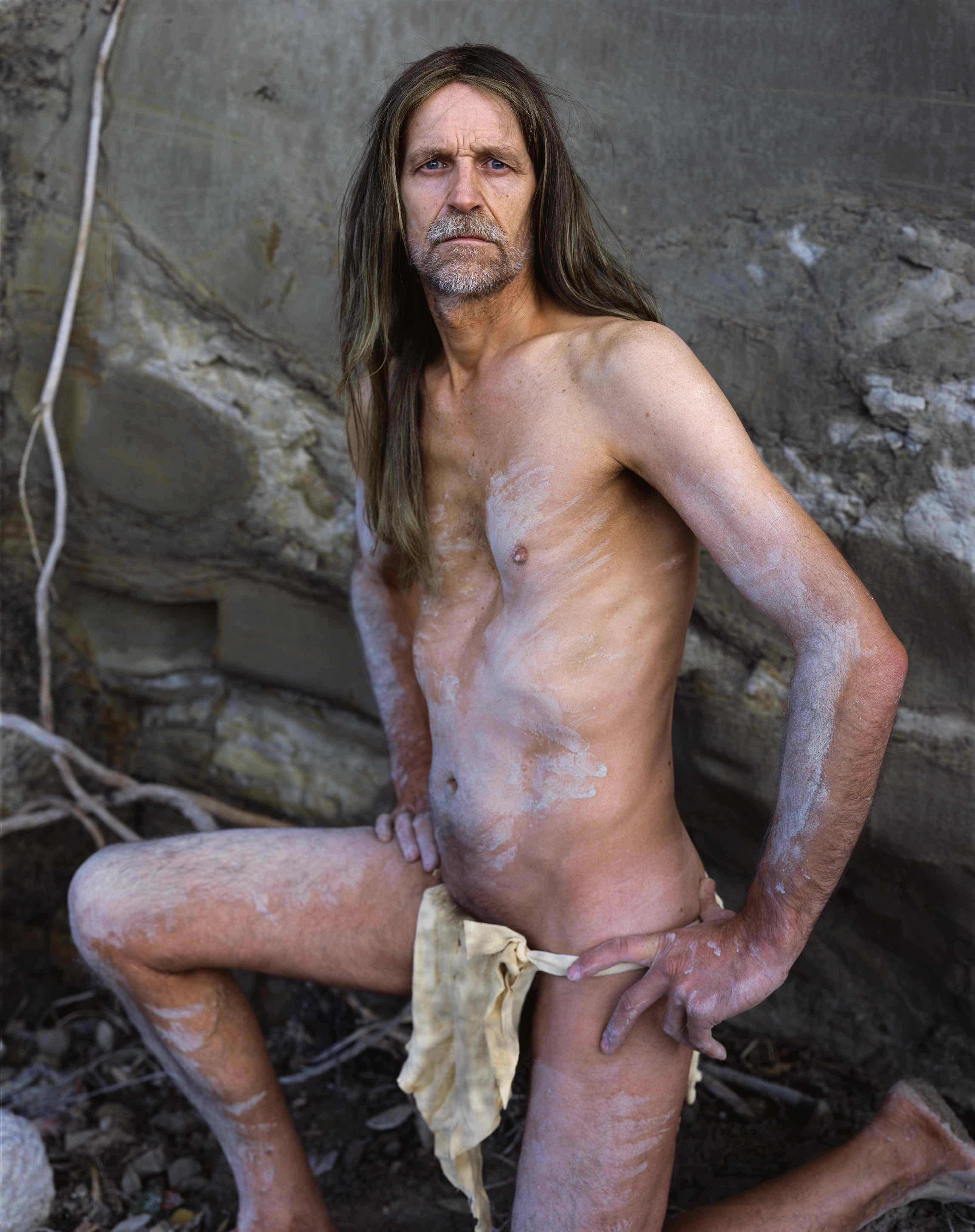
The Yvonne Todd literature is veined with references to cults. Todd and her commentators constantly drop the C-word, yet there are no explicit references to extremist religious groups in the work. There may be vague intimations of cultishness in a handful of images, say in the feral hair and hippie loincloth of Gunther (2010), in the space robes in Gynecology (2006), and in hints of ritual self-and-animal sacrifice in Roba (2004) and Goat Sluice (2006). However, cultishness pervades Todd’s entire oeuvre, including works which contain no such references.

Cults are groups of people who see things in a different way. They are communities within the community, at odds with it. Cults don’t call themselves cults, others do—it’s a term of derision and division. They are defined less by their irrationality than by their deviance, their departure from the common sense.2 A shared faith binds their members, while estranging them from society at large—any ‘us’ needs a ‘them’. And yet the mainstream has much in common with cults. Indeed, each has the same problem with the other—brainwashing. And the same response—deprogramming (or reprogramming).

Todd grew up in the 1970s, the heyday of cults. Christian sects, alternative religions, and counterculture lifestyles flourished. In 1974, the Kirk Labour government established the Ohu Scheme, encouraging rural kibbutz-style communes in the country (possibly as a way of encouraging freaks to leave the cities). Our most famous commune was Centrepoint, a ‘spiritual growth community’, just up the road from the Todds in semi-rural Albany, on Auckland’s North Shore. Bert Potter, a former vacuum-cleaner salesman, set it up in 1977. There, he sat in his peacock chair and railed against repression, guilt, and monogamy, and perfected his own brand of encounter-group psychotherapy. Like many other utopian communities, Centrepoint failed. In the early 1990s, Potter was put away, first for drugs, then for sex with minors. It would be another example of a familiar pattern.3

Back in the day, Todd had nothing to do with Centrepoint, or any cult, commune, or sect. She had an orthodox upbringing (her parents were accountants). But, because of this, the idea of cult life could animate her fantasies in ways that direct experience could not. She admits as much. She says her work Gunther was inspired by ‘memories of a commune in the Kaipara district near my uncle and aunt’s farm. I never went there but heard the stories from my cousins. The commune encouraged a casual atmosphere where nudism was practised. One of the mothers was often naked, sunbathing on a banana lounger, her overgrown pubic area a topic of lengthy discussion among my cousins and me. Instead of consuming lollies and biscuits like normal kids, the children of the commune ate handfuls of savoury yeast from large jars and had odd names like Shanu and Cyrus. We embellished their parents’ nudity to high levels of perversity, although the boring truth was that they were gentle hippies, self-sufficient, working the land, making feijoa wine.’4

Todd’s art is informed by things drawn from her environment, her background, particularly from the novels, TV shows, movies, and other cultural influences she absorbed in her formative years. Her oeuvre offers a mind-map to those talismanic reference points. As she adds works, integrating and cross-referencing new subjects, ‘the world of Yvonne Todd’ expands, old works informing how we read new ones, new works prompting us to reread old ones.

Todd’s world may be unified by her distinctive sensibility, but it also encompasses things that don’t usually get together on the same page.5 Its canon incorporates buck-toothed ugly ducklings (Feast of Phyllis, 2007) and swans (the tragi-glamorous Amanda, 2006), oversexed showgirls (Klerma, 2008) and dowdy Christians (Rashulon, 2007), primped page-three girls (Did Anybody Tell You That You’re Pretty when You’re Angry?, 2010) and grimy hippie dropouts (Gunther). As facets of her world, all Todd’s subjects are somehow interchangeable—stand-ins for one another.

For each of us, some aspects of Todd’s world will be familiar, others inexplicable. Todd’s work plays on how much and how little her world has in common with ours, where it meets ours and where it sheers off. Viewers will vacillate between feeling like members of her cult of sensibility (where it all makes sense) to being tourists in it (where it remains mysterious, exotic, opaque).

Essentially, Todd’s exhibitions take two forms. She makes portrait series, with examples of similar sitters presented in a similar format, like the cosmeticians in Bellevue (2002), the corporate executives in The Wall of Man (2009), and the dancers in Seahorsel (2012). These works survey the members of groups, suggesting communities of like minds. She also makes ensembles of diverse subjects (like The Book of Martha, 2003, and 11 Colour Plates, 2004). The subjects can include portraits, landscapes and still lifes (or, if you prefer a cinematic analogy, characters, location, and props). While images might seem unrelated, the ensembles’ effect is just as cultic as the series’. By presenting diverse images together, framing them under a suggestive title, Todd asks us to imagine that some hidden narrative, some occult knowledge, defines their otherwise inexplicable coincidence.

Even within the portrait series, there is a play between insiders and outsiders. Todd has said that Sea of Tranquility (2002) was inspired by the idea of Mormon pastors’ daughters. However, only three of the five portraits exemplify this idea. The soap-operatic beauty Alice Bayke and the turtle-necked Rebecca Weston don’t fit. Similarly, while the girls in Vagrants’ Reception Centre mostly wear prim Victorian dresses, Mordene and Ethlyn stand out in their contemporary garb. And, while all the other portraits are half length, Ethlyn is full length and plays a guitar. What’s more, all of the Vagrants’ images are inexplicably different sizes—bespoke. Underpinning this play of difference-within-the-same is an idea about individuals and groups—about the way people and things approach and deviate from a norm, and the way we read or intuit such conformity and dissension. Todd prompts us to compare and contrast, and to judge, seeking out heretics and orphans lurking within the club. She makes us discriminate.

Paradoxically, it is with the relatively homogeneous series that we become alert to differences, while, with the heterogeneous ensembles, we suppress them, looking for common ground.

.
Todd’s work may cite elements of mass-media ‘pop’ culture, but she is little concerned with what is truly popular in it. Her references are obscure. Who would have known that January (2006) is based on a heroine in a Jacqueline Susann novel, that Approximation of Tricia Martin (2007) refers to a Sweet Valley High character, and that Joan Kroc (2006) is a nod to the McDonald’s heiress?

Todd is a fan. Fans often pick out and champion peculiar, neglected figures and moments. Such singular, perverse attachments distinguish fans from the hoi polloi. Todd’s work exemplifies the way we cherry-pick from and edit mainstream messages to construct our own highly specified fantasy worlds and identities, transforming the Symbolic (normative images from the Big Other) into the Imaginary (our own thing).6

Such fringe enthusiasms are routinely called ‘cult’. TV shows, of passionate fans while leaving the majority cold. Indeed, the uninterest of others fuels cultic commitments and confirms fans’ suspicion that something special in their favourite things speaks to something special in them. Crucially, there are no solitary cults. To be cultic, obsessions must be shared; they must generate communities of like minds.

The Internet, with its global narrowcasting, has certainly enabled cultishness. Fetishists, perverts and other obsessives who previously feared they were one of a kind can finally find one another. A few years ago, I asked Todd if she saw a link between her work and pornography. She replied: ‘Not with the obvious X-rated kind, but perhaps the more obscure, specialised and, to the non-aficionado, quite boring, obsessively repetitive stuff: the pornography focusing on mundane tan-coloured pantyhose or matronly brassieres and flesh-tone petticoats.’7 Because of some bent or incident, fetishists invest chunks of the ordinary with an extraordinary allure. Of course, Todd is one of them too, trawling specialist sites on the Internet, seeking vintage frocks to use in her photographs, credit card at the ready.

When I look at Todd’s images, I often think: why has this image been made, and for whom? Who is it addressed to? Putting aside the obvious (that it has been made for us by Todd), it often feels like the work is addressed to a specific viewer with a peculiar interest in the subject or its treatment. Take Frenzy (2006). A big-toothed blonde, dressed in acres of tartan, reclines in a breeze-block basement. The image could be the work of an amateur photographer, making do with a toothy date, an odd dress and an inappropriate location. Or, did the photographer get it exactly how they wanted? Frenzy is at once prim and perverse. The dress is weird, monstrous, looming. You can’t see the girl’s body. Is the sexual centre of interest the girl (her hidden flesh), the dress (the strident tartan), those teeth (why not?), or, indeed, the basement itself?

Although we can’t quite pin it down, Frenzy reeks of someone else’s sexual obsession, and leaves us wondering, first, how their proclivities were formed, and, second, about the model’s complicity in them (or ignorance of them). Art writer Serena Bentley said Frenzy reminded her of the Austrian Josef Fritzl, who, for twenty-four years, imprisoned his daughter Elisabeth in his basement, for his pleasure.8 In the small town of Amstetten, Fritzl maintained appearances. No one suspected what lay beneath. Incidentally, his cover story was that his missing daughter had joined a cult.

Todd plays on the difference between the normative (conservative, prevailing, mainstream values) and the alternative (the subcultural, the cultic), and on the way they mirror one another. Todd commentators routinely namecheck a precedent for this—The Stepford Wives, the 1972 Ira Levin novel and 1975 Bryan Forbes film.9 In a white-bread, white-picket-fence Connecticut suburb, women have become compliant mannequins—puppets. The men have replaced their wives with glamorous, docile, submissive fembots. Stepford is a cult, a secret society, albeit one maintaining appearances more normal than normal, straighter than straight. One is reminded of the cosmeticians in Bellevue, who seem both hyper-conservative and alien. Are they authority figures or victims of their own philosophy?10 Similarly, what would it take for the corporate executives and specialists in The Wall of Man to become charismatic cult leaders? Are they already? These days, every respectable father or father figure is considered a potential abuser. Studio photography is typically used to create positive official images. Todd’s images nag at that expectation.

Todd’s 2011 series Seahorsel also conflates the conservative and the cultic, scrambling the look of a mainstream clothing-catalogue shoot with obscure ‘ritual’ actions involving beachy props (shells, seagulls, seaweed, and sand). The key work, Glue Vira, is an encasement fetishist’s dream. It features two women in flesh-coloured body stockings. A glamorous hyper-feminine blonde, with big hair, is posed like a puppet on a string, or as if hypnotised—pure Stepford. A brunette stands behind her. Fabric hangs limp from the arm of the blonde, while fabric billows on the arm of the brunette, implying motion and agency. It’s hard to know if the brunette is another poseable puppet or the puppet master. There’s a creepy eroticism and beauty to the image.

The idea of becoming a doll is not without its appeal. In Seahorsel, Todd acknowledges that even men might enjoy it. Morton features a Ken-doll-like man, with hunky good looks, straight from central casting. His padded neck brace and bodyhugging shirt look like the body of a soft-toy. Todd’s title refers to Morton Bartlett, the American outsider artist, who was shown alongside her in the 2005 exhibition Mixed-Up Childhood. From 1936 to 1963, Bartlett, an orphan and perennial bachelor, made a family of lifelike plaster dolls (the family he never had) and photographed them. His doll works seem both conservative (happy families) and uncanny, creepy (anatomically correct). It is hard to know if Bartlett was an innocent or a pervert (and perhaps the perviness is something we bring to his works). Either way, Todd’s portrait references Bartlett’s implicit dream, to be somehow at one with his doll family.

Todd is a master of the line call and the flip-flop, with everything on the verge of turning into its opposite. Because of this, her works raise thorny questions about women’s agency. Her oeuvre is full of sad cases, cripples, Miss Lonelyhearts, and other victims of circumstance raised to the state of heroines, worthy of a studio portrait. I believe Christianity is at the root of this, for giving us an image repertoire of suffering martyrs turning the other cheek and receiving grace. Todd lets us wonder whether and to what extent her characters are genuine sufferers denied agency (doormats) or self-indulgent thespians ready for their close-ups. Do her female victims own their masochism or abdicate responsibility, blaming their TVs, lovers, or charismatic cult leaders? Todd doesn’t want us to fall down on either side of this interpretive line, but to see the line and the ways our desires inform our judgements.

.
This comes to the fore in Todd’s latest series, Ethical Minorities (Vegans) (2014). With seventeen images, it is her largest series to date. Todd sourced her subjects through ads in Facebook and in Vegan New Zealand magazine, asking for vegans to front up and be counted. She shot those who responded, plus herself (she is a vegan too). Each sitter volunteered to be photographed as a representative of this diet subculture, this vegetarian subcult.11

Vegans are more irritating than vegetarians. Their contrived special needs can be frustrating: they interminably grill wait staff and compel others to switch restaurants, or opt out of the rituals that bind us as a community. They seem to sanctimoniously flaunt their difference, their ethical status. They may presume superiority, but surely these benign extremists are simply princesses with peas. And, quite likely, it will not stop with food, but will be linked to other peculiar values and over-sensitivities. Being vegan is just the annoying tip of an annoying iceberg.

Why photograph vegans? And what do Todd’s photographs of vegans tell us? Actually, nothing in Todd’s images tells us that her sitters are vegans. That is only revealed by the series title. The work begs the question of whether one can detect a vegan by their look, and whether you deduce anything about them as a group by visually surveying them. Evidently they have nothing in common, bar their invisible veganness, but will that halt our judgement? Todd plays with and against stereotype. Some of her subjects are overtly subcultural, wearing their marginal status with pride (one has tattoos and piercings, one has dreads, one enjoys Lycra, another tie dye). Others seem defiantly normal, deceptively straight. A woman in a blue jumper looks way too wholesome—a generic mum. A young couple seem too squeaky clean, posed perfectly—it’s wrong.

This community-within-the-community is presented for our scrutiny and judgement. Todd coaxes out our prejudices, prompting us to intuit veganness in contradictory qualities. In one case, we might associate it with leanness, in another with tubbiness. We might link it to pierced and tattooed skin and to clear unblemished skin. And so on. Todd prompts us to operate like those Nazis who condemned Jews at the same time for their poverty and their greed, for being vermin and effete, for being apart and cosmopolitan. Perhaps Todd is asking whether vegans are a community at all. And, if they are, whether that status comes from them (her examples all raised their hands to be counted) or is imposed on them by us (as prejudiced viewers). Have they been captured in their innocence or their conspiracy?

In making vegans visible, Todd suggests we think of them as a secret society operating amongst us, hiding, undetected. Are vegans the chosen? Are they food fascists looking down their noses at us, condemning us for our dietary crimes? Or, do we condemn them for their presumption, their oddness? Who is oppressing whom here? Are we in the right, because we have the numbers? Or are they in the right, because they don’t? Who has the high ground, the moral majority or the ethical minority?

In previous works Todd has used herself as a model, usually heavily made-up and/or photoshopped, for instance, in Martha (2003), Self Portrait as Christina Onassis (2005), Self Portrait as the Corpse of Sandra West (2008), and Greasy Harpist (2010). But what does it mean for her to include her unvarnished self here, wearing slovenly tracksuit pants? In including herself among the vegans, is she identifying with them rather than us? Or, is she going undercover as a double agent among her own (to report back to us), continuing her duplicitous shell game on a new level? Todd’s work has always played on the thought of being a member of—or estranged from—a community. But, here she is, framed within a world of her making, and it is still not clear whether she belongs.
.
[IMAGE: Yvonne Todd Gunther 2010]


  1. From the film’s advertising copy.
  2. Christianity began as a heretical Jewish cult, at odds with the mainstream, but became a religion. Also, some might argue that Raëlism, with its alien designers, is more plausible than a Christianity premised on a creator god and a virgin birth.
  3. Austrian actionist artist Otto Muehl, founder and leader of the Friedrichshof Commune, was also locked up for drugs and sex with minors. David Berg (aka Moses David), the leader of the Children of God, pimped out his female disciples to lure men into ‘The Family’—he called it ‘flirty fishing’—and is reputed to have been a paedophile.
  4. Yvonne Todd, ‘Do I Even Like Photography?’, Yvonne Todd: Creamy Psychology (Wellington: Victoria University Press, 2014), 29–30.
  5. Todd might be quick to remind us that construction worker Larry Fortensky married Elizabeth Taylor, after they crossed paths at the Betty Ford Clinic.
  6. This is what happens in subculture, where elements and images from the dominant culture (the mainstream) are appropriated and repurposed in resistance to it. See Dick Hebdige, Subculture: The Meaning of Style (London: Methuen, 1979).
  7. Quoted in Robert Leonard, ‘Why Beige?’, Dead Starlets Assoc. by Yvonne Todd (Brisbane: Institute of Modern Art, 2007), 61.
  8. Fritzl’s crimes were discovered in 2008, well after Todd made Frenzy.
  9. Another precedent is Rosemary’s Baby, the 1967 novel by Ira Levin (again) and 1968 movie by Roman Polanski, with its satanic cult next door.
  10. While The Stepford Wives presents itself as a feminist critique, its protagonist, is played by textbook beauty Katherine Ross (also remembered as the love interest in The Graduate). As much as the film seeks to critique absurd standards of female beauty and compliance, the filmmakers couldn’t resist undermining their message by casting eye candy in the lead role. They have their critique and eat it too.
  11. ‘Ethical veganism’ is a vegan subcult. Its followers not only eat a vegan diet they also refrain from and oppose the use of all animal products.
Viviane Sassen: Detail in the Shadows

Photofile, no. 95, 2014.


I had not heard of photographer Viviane Sassen when I chanced upon her
Lexicon (2005–11) in last year’s Venice Biennale.1 I came to the work cold and it confused me. The thirty smallish images were shot in a more-or-less documentary style. They looked like they were taken in Africa, or somewhere similar. The series encompasses images of people (mostly black people), places, and things. A man wearing whiter-than-white trainers bears a coffin on his back (Coffin), clothes hang on plants to dry (Laundry), and a dead tree hosts a yellow fungus (Witch’s Butter). Lexicon evokes a familiar tradition—photographers going on safari to record exotic locales and picturesque locals—but it complicates and exceeds it.

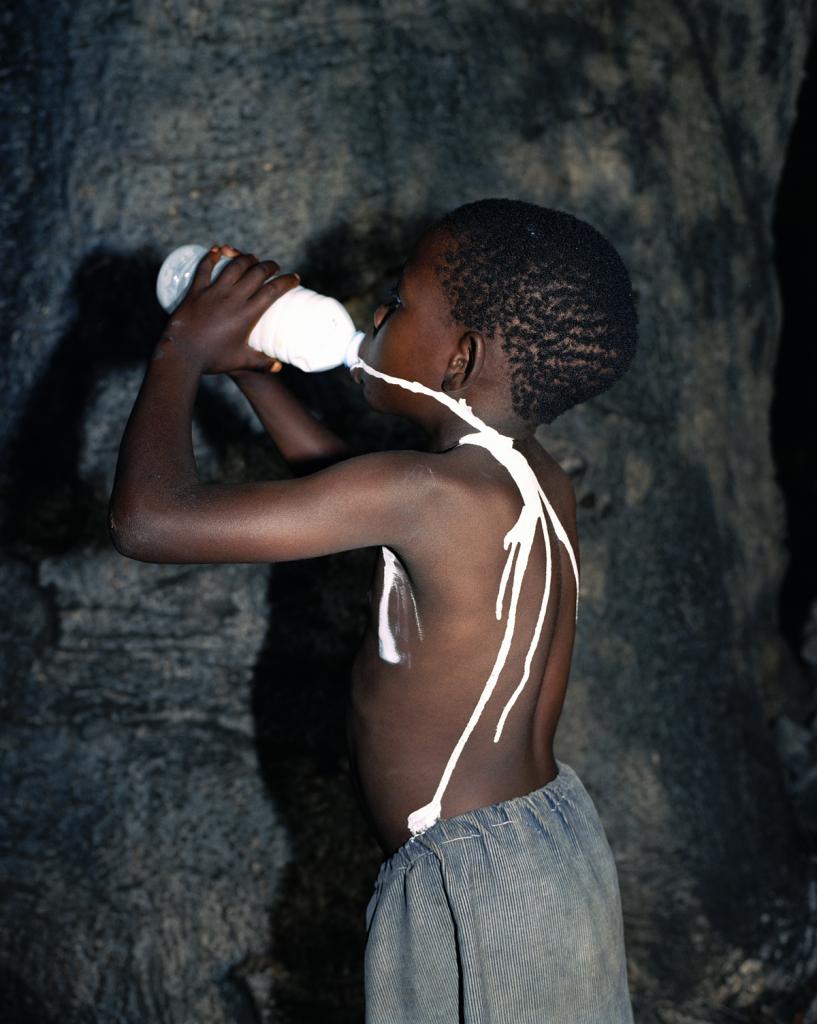
The more I looked at the work, the less simply documentary it felt, in style or ambition. Everything is consummately art-directed. In one tell-tale image (Milk), a boy dribbles white liquid over his black skin, but it is too viscous to be real milk—it looks like special-effects milk. With Lexicon, it is hard to clearly distinguish the aspects that are found from those that are contrived, what belongs to Sassen’s subjects and what she brought to them—in short, what to believe.

Lexicon is puzzling. In so many ways, the images are neither one thing nor the other. The sitters may seem a bit colourfully Third World, but they are also well-dressed and urbane. Despite many references to death and dying, there are no toothless old people; everyone is beautiful—sexy even. The images are redolent with the textures of real lives lived, but also laced with formal conceits and mannerisms. As much as they are a personal response to their subject, they are also a reflection on photography and its tropes. Ambiguity abounds.

In Venice, when I read the wall text, I got the backstory. Sassen is a Dutch fashion photographer, based in Amsterdam. She has worked on assignments for the likes of Diesel, Miu Miu, Stella McCartney and Louis Vuitton, and has published in edgy alternative fashion magazines, including Purple, i-D, Dazed & Confused, Fantastic Man, and POP. For three years, as a small child, she lived in a remote location in Kenya, where her father, a doctor, worked in a polio clinic. It wasn’t until she was five that the family headed back to The Netherlands. Africa—the place of her formative memories—is a home that wasn’t her home. And, so now, she returns there, to make this work.

To me, this explains a lot about the pictures. Sassen is neither a tourist nor a local. She gets up-close-and-personal with her subjects, yet her images remain mysterious, obscure, cryptic. It is hard to see what is going on, to fathom the significance of subjects and gestures. Perhaps this reflects her childhood experience, of being in the fray yet excluded, a white person in a black culture, a child in an adult world, observing without necessarily understanding.

Lexicon has an accumulative, epic structure. While it offers no clear narrative, there are strings of association between images. Lexicon links references to reading, sleeping, dreaming, drowning, and dying. It includes images of sleepers (Belladonna and Saint Louis), of a swimmer with their face submerged (Nungwi), of a man whose identity is concealed and vision thwarted by an open book (Codex), and of a white woman lying in state, with leaves over her eyes and mouth (Inhale). There are also images of body bags, coffins, and graves (Three Kings, Coffin #2, Nadir, and Five Candles). Many of the images were drawn from Sassen’s book Parasomnia, whose title suggests sleeping disorders—the confusion of the everyday and the dream.

The surreal quality of Lexicon is keyed to its subject matter—Africa. Dreams bridge inner and external worlds. They may be in our heads, but they have their roots in unprocessed and disavowed real-world conflicts. We may be the authors of our dreams, yet we experience them as coming from outside us—a cryptic reality to be deciphered. Similarly, Sassen’s work prompts the question of whether (or to what extent) Africa (hers or ours) is an external reality or a projection, a state of mind. She doesn’t answer the question, but lets it hang.

In Sassen’s book Flamboya, Edo Dijksterhuis writes: ‘No part of the world has been so shaped by the images of outsiders as Africa. Images, what’s more, that are full of clichés. Africa, isn’t that mainly starving infants with distended bellies and fat flies swarming around their tear-filled eyes, or burned down huts and severed limbs? Or rather more positively: sun-baked pictures of bone-dry savannas, with elephants and herds of zebras parading before the lens of a National Geographic photographer. At best, the African comes across as a ‘noble savage’, as in Leni Riefenstahl’s highly aesthetic portraits of the Nuba in the Seventies.’2 Africa is a hot potato, an overdetermined nexus of romantic fantasies, racist prejudices, and colonial guilt. But, as much as people generalise about it, it remains huge—culturally and politically diverse. Sassen never specifies where on the continent her individual images come from, but Lexicon does not claim to represent a generic or mythic Africa. It is, in both senses, too partial—it is a personal response and it is overtly incomplete.

For white people, black skin can be a mark of the others’s otherness, their social exclusion. But, for Sassen, raised in a black country, it is the opposite. It is a reminder of her own exclusion. She has said: ‘It’s a more beautiful skin color. When I’m the only white person in a black society, I feel very nude. And when I see other white people in Africa, they’re white, pinkish, ugly and sweating … When I’m in Africa, I feel like I’m coming home, yet I also feel like I’m not one of them.’3

Sassen seems entranced by how black skin appears. In her photographs, black bodies merge into shadows and into one another. Faces coyly emerge from the darkness or retreat into it. Sometimes they become featureless shapes—black holes.4 In photos, black is underexposure—absence of information. In Sassen’s photos, this literal dis-appearance is haunted by problematic metaphors. One of the eternal clichés about Africa is that it is unknowable, incommensurate—the dark continent. At the same time, it is also a convenient screen for our presumptions, including the very fantasy that it is unknowable). Sassen’s shady faces engage such problematic associations. While her images offer hooks to hang our baggage on, the hooks are weak—they aren’t strong enough to hold those ideas. In inviting and resisting our interpretations, Sassen makes us conscious of the limitations of our interpretations.

Asked about her politics, Sassen has said: ‘I’m aware of the whole debate about my depicting black people in Africa as a white European woman, and of me being in control because I’m carrying the camera. But I’m not really interested in that debate, because for me the work comes from a very personal private place.’5 This ‘very personal private place’ is not our place. Sassen’s relation to her subjects is unusual—stemming from her peculiar childhood circumstances. Lexicon is compelling because it communicates something of Sassen’s unique relation to her subjects while also engaging us at the level of our own, more generic cultural predispositions. The framework of her interests and subjectivity locks horns with our own. The work is in two minds.

Sassen’s title is both a key and a red herring. In linguistics, a language consists of two parts: the lexicon and the grammar. The lexicon is the word-stock, while the grammar is the rules by which those words can be arranged into meaningful statements. Both parts constrain what can be said. With her title, Sassen asks us to think of her images as the visual equivalent of words, but lacking a grammar. But, how could these photographs function like words when, as photographs, they are specific, not abstract? Further, if she is tasking us to supply the grammar, into what syntax could we meaningfully arrange these images? In calling the work a lexicon, Sassen frames it as something complete—the full word-stock from which she or we must compose what she or we want to say. But, this suggestion only points to its implausibility—the work’s radically incomplete nature. Indeed, Lexicon is more of an anti-lexicon, with no pretence to abstraction, definitiveness, or universality. Sassen is not summing up Africa. There is no last word.

Sassen has said: ‘I try to make images that confuse me, and I hope they confuse others, too.’6 Sassen frames her audience as much as her subjects.
.
[IMAGE: Viviane Sassen Milk 2006]

  1. Lexicon is drawn from two bodies of work, each published as books: Flamboya (Rome: Contrasto, 2008) and Parasomnia (Lakewood NJ: Prestel, 2011).
  2. Edo Dijksterhuis, ‘At the Visual Level of a Whisper’, in Flamboya.
  3. Tim Murphy, ‘About Face’, New York Times Style Magazine, 8 November 2012.
  4. In Kinee (2011, not in Lexicon), a model’s black face and hair become a glamorous inky splodge, like a Rorschach blot. Perhaps Sassen is suggesting that, for us, Kinee’s meaning is what we bring to her.
  5. Tim Murphy, ‘About Face’.
  6. Viviane Sassen in Aaron Schuman, ‘Viviane Sassen: Parasomnia’, Aperture, no. 206, Spring 2012: 64.

Mikala Dwyer: Drawing Down the Moon

Mikala Dwyer: Drawing Down the Moon (Brisbane: Institute of Modern Art, 2014).


In the 1990s, Sydney artist Mikala Dwyer became famous for creating playful installations that provocatively conflated pedigreed modern art with the amateur, the infantile, and the feminine. Since her 2000 retrospective at Sydney’s Museum of Contemporary Art, her works have moved off, in a new direction, increasingly mining the irrational, the paranormal, the occult. Dwyer has convened circles of anthropomorphic, totemic objects, suggesting seances and covens; has toyed with black-arts paraphernalia, including candles and Ouija boards; has employed palm readers and clairvoyants to serve gallerygoers; has made art professionals dress up as crystals; and has collaborated with neodadaist Justene Williams to channel spirits of female convicts of yesteryear. For Dwyer, it is always about the return-of-the-repressed. As much as formalism seeks to drive out the amateur, the infantile, the feminine, and the irrational, in her work they always come back to haunt it.
.
Mikala Dwyer walks Robert Leonard through her show Drawing Down the Moon, Institute of Modern Art, Brisbane, 2012.
.
Robert Leonard: This show surveys your recent work concerned with the occult. The first work we see is Moon (2009)—a big hessian banner, with hand-cut felt-appliqué letters. It looks like something one might find in a child’s bedroom.
.
Mikala Dwyer: I wasn’t trying to be childish. I associate the work more with Scandinavian modernism, with its preference for wholesome, modern materials—hessian and felt. The words, which are placenames for the swamps, bays, marshes, and lakes on the Moon, were devised by a seventeenth-century astronomer, Giovanni Battista Riccioli. They make for a nice poem. I like the range of names. It’s interesting what’s included and what’s not. There’s success, love, and rot, and there’s rainbows, sleep, fear, and forgetfulness—but no sex. Riccioli projected his Jesuit world view onto the Moon. Here’s this inert, lifeless object in space, and it gets all these human sentiments projected onto it. I’m interested in the way that something so ‘other’ can be anthropomorphised.
.
Wall Necklace
(2012) is also in the first room. It’s like a charm bracelet, a builder’s tool apron, or Batman’s utility belt. But it’s hard to work out what the clip-on tools are for; what they are supposed to do. Wall Necklace brings together magic spells and constructivism.
.
It’s all plastic and Perspex and big geometric shapes. It’s a symbolic key chain, with keys to open the other works in the show. It is one of a series of necklaces I made after the death of my mother, who was a silversmith. I think that many of the forms I’ve worked with in my art I subconsciously lifted from her. I hadn’t realised quite how many until I began to pack up her stuff. Perhaps these forms were passed on to me through my DNA.
.
In the Necklace, there are clean constructivist objects in high-tech materials, but also rustic clay ones. It’s a mash-up of modern and primitive.
.
Jewellery is a mark of civilisation. They recently discovered that the Neanderthals made jewellery, which makes them more sophisticated than previously thought—they could ritualise and symbolise.
.
What are the booze bottle and the soft toy for?
.

The bottle is my mother’s whiskey. She was fond of cheap whiskey and I had to bring her cases of it, weekly. When she died, there were lots of bottles left over. Rather than drink this one, I put it in the Necklace. It’s literally and symbolically ‘a spirit’. It’s a votive offering, like you might find in a voodoo cemetery. The doll is a real voodoo doll made by a witch. I had to judge an outsider-art prize and this woman dragged me over to see her suitcase full of dolls. She was strange-looking and very determined. She got up at 7 o’clock every morning and sewed dolls all day. They were misshapen and smelled bad. I had this one in the corner of my car for a while, but it kept haunting me. I couldn’t let it go, either the smell of it or the shape of it. It just kept insisting that it be somewhere, and somehow it found its way into the necklace.
.
You’re an animist. You talk about objects as if they had agency.
.
I think all matter is conscious to some degree. Everything has a frequency. Sometimes, it takes a while for material to warm up to you so you can actually sense it. You have to be in an attentive state. I try to get to a point where things can speak for themselves rather having me impose my voice upon them.
.
So, are you channelling the objects?
.
No, the objects are doing the channelling. I’m just the props person.
.
Is there a story behind Alphabet for Ghosts (2011)?
.
It’s the product of a collaboration between Alterbeast (Carla Cescon, Tina Havelock Stevens, and myself) and Rolande Souliere. We were working on an exhibition at Penrith Regional Gallery. The building was bequeathed by a former occupant, the artist Margo Lewers, who was instrumental in introducing Bauhaus ideas to Australia. She was a friend of my mother’s, and cantankerous by all accounts. Everyone says the place is haunted, so we conducted a séance. Out of respect for being in Lewers’s home, we decided to summon her for some advice on how to proceed with our work. We wanted to collaborate with her. We made a larger-than-life Ouija board using a Bauhaus font and made a planchette out of Perspex. It’s shape was based on forms in Lewers’s work. By echoing her sensibilities, we offered her a familiar channel to speak to us through.
.
There’s an obvious contradiction in using a rational modernist language to open up a paranormal portal. As a modernist, Lewers seems unlikely to have been sympathetic with occultism.
.
There are lots of closet believers, and I’m sure there are some modernists among them. People tend to see science and occultism as opposed, but Newton was into the occult and William Crookes, who pioneered the cathode-ray tube, was into spiritism. Séances emerged during the rise of science. Spiritists were fascinated by magnetism and electricity.
.
How did your séance go?
.
It was successful. With séances, people expect to see chairs flying across the room instantly, but it’s a slow process. You have to sit there, shut up, and listen. It can take ten hours, it can take ten days. Lewers definitely turned up. I saw static electricity shuffle across the room from where her bed was and disappear. We had a lot of video and sound equipment for the show and it all broke down. The lights went out. It was like she’d got the shits and was fucking up all our equipment. Without a body, it’s hard to communicate, but she did so through electrical interference.
.
Your Costumes (2012) are also equipment for tuning in to the world.
.
The beauty of being an artist is being able to approach knowledge in a lateral, playful way. As an artist, if I want to learn about something, I don’t have to undertake a university course; I have other means. I was thinking, could knowledge be absorbed by wearing a costume rather than reading a book? Could I create costumes that impart knowledge? I started thinking about Friedrich Fröbel’s time as a crystallographer, before he went on to invent kindergarten. I wondered if people could learn about crystallography from the crystal’s point of view by wearing crystalshaped helmets.
.
The helmets look like Ku Klux Klan hoods.
.
I did a performance using some earlier Costumes for my show Monoclinic at Hamish McKay Gallery, Wellington, in 2008. During the opening, I had local art curators and critics—‘judge’ types—wear them. It was an experience for the people wearing the costumes and for the people looking at them. You couldn’t identify the performers until they disrobed.
.
The Costumes have adult associations (I think of Hugo Ball and the Cabaret Voltaire) but also childhood ones (primary-school theatre productions).
.

Yes, they come from both. The idea is extended in the two performance videos that I made with Justene Williams, which drew on Hugo Ball. They came out of my residency at Sydney’s Cockatoo Island and its convict history. Both responded to the history of women on the island. A bush ranger imprisoned there, Fred Ward—also known as Captain Thunderbolt—was rescued by his Aboriginal girlfriend, Mary Ann Bugg. In our video, Captain Thunderbolt’s Sisters (2010), Justene and I clamber around a bunker with high heels gaffer-taped to our feet, wearing stripey prison garb and helmets with slits to look through. We climb around the room without touching the floor, tapping out a communication to the ghosts and to one another with hammers. At one point, we exchange hammers. A lot of Justene’s work rifles through forgotten female histories that run parallel to well-known men’s histories. The other video, Red Rockers (2010), was set in a cave on the island.
.
It looks like a cross between a dada performance and an exercise tape. It’s hysterical feminism.
.
We were playing constructivist whores, sex machines from the future. At the IMA, I put the videos on flat screens inside a cavity in a wall. You viewed them through slits cut in the wall as you passed through a tunnel on your hands and knees. It was like a sex-shop peepshow, but unsexy, with us in weird costumes. You pass through the tunnel like a warder, checking on the inmates, but you also share their viewpoint, because you are looking through the slits in the wall like they look through the slits in their helmets.
.
When you go through to the other side of the wall, it’s a bit of a letdown. You have to drop down and crawl through this tunnel—this portal to ‘the other side’—but when you got there, there are just these burning candles.
.
The candles are a scrying tool, like a crystal ball. You can gaze into the flames, blur your vision, unstructure your thoughts, and go into a kind of daydream. You can put yourself into a mindframe where spirits can give you messages.
.
Lamps (2010-2) is a gathering of totemic lampstands.
.
Lamps weaves together hope and despair, protection and punishment. There are rectilinear lampstands, which suggest totems and gallows—they could protect you, they could kill you. They are built in this functionalist style, in a simple red, black, and white constructivist palette. Some of them have black-and-white prison stripes. (There are also a couple of plain black tree-trunk lampstands, which I took from another work. I included them as anomalies. The work would look too regular if it was just the rectilinear stands.) I imagine the lampstands surrounding a prison compound. Some incorporate slotted boxes that suggest letterboxes, bird boxes, and ATMs. All sorts of things hang off them, including glazed clay weights, which are like handmade philosopher’s stones, and lights—a hopeful gesture. I placed found ornaments all over them. There are all sorts of things, including a crazy Asian conehead version of the Willendorf Venus. There’s a contrast between the functionalism of the lampstands and these tchotchkes.
.
There’s a TV antenna completely coated in silicon glue.
.
Perhaps it has lost the ability to receive messages, perhaps not.
.
The lampstands are almost high enough to hang a person.
.
Or a small child. But they are rickety. They couldn’t support a body without falling over. I’m just using them for hanging lights. The lights stand in for bodies, for life force. We are electricity.
.
By adding the figurative ornaments, the lamps become a landscape.
.
I think of Lamps as a high-rise landscape, which the ornaments populate. The smallness of the ornaments implies vast scale. The lamps are close together, but, from the ornaments’ points of view, they are separated by huge chasms.
.
You made an updated version of The Additions and the Subtractions, where a diversity of sculptural totems gather in a circle. Where did the idea come from?
.
In Berlin in 2006, I was asked to collaborate with an artist duo. They were used to collaborating, but only with each other. So I decided to do an anti-collaboration and make a totally selfish work. I created my own psychic fortress, away from them. I’d been thinking about Freud’s collection of antiquities, which were like his imaginary friends. He travelled with them, and, when he fled Vienna, he took them with him. At the Freud Museum in London, they are still lined up on his desk as a screen between him and his patients. I wanted to do something similar. My fortress—a rubber tent—was guarded by my own amateurish versions of Freud’s figures. The circle works evolved out of that thought. I’ve made a lot of them, probably one per year since then. I recycle elements. I add in pieces and take others out, which is why I call them The Additions and the Subtractions. Each time, I add a new site-specific element.
.
The circle is a ritualistic power form. I’m reminded of spaces like Stonehenge, spaces for initiates.
.
The circle is a convenient system. I can place anything I want into it. It tolerates difference. It unifies all the disparate content. It provides a focus, an inside and an outside, and a threshold. I want to see how people negotiate that threshold. I like the fact that people are tentative about entering the circle, but, once they do, they become performers in relation to other people on the outside, who become ‘the audience’.
.
Some individual totems are flimsy, others are hefty; some are ugly, unformed, or undecided, others pretty, resolved, or refined.
.
Yes, they reflect the chaos of thought. They are half-thoughts, neither-this-nor-that thoughts, the sorts of thoughts that wander in and out of my head during the course of a day. There are short and tall thoughts, deep and shallow thoughts, figurative and abstract thoughts. Some totems are mostly made, some mostly found. Some are highly crafted, some crap. Just as contradictory thoughts co-exist in my head, disparate totems co-exist in the circle. Within its tight geometry, the totems can be themselves. The circle contains their difference without diminishing it. At the same time, as soon as you put one totem next to another, you create a relationship. There are families and factions within the circle. The totems speak to one another through rhymes and contrasts of form, material, and iconography. A lot of them are argumentative, and the circle allows them to remain so. I don’t want to suppress argument. I also don’t want to either homogenise or prioritise. The circle is ecumenical.
.
With so many examples to compare and contrast, the Brancusi-esque play between object and base is heightened. You play out so many possible relations between object and base.
.
There are small objects on large plinths, large objects on small plinths. The totems are all different heights, suggesting a bar graph, a psychic barometer.
.
The work is also a lexicon of art-making techniques.
.
I think of Friedrich Fröbel’s twenty Gifts, which capture all those making impulses that people have. Spells come out of similar impulses: to gather, to join, to hold, to model, to build, to protect, to destroy.
.
Let’s look at some of the individual totems. One is an extremely tall plinth, with figurines around the base and then a few on top. It suggests an upstairs-downstairs hierarchy, a politic between characters on top and characters below.
.
Yes and no. On top, there’s Christ in ascension, but also a smoking Buddha, a Venus figure, a witch, and a misshapen lump of clay. Witchcraft is more earthbound, which is why I find it interesting, but it’s there with the resurrected Christ. This totem expressed all my confused feelings about religion—transcendence and immanence.
.
One of the totems is an upended couch pierced by a length of red timber. I was reminded of The Omen, where photos of future victims reveal a portentous shadow passing through them, as if they had been speared from on high.
.
That couch had been in my studio for ages and I had an overwhelming desire to spear it, to murder it. To me, that couch is a body, it’s a black monochrome, it’s ‘IKEA’, and, upturned, it becomes a cubby-house. It’s been moved from its dormant position to an awake one—you can’t sit in the couch, you can’t be a couch potato. I’ve pulled the couch out from the wall, so you can see its underside, and, in the cavities there, I’ve placed objects: Cuban cigarettes, bottles of wine, and some paperback books. So you can have a smoke, a drink, and a read. People were stealing cigarettes at the opening. The objects invite you to be a bit naughty. The books were given to me by a friend who works with mentally ill people. One of the people she works with gave them to her. It’s a peculiar collection. The titles read like a poem, like the placenames in Moon.
.
Several totems are banged-up bits of sheet copper on plain MDF plinths. They are dispersed throughout the circle.
.
Because my mother was a silversmith, I think a lot about metals. Copper is a conductor and it’s malleable. Placing copper pieces throughout the circle is a way to conduct the conversation—the electricity—through the circle’s neural network. Some of the copper forms have bits of quartz and coal stuck to them, suggesting some kind of alchemic process. One totem is made of metal parts held together by magnetism. Invisible forces are a fact of life. We are only standing here because of magnetism. It’s more earth magic.
.
Tell me about the freestanding curved Perspex sheet with the glowmesh.
.
The Perspex looks like a screen to get dressed behind, except it’s transparent. I think of it as a kind of radiation shield; you stand behind it to protect yourself from the circle. The Perspex is the shield and the glowmesh is a protective costume.
.
A lot of the totems are about secrets.
.
Like the plastic display-dome ones. The domes are grubby, so you can’t see what’s inside. They are also completely glued up, so you will never access their secrets. Sometimes it’s better not to know. I inserted messages on paper scrolls into some of the totems, Wailing Wall–style. Some of them came from séances—they are letters to the dead. They are rolled up, so you can’t read them.
.
Why are rituals so important to you?
.
Because they slow us down. After my mother died, I had to pack up all her stuff. I had to do it way too fast. I thought, what if, instead of putting all her letters into the bin, I could burn them and say a prayer, and somehow embody the ancestral knowledge in a more meaningful, osmotic manner.
.
You called your wall painting Spell for a Corner (2012). Why does a corner need a spell?
.
It needs to be liberated from itself. Spell for a Corner is a salutation to the Moon, entreating it to come down. For me, bringing down the Moon is all about questioning the opposition between the transcendent and the earthbound, idealism and materialism—the continual problem of the woman. The painting’s geometries are my ponderings on how to do that. Of course, Moon is also about bringing the Moon down, but there it is by bringing it into language.
.
The wall painting reminds me of the early days of abstraction, when it was freighted with all kinds of metaphysical and occult speculation.
.
I like the Swiss healer-painter Emma Kunz (1892–1963). Her symbolic mandala-like abstracts feature intricate webs of lines. She made them using a divining pendulum. They were not made to be hung on gallery walls, but to lie on the floor between her and her patient. She used them as energy conduits through which she could realign and rebalance her patients’ psyches.
.
In The Silvering (2010–2), a sheet of Mylar is suspended from Mylar party balloons.
.
The balloons are helium-filled. I’m fascinated by helium. Most helium is helium-4, which is believed to have been formed during the Big Bang. It’s ancient. Mylar is a high-tech, space-age material, which was used to insulate lunar modules. The Silvering is a floating ghost sculpture. It does what you don’t expect sculpture to do, to hover and drift around the room. You can interact with it and try to herd it around. I was thinking about how to float a void—the balloons being like mirrored zeros. While many of my other works are earthbound, The Silvering is trying to lift off. Nevertheless, the balloons leak and need to be pumped up every day. The work is constantly falling back to earth, confounding that idealism. There’s hubris there. Again, there’s a connection with my mother, as a silversmith.
.
The IMA version is different to previous versions. It’s like a mirrored cave.
.
That came about by accident. The first Mylar sheet we used was too heavy, and, when we took the weights off, the balloons couldn’t lift it. We started transferring the balloons to a lighter sheet, which floated up over the other one, making this two-level structure, one sheet airborne, one earthbound, creating a walk-in cave. For some time, I’d been trying to make a cave that would float, so I was pleased. I left it. I like the idea of having a primitive kind of architecture—a cave—in space-age materials, and floating. There’s a strong desire to make buildings float, but it’s constantly thwarted by the need for plumbing.
.
A Shape of Thought (2007) developed out of the Empty Sculptures.
.
For the Empty Sculptures, I used a plastic used in vacuum forming. I discovered it through a New Zealand props-maker working on Lord of the Rings. It’s malleable—it goes soft at low temperatures. I heat it with a hot-air gun, wrestle it into shape, and weld it to itself. I hate working with it. It’s disgusting. But I constantly find new possibilities for it. The material is used to create clean, hard-edged, repetitive geometric forms for packaging, but that’s not how I use it. My forms always have an organic quality.
.
The Empty Sculptures make me think of rocks, but they are the opposite: they’re hollow (all skin), synthetic, transparent, and as light as a feather. They are like ghost rocks.
.
My Empty Sculptures are hauntological—they play on the edge between being and not-being. You have to negotiate them in space like boulders, but they are transparent. You can see into them, through them, and they distort your view. They’re an odd combination of the lumpy-and-primitive and the synthetic-and-modern. In A Shape of Thought, I project videos onto the transparent forms. One is a video of my eyes; the other, of my father’s eyes. It’s like these ectoplasmic, psychoplastic sculptures are forming in the nexus of our gazes, as if my father and I are willing them into being, mentally shaping them. After I made this work, someone said to me: you’re doing that because your father worked in plastics. I hadn’t realised that before, but it’s true. My father was an industrial chemist who worked with plastics. While my mother was craft based and materialist, my father was the mystical scientist—scientific but romantic. Knowledge gets passed down in your DNA. Whether you know it or not, you are often just riffing off your parents.

Promiscuous Collaborator

Art News New Zealand, Winter 2014.


Robert Leonard is one of New Zealand’s most experienced contemporary-art curators. In January, he left Brisbane, where he was Director of the Institute of Modern Art (IMA), to become Chief Curator at City Gallery Wellington. He was also appointed curator for Simon Denny’s New Zealand 2015 Venice Biennale show, which will refer to the ‘Five Eyes’ agreement. This agreement links the United States, the United Kingdom, Australia, Canada, and New Zealand in a clandestine alliance, sharing ‘signals intelligence’. Virginia Were asked Leonard to share intelligence regarding his future plans.
.
Art News New Zealand: After nearly a decade in Australia, why did you return to New Zealand?
.
Robert Leonard: I started directing the IMA late in 2005. Eight years was probably one too many in the job. It was time for a change. As a curator, it’s good to move around. It means you can repeat yourself. In a new place with a new audience, you can work with the same artists and ideas again. You can revisit, refine, and amplify.
.
Why move to a curatorial post back in New Zealand?
.
Running the IMA was a great experience, but consuming. I learnt that I could direct an organisation, but I also learnt that it’s not what I want to do. I’m a curator. That’s what gives me pleasure, and, ultimately, it’s where I will make my mark. I loved my time in Australia, but my expertise is in New Zealand art, and I couldn’t make much use of it there. I wanted to put myself back into a situation where I could capitalise on my knowledge.
.
City Gallery has a bigger audience.
.
The IMA is hugely influential, but it has a tiny immediate audience. By the end, I was yearning for a larger audience, a public-gallery-size one.
.
How are you reconnecting with New Zealand?
.
I never disconnected. In Australia, I worked with New Zealand artists and galleries. There was lots of back and forth. But, I do need to catch up with what younger New Zealand artists—artists in their twenties—have been up to. I need to spend some time in artists’ studios and artist-run spaces.
.
And reconnecting with Wellington?
.
I’m an Aucklander by birth and breeding, but I’ve lived in Wellington twice before. I love the scene. Wellington is affluent, educated, but bohemian. It has become such a lifestyle city. I live in cafes.
.
City Gallery doesn’t have a collection. What are the advantages and disadvantages of this for a curator?
.
I’ve worked in collecting institutions and non-collecting ones. I’m proud of having acquired important works and I get a kick out of seeing them included in shows by other curators. ‘I bought that,’ I say. It’s fun acquiring art. Dealers are so nice when you have a budget; they roll out the red carpet. That said, I think collection-based institutions rely on their own collections way too much. They get resistant to borrowing in works from elsewhere. That’s limiting for curators (and audiences). For me, the benefit of working in a non-collecting institution is that you simply have to borrow works, so you get to work with many collections.
.
You’ve admitted to being a ‘promiscuous collaborator’.
.

At the IMA, budget and audience were small, with limited scope for growing philanthropy. I developed a business model in response to that. I did shows as joint projects, both to fund them and to get bigger audiences (increasing reach and impact). City Gallery doesn’t have the same issues, but I hope to keep working with my friends in other galleries, here and there. I like working with other curators. I don’t want to be limited by my own thoughts.
.
Can you tell me what you’re working on at the moment and what we can look forward to seeing at City Gallery in the short to medium term?
.

I was working on City Gallery’s programme before I arrived. The IMA and I had a hand in the Gregory Crewdson and Shane Cotton shows last year. Currently, City Gallery is showing three shows I’ve done: Simon Starling (which I wrote the essay for), and McLeavey Sat Here and Viviane Sassen: Lexicon (which I put together). I’m working on a raft of new shows, including an Yvonne Todd survey for the end of the year. And I have some bigger art-history projects in the pipeline, but I don’t want to jinx them by going public just yet.
.
How did you come to be doing Sassen?
.

She’s a Dutch fashion photographer. I saw her work in Venice last year and fell in love with it. She shot Lexicon in Africa, where she had spent some of her early childhood years. The images sit in some no-man’s-land between the documentary and the directorial, fact and fiction. You don’t quite know how to read them. Sassen is fascinated by black skin and how it appears in photographs, with black people disappearing into shadows and into one another. The images are haunted by political implications, but it’s hard to know whether the politics are in the images or are baggage we bring to them. Sassen frames her viewers as much as her subjects.
.
It’s like you made a solo show but included other artists.
.
It was an experiment. Sassen’s work is subtle. I wanted to prompt people to look at it closely. So I framed it with two films that address the way Europeans view the African ‘other’. There’s Statues Also Die, a 1953 essay film by the French filmmakers Chris Marker and Alain Resnais. It starts out by considering how we see ‘primitive art’, then spins off into a Marxist critique of racism and colonialism. It’s a product of its time and its politics are very black-and-white: whites think this, blacks think the opposite. The other film goes a different way. It’s Pieter Hugo’s recent music clip for black South African rapper Spoek Mathambo’s cover of Joy Division’s She’s Lost Control. With scenes of cemeteries, burning slums, minstrels, voodoo, possessions, and cathartic violence, it relishes problematic, stereotypical images of Africa. It re-appropriates them, camps them up, has fun with them. In the show, you see Sassen’s photos first, then the films. After you see each film, you pass back through the photos again, and hopefully see them again, differently.
.
You’ve called yourself an ‘Australasia-based curator’. At the IMA, you introduced Australian audiences to New Zealand artists. Can we look forward to seeing Australian artists here?
.

At the moment, I’m working on a show with Brisbane artist Grant Stevens, which opens in late June. I’ve also co-curated a survey of Melbourne artist Stuart Ringholt, currently on at Monash University Museum of Art, Melbourne, which we plan to show next year. It includes a giant, out-of-kilter mantle clock.
.
You’ve mentioned your desire to balance your love of detailed exhibition making with coalface responsiveness, high turnover, and direct collaboration with artists. Has your curatorial practice changed over the years?
.
I started as a curatorial intern at the National Art Gallery in 1985. I learnt exhibition making by working with the collection. Back then, solo shows weren’t a big part of it for me. I was a group-show curator. I saw my job as generating new meanings through novel, even perverse, juxtapositions. I didn’t consult artists. I took liberties. That’s why I got into hot water with Headlands in 1992, but it also made for a good show. Later, I would increasingly collaborate with artists on their projects and solo shows—a completely different thing. I like working with artists, but I also like having the freedom to curate independently of them. I don’t believe curators should just be enablers for artists. We need to be free, on occasion, to make shows that exceed, even challenge, what artists think and want. At different moments, curators have to be able to work for artists, with them, and against them.
.
How do you find a balance?
.
I like to work across a whole programme, rather than just making individual shows. I want to make a programme that explores art by taking different approaches.
.
Which curators do you admire?
.
My reconnaissance trips are usually based on alignments of biennales. Biennale crawls are great for research, because I get to see acres of new work. But biennales tend to be bad shows, sloppily crafted and philosophically thin. I’m not a fan of curatorial novelty and curatorial naval-gazing. I prefer thoughtful, deeply researched, impeccably constructed, old-school museum shows. I’m quite conservative in that way. I see exhibition making as a craft.
.
You’re the curator for Simon Denny’s Venice show next year. What do you like about his work?
.
I was a late convert to Denny’s art. It only clicked for me when I saw his work at Venice last year. Before that, I knew that what he was addressing was interesting, but it was only then that I began to appreciate how he was addressing it.
.
Denny’s engagement with post-internet aesthetics, surveillance, and loss of privacy seems timely.
.
Denny addresses styles, subjects, and issues that are so new, so contemporary, and so vulgar that it is hard to assimilate his work into prevailing notions of art or prevailing canons of good taste. That’s why it sticks out. In art, he has laid claim to a huge area of new style and new content. I suspect that, in the future, anyone who deals with this material will be understood as operating in Denny’s wake.
.
What do you do to relax?
.

If I take time off, it’s usually to visit galleries. Being a curator is a great job. Not only am I paid to do my hobby, I’m given money and resources to do it with, big buildings to do it in, teams of people to help, and audiences to test out my ideas on. I’m spoilt. I don’t need spare time.
.
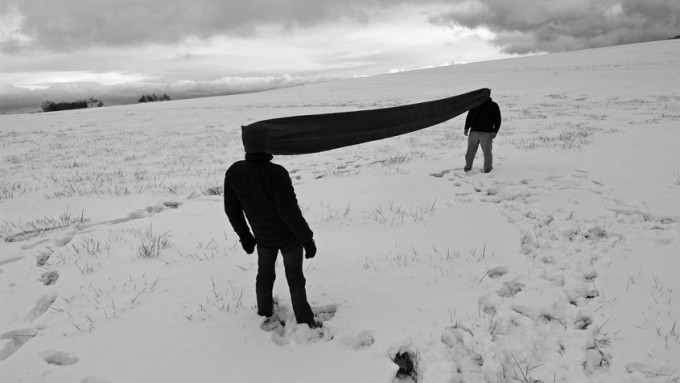
[IMAGE: Franz Erhard Walther and Santiago Sierra Demonstrating Work No. 46 from Walther’s First Workset Sehkanal 1968 2011]


Stuart Ringholt: The Artist Will Be Naked

Stuart Ringholt: Kraft (Melbourne and Brisbane: Monash University Museum of Art and Institute of Modern Art, 2014).


In 2011, I whipped up a show on art and therapy for the Institute of Modern Art, Brisbane. I chose the theme because it was derided and disreputable, a bit of a joke, or so I thought. I took my title, Let the Healing Begin, from the dialogue from the 1997 Gus Van Sant film Good Will Hunting, where Will Hunting (played by Matt Damon) dismisses therapy, even though, in time, he comes to value it—as would I, grudgingly. The show included art stars like Marina Abramovic, Mike Kelley, Tony Oursler, Grayson Perry, Otto Muehl, Matt Mullican, and Gillian Wearing, but my starting point was the recent work of Melbourne artist Stuart Ringholt. His Anger Workshops at the 2008 Sydney Biennale had made art-and-therapy a talking point in the Australian art scene.

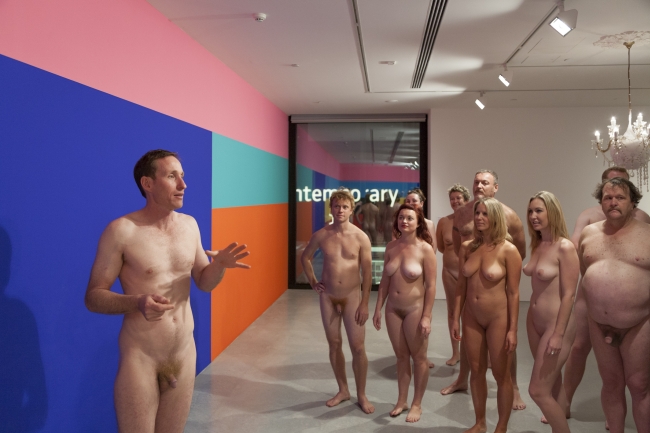
I asked Ringholt to be in my show. I wanted books, photos, videos, and mirrors. He agreed to everything, but proposed an additional work. He wanted to present a guided tour of the show, prior to the opening. There was a catch: he would be naked and so would the audience. When he suggested this, I flinched. At first, all I could see was worst-case scenarios, with me ending up in the Courier-Mail explaining myself to the ratepayers. Ringholt admitted that he had already suggested the idea to other galleries, all of whom had passed on it. But, I had to concede, given the theme of my show, it was perfect. I could hardly say no.

There was a lot to think through. Conditions had to be safe for participants and organisers alike. I didn’t expect children to come, but what if they did? I made it adults only. I had a lawyer write a comprehensive waiver, which participants had to sign. Non-combatants could not enter while the tour was on, and windows would have to be blocked and surveillance cameras turned off, preventing peeking. Participants had to feel comfortable: there would need to be a changing room and lockers, and we would provide thongs (New Zealanders call them ‘jandals’), so there was no risk of participants cutting or soiling their feet (at least, no responsibility if they did). Health and Safety, always!

With the publicity, I went low key. I wanted to keep it out of the papers. I put a small listing on our standard invitation, where I would normally mention the artist talks that precede our openings. It read: ‘The opening will be preceded by a tour of the show by artist Stuart Ringholt. The artist will be naked. Those who wish to join the tour must also be naked. Changing facilities provided. Adults only.’ Despite the modest promotion, the upcoming tour became the talk of the town. For a week or so, dozens of people personally apologised to me because they couldn’t make it. Usually, parishioners feel no compunction to justify their absence, but, on this occasion it seemed, everyone was compelled to. ‘I’d really like to, but I have something on.’ ‘I’m out of town. Could you stage it again, perhaps.’ ‘I’m not a prude. I have to pick up my sister from the airport.’ It was then that I realised that the project was bigger than just those who came on the day. It also involved those who chose not to participate, who opted out. It forced them to make a choice. But, as they did so, they too grappled with the proposition. Or, did the proposition grapple with them?

Myself, I didn’t want to participate (more vanity than shyness). I was also nervous about my staff joining in, either working (as my employees) or on their own time (as members of the public). I didn’t want employment issues cropping up later. Instead, I employed two freelancers, a man and a woman I knew would feel comfortable naked. Actually, I chose them because they were ripped, because I felt comfortable with them being naked. At first, I argued (to myself) that we needed hotties to make participants feel comfortable—no one wants an ugly host. Later, I realised it was all about organisational ego. This perfect couple were my (and the IMA’s) proxies, my body doubles, my ego ideals. My approach was definitely mistaken. The point of the piece was surely to cast aside such vain considerations. (Later, Ringholt would express his concern that our naked female host wore high heels, setting the wrong tone. Where did she think she was?)

On the day, I wasn’t really required, but I was there anyway, waiting to see who would turn up. About twenty-five enthusiasts came. The demographic was odd. There were a lot of flabby older men (who perhaps didn’t care how they looked) and as many svelte younger women (who seemed rather happy with how they looked), or so it seemed to me. I wondered if younger guys were put off by the fear of having an erection in public. There were a few familiar faces (art lovers), but half the participants I’d never seen before and never would again. Clearly, some stripped off to participate, others participated in order to strip off.

One man arrived late, covered in body paint. We had a long debate over whether to let him in (body paint wasn’t anticipated in ‘the rules’). The man explained that he was a naturist and had just been on a naturist cycling event. He said he was surprised that we hadn’t advised the naturist community of the tour. If we had, they would have been there in droves, he said. They are always looking for something ‘different’. Then, I wondered why we hadn’t thought to. I assumed that the event was intended for participants who were challenged by the prospect of being naked in public, rather than for those who were affirmed by it. But was this Ringholt’s presumption or mine? What would it mean for naturists and non-naturists to share the stage? Did Ringholt want to generate a comfortable/ uncomfortable dynamic between naturists and non-naturists? What would that achieve?

Before the tour began, Ringholt briefed the participants: don’t stare at other people, don’t touch other people, don’t be sexual, and, men, if you find yourselves becoming aroused, please, quietly withdraw. I found this all quite paradoxical. Naturist philosophy is all about throwing off the shackles of social repression (aka clothes), and yet, it seemed to me, repression simply kicks in at a higher level. What is the point of being naked with others if you can’t check them out (and if they can’t check you out)? And, why not enjoy an erection, if no one is supposed to be looking anyway? To me, ‘freedom from clothes’ means less freedom, more rules, more repression. But when I asked Ringholt about this, he shrugged it off as a question of no consequence, like I didn’t get it. My problem. Maybe it was.

At once public and private, the one-hour tour offered a carnivalesque interruption in the gallery’s normal programming. I waited outside as the tour took place, imagining what was going down. Even though the tour was a work in my show, in my gallery, I was excluded, unless I chose to meet the artist’s requirements. Out of earshot, I worried about what crackpot Rajneesh interpretations the always authoritative Ringholt was offering of my show. And what were other people saying about it? I couldn’t correct them. Why had I let Ringholt hijack my project?

Of course, it wouldn’t end with the tour. The fact that subsequent visitors knew the naturist tour had taken place would frame their perceptions of the show. Although fully dressed, they could not help imagining themselves contemplating the show in their birthday suits.

A few participants escaped early, finding our air-conditioned galleries a little chilly—something we hadn’t thought of. But most came out together, at the end, fully dressed, merrily chatting amongst themselves. Convivial. As they did, other people had already begun to arrive for the opening proper. Indeed, it seemed to me that many came a little too early, as if curious to see who had attended the tour. Rubberneckers, perhaps.

A couple of days later, Ringholt’s dealer Josh Milani naughtily emailed me a photo that had been taken during the tour (with the permission of the participants, of course). It had a coy quality, with figures deftly arranged to conceal any sexual characteristics, primary or secondary.1 Everyone in the shot seemed to be sharing in the joke. (Two young women artists from Brisbane’s Inbetweenspaces also took the tour as an opportunity to photograph one another naked in the citadel, humping the architecture. They called their work Wall Fucking. I never saw the images, which were quickly reported and taken down by Facebook.)

After the quiet success of the IMA tour, other galleries invited Ringholt to present naturist tours of their shows. He has now conducted them in group shows at the Museum of Contemporary Art (MCA), Sydney; Australian Centre for Contemporary Art, Melbourne; and Museum of Old and New Art (MONA), Hobart. He has also just done one at Monash University Museum of Art, Melbourne, of his solo show Kraft.

Early on, Carolyn Christov-Bakargiev wrote of Ringholt: ‘Nothing he does seems legitimate as art, let alone arguable as important art, and yet he claims it is, and positions it with tremendous assurance.’2 Christov-Bakargiev raises the old question: but is it art? Of course, this is a question not only for Ringholt but for all works that use participation to break down or upset the prevailing distinction between audience and art, viewer and viewed, subject and object. The tours are, at once, art works and guided tours of art works. They are art works that reframe other art works, and, in the process, reframe spectatorship itself. But what does it mean to do a naturist tour of an art show? And then, how is doing a naturist tour of an art show as art different again? What does the ‘as art’ add and change? Ringholt leaves the question hanging.

Ringholt is known for his collages, and the naturist tours have a collage logic. It is as though naked people taken from another context or genre have been collaged into the art gallery, generating a surreal effect. When you look at photos documenting the tours, you can see that something latent in the artworks is unlocked—is released—when people stand before them naked, as God intended. It is as if there is some secret history of art, some art truth, only available to naturists. For instance, at the MCA, those fleshpots basking before Robert Owen’s colourful, enveloping wall painting seemed to have co-opted it for chromotherapeutic ends, bathing in its reflective glory. Alternatively, assembled around Wim Delvoye’s pooing machine Cloaca at MONA, they seemed to take its scatological excess personally, as though ready to join in (or compete).

Thinking back to my show, Let the Healing Begin, I wondered how being naked before particular works might have transformed them. For instance, how would naked people read Ronnie van Hout’s small sculpture in which the artist is transformed into a fruity phallus, a giant banana with arms and legs? Interestingly, the show also featured numerous works that assumed that we need to don masks and disguises in order to reveal our truths (Pierre Molinier’s cross dressing, Polly Borland’s plushies, and Gillian Wearing’s masked confessions). But, while such works directly contradict Ringholt’s naturist rhetoric, this contradiction is only sharpened by his tourists confronting those works naked. It is as if they are pressing or testing the question: who is more naked, the nudist or the cosplayer?

Collages are all about displacement. Ringholt’s collages often find him taking a circular excerpt from one image and laying it over another image, creating an uncanny near match. In many of his collages, the circles are images of heads, which are overlaid on bodies. The effect recalls those fairground amusements where people poke their heads through holes in pictures so others can imagine them with an absurdly wrong body, although, in Ringholt’s collages, the effect is often quite subtle. Ringholt plays on the way we think of our minds and bodies as operating on different planes—the old mind/body split. Indeed, this split is a function of clothes themselves. Clothes take our bodies out of the social equation, so we can deal with one another as disembodied talking heads. If our heads are disconnected from our clothed bodies, they are doubly disconnected from our naked bodies.

Pointedly, after the tours, Ringholt made a new series of collages, his Nudes 2013. He made some fifty-four of them, before he got it out of his system. They are an extension to the tours and a foil to them. Instead of placing heads onto clothed bodies, here he  collaged artworks onto naked bodies. He took cheesy, fetishistically attired female and male pin-ups and covered their rude bits (sometimes only partially) with images of art works, appropriating other artists’ creations as fig leaves. This time modesty wasn’t the point. Ringholt chose artworks that physically and metaphorically echoed—and amplified—genitals (those of the model’s sex or the other sex). Although he coyly concealed the rude bits, this only made his soft-core images more suggestive and obscene. There was also a bit of genderbending. In one collage, a minimalist sculpture placed across a naked man suggested a gaping vagina. Such visual innuendos are worthy heirs of Austin Powers and Benny Hill. He thrusts his ribbed ‘endless column’ into her shiny ‘untitled void’! Boom boom.

In the Nudes, there is a play between the print-world scenarios of pornography (tacky) and art books (classy). Interestingly, artworks, such as those in the collages, would not be out of place in pornography’s mise en scène; however, we would not expect to see naked people standing (or prone) before artworks in art books—a point on which the naturist tours turn. In Ringholt’s Nudes, it is like my hottie tour guides have returned, in their inappropriate high heels (literal and metaphorical). When they debuted in Melbourne Now at the National Gallery of Victoria, the Nudes seemed to be tucked away, as if behind the video-store curtain.

While the Nudes developed out of the tours, they are totally different. They admit sexuality and the gaze in ways the tours couldn’t. In Ways of Seeing, John Berger famously distinguished the naked from the  nude, saying that being naked is just being yourself with no clothes on, while being nude is wearing no clothes for the purpose of being looked at—an object of the gaze.3 Nudity is thrilling (artistic), nakedness more banal. If the naturist tours lean towards the naked, the Nudes are more, well, nude.

I once heard Ringholt, perhaps disingenuously, describe his Nudes as occult metaphysical allegories, confusing listeners who now wondered if they had totally missed the point in engaging with the obvious—you can’t always tell a book by its cover. Pointedly, one of the Nudes does not use an artwork as its fig leaf but a book cover. In it, Dita Von Teese’s nakedness is coyly concealed, or redacted, by a giant copy of Professor Imre Lakatos’s seminal mathematics treatise Proofs and Refutations: The Logic of Mathematical Discovery. The image is ambiguous. The book could be hovering phantasm-like between us and the woman, or perhaps we have interrupted her while she was doing her homework (in her hosiery). While it is an exception, I fancy this image is also a key to the series. I am reminded of Slavoj Zizek, who compared himself with the drooling pervert who, in public, conceals his pornography within a worthy textbook. The same but the opposite, Zizek said he instead hid his abstruse philosophy behind pornography (Hegel being the greater and preferred obscenity).

Professor Zizek’s comment made me wonder where our pleasure and perversity in this bookish Nude might lie: in the nude (the girl), her fig leaf (the maths book), or both. If it lies in the girl, perhaps the work is analogous to Marcel Duchamp’s Large Glass 1915–23, which cloaked its moist prurience in the arid language of technical drawing. If it lies in the book, perhaps it is instead analogous to the renaissance painter Uccello, who neglected his hankering wife’s nocturnal requests to pursue his solitary candlelit perspective studies, meanwhile taunting her with his inevitable riposte: ‘Oh, what a lovely thing this perspective is!’4 Then again, if it lies in both, conflating girl and book, it could be analogous to that genre of pornography which offers up naked women body-painted in the ‘strip’ of popular soccer teams, so horny fans can enjoy their mutually exclusive love interests momentarily aligned, maximising their pleasure in an erotic double- or triple-word score.

But surely I digress. Whatever way you want to have them, the Nudes promote a vulgar, proud, ecstatic romp through the art-museum masturbatorium, one unconstrained by standing orders and shame. Necessarily banished and repressed in the tours, here libido returns with a vengeance. Everyone in Ringholt’s pictures is having ‘an art experience’, if you know what I mean. Worthy artworks (even the worthy maths text) double as sex toys. But what of the viewer, clothed, looking on? Should they follow suit? Is this an invitation to revolt?

Ringholt’s work always obeys a collage logic, even when it isn’t a collage. For instance, when a clock from a parallel universe is beamed into our own, or a bunch of streakers (exiled from Eden or escaped from Auchwitz) overrun the art museum. Ringholt’s works ask us to imagine that our everyday reality is itself somehow a collage, and the seams are showing. But as much as his works might upset the apple cart, the oppressive unity and commonsense of the everyday, Ringholt ultimately holds out for the possibility of some future reconnection, restitution, and reintegration. Ultimately, he would return us to a holistic, organic, utopian, orgasmic, pre-collage (or post-collage) state. Cutting through the world is a first step in repairing it, in (re)making it whole—the first step in healing. But the question remains: Should we leave our stilettos at the door? Will there be high heels in heaven?

  1. Documentation of subsequent tours would not be so coy.
  2. Carolyn Christov-Bakargiev, ‘First Take: Carolyn Christov-Bakargiev on Stuart Ringholt’, Artforum, January 2007: 199.
  3. John Berger, Ways of Seeing (Harmmondsworth: Penguin, 1972).
  4. According to Vasari.

Curnow’s Leverage

The Critic’s Part: Wystan Curnow Art Writings 1971–2013, ed. Christina Barton and Robert Leonard, with Thomasin Sleigh (Brisbane and Wellington: Institute of Modern Art and Adam Art Gallery with Victoria University Press, 2014). This is one of two introductions to the book.


Give me a place to stand and I will move the earth.
—Archimedes of Syracuse

 •
Wystan Curnow has been writing on art for half a century. His singular contribution to New Zealand art and art history is keyed to a crucial fact: he left New Zealand and came back. In 1963, Curnow travelled to the US to do a doctorate in American literature. There, he was exposed to countercultural ferment, to new thinking in the humanities, and to the latest art. Going to the US unmoored Curnow from his peers in New Zealand, setting him on another intellectual trajectory. Returning home in 1970, he would re-enter an art scene that, despite its having grown considerably, he could only see as small, isolated, and provincial. Here, painting was the dominant medium, landscape the dominant subject, and national identity the dominant idea. However, the country’s painting mainstream was being challenged on either flank by forms of ‘internationalism’; firstly, and somewhat belatedly, by modernist abstract painting, and, secondly, by the emergent, and more internationally current, ‘post-object art’ (as it was known in Australasia). Curnow would align with both.

Overseas experience gave Curnow a distinct perspective on the vices and virtues of New Zealand art and a hefty critical toolbox with which to address them. He was not a generalist or a jobbing critic. He wanted to say something new, not simply ‘fill in the cultural space already known’, as he later put it.1 He wrote on relatively few artists, but repeatedly and at length. He always had an agenda. He wanted to change things: to give New Zealand art a wider context and to up-skill the culture so that it could better engage with and support what advanced artists were doing. He also had an approach: he experimented with writing styles, seeking to develop new forms of art writing to meet the ambitions of new forms of art. While his criticism certainly moved with the times—responding to and participating in big paradigm shifts (formal abstraction, post-object art, postmodernism, feminism, biculturalism, and globalisation)—it nevertheless remained surprisingly consistent across the decades. Curnow generated a unique, serious, ambitious body of art writing, one that differs, in content and form, from what other New Zealand art critics produced. A project underpins it all.

•
In 1939, Wystan Curnow was literally born into New Zealand’s art and literary scene. His father was poet Allen Curnow, a leading figure in New Zealand literature, his mother, Betty, was an artist, and they named Wystan after British poet W.H. Auden. Curnow’s Christchurch childhood home was a meeting place for intellectuals, writers, and artists, including Rita Angus and Theo Schoon. (Angus drew Wystan as a child and painted the iconic portrait of his mother in the Auckland Art Gallery collection). The Curnows moved to Auckland in 1951, when Allen accepted a lectureship in the English Department at the University. While at secondary school, Wystan was a regular visitor to Auckland City Art Gallery, and took painting classes there under Colin McCahon, a family friend from Christchurch.2 Later on, as an undergraduate, he would drop by to chat with Director Peter Tomory and his staff in the lunch room.3 Curnow studied English Literature and History at the University of Auckland, completing his BA in 1960 and his MA with first-class honours in 1963. Curnow’s earliest art writings include reviews of dealer shows by Milan Mrkusich and McCahon, published in 1961.

Curnow chose to do his doctorate in the US, rather than England. Working on American literature was a mark of his attraction to the new world over the old, and to postcolonial rather than colonial literatures. Leaving in 1963, he based himself at the University of Pennsylvania in Philadelphia, where he studied under Morse Peckham. Despite being a scholar in the traditional areas of romanticism and aesthetics, Peckham developed a new approach, grounded in semiotics, behaviourism, linguistics, anthropology, and art history. His ‘post–New Critical and post–New Left theoretical approach’, as Curnow described it,4 offered a new account of literary and cultural change. Peckham’s controversial book, Man’s Rage for Chaos: Biology, Behaviour, and the Arts, which advanced a behaviourist theory of art making, was published in 1965, while Curnow was still his student. The book provided Curnow with a theoretical overview and useful terminology. Crucial were the division of labour between ‘primary producers’ (artists) and ‘secondary’ ones (such as critics), the centrality of the ‘art perceiver’s role’, the notion of art as ‘problem solving’, and ‘psychic insulation’ (the crucial condition artists require in order to produce important new work).

It was a thrilling time to be in the US—a moment of cross-referenced artistic, political, and cultural upheaval. The civil-rights movement and anti-Vietnam War protests were in full swing (Curnow arrived in Philadelphia as Martin Luther King Jr. made his historic march on Washington). Just as influential as his studies would be Curnow’s immersion in the contemporary-art, music, and poetry scenes of Philadelphia and New York, which was less than two hours from Philadelphia by train. Already an aficionado of American jazz and abstract expressionism, Curnow threw himself into the big city’s cultural life. Although he spent time in museums, he gained his real art education in dealer galleries, grounding himself in what would prove to be the most advanced art of the time: pop art, minimalism, conceptualism, colour-field painting, and kinetic and light art—the new forms into which modernism was evolving.

In 1967, Curnow completed his PhD on Herman Melville’s late, proto-modernist poetry and took a job teaching at the University of Rochester, in upstate New York. There, he became embroiled in the kinds of political protests that were erupting on campuses across the US. In 1970, seeing no signs of the turmoil abating, with a wife and young family, and a desire to reconnect with home, Curnow returned to take up a position in the English Department at the University of Auckland, where his father was still teaching.

While in the US, Curnow had kept abreast of New Zealand art, especially through visits from friends such as Hamish Keith, Don and Judith Binney, and Jim Allen (Head of Sculpture, Elam School of Fine Arts, University of Auckland). On his return, Curnow was rapidly recruited as a critic, and was encouraged in that role by Allen and Tony Green (the inaugural head of Art History, University of Auckland, who had recently arrived from Edinburgh). The Critic’s Part opens with two reviews of 1971 Auckland City Art Gallery exhibitions that anticipate the directions in which his criticism would move. In one, Curnow enthuses over a touring show by celebrated American abstract painter Morris Louis; in the other, he critiques the curatorial sloppiness of Young Contemporaries, a local young-artists survey show.

In the early 1970s, New Zealand art was largely a painters’ scene. A small market had developed and a few painters were becoming household names. After what he had experienced in the US, Curnow found much of the work unremarkable, although he remained a huge McCahon fan. Instead, he was drawn to the alternatives, to modernist abstraction, and, even more, to post-object art. The fledgling post-object-art scene, centred on Allen’s Sculpture Department, would become his focus. Allen had recently returned from his 1968–9 sabbatical trip to Britain, France, Mexico, and the US (where he had stayed with the Curnows). Fired up by what he had seen, he was fostering experimental art with his students. Curnow responded enthusiastically. This was the kind of work he recognised as contemporary, being akin to the context-sensitive, ephemeral, conceptually driven work he had seen in the US. Curnow attended art-crit sessions at the School and quickly became the ‘house critic’ of the movement.

In the 1970s, Curnow embarked on a mission to raise the stakes for serious writing on art and literature in New Zealand. He attacked the art and literary establishments, charging them with a lazy deferral to romantic, expressive, and biographical modes of analysis, and called for a deeper engagement with new forms and ideas, particularly those emanating from the US. Recognising a lack of venues for sustained commentary, he created an opportunity for himself and others to publish longer pieces by editing the book Essays on New Zealand Literature (1973). Alongside contributions by Terry Sturm, Robert Chapman, and others, Curnow offered his own manifesto-like essay ‘High Culture in a Small Province’, a trenchant diagnosis of the limitations of the local scene.

‘High Culture’ didn’t pull its punches. Curnow was not afraid to describe the scene as hamstrung by smallness and lack of specialisation. Quoting Peckham, he characterised high culture as concerned with ‘discovering and creating problems’: ‘it contains in solution innumerable ambiguities and ambivalences and puzzles and problems’. (Later, he would put his own spin on it, describing it as the pursuit of ‘new forms of thought and feeling’.) In ‘High Culture’, Curnow complained that New Zealand’s cultural middlemen (its critics and commentators) dragged art down by seeking to reduce the distance between art and the public, when they should be seeking to increase that distance by generating the ‘psychic insulation’ that would enable artists to be ambitious, free of the restraints placed on them by an uninformed, unappreciative society. The essay did not win Curnow many friends, but its combative, elitist tone was a telling marker of the end of New Zealand art’s nationalist era.

‘High Culture’, and its 1975 companion piece ‘Doing Art Criticism in New Zealand’, made the case for serious criticism as a necessary component of a functioning art scene. If these essays established a job description for the critic, Curnow’s other writings show him seeking to fulfil it. He wrote short-form reviews for mainstream magazines, such as the Listener and Arts and Community, and longer pieces on Billy Apple and post-object art for Auckland City Art Gallery Quarterly. For the new glossy, Art New Zealand, he wrote essays on McCahon, Len Lye, and Max Gimblett, and ‘Art Places’ (a series of diaristic accounts of his art adventures in New York, Toronto, and Sydney).

Curnow had a distinctive voice. He could move back and forth between an essayistic style instilled by his academic training and a colloquial reportage style informed by the immediacy and directness of New Journalism and New American Poetry.5 His writing offered a vivid account of what it meant to be exposed to new kinds of art in the here and now. Curnow wanted to get past habitual approaches. In experimental texts such as ‘Mt. Eden Crater Performance’—a stream-of-consciousness, phenomenological account of a 1973 Bruce Barber performance composed in situ during the event—he bypassed standard critical approaches. His writing suggested a rejection not only of New Zealand amateurism but also of the ‘frame lock’ and ‘tone jam’ of American academics (including Peckham).

In 1976, ‘Mt. Eden Crater Performance’ was published in New Art: Some Recent New Zealand Sculpture and Post-Object Art, which Curnow edited with Jim Allen. Perhaps Curnow’s most substantial output in the 1970s, this book documented moves in New Zealand sculpture since the late 1960s. Featuring the work of Allen, his students Barber, Philip Dadson, Maree Horner, and Leon Narbey, plus sculptors Greer Twiss, Kieran Lyons (visiting from Britain), and Don Driver (the only artist not based in Auckland), it was the principal published resource dedicated to ‘the movement’. On every level, New Art declared its difference: by including relatively unknown artists (students!) alongside established ones, by incorporating visitors, by refusing exegesis in favour of experimental reportage and ‘documentation’, and by treating the printed page as a kind of ‘artist’s space’. New Art set out to mirror post-object art and to establish an alternative New Zealand art canon, with the expatriate innovator, Len Lye, as its touchstone.

Also in 1975, another New York–based expatriate artist, Billy Apple, visited New Zealand. On the fly, he produced a series of site-specific shows in galleries throughout the country. Apple typically explored the spaces by subtracting things from them; for instance, he cleaned wax off floor tiles at Auckland City Art Gallery. New Zealand was not ready for such conceptualism. To many, it seemed that the artist was a charlatan, exhibiting empty galleries. The ensuing bad press certainly confirmed Curnow’s arguments about New Zealand art’s lack of psychic insulation. Curnow addressed this directly in an essay in Auckland City Art Gallery Quarterly (‘Billy Apple in New Zealand’), where he analysed the media response before moving onto the work itself.

When Apple returned in 1979 to do a second string of shows, Curnow lent his services to the artist, managing the press, riding shotgun. In addition to keeping journalists off Apple’s back, Curnow became involved in making the work—a collaborator. He helped conceptualise, produce, and mediate the shows, providing explanatory wall texts that effectively became part of the work. If Curnow had suspended criticality in order to write his ‘Mt. Eden Crater Performance’ text, his collaboration with Apple further blurred the boundary between artist and critic, countering the idea of the critic as a neutral, independent voice.

•
The early 1980s saw a sea change in art—postmodernism. At the University, Curnow was teaching contemporary American poetry with Roger Horrocks.7 Their students Alex Calder and Leigh Davis were eager conduits for the new ‘theory’. Curnow and Horrocks worked with them, and with fellow poets Tony Green and Alan Loney, to produce the short-run postmodernist magazines Parallax, And, and Splash.

Published in the first issue of Parallax, Curnow’s essay ‘Post-Modernism in Poetry and the Visual Arts’ (1982) was the first local attempt to systematically address the change. Curnow’s thinking developed not from continental philosophy (as would become the norm) but from American literary and art theory; he drew heavily on writers, theorists, and artists whom he had been exposed to in the US in the 1960s. Curnow identified postmodernism with those who disavowed romanticism’s metaphysical tenor in favour of direct engagement with material reality. This ‘new stance towards reality’, he argued, gave rise to new forms of art that reject the expressionist transformation in favour of procedures, such as measurement and serial arrangement, which accede more fully to that which is ‘given’. Curnow ended up asserting the ‘linguistic’ basis of contemporary representations (the materiality of signs) and warned against delving beneath the surfaces to lay claim to deep, personal, or transcendent meanings.

The essay did not get picked up in New Zealand; it would not be influential. In fact, the ironic appropriation that would become postmodernism’s hallmark suggested a break with the blunt literalism of the very forms of art practice Curnow celebrated in his essay. The ‘Post-Modernism’ essay was premature. It was written before the influence of L=A=N=G=U=A=G=E poetry and post-structuralism had properly worked their way into Curnow’s writing. However, now, the piece appears more prescient. As postmodernism has become a disregarded term, and with growing interest in the art of the late 1960s and 1970s, it helps us to understand how postmodernist sign-play could develop out of minimalism’s and conceptualism’s literalness, rather than against it. Curnow constructed a bridge between conceptual art and what followed.

In ‘High Culture’, Curnow had criticised the versatility—the lack of specialisation—demanded by a small scene. However, he would go on to wear a range of hats. Curnow’s engagement with the international art world made him a powerful figure at home. He became the go-to guy on New Zealand art, contributing to international art magazines such as Artforum and Studio International. He became involved in exhibition making, as New Zealand commissioner for the 1982 Biennale of Sydney and curator of I Will Need Words, an exhibition of McCahon’s word and number paintings for the 1984 Biennale. After meeting Edinburgh gallerist Richard Demarco at Wellington’s F1: New Zealand Sculpture Project, he arranged for I Will Need Words to travel to the Edinburgh Festival, where it was accompanied by another show, ANZART in Edinburgh (1984), whose New Zealand half he also curated. As a curator, he would go on to be associated with the rise of discursive ‘theme shows’ in the postmodern late 1980s and 1990s, with shows like Sex and Sign (1987). In addition to enjoying long-term relationships with many New Zealand art museums as a writer and curator, Curnow also helped found New Zealand’s first funded ‘alternative space’, Auckland’s Artspace, serving as its inaugural chair, and he would later become a Len Lye Foundation Trustee. All this time, he was also an active poet. While this diverse, DIY activity might seem to fly in the face of the disdain for jacks-of-all-trades that Curnow had expressed in ‘High Culture’, all his engagements were strategic—designed to advance the cause of high culture.

•
‘Be honest, have you ever heard of New Zealand art?’, Curnow wrote in Studio International in 1984.8 He was never afraid to acknowledge New Zealand art’s marginality, and yet his internationalism was complex and nuanced.

Curnow always tried to put New Zealand art into an international context. The artists he celebrated tended to be internationalist in their outlook or situation. He reclaimed expatriates like Apple, Lye, and Gimblett. Even when he wrote on McCahon, an artist synonymous with New Zealand, he put him in the company of overseas figures, like Barnett Newman, Jasper Johns, Julian Schnabel, and Imants Tillers.9 Curnow’s internationalism was enabled by regular travel. His long tenure at the University enabled him to leave on sabbaticals and for conferences. He regularly went to the US, and, from the early 1980s on, to Australia and Europe as well. It was during his visits to New York in the 1970s (some documented in ‘Art Places’) that he became a fully fledged emmisary and art bagger, engaged and at large, doing the business. On his travels, Curnow built a network of collaborators and friends in high places, including Jacki Apple, Charles Bernstein, René Block, Rudi Fuchs, Jan Hoet, Thomas McEvilley, Terry Smith, and Lawrence Weiner.

While he explored ways to write New Zealand art into the international context, Curnow was also aware of the limitations and presumptions of those at the centre. His writings often drew attention to the power dynamics underpinning international exhibitions (Te Maori being a compelling example). As much as he argued a wider context for New Zealand art, he also sought a wider context for international art. He plugged into the ‘dispersed centres’ of what would come to be known as ‘global conceptualism’—places like rural Mildura in Australia, Halifax in Canada, Edinburgh in Scotland, and, later, numerous hot spots in Eastern Europe. Curnow’s internationalism was self-consciously and often assertively provincial. While he read New Zealand art from the viewpoint of the centre, he also read the art of the centre from an antipodean perspective.10 This richness was evident in the way he simultaneously argued McCahon into the mainstream of twentieth-century Euro-American modernism and asserted his remoteness from it. It also made him the perfect commentator on Australia’s leading appropriator, the diasporic Tillers.

It is interesting to contrast Curnow’s internationalism with Francis Pound’s. In the 1980s and 1990s, both critics advocated internationalism, but each meant something different by it. Emerging ten years after Curnow, in the postmodern 1980s, Pound was aligned with the market mainstream, and almost exclusively focused on painting, while Curnow was grounded in post-object art. Throughout the 1980s and 1990s, Pound’s taste was current and was hugely influential on the new collectors (via Auckland’s Sue Crockford Gallery), while Curnow’s seemed grounded in the late 1960s and 1970s. However, times change. Today, from our post-medium vantage point, and with a revival in interest in experimental art of the 1960s and 1970s, Curnow’s internationalism has the greater purchase and currency.

While Curnow was critical of New Zealand art’s nationalism, he was always sensitive to questions of place, of location. While he rejected the expressive-realist tradition (which promoted landscape painting as a window on the world), he was enthusiastic about conceptual artists who drew on the alternative tradition of cartography to address place. Curnow liked maps because they sidestepped the romantic investments and epistemological presumptions of landscape painting by foregrounding the use of arbitrary signs and cultural conventions. In 1989, Curnow curated a theme show for the Govett-Brewster Art Gallery, Putting the Land on the Map: Art and Cartography in New Zealand since 1840. It juxtaposed historical material (maps and early topographical watercolours) and Maori ‘oral maps’ with works by contemporary New Zealand artists (Andrew Drummond, Derrick Cherrie, Philip Dadson, John Hurrell, Tom Kreisler, Ruth Watson, and others). The show argued that mapping codes tell us less about locations than about ourselves, our ‘prospects’ and ‘projections’, in the process demonstrating how Pakeha overwrote Maori in staking their claim to this place.

In the late 1980s and early 1990s, biculturalism complicated the nationalism–internationalism debate. Maori issues had first entered Curnow’s work in the 1980s, when he wrote on McCahon’s works with Maori themes. Although he had no interest in the first generation of contemporary Maori artists, in the 1990s, Curnow would begin to write on the new generation, notably Jacqueline Fraser and Michael Parekowhai, and would work on and around Leigh Davis’s 1998 art/poetry project Station of Earth-Bound Ghosts, which celebrated Maori rebel leader Te Kooti. Curnow folded biculturalism into his increasingly postcolonial internationalism. But, if Putting the Land on the Map co-opted Maori concerns in contesting the old Pakeha nationalism, elsewhere biculturalism was being conscripted into a new kind of neo-nationalism, typified by the country’s combined National Art Gallery and Museum, Te Papa.

After Putting the Land on the Map, art and cartography remained a focus for Curnow, spawning conference papers, articles, and, ultimately, the book chapter, ‘Mapping and the Extended Field of Contemporary Art’. This interest was timely, being keyed to the art world’s ‘global turn’ in the late 1980s and 1990s. With John McCormack (then Director of the Govett-Brewster Art Gallery), Curnow developed a new project to address this turn from an antipodean standpoint—Under Capricorn. In 1994, they organised the conference Under Capricorn: Is Art a European Idea? in Wellington. Speakers included Thierry De Duve, Thomas McEvilley, and Marian Pastor Roces. (Curnow’s paper, on Gordon Walters and Jacqueline Fraser, is published here for the first time.) Two years later, they followed up with an exhibition, curated by Curnow and the Stedelijk Museum’s Dorine Mignot. Under Capricorn: The World Over showcased artists articulating the global turn, placing New Zealand artists, including McCahon and Parekowhai, alongside artists from Australia, the US, Europe, and Japan, linking them through such shared themes as ‘nexus’, ‘panorama’, and ‘globe’. The show was staged on both sides of the world simultaneously, at City Gallery Wellington and the Stedelijk in Amsterdam, with the same artists showing in both places. It was a refutation of established nationalist ways of thinking and working as well as a critique of the geopolitics of the now commonplace international biennale.

•
In the late 1990s, Curnow began to consolidate, writing and editing monographs on individual artists. He completed books on Tillers, Gimblett, Lye, and Stephen Bambury (a McCahon biography is still in the pipeline). He also began to write texts reviewing his previous work and concerns, clarifying, upgrading, and polishing his project (for instance, ‘Writing and the Post-Object’).11 Written especially for this collection, ‘High Culture in a Small Province: Further Thoughts 1998–2013’ is a great example of this, with Curnow revisiting his original ‘High Culture’ essay four decades on.

In ‘Further Thoughts’, Curnow’s focus is cultural and political economy. When he wrote ‘High Culture’, things were very different. New Zealand was economically and culturally isolated and New Zealand art was asserting a national identity in the face of that isolation. The country was also still constructing an infrastructure for high culture. However, today, New Zealand enjoys a well-developed art infrastructure and our artists participate in a global art world, with offshore residencies and the Venice Biennale. The change is tied both to internal developments in the New Zealand art scene and to external developments in the wider art world linked to globalisation and neo-liberalism.

Curnow’s relation to neo-liberalism is complex. On the one hand, he is a classic left-winger. His writings are politically aware, being peppered with references to social-justice issues (such as the Springbok tour and Maori land rights) as well as to art politics. In ‘ANZART as Is’, for instance, he exposed vested commercial interests underpinning a touring blockbuster exhibition, and, in ‘Te Maori and the Politics of Taonga’, he addressed the deal with the devil that Maori struck by getting into bed with the show’s sponsor, Mobil. On the other hand, Curnow was always an unapologetic elitist, dismissive of both populism and preachy didacticism in art. In ‘High Culture’, he argued that the public had little chance of genuinely appreciating the best art, and quoted Peckham saying that the best art ‘maintains itself by alliance with political power, social status, and wealth’.12

Neo-liberalism has transformed New Zealand culture, changing what and how New Zealanders think about all manner of things, including art and its institutions. In New Zealand, the changes can be traced back to 1984—when a new Labour government banned nuclear ships but also deregulated the economy and flogged off state-owned assets, in the process collapsing the commonsense distinction between left and right wing. By 1984, Billy Apple, ever alert to the Zeitgeist, had already shifted to painting and was making works that reflected on and celebrated (rather than critiqued) the emerging art market—particularly the good names of collectors. As Apple became something of a court painter to the new elites, Curnow, as his apologist, went along for the ride. In 1985, the fashion magazine ChaCha photographed Curnow (in aviator shades) and Apple standing outside Auckland City Art Gallery with Apple’s Porsche; they looked triumphant—as if they were the landlords. But, there must have been a dash of irony, because, around the same time, Curnow was also writing up Bruce Barber’s Marxist critiques of American right-wing ideology (‘Bruce Barber’s “Vital Speeches”’).13 You might say Curnow was having a bob each way, but, actually, he was—self-consciously—surfing the number-one antimony of his time (and place).

By the 1990s, art museums were scrambling populism and elitism, pursuing bums-on-seats (customers) with bread-and-circuses and pursuing corporate sponsors (stakeholders) with cocktails. On the one hand, art museums were being rethought as a broad-audience entertainment option; on the other, corporates were drawn to contemporary art, believing its speculative activity mirrored their own. Things looked rosy: the infrastructure had expanded, art museums were more popular than ever, and New Zealand artists were being plugged in internationally. However, art was also being co-opted by cultural, corporate, and creative-industries rhetorics, undermining the high-culture project. Curnow was well placed to observe the changes and to understand and warn of their implications. He would also have access to new tools. In ‘Further Thoughts’, Peckham gives way to Jacques Rancière (The Politics of Aesthetics, 2004) and Luc Boltanski and Eve Chiappello (The New Spirit of Capitalism, 2005).

In the 1970s, Curnow had resisted New Zealand art’s nationalism, casting it as parochial. However, in ‘Further Thoughts’, he implicitly counters its new self-congratulatory internationalism. The piece concludes by discussing a work that responds to the merging of tourism and entertainment industries, Cruise Line, by our young, internationally hot-right-now, expatriate artist, Simon Denny. I imagine that, back in the 1970s, Curnow would have been anxious to plug Denny into the international discourse; however, Denny is already plugged into it (indeed, he is better known and understood offshore than in New Zealand). So, perhaps perversely, Curnow instead writes Denny into an obscure local narrative (or, more correctly, he uses Denny’s work to construct that narrative for the first time). He links Cruise Line to a work produced in New Zealand in the 1970s by the visiting British artist Kieran Lyons and to works produced overseas by expatriate New Zealanders, Bruce Barber, Darcy Lange, and Michael Stevenson. All these works address capitalist rhetoric, presaging Denny. In forging this counter-intuitive canon, Curnow creates a defiantly local context for our currently most internationally successful artist, while nevertheless resisting the way the local is typically conceived (as New Zealand artists living in New Zealand making works for New Zealanders). In this, his last word (for the moment), Curnow presents himself as an internationalist from here, an antipodean internationalist.

•
Everything contains its opposite. Globalisation makes the world bigger and smaller; it promotes difference while extinguishing it; it embraces previously marginal ‘voices from the wilderness’ but weaves them into the rich tapestry of empire. New Zealand art has become part of an international art world, but it’s a very different international art world to the one that shaped Curnow in the US in the 1960s. His writings help us to understand how New Zealand art evolved out of its inward-looking nationalism (the early days of the mission) to take its place in the brave new global art world of the twenty-first century. Indeed, his writing enabled that shift. But, as much as Curnow wants New Zealand art to be part of a bigger discussion, he refuses to sacrifice place, recognising that his unlikely location provides insights into and leverage upon the dynamics of ‘international art’ and ‘world art’. Curnow’s self-consciousness—and his commitment to putting his own practice into a historical context—makes his back catalogue of writings of singular value in understanding our current moment; in tracking how we got here and in imagining where to next.••

  1. Wystan Curnow in conversation with the author, January 2014.
  2. Auckland City Art Gallery became Auckland Art Gallery in 1996.
  3. See Curnow’s descriptions of this time in Thomasin Sleigh, ‘Neither Here Nor There: The Writing of Wystan Curnow 1961–1984’, unpublished MA Thesis, Victoria University of Wellington, 2010, especially 7–14.
  4. Wystan Curnow, quoted in ibid., 35.
  5. Before he left for the US, Curnow was an avid reader of Evergreen Review and of Grove Press and City Lights books. At that time, little contemporary writing was offered to students, either in New Zealand or the US. When he returned to Auckland, Curnow joined Roger Horrocks in teaching Horrocks’s already-established course in American poetry. Together, they brought the course’s focus increasingly into the present. By the 1980s, they were bringing American poets—including Charles Bernstein and Jackson MacLow—to New Zealand to guest lecture in their course, which had few, if any, parallels, even in the US.
  6. Charles Bernstein, ‘Frame Lock’, in My Way: Speeches and Poems (Chicago: University of Chicago Press, 1999), 90–9.
  7. Curnow and Horrocks did their MAs together in Auckland, and Horrocks also did post-grad studies in the US—at Berkeley.
  8. See Wystan Curnow, ‘ANZART as Is’, Studio International 197, no. 1005, Summer 1984: 40.
  9. Curnow has also written on international artists, including On Kawara, Lawrence Weiner, and Vito Acconci. His involvement with the L=A=N=G=U=A=G=E poets is longstanding.
  10. Sleigh highlighted this in titling her thesis ‘Neither Here nor There’.
  11. This book is itself a contribution to that reflective process.
  12. This is a direct quote from Peckham. Wystan Curnow, ‘High Culture in a Small Province’, in Essays on New Zealand Literature, ed. Wystan Curnow (Auckland: Heinemann, 1973), 155.
  13. Curnow also enjoyed a close friendship and working partnership with poet/critic Leigh Davis, who had been one of his students in the English Department and an editor of And. After university, Davis became a money man with Fay Richwhite, where he was involved in the privatisation of New Zealand Rail in the 1980s. By the late 1990s, Curnow was working on Davis’s project Station of Earth-Bound Ghosts, celebrating Maori rebel leader Te Kooti. Davis also named his private-equity fund, Jump Capital, after one of Curnow’s favouite artists, Colin McCahon. For Davis, Te Kooti, McCahon, and merchant banking were not odd bedfellows. Davis challenged any assumption that his art and business practices were contradictory. See Nevil Gibson, ‘Leigh Davis: Avant-Garde in Business, Arts, Adventure’, National Business Review, 9 October 2009.


Simon Starling: Please Explain

Simon Starling: In Speculum (Melbourne, Brisbane, and Wellington: Monash University Museum of Art, Institute of Modern Art, and City Gallery, Wellington, 2014.)


Simon Starling’s intricate projects explore the legacies of modernism and globalisation by addressing the peculiar histories surrounding specific objects and sites of art, design, and science. His erudite works address transformations and transmissions across time and space—echoes and dislocations. But, while they bookishly mine history, there is always something unexpected, excessive, witty, perverse, serendipitous, convoluted, counter-intuitive, or crafty about them.

My first in-the-flesh encounter with Starling’s work was at the 2003 Venice Biennale. In the Arsenale, a Fiat 126 car was hung up, wheels-to-the-wall. It had a two-colour paint job: red with white doors, white boot door, and white bonnet. I thought the sporty look might have something to do with its acrobatic performance, scaling the wall, defying gravity. I fancied the work to be a Duchampian gesture, as if Starling were doing to this car what Marcel Duchamp had done for the urinal—turning it in space and reframing it as art to create a new thought for it.

However, when I went to the wall text, I learnt more, much more. It offered a big back story, which made my initial impressions seem naive and irrelevant. I learnt that Fiat introduced the 126 at the 1972 Turin Motor Show to replace the Fiat 500. Later, in the 1970s, they moved 126 production to Bielsko-Biala, in communist Poland, where labour was cheaper. After 1982, the 126 was not sold in Western Europe, but it continued to be produced for the Eastern European market until 2000, becoming a symbol of communist-bloc life. Knowing this, in 2002, Starling purchased a 1974 red Italian 126, made in Turin, and drove it to Bielsko-Biala. There, he bought the white Polish 126 parts—side doors, boot door and bonnet—and transferred them onto his car. Even though the Polish Fiat parts were produced some way away, in a different time, under a different political regime, they fitted seamlessly. Starling had picked his colours so the end result would recall a Polish flag, titling the work ‘Flaga’. Starling drove his Italian-Polish hybrid back to Turin, to exhibit at his dealer gallery there, Franco Noero. Return to sender.

As soon as I read the wall text, Flaga clicked. It was a eureka moment—a reveal. The work went from being puzzling, ambiguous, even opaque, to being totally unambiguous and transparent. I got it. The work was, specifically, about a micro-history (about how this Italian classic ended up being Polish), and, more generally, about a macro-history (about how national brands persist under multinational capitalism). For me, any further reading of the work would now be constrained, framed, by this understanding. Starling’s work, it transpires, often turns on such arcane back stories; things the viewer is unlikely to know to begin with and which they would be unlikely to deduce if coming cold to the work.

After reading the wall text, Flaga seemed straightforward enough—an informative gesture. And yet, soon, it started to beg all sorts of questions. I began to wonder, is the work literal (a straightforward Mythbusters-style demonstration, proving that, yes, Polish Fiats are identical to Italian ones), or, in turning a car into a flag, does it operate more at the level of metaphor? What, where, and when is the work? Is it the thing in the gallery, framed as art, or was it the performance (the journey the car went on)—or somehow both? Is the context of the car’s exhibition crucial or incidental? Is it the same work when shown in Turin (the 126’s city of origin) as it is when shown in Venice (in a show where national reputations are on the line, in a city without cars)?1 Would it be the same work if shown in Poland? Where does the macro-history being represented (the story of Fiat production) and the micro-history of its representation (Starling’s trip) begin and end, or are they imbricated?2

That Fiat 126 hanging on the wall may have embodied—or been a manifestation of—Starling’s idea, but it deliberately fell short of expressing or representing that idea, at least without reference to the wall text as its supplement. Now, I appreciate that, in looking at contemporary art, one experiences this wall-text effect a lot, but mostly it is incidental. However, with Starling, it’s crucial. And, also, ‘getting it’ is only half of it. Before the click, Flaga is an enigma: we wonder what it means. But, after the click, we wonder how it means. The work goes from being puzzling at the level of content to being intriguing for its logic, its ‘form’. The work messes with us—transforms us. Once we have read the wall text, we can’t return to our innocent pre-click engagement with the object. Despite this, writing on Starling’s work (including the artist’s own) tends to be preoccupied with questions of content (what it means)—exegesis. Indeed, it sometimes reads as if there is no viewer and no viewer experience to account for. As much as commentators highlight Starling’s central theme of transformation, they strangely shy away from addressing the way his work remakes the viewer, reframing spectatorship.
.
It’s interesting to compare Flaga with a later, grander, more convoluted work, The Nanjing Particles (2008). Starling made the work for Massachusetts Museum of Contemporary Art (MASS MoCA) in North Adams. On entering a huge hall, you see a massive photographic mural. It’s an enlargement of an 1875 stereoscope photograph showing a group of Chinese immigrant workers brought to North Adams to break a strike at the Sampson Shoe Company (located on what is now MASS MoCA’s campus). A circle has been cut in each image. Literally and figuratively mining the photograph, Starling extracted a silver grain from each circular section and scanned them in three dimensions using an electron microscope. With this information, he had the forms rendered as massive stainless-steel sculptures at a million times their original scale. The sculptures—enlargements of enlargements—look like shiny, biomorphic Henry Moore sculptures. They also recall the world of computer-generated special effects, particularly the liquid-metal terminator in Terminator 2 (1991). However, despite their high-tech, space-age fantasy look, these blobs were painstakingly forged, shaped and polished by hand, using cheap labour in Nanjing, China.

Of course, it is impossible to get any of this until you read the wall text. ‘The shiny forms reflect the museum’s historic architecture as well as the visitors who have replaced workers in the space, connecting sites past and present through a consideration of global economic conditions’, it points out. For the cold caller, however, the work remains inscrutable. Without the wall text’s explanation, there is no discernible relation between the parts: it’s hard to identify the photographs’ subjects or to see why circles have been cut into them. While we can see that there are two photographs and two sculptures, they seem unrelated: chalk and cheese. Their relationship is an enigma.

While Flaga and The Nanjing Particles have analogous content (linking globalisation with cheap labour), they diverge at a formal level. Flaga involves a revealing demonstration (yes, the Polish parts really do fit), while The Nanjing Particles is built around a fallacy. Like the photographer in Michelangelo Antonioni’s 1966 film Blow Up, Starling delves into the photographs’ grain to a level at which the photographs no longer have anything to say about their subject. Starling brings the tools of rational scientific inquiry to bear on the photographs like some forensic scientist, but the way he does this is absurd. The work is about a kind of false logic—a fallacy of close reading. Perhaps Starling is in denial, avoiding the traumatic nature of the photographs (as evidence of racist exploitation) by addressing them at the microscopic level (where the politics disappear).

Or, perhaps he arrives at the traumatic kernel in a roundabout way. Sure, those big shiny baubles tell us nothing about the subjects of the image from which they were derived—they don’t disclose that history. But, in this, they exemplify what Karl Marx called ‘commodity fetishism’. For Marx, commodities are magically imbued with independent personalities, concealing the fact that they were produced by alienated labour. This may be to do with the way they are styled and marketed by others, but we are also complicit in it, because we don’t want to know.

In The Nanjing Particles, we confront Starling’s high-tech stainless-steel blobs as something marvellous, miraculous, even virtual. Until we read the wall text, we don’t think about their production by hand in Chinese sweatshops, so would not link them to the exploited ‘coolies’ in the older photographs.3 Similarly, we happily replace parts on our Italian car with cheaper Polish ones without worrying about how little Poland’s workers were paid compared to their Italian comrades. As lessons in commodity fetishism, The Nanjing Particles and Flaga work because they don’t instantly betray their origins.
.
Starling’s current Australasian touring exhibition, In Speculum, debuted at Monash University Museum of Art, Melbourne. It showcases six very different projects made over the course of Starling’s career. Wilhelm Noack oHG (2006), Three White Desks (2008–9), Project for a Masquerade (Hiroshima) (2010), and Black Drop (2012) are bookended by the earliest and most recent works, Le Jardin Suspendu 1998 and In Speculum 2013, both of which have Melbourne connections.

Le Jardin Suspendu was made for Strolling: The Art of Arcades, Boulevards, Barricades, Publicity, a show that included several emerging Scottish artists, held at Melbourne’s Heide Museum of Modern Art in 1998. The Museum occupies Heide II, an iconic international-style building from the 1960s, the former residence of modernist art collectors John and Sunday Reed. Although the Reeds planted their grounds with exotic trees, they left a large indigenous River Red Gum, which bears a boat-shaped scar, apparently inflicted by an ancient Aboriginal canoe-maker. The contrast between the modernist house and the scarred tree prompted Starling’s work.

Paralleling the construction of that wooden Aboriginal vehicle, Starling built a model aeroplane from another kind of tree. He made a scale model of a 1920s French ‘Farman Mosquito’, the plane that featured in Le Corbusier’s seminal 1923 book Towards a New Architecture, where it provided an analogy for the modernist home as ‘a machine for living’. After flying the radio-controlled model over Heide II, Starling installed it inside, on a glass table, by a window, looking onto the garden.4 The wall text starts: ‘A 1 : 6.5 scale model of a 1920s French “Farman Mosquito”, built using the wood from a balsa tree cut on the 13th of May 1998 at Rodeo Grande, Baba, Ecuador, to fly in the grounds of Heide II, Melbourne, designed in 1965 by David McGlashan and Neil Everist’. We are left wondering why Starling is quite so specific. He doesn’t use a generic modernist airplane, but the Farman Mosquito. He doesn’t use just any balsa wood, but ‘wood from a balsa tree cut on the 13th of May 1998 at Rodeo Grande, Baba, Ecuador’.

The wall text prompts us to make these connections, when otherwise we wouldn’t.5 It goes on to force the Ecuador connection: ‘Two years after Heide II was built, the Spanish explorer Vital Alsar journeyed from Ecuador to Australia by balsa-wood raft, landing at Mooloolaba, just north of Brisbane. His 8,600-mile voyage showed the possibility, if not the proof, of the cross-pollination of ideas, goods, and people among the ancient cultures of the Pacific. Paralleling the building of the Aboriginal canoe, a modern structure was built from another kind of tree: an aeroplane for Heide.’

The model modernist airplane looking out at the garden, with its scarred Gum tree, reminds me of the famous match cut in Stanley Kubrick’s 1968 movie 2001: A Space Odyssey, where a bone, a prehistoric tool hurled into the air by an ape ancestor, transforms into a spaceship. Starling also makes a poetic link across time and space, and yet his work couldn’t be more different. Kubrick’s cut is concise, it makes an explicit point: from prehistory to space age in the blink of a cosmic eye. We are not presented with anything extraneous or distracting, so the point is clear. What kind of bone it is or who built the space ship is downplayed, irrelevant. By contrast, Starling overloads Le Jardin Suspendu with specificity and detail.

A study in digressions and segueways, Le Jardin Suspendu is a non sequitur, a shell game. On the one hand, if the work is intended to be a poetic analogy, Starling offers too much information—information we don’t know how to use. On the other hand, if it is intended as history, it is peculiarly wilful. Starling leaps from one space-and-time, or one anecdote, to another, as if by free association, drawing an implausibly long bow. As much as he mimics the manner of the historian, the links he makes in the work are not causal ones that already exist in the world but associations that exist in his head, which he then proceeds to reify. Like a conspiracy theorist, he conflates the scatter-brained logic of his mapping with what he is mapping. The work may be logical—yes, McGlashan and Everist’s international modernism had its roots in Le Corbusier and co.; yes, balsa is another kind of wood; and, yes, balsa comes from Ecuador—but it is logic in the service of sophistry. Where is he going with this? Up the garden path!
.
Static art media don’t lend themselves to storytelling, which is inherently diachronic. For instance, so-called ‘history paintings’ don’t really narrate stories so much as illustrate them. You have to already know the story (the ‘before’ and ‘after’) to appreciate the narrative component. Three White Desks is all about this. Starling presents the ‘dots’, then provides a text explaining how and in what order to join them.

The work is based on an obscure sidebar story from art and literary history. In the late 1920s, long before he would become the famous expressionist painter, Francis Bacon begins making sleek modernist furniture in London. Through his friendship with expatriate Australian painter Roy de Maistre, Bacon is commissioned to create a beautiful writing desk for the expatriate Australian writer Patrick White. When White returns to Australia in 1947, he sells the desk—a move he will regret. Later, he tries to get a Sydney cabinetmaker to remake the desk from a photograph, but the result is shabby, not a patch on the original.

Inspired by this tale, Starling sources the original photograph of White’s desk, gives it to a Berlin cabinetmaker and asks them to produce their best estimation of Bacon’s original. The Berlin cabinetmaker does so, photographs their desk, and sends the image to a Sydney cabinetmaker and asks them to reproduce their desk in turn. The Sydney cabinetmaker does so, photographs their desk, and sends the image to a London cabinetmaker and asks them to reproduce their desk in turn.

With each reiteration, qualities are lost. The first desk is attenuated, lacquered white, with shiny handles; the third is squat, robust, unpainted, au natural. Starling brings the desks together, installing them in sequence on top of their travelling crates, accompanied by a print showing various source and reference images, including views of Bacon’s early furniture studio, of his later painting studio, and of White’s office with the original desk. Of course, if you don’t know the story, you would not assume the desks are genealogically related. That narrative has to be read in.

Each time you make a copy, you lose something of the original and gain something new. Like a game of Chinese Whispers, Three White Desks demonstrates this principle of ‘generational loss’. For antipodeans, like White, like ourselves, this may remind us of our provincial condition and how earlier generations of our artists misunderstood modernism, because their view was distorted and diluted by distance, and because they received it through ‘translations’—typically copying it from photographs.6 But Three White Desks is also a more general comment on the fragile nature of reception, one cross-referenced to our own reception of it. Onto the story of White’s desk, Starling superimposes the story of himself making his work, and, onto this, we superimpose ourselves, as viewers, making sense of that work, providing our own interpretation. As interpreters, we become hermeneutic cabinetmakers, interpreting Starling’s interpretation of Bacon. Three steps, like the three desks. Here, Starling and ourselves are implicated as translators of history, adding something of ourselves in the process.
.
Anthropologist Claude Levi-Strauss used the term ‘bricoleur’ to designate the ‘jack-of-all-trades’, the tinker who adapts what is at hand to his needs. For Levi-Strauss, the bricoleur is the polar opposite of the engineer, the specialist who operates systematically within a discipline, always using the right and designated tool for the job. Starling has often been called a bricoleur. But if he is a tinker, he’s a high-end one, with access to specialist equipment and expertise. What happens when you place the engineer’s systems and tools in the hands of a bricoleur, a dilettante, a tourist?

Engineering is the subject and medium of Starling’s film-sculpture Wilhelm Noack oHG. Noack is a long-standing Berlin metal-fabrication firm. It had links with the Bauhaus, worked on projects for the Third Reich, was involved in the post-war boom in architecture and exhibition-making, and now fabricates works for artists. While living in Berlin, Starling made a four-minute 35mm film documenting the Noack workshop and archives. He didn’t bring tracks, dollies and cranes, but instead mounted his camera on the metalworking tools and trolleys he found on site (devices clearly designed for other purposes). With its eccentric camera movements, his film suggests the point-of-view not of a human subject but of the workshop itself, as if the film were the workshop’s own self-portrait.

Film projectors are typically constructed so they can present a variety of films. However, Starling had the Noack team fabricate a bespoke projector capable of projecting his film only. It has a novel looping device, resembling a spiral staircase, of a type Noack frequently build. The device transports the precise length of Starling’s film, so you can see every foot of film cycling through it at once: the entire film is constantly on the move.

Wilhelm Noack oHG is a study in self-reference and self-regard. The machine is so extravagant and absurd that our attention is split between watching the film and watching the projector, between looking at the representation of machinery and the machinery of representation. As the real clatter of the projector gets conflated with the film’s recorded soundtrack of workshop noises, Wilhelm Noack oHG makes an analogy between the projector and the workshop, and between the cinema (the obsolete medium of film) and old-school engineering.
.
It is often said that Starling’s work is about histories—about investigating and recovering them. But Project for a Masquerade (Hiroshima) goes the other way. It takes a true story and proceeds to bury it in a fiction. The film outlines a proposition for the performance of a Japanese Noh play, conflating two tales of duplicity—one fictional, one true.The fictional story is Eboshi-ori, the 16th century Japanese tale of a noble boy, Ushiwaka, who disguises himself to escape his past. The true story is the Cold War saga that evolved around Henry Moore’s 1965 sculpture Nuclear Energy. Installed at the University of Chicago, this monument marked the site of the first self-sustained nuclear reaction—the birthplace of the atomic bomb and the nuclear age. Perversely, Moore later placed a second, smaller version of the sculpture into the collection of the Hiroshima City Museum of Contemporary Art, with its name changed to Atom Piece.7

In the film, we don’t see the play performed. Instead, Starling shows us historical source imagery relating to Moore’s story and footage of master mask maker Yasuo Miichi crafting the masks for the play, while a voiceover interweaves the Moore and Eboshi-ori stories and outlines the casting. The Moore story is already full of duplicity. While his sculpture looks like it conflates a human skull and a mushroom cloud (a hybrid image favoured in Campaign for Nuclear Disarmament posters), Moore would later pretend he had based it on an elephant skull. At first, Starling seems to want to find out where Moore really stood on the bomb. However, before we can get our heads around the implications of this true story, Starling obfuscates it, filtering it through Eboshi-ori.

As the film explains, Starling would have his play’s characters represented by Western figures, personages who straddle the worlds of fact, fiction and myth, including Moore, Sean Connery’s James Bond, art-historian/Soviet spy Anthony Blunt, Joseph Hirschhorn, Enrico Fermi, Goldfinger’s henchman Odd Job, Colonel Sanders, and Moore’s sculpture Nuclear Energy/Atom Piece (as Ushiwaka). Characters played by characters—double and triple agents. Rather than clarify anything, we are enveloped in an intrigue of multiplying allegorical possibilities—a hall of mirrors. (The film is shown accompanied either by an installation of the ten wooden masks for the play, considering their reflections in a wall-sized mirror, or by two masks, based on the two sides of Moore’s sculpture, confronting one another.)

Riffing off themes of deferral, duplicity and doubling, the film’s ultimate subject is masking itself. Starling plays on the Janus-like aspect of Moore’s sculpture, as if to raise the question of whose side Moore is really on. However, rather than clarify things, his voiceover overloads us with information, stretching our capacity to take it all in, loosening our grip on the true story. We are left wondering where we are being led—towards the truth or away from it? Starling makes us question the motives and veracity of the narrator (his stand-in). Is he guide or deceiver, offering information or disinformation? Starling, too, is a potential double agent. On a formal level, he demonstrates the ultimate artistic spy craft. Instead of creating a work to be interpreted through a supplementary wall text (his standard m.o.), Starling tricks us by turning the wall text into the work (becoming the film’s voiceover), while neglecting to make the work itself (the play). Thus, Starling fabricates all the evidence for something that never exists.
.
Starling’s works remind me of Connections, the pioneering 1978 British television series presented by science historian James Burke.8 Subtitled ‘An Alternative View of Change’, Connections offered novel narratives of scientific discovery and invention, linking diverse places, moments and disciplines. Burke’s approach was counter-intuitive: one episode traced the invention of the chimney, knitting, buttons, wainscoting, wall plastering, glass windows, and private bedrooms to the Little Ice Age, while another connected the development of the movie projector to improvements in castle fortifications prompted by the invention of the cannon. Favouring a principle of historical contingency over one of historical necessity, Burke rejected the conventional teleological view of ‘progress’, and emphasised the way discoveries were often inadvertent and would be co-opted to ends no one could have anticipated. Connections epitomised a new rhizomatic take on history that would become hugely popular. Today, airport bookshops brim with pop-science and cultural-studies bestsellers that tell big-picture stories through history’s unlikely and belated details—such as the pencil or salt.

Starling’s film Black Drop could almost be an episode of Connections. It is set in a Steenbeck 35 mm film-editing suite. We see the editor trying to order diverse footage. As the fragments are assembled, a complex history emerges linking Captain Cook (1728–79), French astronomer Jules Janssen (1824–1907) and Starling himself (1967–) as observers of successive transits of Venus. The film explains that Janssen developed his ‘photographic revolver’ to accurately time a sequence of photographs showing the transit. Although the device proved ineffective on the day, Starling argues that it was a precursor to Étienne-Jules Marey’s photographic rifle and the Lumiére Brothers’ cinematograph. Thus, Black Drop links astronomy to the birth of the movies. Starling includes his own footage of the 2012 transit, shot on film—an already obsolete medium (and in black-and-white to boot). Starling predicts it will be the last time the transit will be recorded on celluloid (the next transit will be in 2117).

On the one hand, Black Drop is a relatively conventional documentary, with an explanatory voiceover, and a beginning, a middle, and an end. On the other hand, it is eccentric, enclosed, and self-referential (it shows itself being made and it addresses the invention of the technology with which it is made). While the account it provides is ostensibly all true, in focussing on the editing studio, Black Drop admits that history is also a provisional construction.

If Starling made his name by making works in static media that pointedly require wall texts to furnish their narratives, his foray into narrative filmmaking with Project for a Masquerade (Hiroshima) and Black Drop finds him reabsorbing the wall text back into the work.
.
The most recent work in the show, In Speculum, was prompted by a visit to Museum Victoria, Melbourne, to view the Great Melbourne Telescope, which is currently being restored. When built in the nineteenth century to study nebulae (clouds of gas and dust in outer space), it was state of the art. Of course, these days, science has little need for optical telescopes; they’ve been replaced by radio telescopes and deep-space probes. Starling was particularly taken with the telescope’s reflecting speculum mirror.9 Made of cast metal, it is circular, with a central aperture. It weighs one-and-a-half tonnes. Starling made a series of photographs of other components of the currently disassembled telescope reflected in it, creating the odd impression of the telescope looking not outwards but at itself—the mirror capturing and reflecting bits of the telescope usually invisible to it and its users.

Returning to his studio in Copenhagen, Starling made a film with the Swedish cinematographer Maria von Hausswolff. Her camera was trained on a telescope mirror that Starling turned this way and that to reflect images arranged about him in the space—miscellaneous views of studios and workshops, and related historical and contemporary photographs, diagrams and technical drawings. Von Hausswolff’s job was to try to keep the images in focus. Although the film was subtitled Studio Edit, there was no editing: the film was a single take the length of a roll of film. The appearance of editing was created by Starling’s switching from image to image using the mirror. In the Melbourne show, Starling inserted the Great Melbourne Telescope’s speculum mirror into the gallery wall and projected the film through its aperture onto the opposing wall, so his film was also reflected in the face of the mirror, thus reversing the normal process in a telescope (where light falling onto the speculum mirror is reflected onto another mirror and back, through the speculum mirror’s aperture, to an eyepiece). With its circular images, the film looks like an old magic-lantern show—another forerunner of the cinema—crudely shuffling slides to put things in order, attempting to create a narrative.
.
Starling is a conceptual artist. We think of conceptual art as ideal (to do with the world of ideas), rather than material (to do with actual things). This is exemplified by classic ‘idea art’ from the 1960s, by artists such as Joseph Kosuth, who understood their practice as philosophy waged by other means. But times change and conceptualism has now become resolutely impure, being embroiled with all that it once opposed. Instead of addressing platonic abstractions (‘concepts’), Starling’s conceptualism gets down-and-dirty with actual things—things with multiple properties, things freighted with history, like Patrick White’s writing desk or the speculum mirror of that Great Melbourne Telescope. Lacking the ‘engineering’ methodology of the certified historian, Starling intuitively bricolages stuff, scrambling things and concepts, the real and the ideal.

Where Kosuth and co. famously abandoned the studio, Starling constantly returns to it. Each work in the exhibition brings the idea of the studio or workshop into play in a different way. Le Jardin Suspendu presents the model plane on a glass-top table, floating above miscellaneous detritus from its construction and flight. Three White Desks concerns the re-creation of a writer’s workstation, conflating Patrick White’s desk, Bacon’s furniture workshop, and the workshops of the far-flung cabinetmakers who subsequently reprised it. Wilhelm Noack oHG addresses an engineering workshop. Project for a Masquerade (Hiroshima) was shot in the apartment-workshop of the Noh mask maker. Black Drop includes footage of the Steenbeck editing desk on which the film was made—a mise en abyme. The In Speculum photographs were taken in the back rooms of Museum Victoria, where the giant telescope is being restored, and the accompanying film was shot in Starling’s studio, using images of yet more studios and workshops. Starling describes his studio as it appears in this film as ‘a disorientating and impossibly layered hall of mirrors—a decentered, spectral space’.

Starling’s works are heterodox. They do different things in different ways to different ends. Some of his adventures are circular, ending where they began, but not exactly. Others are one-way streets (technological obsolescence is a perennial theme), others still are epics, Cook’s tours, wild-goose chases, shaggy-dog stories, rivers of no return. Some works are short circuits, others infinite loops. With his absurd devices (recalling William Heath Robinson) and his films’ plummy BBC voiceovers (recalling Peter Greenaway’s early mockumentaries), there is something of the English eccentric and amateur scientist to Starling. Droll humour plays a big role.

Starling is associated with the recent ‘research turn’ in contemporary art. Indeed, he has become one of its prime exemplars. Here, in the antipodes, this turn is linked to university art schools, which are concerned with legitimising art as a form of knowledge production alongside other university disciplines. (In New Zealand, university artists are encouraged to make ‘PBRF art’.10) But, while Starling’s works are underpinned by research, they are not really about generating ‘knowledge’, at least not in the way the university understands it (and rewards it). They are more speculative,, poetic and illogical—even pataphysical. They are parodies of ‘knowledge production’ as much as instances of it. (That said, let’s not forget that undisciplined intuition, speculation, hunches and imaginative leaps are actually the basis of much scientific discovery and invention. Art’s and science’s methodologies may be considered remote, but Starling also implies their kinship. Even science needs its loopy bricoleurs to escape the limitations of its old engineering.)

Cross-referencing and cross-pollinating scenes and means of making, Starling promotes the studio-workshop as analogous to the mind, where concepts (rather than things) are also constructed, manipulated, and modelled. Mixing his metaphors, mismatching his methodologies, and miscegenating the concrete and the conceptual, Starling offers us miscellaneous models of thinking. As much as it is an enquiry into its subject matter, Starling’s work is an enquiry into enquiry itself.


  1. Flaga was included in Igor Zabel’s show Individual Systems in the curated part of the 2003 Venice Biennale. That year, Starling was also Scotland’s national representative.
  2. Starling explains: ‘the work may have three or four manifestations … as a performative event … as a sculpture … as a very carefully produced book, and as an anecdote. For me all these things have equal value … In that way, the form of the work remains somehow fluid or elusive.’ Simon Starling, quoted in Francesco Manacorda, ‘Interview: Francesco Manacorda in Conversation with Simon Starling’, Simon Starling (London and New York: Phaidon, 2012), 15.
  3. Tellingly, in showing the sculptures being produced in a low-tech factory and showing the people who worked on them, The Nanjing Particles exhibition catalogue admits the work’s conditions of production. Susan Cross and Anthony W. Lee, Simon Starling: The Nanjing Particles (North Adams, MA: MASS MoCA, 2009).
  4. In subsequent presentations, the view through the window is simulated using a large photographic transparency.
  5. Or, as Pierre Huyghe put it, ‘When people talk about Cezanne’s paintings, they don’t pay too much attention to what kind of apple he is painting, whether it is a Granny Smith or whatever, because that’s not the point.’ (Cited in Amelia Barikin, Parallel Presents: The Art of Pierre Huyghe (Cambridge, MA: MIT Press, 2012), 72.) Of course, if you add a wall text telling us the variety of apple Cezanne used, we will think about it. It’s a curator’s trick. For instance, in Documenta 13 (2012), curator Carolyn Christov-Bakargiev presented Korbinian Aigner’s colour-pencil drawings of apples, made between the 1910s and the 1960s, explaining that the apiarist continued to develop new strains of apple while interned in a Nazi concentration camp. Putting a Starlingesque spin on Aigner’s innocuous still lifes, she deftly transformed them into staunch acts of resistance.
  6. Being from New Zealand, I am reminded of both Colin McCahon and Julian Dashper. McCahon: ‘It was a dull, uninteresting afternoon. We were looking through copies of the London Illustrated News. The Cubists were being exhibited in London, were news, and so were illustrated. I at once became a Cubist, a staunch supporter and sympathisier, one who could read the Cubists in their own language and not only in the watered down translations provided by architects, designers and advertising agencies. I was amazed when others couldn’t share this bright new vision of reality. I began to investigate Cubism, too enthusiastically joining the band of translators myself.’ (Colin McCahon, ‘Beginnings’, Landfall, no. 80, December 1966: 36.) Dashper: ‘The modernism that came to New Zealand had to come a long way to get here. It is only natural, given the way it was packaged, that it got damaged along the way.’ (Julian Dashper, ‘Artist’s Notes’ (1990), reprinted in, Julian Dashper, This Is Not Writing (Auckland: Clouds and Michael Lett, 2010), 22.)
  7. This was to be the title for the original Chicago sculpture, but, apparently, the commissioner objected, because ‘piece’ sounded too much like ‘peace’.
  8. James Burke wrote and presented the ten-episode Connections series for the BBC in 1978. He made a second series in 1994 and a third in 1996.
  9. Speculum is an alloy of copper and tin.
  10. PBRF stands for Performance-Based Research Funding.


Ocula Conversation

https://ocula.com/magazine/conversations/robert-leonard/


Kate Brettkelly-Chalmers interviews Robert Leonard.
.
Kate Brettkelly-Chalmers: You recently returned to New Zealand from Brisbane’s IMA. Has your time away changed the way you think about New Zealand art or curating art from this country?
.
Robert Leonard: I spent eight-and-a-bit years in Australia, from late 2005 to early 2014. When I went there, I thought I already knew the Australian scene rather well. But I quickly realised that I had an outsider’s take on it, and that Australians similarly had outsiders’ takes on New Zealand art. I saw that there was a New Zealand canon of Australian art and an Australian canon of New Zealand art. Working in Australia gave me a sharper appreciation of how the same art can circulate simultaneously but differently in its local context and in international ones—and why. It taught me to value the nuanced village micro-discourse and the global macro-discourse equally, but also to clearly distinguish them. I came back to New Zealand because I wanted to do projects with New Zealand art that would only make sense here—projects I couldn’t do anywhere else.
.
Can you talk about your long-term approach to exhibition programming? What role do you see City Gallery playing?
.

I want the Gallery to focus on bigger, more researched, more consequential shows, a lot of them dealing with local art history. I call these shows stews, because they take a lot of curatorial cooking. But I want to supplement them with smaller shows, quickly curated thematic sketches and solo projects that provide our audience with access to what artists are doing right now. I want both ends covered, but I don’t want to confuse them—I want them to be in explicit counterpoint. Part of the trick with preparing shows is knowing how much or how little cooking they require.
.
Recent curatorial practices have become more about making exhibitions and less about collecting. Of course, a curator might be in charge of a collection and carefully weighing acquisitions, but they might also be concerned with making connections outside of the institution; bringing artists, art practices and works together; making selections and creating insightful combinations. You could say that once curating was introverted and now it is extroverted …
.

Sure, these days curating is show business. But I’m not so sure that shows today are that curatorially extroverted. I don’t see many shows where curators take the lead, where they foreground themselves. Many curators are slaves to their directors, to artists, or both. While I was in Australia, I was surprised by how many big museum shows were conceptualised and driven by directors, with curators (often teams of them) simply tasked to deliver them. On the other hand, with the solo shows with major artists, the artists tended to have veto over everything, so curators didn’t enjoy much freedom there either. I worry that the idea of curators as authors has been downgraded. I’d like to see more extroverted curating.
.
When you set out to be a curator, what influences and pressures shaped you?
.

I trained as an intern at the National Art Gallery in Wellington in 1985. There, I worked a lot with the collection. I didn’t have much to do with artists. There was freedom in that. I could take liberties—I could juxtapose works in ways the artists wouldn’t have approved of—because the Gallery owned the work. I could play. Later, when I was running Artspace, I was mostly doing solo shows with artists. There, I was more of a collaborator or enabler for the artists, partly because they were supplying the work. That was interesting too—a different aspect of curatorial enquiry. But, what you call ‘extroverted’ curating I associate with a collections-based approach. Extrovert curating can only happen when works leave the artists’ control and when curators aren’t beholden to other agendas.
.
City Gallery is a non-collecting institution, but you have previously worked with large collections. Do you miss working with a collection or having the responsibility for history that it brings?
.
In my exhibition making, I’m always working with collections—other institutions’ collections. At City Gallery, everything is borrowed. I feel sorry for art-museum curators who can’t borrow, who are told their shows must be ‘from the collection’. They may have great collections, but even a great collection is limiting. You jump through hoops looking for new ways to rearrange the same things in conversations with one another, but never in conversations with anything else.
.
Any thoughts on the relationship a non-collecting institution has to the production of history?
.
With big museums, their collections tend to be the focus of their legacies. For non-collecting galleries, it’s publications. They are the trace of what’s been done—without publishing, exhibitions are quickly forgotten. City Gallery has always done a lot of publishing. I’m keen to continue. I love publishing.
.
I often wonder if a curator’s job is not one of picking trends or delineating themes, but one of scale—deciding when things should be large or small, loud or quiet, where and how emphasis should be laid. Does this hold true for you?
.
Absolutely. Curators shape exhibition experiences—there’s a craft element to it. Sequencing, chapterising, pacing. It’s like creating a mix tape, where you intersperse anthems with ballads; electric and acoustic; moving it up a notch, then down. Counterpoint is everything. Curating is a physical, concrete activity. It’s about arranging actual things in space and time (gallery space and viewer time), and it’s about logistics and money. You’re seldom curating your dream show. You’re curating what you can get your hands on. If you are doing an art-history lecture, you can always include slides of Duchamp’s Fountain and Malevich’s Black Square. But, as a curator, you have to access actual works, and you are going to find it hard to borrow Fountain and Black Square for your show, even if they are essential to your thesis. Political, practical, and financial constraints force curators to be creative and opportunistic in ways that art historians seldom need to be.
.
How would you describe what you do as a curator?
.
Curating has become cool, and, consequently, the term is much abused. The idea has become inseparable from the Internet-age phenomenon of aggregation. We hear of people ‘curating’ shop windows, fashion shows, their websites, dinners, and parties. But actually, I like the idea of the curator as party liaison: bringing together particular artworks and particular audiences, creating occasions. There is a slutty, impresario aspect to it. Curators are often cast as autistic pointy-heads, concerned with the art and artists rather than the audience, but, in my experience, that’s totally untrue. Curators curate audiences as much as art. It’s a social thing.
.
Can you tell us about what you have coming up, what you’re excited about?
.
I’m working on a massive Yvonne Todd survey show that opens in December. Creamy Psychology will fill the entire gallery. It’s an experiment. The scale is a risk, because the show will have to sustain viewer attention without seeming repetitive—and there’s nothing else on. We haven’t spread our bets this time.
.
You are the curator for next year’s New Zealand pavilion at Venice, working with Simon Denny. Can you talk about your role as curator there? Why is it important to have a curator for a solo show or a singular project such as this?
.
With Venice, you could argue that a curator isn’t absolutely necessary. In 2011, Michael Parekowhai made that call and went without. But I thought that was a shame, because it is a great experience for a curator, and curators need these opportunities too. But yes, Venice is an artist-led project. As curator, I’m there to assist the artist, to be a sounding board and to ride shotgun—to do what needs to be done. I’m not there to be an extrovert curator. Much of the job is insulation, sitting between the artist and other agencies, being the Babel fish. I did Venice once before. In 2003, I was co-curator of Michael Stevenson’s This Is the Trekka. I had never been to the Biennale before and it was only New Zealand’s second time. Back then, neither I nor Creative New Zealand knew what the curator’s role could really be. Now, we both have more Venice miles under our belts. I know how it works, so I can be more help. And Denny’s project, Secret Power, is bigger than Ben Hur, so there will be no idle hands. I’m grateful to get a second go.

Michael Zavros: What Now?

Art Collector, no. 68, 2014.


Robert Leonard interviews Michael Zavros.
.
Robert Leonard: Your upcoming Starkwhite show is named after your self portrait Bad Dad, made for the 2013 Archibald Prize. In the painting, you’re in the pool, checking out your own reflection.
.
.
Michael Zavros: I was inspired by seeing Caravaggio’s Narcissus (ca. 1597-9) in Rome. Caravaggio simplifies things by isolating Narcissus in darkness. Narcissus and his reflection make a circle, leaving a dark void in the centre of the painting. By contrast, I pump up the background noise to heighten the sense of paralysis, the stillness.
.
Where are the kids? Neglected, clearly. But we only imagine this because of the title. Are you feeling guilty?
.

When you become a dad, its almost impossible to be self reflective—as I am too often—without feeling guilt. Once you’re a father, you can never not be a one—it is defining. So, that narcissistic gesture can only ever be through the lens of that experience.
.
You said the pool toys are a homage to Jeff Koons. What do you like most about Koons?
.

His speaking voice. It reminds me of TV evangelists. I like the way he poses in front of his work, arms outstretched, welcoming his flock. When he calls his Puppy ‘a contemporary sacred heart of Jesus’, he means it. Koons said he began making the joyous inflatables to reach out to his son Ludwig Maximilian, exiled in Rome with his ex-wife Ilona Staller. I love Koons’s enthusiasm for his subjects and his deadpan, cheesy manner.
.
The show will include Phoebe Is Dead/McQueen (2010). It imagines your daughter dead, wrapped in an Alexander McQueen skull-pattern scarf. When you painted it, McQueen had just committed suicide following the death of his mother. Can tragedy be beautiful?
.

Perhaps not tragedy, but melancholy can be beautiful. The best pop songs are the sad ones. Last night, I was watching 56 Up (2012), the latest in the 7 Up series. Its views of British middle-aged people’s lives, full of failure and remorse, are intercut with poetic flashbacks to their bright-eyed youths, full of hope and optimism. And I thought, ‘Isn’t that beautiful, isn’t that sad.’
.
You’ll also be showing your 2010 video showing Phoebe dancing to Lady Gaga’s ‘Paparazzi’ while you paint. The little monster is wearing a tutu, dark glasses, and mouseketeer ears. What’s your position on Gaga?
.

At age four, Phoebe was obsessed with that song and entranced by Gaga’s artifice. She saw that Gaga was not afraid to be ugly for her art. Gaga may be the perfect role model for a little girl. Phoebe is still a fan. We bought her Gaga concert tickets for her birthday.
.
Are you a permissive dad?
.

Yes, but I’m also a disciplinarian. ‘Yes, you can wear that age-inappropriate T-shirt, but tuck it in and brush your teeth.’
.
You just painted a small portrait of Phoebe in sunglasses. She’s getting older. Do you plan to keep painting her?
.

Yes. She’s my muse. She’s a fantastic model. She turns it on for the camera, and for me, in a way that’s compelling and confronting. Of all my children, she feels the most like me outside of me. My Phoebe works are all self-portraits.
.
These days, child-protection campaigners project all sorts of anxieties onto tame images of children.
.
I’m bothered by those knee-jerk responses. They seem bereft of intelligence or consideration. For me, my children are my triumph, but they also hold up a mirror to my failings. Having children has made me think more keenly about everything. Before I had them, I didn’t fear death.
.
You are known for painting ‘trophies’. Are children trophies?
.

They can be. But you have to find the right child. It took Madonna weeks to find the right one in Malawi.
.
[IMAGE: Michael Zavros Bad Dad 2013]

Copyright © 2026 · Genesis Framework · WordPress · Log in