Robert Leonard

Contemporary Art Writer And Curator

Jim Speers: Everything Is in Two Minds

Jim Speers: Communicating at an Unknown Rate (Hamilton and Auckland: Waikato Museum of Art and History and Artspace, 2002).


Robert Leonard talks to Jim Speers about his shows United Foods (Waikato Museum of Art and History, Hamilton, 1999) and Tiffany’s Kyoto (Artspace, Auckland, 2000).
.
Robert Leonard: How did United Foods come about?
.
Jim Speers: Waikato Museum wanted me to redo my lightbox installation from the Sydney Biennale, which would have been easy. But I wanted to do something new, so I came back at them with a proposal in response to their big gallery. That space is really hangarlike and a lot of work struggles there or just dies in its microclimate. It’s one of those grand, overtly architectural spaces which supposedly offer maximum flexibility, like Te Papa. I call that style Tilt-Slab Baroque. Good, if you’re building a gymnasium that has to double as an opera house, I guess. That main gallery is so gratuitously epic you feel like you are still outside and I thought it would be funny to build a whole building within it. I wanted to do something that matched the museum’s capricious but apparently utilitarian architecture. I’m still a bit surprised they went for it. I was thinking about the places you find lightboxes, like malls, food halls, and airport corridors. Whether they’re photographic or just graphic, lightboxes tend to occupy constricted spaces. Their lights play off the shiny surfaces around them rather than dissipating, while suggesting openness—a beyond. And I got to thinking about the architecture of those places, how they’re constructed out of lightweight, synthetic, prefab materials, just like the lightboxes. So it’s the environment reflecting on itself, echoing itself. Then I thought it’d be interesting to bring the lightboxes into play within a structure that’s itself a kind of lightbox.
.
When I look at your metal and acrylic building I think of the Philip Johnson Glass House, Japanese tea-houses with translucent screen walls, and Dan Graham pavilions. What were you thinking of?
.
Actually, I was thinking of it being like the Monument to the Third International but for fish-factory workers, replacing height with width so Tatlin’s vertical swagger becomes horizontal stutter. Tatlin’s Monument was a revolutionary idea. It spoke to the future, to a brave new world, a realm of possibility. And it still does, because it was never built, it was only ever a model. So it remains utopian, a no-place. I wanted to pollute the Tatlin idea by conflating it with the banal architecture of malls, that kind of everyday modern architecture we don’t confront as a possibility but as an actuality, a bad actuality, one that needs to be filled with lightboxes, softened and opened up by them. Really, I like modernism gone wrong—I prefer it. Modernism in the hands of the trades, as Tatlin and Rodchenko imagined it: signwriters and engineers, builders’ housing rather than architects’ housing. I like foodhalls, because it’s like they have the Tatlin idea going but it’s no longer utopian, because there’s all this other stuff which seems to contradict Tatlin. For me the contradiction makes it richer, with a lightbox of a South Seas paradise punctuating some featureless corridor. Everything is in two minds.
.
You worked with architect Chris Lapwood. Was it a collaboration? 
.

Yes and no. I needed an architect. I wanted to incorporate an architectural language into my art, and I couldn’t do it on my own, I don’t know that language. I thought of Chris as an architectural adviser, giving me access to the code. I took him, his style, his approach, as a readymade. Obviously, United Foods does reflect Chris’s interests. Working with him made a huge difference, and I learnt a lot about architecture doing it. He challenged all my preconceptions about the language of building; architects know the rules so they can play with them. Chris got me thinking about how people move through space, the potential of space. The building was originally going to be an inclined ramp, but after we got together it became a stepped structure. The low-cost space-frame approach was another Chris thing. Initially, I was going to do the framing in wood, which I thought would be simple, but actually it would have been a nightmare. Chris’s way was easier, cheaper, faster. The thing was conceived within a pre-fab building system, with everything based on a standard sheet size, 1.2 by 2.4m units; then sent straight from auto-CAD to manufacture, with every piece computer cut to half-a-millimetre tolerances, the whole thing stamped out in four hours as a kitset.
.
It’s modular. Why did you arrange it as you did? 
.

We started with a model, with panels and framing components at 1:20 scale, and tried out different arrangements. The building retains a memory of being born through this process, it looks like the builder could return any minute and rearrange it, make something different from the same components. Some of the acrylic sheets are on the outside of the frame and some inside. So structural elements are visible here and there, accessible. In place of doors and windows, there are gaps to enter and exit and look through. It really looks like a house, but it lacks a continuous skin, and there’s no detailing. There are no steps to assist your transition to different levels. There are no features which might prevent the whole thing being rearranged. It’s just blocked out, a skin and bones home, waiting for customisation. The arbitrary nature of the structure makes you want to explore it, its possibilities.
.
It’s clad in opal acrylic, which is neither wall nor window but a bit of both. 
.

The opal is in between transparent and opaque, so you can see things happening behind it and movement reflected in it. I wanted to emphasise the skin as a membrane, a division that creates inside and outside, but also to complicate that, so notions of inside and outside become confused. I wanted to test people’s assumptions about what a house is and how it works. My building looks like a house. It encloses a volume, but this volume is not ‘insulated’—it’s permeable. So it’s like a drawing of a house, or a movie-set house. I remember someone once went to an architect friend with just fifty grand and a section and asked him to build her a house. And he said, ‘For that I can’t build you a house, but I can build you a dwelling.’ I’m interested in that distinction: when does a container become a dwelling, and a dwelling become a house? That’s about practicality and cultural values: building codes and budgets.
.
Why did you call the show United Foods? 
.

I was thinking of those big articulated trucks with their company names on their sides. They leave Auckland in convoy, head down through Tokoroa, then fan off down East and West Coasts, joining up at the ferry at 2am. The names are meaningless and meaningful at the same time. United Foods was my version, grand and simple at once. It’s authoritative, suggesting multinational omnipresence, but basic—‘Foods’. In my lifetime, ‘United’ has gone from implying cohesion (good) to signifying conglomerate (evil), while ‘Foods’ evokes basic, universal needs, plus nondescript brandpower.
.
How does this relate to the show? 
.

Well, with the title there’s a play going on in the space between the two words, a play that belies the kind of ‘identity’ that people supposedly seek with brand names. There’s also a play within the terms as individuals. I suppose I’m looking for that kind of generative disorder in the works, in the way their parts function in themselves and in relation to one another. The components are contradictory, they have these odd disconnected histories, having been indentured to different uses in different places, different times. And that really comes to the fore in Tiffany’s Kyoto. People think branding is about clear identities, but I think brands are more like about attracting dissonant meanings to the same point. Brand names are generators powered by absorbing contradiction.
.
In Tiffany’s Kyoto, you replay elements from United Foods. There’s a glass wall, a house shape, a mirror wall, and a soundtrack. Let’s start with the house.
.
With the house, I was thinking, at once, of paper cranes and of generic modern sculpture, like that Terry Stringer in Auckland’s Aotea Square. The shape came from playing with a square of paper, folding it into that shape, and imagining it up big. Scale’s interesting with origami, or irrelevant. In the origami world, a flower and an elephant end up the same size because you are restricted by these standard-size squares. As with the building at Waikato, I wanted to blow up my model to real scale, so again you relate to it in part as a model, and in a way that belies your relationship to it in real space; it’s like you’ve put it back into your head. The house is made of plywood. It’s an indoor thing, like wooden furniture, even though it feels like something you would do in Corten Steel and put out in some plaza. There’s a contradiction there. It’s meant to remind people of churches, you know that style of 1970s evangelical architecture, massive A frames, with Oregon beams and lined in plywood, match joined; kind of precious and kind of vernacular all at once. They build lots of churches like that in Tonga.
.
The glass isn’t part of the house anymore. It’s become a stand-alone element, a glass wall. 
.

I wanted it to split the space and make for this vitrine effect. Whichever side you’re on, the wall separates you from the other side; it makes distance without distance. And it works as an acoustic barrier too, which I wasn’t expecting. It’s the inside/outside thing that I was talking about with United Foods. The glass constrains your movement through the space in a completely arbitrary but also highly specific way, suggesting how people get partitioned off into glass-roomed work stations in offices. I was thinking a lot about the politics of space in sitcoms, where the tension and the fun comes from those constrained sets, people entering, exiting, forced together; people fighting the hierachies implicit in the space. The limitations of the set are crucial in making the chemistry of the comedy plausible. In Seinfeld or The Mary Tyler Moore Show, the laugh track is synchronised with the architecture. I wanted the show to be something you would move through and around, so you would have a different sense of it depending on where you were in it. You were part of it, and other people seeing the show were part of it with you. At the opening there was this lovely feeling because it became a space to linger in and socialise in, something incidental. I was reminded of Satie’s Furniture Music, which you weren’t really supposed to listen to. In fact Satie told people off for listening, for paying too much attention.
.
The title—Tiffany’s Kyoto?
.
There were these photo-essay books from my childhood, stories of a day in the life of someone ordinary in some other country, say a girl having breakfast and catching the bus to school. It was social studies, pop anthropology, a way of talking about other cultures, with the same things happening in other places in subtly different ways. So I imagined this character Tiffany who lived in Kyoto, and that the show might be her Kyoto.
.
Tiffany isn’t a very Japanese name. 
.

I was thinking of all those Japanese rockers dressed like Elvis—more Elvis than Elvis. I was thinking about how people adopt markers from other cultures, getting them through the media, especially off TV. People don’t go for the ordinary but for the memorable extreme, the distinctive. So you’re Japanese, right, and rather than calling your child Barbara, a more common American name, you call her Tiffany because of some soap opera. It’s like mangling the code. But these mistakes actually tell us who we are. With Tiffany’s Kyoto, there was also the thought of the New York jewelry store, as though it might be franchised into Japan; and the movie Breakfast at Tiffany’s with Audrey Hepburn living on a plane above her real situation as a call girl—more code mistakes. Tiffany’s has become a common image of the chic and classy. There’s also a great scene in Midnight Cowboy where John Voight tries to hustle a Fifth Avenue lady outside Tiffany’s. He’s heard about hustlers, and he’s come to New York and thinks he’ll make a living doing it. But he’s too much of a hayseed and he ends up hustling the men—he can’t get women. He dresses as a cowboy and doesn’t realise it’s not a look they’ll go for, he doesn’t realise that it actually makes him look like a gay icon. Another mistake. That idea of dislocation, things out of place, is reflected in the invitation card, where a Brancusi finds its way into a Tiffany’s Kyoto window display. Mistakes have an internal logic. They are kind of tragic but fruitful; they make our world habitable.
.
Trees make our world habitable. Is that what your trees were doing in Tiffany’s? 
.

I wanted the kind of trees they plant in our city plazas and down suburban pavements. They grow them in the nurseries until they’re five, and then plant them in the street, and they are always moving them and replacing them. They’re so generic you would hardly notice. I wanted my trees to be bigger than Christmas trees, but smaller than the trees you would find in a forest; small enough to soften an architectural landscape, to make you feel part of something humanly scaled.
.
Your trees are dead, or perhaps just wintery. But the video recuts bits from the TV documentary, The Private Life of Plants, with lots of blooming. 
.

The video was based on reports of the Japanese having scenes of nature playing on videos inserted into walls in malls and into lampposts, creating an artificial natural horizon to chill you out in their congested cities. Who knows if they really have them? The idea has entered our culture as apocrypha, as a legend of urban extremism. The people I know who have visited Japan never mention them.
.
Let’s talk about the other room with the barrels. Barrels suggest pollution—oil and toxic waste—but you seem to be offering them as something sublime. 
.

Oil barrels are generally dirty, and yet, by painting them white, I think I affirm that dirtiness. Their excessive sterility fails to convince. It’s oil barrels in denial, like Benetton is in denial. You know the Benetton advertising aesthetic, how they use ‘dirty’ subject matter, like refugee ships and prisoners on death row, as a mark of their concern, or their being above it all. But they make pullovers. With the barrels I was thinking of ice floes, that’s why they were strewn randomly. Actually, the delivery guys just left them lying on the floor like that, and I had no need to compose them any further. I always wanted to do a sculptural version of that Caspar David Friedrich painting Sea of Ice—which is actually strangely reminiscent of the Terry Stringer in Aotea Square—but this seemed a more concise way of getting the same effect. Sea of Ice suggests a natural disaster, but this is something more cultural. The barrels are blank, unbranded. They’re like display barrels, props. And the mirrors maybe recall department stores. We could even be in a Benetton shop. I like the way the mirrors double the size of the gallery and make viewers self-conscious. People see themselves as part of the installation, in their own clothes. Do they fit the advert, the scenario?
.
The piped soundtrack was a looped sample from Dylan’s ‘Knockin’ on Heaven’s Door’. Sam Peckinpah used that song in his film Pat Garrett and Billy the Kid. How did it find its way to Kyoto?
.
That came about in an odd way. I was into that Gabrielle song ‘Rise’, which samples the opening bars from Dylan’s song. It struck me how compressed and processed the sample felt, how artificial, like there was no space left in it, like it hadn’t actually been played by hands on instruments. It’d got so far from the grittiness of the original. I wanted to reopen a space between then and now, between Dylan and Gabrielle, so I took the Dylan original and looped the opening bars like they are in Rise, but without the other things you get in Gabrielle’s song: none of her singing, none of the production gloss. I wanted to make an issue of the impulse behind sampling, when the people who do it want to leave the original so far behind.
.
You seem fascinated by genre: categories and category mistakes. What is it about genre? 
.

I’m interested in the space that genre provides for the repetition of structure or incident. Motifs are used again and again, and sometimes in contradictory ways, and they absorb the contradictions. Each time you reuse them, you dredge up the whole history of their prior use. It’s like in dreams where simple images stand in for these complex associative chains. And I like to think my work is sort of dreamlike. Not that I’m trying to mystify anything, the mystery is there already in the stuff. I like the idea that I’m working with the subconscious of our everyday world, of commerce culture, the idea that there’s a huge depth of association bubbling away under the surface that’s not quite gettable.
.
I found the show quite religious, all about life and death: the house’s church shape, the dead winter trees, the opening buds in the video, and the religious implications of ‘Knockin’ on Heaven’s Door’. 
.

Well, that’s your interpretation. I was interested in the variety of associations Tiffany’s drew out. With the house, some were reminded of a church but one woman recalled 1970s feminist imagery. Judy Chicago! Some of the interpretations were far fetched, but actually that’s not a problem.
.
But Jim, surely it is a problem if people read any old thing into it. Where’s the art in that?
.
It’s not a problem at all—it’s the point. It’s less about what you read, than how you read. Will-to-interpretation, that’s my subject. I offer an absence around which people can organise their memories, fantasies, knowledge, and then maybe catch themselves doing it. But in the end, it’s a sense of that crucial absence that I want to leave them with. I mean Tiffany’s Kyoto is informed by the lack of an idea about Kyoto, the space between me and the real Kyoto, and a Tiffany I never got to meet.
.
[IMAGE: Jim Speers Tiffany’s Kyoto 2000]
John Reynolds: A City Street. A Sign. Dusk.

John Reynolds: Sumwhr (New Plymouth and Auckland: Govett-Brewster Art Gallery and Artspace, 2002). This interview addresses two shows: Harry Human Heights, Artspace, Auckland, and K Road to Kingdom Come, Govett-Brewster Art Gallery, New Plymouth, both 2001.


Robert Leonard interviews John Reynolds.
.
Robert Leonard: Artspace’s show is called Harry Human Heights. How did you arrive at the title?
.
John Reynolds: It’s a street in Meadowbank. I imagine Harry Human was some worthy burgher or local councillor who perhaps had a passion for drains or traffic and they decided to name a street after him. Someone in the council had a rush of blood to the head and a dose of alliteration and proposed ‘Harry Human Heights’. The name has a Shakespearean echo but a conventional suburban location. The street arcs around and overlooks a golf course. It offers elevation, a view, but goes nowhere. You get pedestrian vista. I may be overly drawing this out but that’s what I intended with the show. It’s in two sections and one provides a platform from which to view the other.
.
Let’s start with the two huge works in the main room.
.

Well, I had a cantankerous drive to exhaust the possibilities of the interlocking dotted-rectangle motif I’d already explored in big works like Y2K from 1999. In that one, you have large rectangles with smaller ones inside them, then smaller ones that cross through both. You get this sense of recession through the composition; it’s a pictorial effect. But, in the new works, the marks are evenly dispersed, and the space, the recession, is caused by the use of different colours in different areas. It’s a bit like a shag-pile carpet, where some areas have been flattened and others raised. The paintings have that textile or dot-screen continuousness. They’re atmospheric, inflated. I like that sense of something ambitious in terms of scale, yet made up of fragments, small things. Huge but not heroic.
.
Why are the titles so obtuse?
.

Both titles are lines from Leigh Davis’s poem The Book of Hours. Trading Hours and Various Materials is the white iridescent one and King for a Thin Day the bronze/brown one. For me there’s a connection with some of the first works I ever showed, which had titles like Haulage and General Practice and Protocol for an Odalisque. Even then there was a real unhinging going on with the titling.
.
Trading Hours
is atomised, like a mist of perfume.
.
There is a story I like. The winemaker Michael Brajkovich was in France drinking champagne. He would have it as an aperitif in the morning, then at lunch, then in the evening with his meal. It surprised him that there was so little fruit in it. He observed that it’s a thin wine; it’s by putting the bubbles in that they give it essential volume—‘mouthfeel’. There’s a connection with King and Trading Hours. They’re big works, without much paint on them. They’re bubbly.
.
King
and Trading Hours remind me of Emily Kngwarreye. Rex Butler said while indigenous Australian artists are generally famed for making work with secret content, in Kngwarreye’s late paintings her content is that very idea—‘secret content’.
.
Diane Arbus once described her art as ‘a secret about a secret’. I do see a connection with Kngwarreye. Do you know that massive painting Big Yam Dreaming? It’s about proximity. Looking at it, you get a real sense of the physical space between the artist and the work when she made it. And that has a huge bearing on where viewers stand and how they engage. I remember seeing a photo of her painting it. She’s sitting on the ground, in the middle of the canvas, layering up that web of ghosting lines, a brush in each hand—she was ambidextrous. That painting is claustrophobic. There’s a kind of blindness involved in the way it was painted. Kngwarreye couldn’t stand back, couldn’t see what she was doing, couldn’t consider the work as a whole to edit it. Her field of operations was an arm’s length. It was like she was feeling her way across. The painting lacks finesse. It’s callous and eloquent at once.
.
How does that connect with what you’re doing in your big paintings at Artspace?
.

I’m also repeating my mark close up, at a standard distance from the surface. The works are a product of a mind-numbingly simple process. I’m watching something emerge out of repeating a simple gesture over a large expanse. I know, if I make a mark hundreds of times, this way and that, something will happen. I’m interested in what that something is. Oil sticks are a big part of it. They don’t allow that painterly fluency. I need the crudity—that burnt-stick quality. The label on my ivory-black oil sticks says ‘carbon from charred bone with oil and waxes’. There’s something about that, something basic.
.
In the smaller galleries, you’re running Epistomadologies, a frieze of seventy-five works on paper.
.

I wanted to polarise the experience. The layout of the spaces at Artspace invited this. I wanted a central issue in the main room and then voices off—the text that berates it, nags it—rattling on to the side. The show’s a two-way thing. In the main room, you can hear the creak of scaffolding. I’m trying to position something wall-sized, something unwieldy. Some kind of siege machinery has been wheeled up and it’s cumbersome. The Epistomadologies, on the other hand, are a tunneling. A kind of grandstanding occurs with the big works, a self-importance that gets deflated or complicated with the works on paper. They don’t support the big paintings in any way. They toil on the edges.
.
But the big paintings seem light, devoid of moral import, while the Epistomadologies … they’re fraught with it.
.

The Epistomadologies were done at the same time, but they’re off on a tangent. They’re like broadsheets, tracts, complaints, arguments propelled against the throw of the big works. They’re a series of letters, attempted communications, niggles. The title, of course, is from James Joyce. It’s one of his mangled words, and there’s a genuflection there too. ‘Ta ra ra boom decay.’ The works are oil stick again, but this time on galvanised, anodised, and pearlescent papers rather than the inert support of primed canvas. It’s dirty drawing on lustrous metallic grounds.
.
The title implies epistemology, the branch of philosophy addressing the conditions of certain knowledge.
.

My project deals more with uncertainty, botched attempts to know. In the Epistomadologies, the road signs all point right, right out of the frame. It’s one page after another after another, with a desire building for some destination or resolution, but this expectation isn’t met. The piece lurches forward, directed by those signs pointing the way. Coherence may be on offer, but it ain’t there. The whole thing disperses or flickers into something else. It’s all bogged down in a ‘syntax of weakness’, to borrow a phrase from Beckett. It’s like some monumental mason’s backyard littered with broken or unfinished markers, all of a heap.
.
In several works in the Epistomadologies, you quote ‘Amazing Grace’, a spiritual about finding coherence, even as you shrug it off.
.

I got the ‘Amazing Grace’ lines from Leigh Davis, from one of the drafts for his Book of Hours. Leigh rewrites the lyrics as they’re sung, all warbly ‘Buu-ut no-oww I am foww-wnndd’—and I run his lines in these crazy Braille dots that suggest a Broadway sign, names in lights. It’s a Chinese whispers/bush telegraph kind of thing. I have a long interest in how images can percolate and garner references with time—or, better, atrophy. Like that gnarled tree motif I use in the Epistomadologies. It comes from a twelth-century Spanish fresco I saw in the Prado in 1992, a tree of life. It’s a rich image, but, in my use of it, where it’s symbolically described, a certain insufficiency kicks in. Viewers won’t pick up on the original reference, and I wouldn’t want them to. But, I’m interested in leaving them with a sense of my having tinkered with something, disassembling its possibility, a sense of decline.
.
Why all the grids?
.
Sometimes I think of them as being like the markings on a view camera’s ground glass, as something to look through. I can tell you how they came about. I was flying from Mangere to LAX, on the way to see the Donald Judds at the Foundation in Marfa. I was bored and staring at that little screen where they put up the information: -10° outside, 33,000 feet up. And they show this map: a grid with a stick plane and a big shape that’s the US. At one stage, the only text on it was ‘Santa Barbara’. I suppose that’s where the radio tower is. Anyway, it was on that flight that I started drawing grids in my notebook, grids with placenames. So, they came from charting tedious longitudes and latitudes, and on the way to a desert.
.
What did you get out of the trip to Marfa?
.

Dan Flavin. Flavin more than Judd. I had gone to see the Judds, but they’d just opened this big posthumous Flavin installation at Chinati, and that’s what really impressed me. Judd and Flavin are both minimalists, of course, but they’re totally different. I like Flavin’s sensibility more than Judd’s theatre. No one talks about Flavin’s colours, but they’re hypnotic, they’re sick. If Judd is daylight, Flavin is twilight. He makes me think of Eliot’s ‘violet hour’ and Baudelaire’s ‘green shadows’. I’ll side with the fuzzy of Flavin over the prescription of Judd. My grids in Epistomadologies have nothing to do with Juddian minimalism. The important thing is that their abstraction doesn’t exist in isolation, it relates to other images in the frieze. How can I explain? I remember a talk Keri Hulme gave at the Auckland Art Gallery years back. Someone asked her about her working method and she mentioned ghost nets, those old fishing nets that get cut loose at sea. These nets, kilometres of them, drift through the ocean collecting and killing things. I like that image. My grids are like that, and they have different densities, like a series of sieves.
.
The signposts are like trawls of names.
.

The way the road names are stacked in alphabetical order satirises the whole cataloguing imperative. The signposts are wobbly accumulations, graveyards of signs. The names all have this allegorical, liturgical quality: Harry Human Heights through to Hope Street. They’re august and portentous, but there’s a buffoonery—something laughable and calamitous—about them. Names like Anxiety Point and Ash Pit Road I’m exploiting for their humour, or their leverage. All Day Bay! I want to look at how we name things for its banality and its genuinely loopy poetry.
.
You’ve also been making signposts with anagrams.
.
I fancy anagrams as a tool for unravelling, with a basis in arbitrariness. I’ve used some to punctuate the Govett-Brewster show as hysterical museum labels. The signs point left and right, but the words aren’t opposites. LADIES/IDEALS. They all link up in some hard-to-specify way. ADORING/ROADING.
.
Why did you call the Govett-Brewster show K Road to Kingdom Come?
.
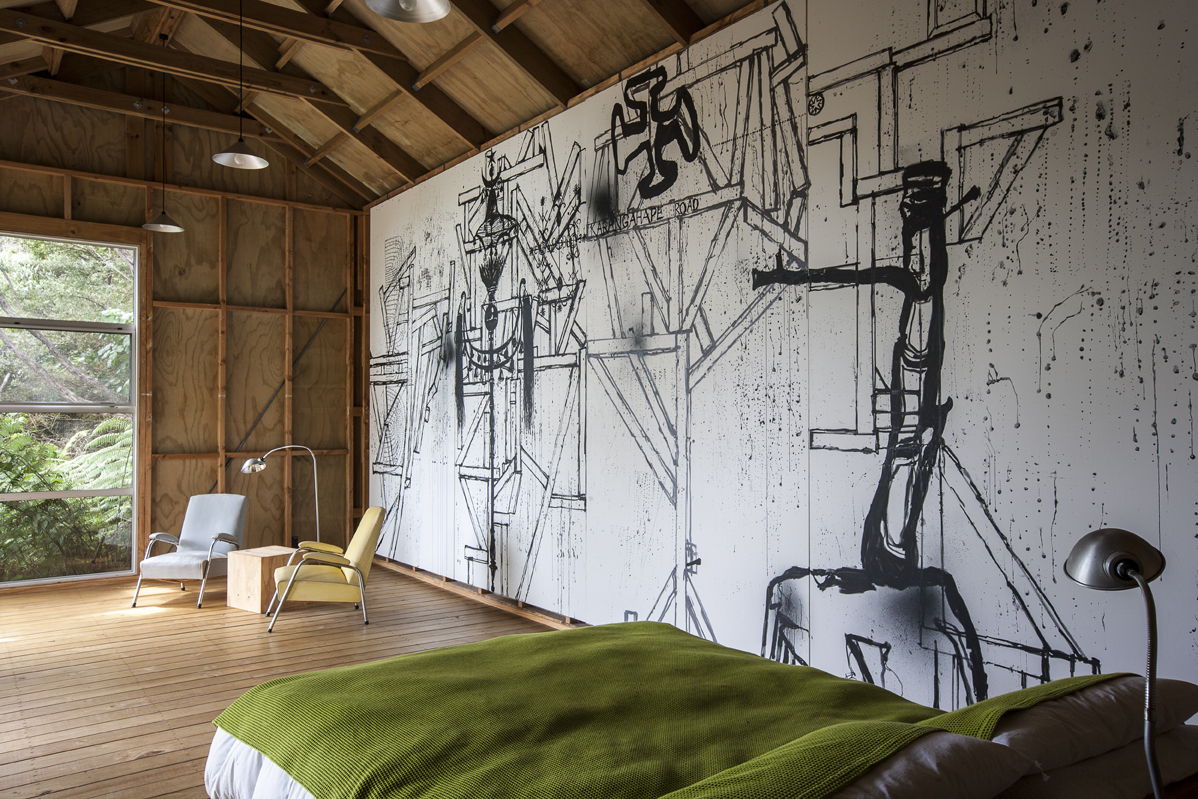
It’s titled after the first and last works you come across, which also just happen to be the earliest and most recent works in the show. Climbing the stairs, K. Rd. (1995) is the first thing you hit. Queen Street is Auckland’s spine. Karangahape Road runs at odds with it. Similarly the big painting makes a T with the gallery staircase. K. Rd. is large scale, but pantomime, slapstick: cardboard and string, pomp and paucity. In the background, there’s a clunky gantry with components suggesting a boat prow—the Argo!—a gibbet, lampposts, scaffolding, and props. All this creaky carpentry supports a ‘Karangahape Road’ sign, and, far right, a little empty Gustonesque picture frame. That sets the stage. Then, in the foreground, you’ve got these three protagonists. There’s a ‘Jingling Johnny’, one of those nineteenth-century Turkish military standards: its got a Muslim crescent moon, horse hair, and bells. During the Crimean War, the victorious British forces seized them as trophies, cruelly parading them as their own. There’s a corpulent Maltese Cross, like a nativity star, suspended, dangling. Finally, stage left, there’s a grounded Beckett/Dr Seuss thing: a leering tree trunk with a single pointing branch. I think of Waiting for Godot, with Beckett’s pared-back opening lines: ‘A country road. A tree. Evening.’
.
Does it have anything to do with Karangahape Road?
.

It does and it doesn’t. Throughout the show there’s this fierce directing going on, but it’s all misplaced and conflicted, like those street signs, pointing somewhere else, beyond the frame, nowhere. That’s a big part of Western Springs/Bloody Angle (1998)— the work on the blackboard—where you have two geographies overlaid. There’s a map of Western Springs, Auckland’s picturesque reserve, with signs pointing to ‘Three Kings’ and ‘Saint Lukes’, and then, inverted and overlaid upon it, a map of Gallipoli from the time of the ANZAC fiasco. I’m interested in how both places point elsewhere: Western Springs evokes the cradle of European civilisation while the Gallipoli campaign was the bloody crucible for nationalism at home. In my upside-down Gallipoli map, the names of the New Zealand contingents—‘Auckland’, ‘Wellington’, ‘Canterbury’—are superimposed on the ancient Mediterranean landscape. ANZAC names for Turkish killing fields—‘Lone Pine’, ‘Bloody Angle’, and ‘the Daisy Fields’—also appear. It’s an ongoing fascination for me, that slippage between destinations and within placenames, the ways geography and history get smudged.
.
There are lots of big paintings in the show. How does the bigness work?
.
K. Rd.
is the beginning of the show, but it’s also the end of something for me, the end of the road for big composition. Something unravels. I keep scale but get rid of foreground/background, figure/ground. You get works like Nietzsche on Whites Beach and The Temptation of Saint Anthony. You get shallow Byzantine pictorial space—planiverse. These big paintings aren’t exactly abstract, aren’t exactly figurative. They’re diagrammatic and calligraphic, hieroglyph and pattern, sign and grid, at once. I think of the hypnotic repetitive forms in Moorish art. Muslims consider images graven. Instead they have this repertoire of abstract motifs, conflating vegetal forms, writing, and pattern. In multiplying and expanding, these forms direct the viewer’s mind to bigger structures. These ornamental patterns embody Islamic principles of interconnection and integration. I think of tukutuku.
.
Nietzsche on Whites Beach
is encrypted, obscure. You want to read it, but you can’t.
.
It’s New Zealand’s largest finger-painting. One of my favourite Nietzsche quips is from The Will to Power: It is easier to be titanic than to be beautiful. The painting was done in 1996, but now it reminds me of those vertically cascading numbers on the computer screens in The Matrix. In the film, those numbers are at once a code and a veil; they’re hypnotic. People learn to read them, to break in. Numbers are what their world is made of and appearances merely effects, but their world is also a lie, a projection. The Matrix is technological and primal, science and mysticism. Face of God stuff. The painting’s like that too. How to read it? I see bar codes and DNA typing strips too. On the other hand, there’s also this ‘un-ambition’ at work. The scale is grand, but the motifs could be inconsequential or contingent. That’s part of its provocation.
.
What’s Nietzsche doing at Whites Beach?
.

The idea is an opera and slightly absurd. Whites Beach is minor, a small stretch of sand between North Piha and Anawhata on the West Coast; while Nietzsche is major, one of philosophy’s heavy hitters. There’s a displacement or inversion there. A little while ago, I was reading Patrick White’s autobiography Flaws in the Glass, and he describes being a novelist in Australia in the 1950s and 1960s. He talks of growing up in a country where the gospels floated and blew in the wind and didn’t quite meet the landscape. They slid off it. With White, you get the Australian interior, a desert, but alongside it another dryness, the dryness of the tradition, of the gospel, not connecting. And, I immediately thought of Colin McCahon, where you have this tension between a cultural inheritance and the bare facts of a new landscape: Moby Dick, an apparition, sighted off Muriwai. I also think of a postcard I’ve got of Joseph Beuys with a branch, drawing a skeleton on the wet sand.
.
Density seems crucial. You get vertical compression in Nietzsche, but dispersal in the new one, Office of  the Dead.
.

Dispersal, sure. There’s a story behind Office of  the Dead. On that trip to Marfa with Leigh Davis, we had to drive through 200 miles of Texas desert. Every now and again there’d be this isolated little post with a chevron pointing the way, just like they do at home, and I’d just have time to grab the camera and get a blurry photograph. There was this nice theatre with these simple signs punctuating the desolate landscape. Heading for the Rio Grande, you’re in a geography layered with American and Mexican history, but those chevrons were a connection for me. With this work, I wanted to do something with the chevron that drew on its life as a familiar sign while freighting it with something else. I took that central image of the yacht race from Leigh’s poem Office of the Dead, the Coastal Classic. They sail from Auckland up past the Poor Knights to the Bay of Islands and back. In his book, Leigh pictures the regatta using letters. I drew on that in my work.
.
You left your oil sticks behind this time.
.
This one’s hard edge. There’s a flight of chevrons in reflective vinyl on aluminum, different sizes, colour variations, all pointing right, on a wall seven metres high. There’s a lot in Leigh’s poem about the space between things, and the gearing of that space. He considers energy and dissipation. He’s got lines like: ‘Slow work of compression and slow work of expansion / Cessation of Labour Weekends marking time / Here in the regatta of differences, regatta of constants on the water’. My work rolls with this contemplation of passage. On the one hand, the work is terribly static, like butterflies pinned to the wall. On the other, it has this flickering, flaring quality; a swarming vitality. It also moves the viewer on, picking up on all the other signpost imagery in the show. The arrows resignedly point the viewer to Kingdom Come.
.
In other words, the viewer is delivered.
.
Kingdom Come
is all the colours in the rainbow. It’s a dispersion of bright patches, a diagram of dissolutions. At first glance, there’s no particular order. Actually there’s a quiet shift in the spectrum through the four panels. Your eyes glide across it without its offering traction. It doesn’t shape or arrest attention, but stimulates a busy kind of searching for shape. Some people would see it as being like a 1950s Formica design. Again, I think of tukutuku panels. In tukutuku, the pattern is a function of the binding that secures the panel. I like how tukutuku panels in meeting houses act like codas, pauses between the big stories, rests. In Kingdom Come, it’s like the primary event is in abeyance in some way. I think the painting is like the ceiling of Auckland’s Civic Theatre, those stars, those constellations, distracting you, holding your attention before the curtains part.
.
So is Kingdom Come the end of the show?
.
It’s not ‘the end’, more a delay or a cul-de-sac.
 It’s hung in that odd corridor space that links back into all the other rooms. That space is a drive-by, a flyover, not a resting place. So, at the supposed endpoint, the conclusion, you get routed back into the show. Another thing, you can’t get a proper distance on the work. Any way you come at it, it’s hard to take in the whole thing—you’re too close. It’s like being in the front row of the cinema with a bent neck. The prospect is compromised. Kingdom Come may be advertised as destination, but it’s deliquescence.
.
You satirise the big themes, but also provide occasions to think big. Is the unpicking part of the thinking big?

.
That’s what I want with Kingdom Come. And it may be a house of cards or a royal flush. The title promises some sweeping sense of conclusion, but the work demonstrates a blandly repetitive procedure, a paucity of means. It’s like McCahon, in works like HiFi, signalling an ambitious purpose while employing a pointedly inadequate, semantically weak language to affect it. It’s an arte povera thing. It’s almost as if you have to drive a big wedge between the ambitions of the work and the nuts and bolts of it. Is it coalescing into intelligence or blindly unravelling?

Gavin Hipkins: The Colony

Gavin Hipkins: The Colony, ex. cat. (Auckland: Gus Fisher Gallery, 2002).


Photographer Gavin Hipkins is fascinated by botched utopias. He is known for creating massive works from dozens upon dozens of similar images. The subject matter is typically banal, pointedly inconsequential—strips of plasticine, lengths of liquorice, polystyrene balls—but, repeated, massed, and marshaled, the cumulative effect is monumental and pulsing. Mimicking the heroic rhetoric of state engineering projects, Hipkins gives these works suggestive portentous titles: The Tunnel, The Field, The Circuit, The Coil, The Track, The Mill.

Hipkins’s retro-modernist arrangements hark back to a time when photography’s new ways of seeing were optimistically linked to a new vision of the modern world aligned with both progressive social programmes (Rodchenko and Moholy-Nagy) and fascist ones (Riefenstahl). Equally, they look to the present, to our current vogue for a modernist style evacuated of social concern and specificity—the style of Wallpaper magazine. Hipkins takes us to the heart of photography’s complicity, its ability to spectacularise and obscure the world in the name of delivering it. He works the space between the medium’s evidential force and its potential for abstraction, its ability to beautify—its propaganda power.

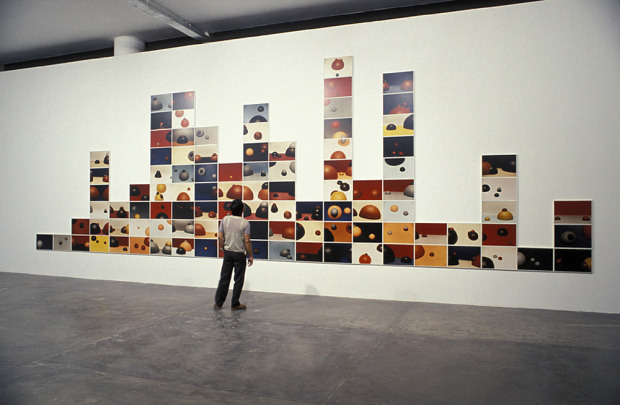
Hipkins files his new work The Colony under science fiction, the genre that looks back and forth, framing retro-politics as brave new worlds. He shot one hundred photographs of hemispherical polystyrene blobs. The individual images are crude, slipping in and out of focus. Geometric yet organic, the blobs resemble at once alien pods, igloos, pup tents, breasts, the curvaceous hills and mud pools of his native New Zealand, and bacteria. The psychedelic colour scheme is both candied and toxic; we could be staring into a lava lamp, perhaps furthering a boudoir subtext. There’s no reference for scale. The work could imply a macroscopic view (an imperialist invasion, a commune of hippie drop-outs in their geodesic domes, or a high-tech off-world encampment on a weirdly hued planet) or a microscopic one. The photos are stacked at random like a bar graph or a high-rise city skyline, as if anticipating the colony’s future order. Hipkins runs all possibilities at once. Nothing much is specified, but all possibilities are keyed to a sense of ecstatic viral replication.

The Colony goes to work on the viewer, dazzling the eye with its rhythmic prospects rather than addressing the privations and violence we know to be inherent in the colonial adventure. If at first glance it looks like an advertisement, recalling the idyllic scenes that enticed New Zealand’s first European settlers, in no time it comes to seem unstable, tinged with menace, a little creepy. If Hipkins offers us something formal looking and alluring—eye candy—he does so to evoke precisely what’s missing, what’s latent. Revving up the rhetoric of modernist photography, The Colony is haunted by what it elides: hygienic modernity crosses over into disease, science fiction into horror.

Copyright © 2026 · Genesis Framework · WordPress · Log in