Robert Leonard

Contemporary Art Writer And Curator

Ava Seymour: I’m So Green

Contemporary Visual Arts, no. 29, 2000. Review, Ava Seymour: I’m So Green, Anna Bibby Gallery, Auckland, 2000.


Photomontage is a maligned medium. It has escaped its pedigreed roots in the socially conscious work of Hannah Hoch, John Heartfield, Laszlo Moholy-Nagy, El Lissitzky, and Co. Today it is relegated to the high-school art class where endless spotty boys correct covergirls under the alibi of self expression. Ava Seymour’s photomontages drag the medium’s spotted history along with them.

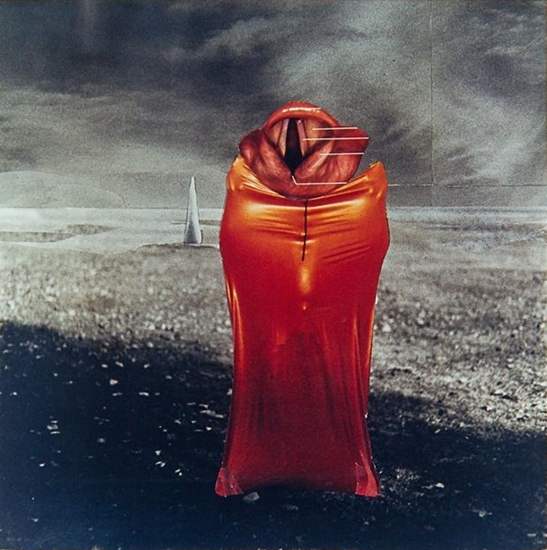
Seymour’s title is the name of a Can song, but equally it recalls Kermit the Frog’s outsider anthem ‘(It’s Not That Easy) Bein’ Green’. In the ten photomontages in the show, aliens cobbled together out of bones and viscera taken from medical textbooks and rubber-clad bodies lifted from fetishist magazines hang out in bleak black-and-white pastoral landscapes. The images look like formal photographic portraits, with the sitters caught awares, complicit in their presentation. Framed as individuals or couples, her deviants address themselves to the camera, apparently proud of their tentacles and cloaks. They make eye contact, addressing us as brothers.

Seymour’s images recall the work of German photographer August Sander, who sought to record the shape and character of society in the Weimar Republic. He constructed his portraits to exemplify social roles—the student, scholar, soldier, clergy-man—within an overarching pseudo-scientific typology. The merest details in Sander’s studies—physiognomy, pose, clothes and attributes—are telling. Seymour parodies this type of anthropological photography. We scour her pictures for evidence of rank or role. Her characters ask to be distinguished by their more or less elaborate suits, more or less regal demeanour, in a game of alien What’s My Line?

Seymour’s images also recall Diane Arbus’s ‘freak’ photographs. Indeed an Arbus series depicting mentally underprivileged persons provided much of Seymour’s backgrounds, and so informed the compositions as a whole. Photo-historian Graham Clarke has linked Arbus and Sander, which might seem odd given that Sander’s social mapping project is inclusive and categorical, while Arbus focuses on marginals. But as Clarke would have it, Arbus elaborated Sander’s seventh major category, ‘The Last People’, those whose social role is not having one. For Sander, they were the lumpen-proletariat: the disabled, the beggar, the vagrant, the victim of an explosion. For Arbus, they were giants, circus freaks, midgets, idiots, transvestites. This underclass explicitly exposes the terms by which society confirms and defines social significance.

Seymour moves on from Sander and Arbus. Her last people have become fancy-dressed hipsters. These Frankenstein monsters appear to have created their own social pecking order, with their own markers of difference. And here they are—proud, consenting to be documented in all their finery. They loll on lilos, pose with their spouses, and show off their one good eye. Within the group, even they have their own outsiders. A single pathetic figure in a no-frills rubber suit, slumped, with a basic bone for a head and no details in the face, is clearly the runt of the litter; a freak amongst freaks.

It’s no accident that Seymour uses the fallen, abject medium of photomontage to derange and reinstate an idea of the social. I’m tempted to understand Seymour herself as green, an outsider, staking out a place for herself on the fringe of the art world, in this her first dealer-gallery show.
Jim Allen: Contact

(with Wystan Curnow) Art New Zealand, no. 95, 2000.


Legend would have it that Jim Allen was the prime mover in the development of post-object art in New Zealand in the 1970s, yet his story is absent from the history books and few examples of his post-object work are preserved in museum collections. One of the foremost New Zealand art educators of his generation, Allen visited Europe, the US, and Mexico for his 1968 sabbatical, returning with first-hand knowledge of new developments in art and news of student unrest. Under Allen’s leadership Elam’s Sculpture Department became a scene, a hothouse for experimental art. A tireless facilitator, Allen organised exhibitions and symposia, as well as making his own work. He also initiated international dialogue, bringing in visiting artists to teach at Elam and organising New Zealand participation in Mildura Sculpture Triennials and at the Experimental Art Foundation, Adelaide. In 1975, Allen crossed the Tasman and became the first director of Sydney College of the Arts, the renowned art school. Now retired, he returned to Auckland to live in 1998. That year, he installed a new version of his 1975 work Arumpa Road at Artspace, in Action Replay: Post-Object Art. Two of the exhibition’s curators, Wystan Curnow and Robert Leonard, talked to him.
.
Wystan Curnow and Robert Leonard: You did not begin teaching art at the tertiary level, but in the school system. How did teaching in primary and secondary schools inform your approach at Elam?
.

Jim Allen: When I came back from the Royal College in 1952, I was looking for work. Dick Seelye suggested I talk to Gordon Tovey, the National Supervisor of Art and Craft. Gordon was looking for ways to involve Maori in education and he’d already put energy into Gisborne and Porirua. Now, he wanted to extend an experimental approach to isolated communities. As I was not a trained teacher, I was appointed as a field officer and it was decided that I should work in the far north. With Bob McEwen, we selected three schools: Te Hapua, a school in a predominantly Maori community run by an expat Brit, George Ball-Gymer; Paparore, with a Maori head teacher and students of Maori and Dalmatian ancestry; and a sole charge school, Oruaiti, near Mangonui, taught by Elwyn Richardson, a brilliant teacher. Each school was quite distinct in terms of its community and the teaching set up. Almost all the children at Oruaiti came from the local Plymouth Brethren farming community. The Department’s Northland art advisors at the time—including Ralph Hotere, Katarina Mataira, Muru Walters, and Fred Graham—were pretty high-powered.

I spent the best part of six months at Oruaiti. Elwyn was a friend of Len Castle’s and Barry Brickell’s. He had already done considerable clay work with the kids, building impromptu kilns and firing things in biscuit tins, so they already had a background in clay. But I was able to show them different techniques and really push them. We built primitive keyhole kilns with twenty-four–gallon drums, lining them with bricks and laying them down in cuttings in banks. I remembered the Mexicans had built large terracotta figures by mixing bullrush seeds into the clay, which gave it high-tensile strength. We built enormous clay structures like that and had competitions about how high we could go without their collapsing. It was all a game.

One day, Elwyn and I were watching kids in the playground and thought it would be fantastic if we could bring the imaginative play and creative energy happening spontaneously there into the classroom. From then on, we more or less deliberately set out to re-examine each teaching situation in these terms. In essence, we connected activities, using one to reinforce another. Art making was linked to the three Rs and vice versa, with amazing results. It was an exploding chain reaction. Elwyn had the kids writing poems and producing magazines. I included examples in my reports to Tovey and they later found their way to Beeby, then Director-General of Education, where they were acknowledged with enthusiasm. Essentially Elwyn made it all happen. I was just a bit player.

I also did some secondary teaching at Northland College and Kaitaia College, where I was particularly challenged by a hard bunch of Maori kids, some fresh from borstal. There was no way of disciplining that mob, so it became a matter of channelling all their free energy. I got a lot of sandstone and pumice and we were chopping out figures and heads and animals with tomahawks. We made some incredible painted mobiles out of twenty-to-thirty-foot flitches from logs from the Totara North sawmill. The kids were great and we had a ball. In 1954 or 1955, I brought a truckload of our work down and filled the Auckland City Art Gallery. This was when Eric Westbrook was Director. He was very supportive and the exhibition seemed to make a big impression.

Not being a trained teacher, working with kids became a matter of sitting down with them, responding to them, treating them as real people, and showing them how to make the things they dreamed up. Nurturing, stimulating, and resourcing students—intellectually, emotionally, and experientially—that then became the basis of my teaching approach at Elam. My own training at art school in Christchurch had been craft-based—we weren’t encouraged to experiment or to take note of what was happening in the outside world. It was only after my time at the Royal College, London, and visiting major art galleries and museums in Europe, that I came to realise that ‘teaching’ could lead to gross inhibition and distort natural aptitudes. So, I quite consciously went the other way.

Subsequently, people have said I didn’t seem to teach anything, and this always pleases me. My effort went into creating a supportive environment, encouraging experiment and exploration, insisting that people find their own answer rather than providing them with one. I guess it was backdoor teaching, not leading from the front. I was always reluctant to tell students what to do.
.
At Elam, you pioneered the use of group crit sessions as a teaching tool. They were serious, with a tape recorder running.
.

The crit was a working forum, a closed group. It was just between us. It was based on trust, and, if anybody had broken that trust, it would have collapsed. It took time for a confidence to emerge, where we could really exchange. Students were forced to explain what they normally wouldn’t explain. And when you’re making art that’s important to you, you’re vulnerable. Some of it was pretty close to the bone. People like Bruce Barber could be hard on me or anybody else. It was tough. But, if you draw people together in a context of mutual respect, it can be like a battery; their proximity generating energy, shape, and motion. Nikos Papastergiadis uses the word ‘cluster’ to characterise this approach; ‘cluster’ indicating both the shape of people gathering and the process of their assembly.
.
What was Elam like when you were there, back in 1960?
.

The art school was in the process of formalising its relationship with the university. Paul Beadle had just been appointed head of school and a new building was on the way. Students had spent a lot of time drawing from plaster casts, but, during the move, the casts mysteriously ended up in Grafton gully. Afterwards, I thought that a bit precipitous, but it certainly helped to make a break. Also, as the prevailing attitude had been that students shouldn’t read books and that ideas were bad for them, there was practically no library. A librarian was appointed and a start was made in building up a collection. Serials were a priority, and, in a couple of years, the library was the place to go to for up-to-date information. By the 1970s, everyone was pretty familiar with what was happening internationally.
.
If you’d just been taught technique but not ways of thinking, going from the Canterbury’s art school to London’s Royal College in 1950 must have been difficult.
.

Traumatic. It was like I’d stepped out of the nineteenth century. I had some glimmerings of impressionism, but, beyond that, nothing. So, when I got to London, I was starting from scratch as far as contemporary art was concerned, and it was a struggle. Fellow students viewed my efforts with disbelief. It took eighteenth months and a total change of attitude to get to grips with my situation. There was a sense of excitement about the new directions sculpture was taking. Reg Butler and Lynn Chadwick were ahead of what was happening at the College. Eduardo Paolozzi had his first show while I was a student. When the time came to return to New Zealand, I was pretty well up with it.
.
In 1968, you went back on your sabbatical, the main purpose being to visit art schools in the UK and US. When you got to London, you contacted several expatriate New Zealanders—graduates from Elam and Canterbury—who had gone on to do post-graduate work at the Royal College: John Panting, Stephen Furlonger, Graham Percy, and Bill Culbert.
.

Yes. In fact, we stayed with the Pantings and others until we found a place of our own. By then, most of them were teaching in art schools, which was a great advantage for me. Furlonger was typical, teaching in three: the Central School in London; Nottingham, where Culbert had spent time; and Brighton. I was able to travel with them, sit in on crit sessions, and meet many of the staff and students. I spent about six months traveling around, visiting art schools. This also included sitting in on interviews for selecting new entrants. The rigour of the process impressed me; seven or eight staff quizzing each candidate for up to an hour, about their reading, then onto what art they liked and why, galleries they visited. It wasn’t kid-gloves stuff. They’d take issue, provoke arguments.
.
1968 proved to be a wild year, with riots, student protests, strikes, insurrection—if not revolution—threatening everywhere. How did these events impact upon your travels?
.
Well, I had renewed contact with Heinz Hengis, one of my teachers from my Royal College days, now teaching at Winchester. Back in 1951, he had taken a group of us through the still little-known Lascaux caves. He owned a small farm in that part of France, the Dordogne, between Les Eyzies and Montignac. When we caught up with him again, he offered us the use of it. We were there for a few months, did a lot of caving, and visited archaeological sites. The area had been lived in continuously for 30,000 to 40,000 years. Every creek contained ancient antler and reindeer bone and worked flints. Amazing. Next to our farm was a property owned by Harvard University, a permanent base for archaeology students. While we were there, Bobby Kennedy was shot. The staff and students were devastated. At the same time, we became aware that riots were taking place in Paris, and we began to think about getting out. Stuck in the countryside, it was hard to know exactly what was going on. The riot began with the students, but expanded into a nationwide critique of the repressiveness of Gaullism. The trade unions joined the students, the banks closed, there were food shortages, you couldn’t get petrol—all of France was affected. Parallel uprisings occurred in other countries. We had just enough petrol to get to a port, and, somehow, we got ourselves back to London.

As the authorities in Germany and France brought the uprisings under control, trade-union and student leaders, like Rudi Dutschke, refugees mainly from France and Germany, began to turn up in London. They set up camp in the old Crystal Palace grounds, drawing thousands of supporters to round-the-clock speeches around bonfires that were never allowed to go out. The Brits had their own problems. There was a nationwide revolt in the art schools over the Summerson Council’s hard-nosed approach to implementing the recommendations of the Coldstream Report, creating a new system of art education. There were funding cuts and art schools were finding it impossible to get accreditation. The action was not exclusively or even predominantly led by students. Much of the dynamism that sustained the movement came from the persistent grievances of staff, particularly part timers. There was great solidarity between staff and students. A good example was the last stages of the Guildford sit-in, where students were prepared to face imprisonment until they were assured staff would not be victimised. The ferment spread to the universities where there were sit-ins and twenty-four–hour open forums where all sorts of grievances were aired. The BBC was covering it all, moving from one hot spot to the next. These events were enormously instructive to me as they brought out into the open both philosophical and practical issues not normally accessible to an outsider.
.
What about exhibitions? 
.

There was a major Henry Moore retrospective at the Tate. Royal College students tended to dismiss Moore, whose influence had been all-pervasive in Britain. It was an impressive show which included a lot of work that hadn’t been seen before, and it led to some well-informed discussions on his achievements. I was acquainted with two of his assistants, Oliffe Richmond and Alan Ingham, a New Zealand sculptor, and I was able to visit his studio. I met Moore later at the Tate, the first time since RCA days. There was a Takis show at the Arnolfini in Bristol. I also met Guy Brett, whose book on kinetic art I’d read in New Zealand. He invited Pam and me to his flat, where he still had most of the material he had gathered for his book, and we went through it together. This was my first acquaintance with South American work and the visit certainly stimulated my interest in Lygia Clark with her articulated metal sculptures, Mira Schendel with her knotted droguinhas, and Helio Oiticica, whose use of capes would have a direct influence on my Parangole Capes performance at Auckland City Art Gallery in 1974. His capes had deep pockets filled with tempera powder and the performers finished up with blue and orange arms and hands!
.
You were particularly interested in kinetic art.
,
Well, I was interested in everything. Guy Brett introduced me to the Signals Gallery in Wigmore Street, which featured such artists as Takis with his telemagnetic sculptures, Liliane Lijn, Jesus Rafael Soto, and the Philippine artist David Medalla. Auckland Art Gallery owns a typical Soto and one of Medalla’s bubble sculptures, both from this period. Signals Gallery was a focal point for Continental and Latin American kinetic art in the same way that Lisson Gallery gained a reputation for new and breakaway British sculpture. There were important shows at the ICA. Cybernetic Serendipity addressed the cross-pollination of art and science. Of course, back then, cybernetics was informing discussion around psychological and social processes, and it was very influential on my work. Another ICA show responded to the political upheaval in the British art schools, displaying documents and statements and providing a venue for debate. And I saw a lot of painting, of course. Marlborough Galleries were showing Graham Sutherland and Richard Hamilton. The Art & Language people were making their presence felt, and people like Panting and Furlonger were attracting attention with their brightly coloured fibreglass sculpture.
.
And they were very much in the forefront of developments in sculpture in the UK.
.
Yes, though it hadn’t been easy for them. Their work was known and respected within the fraternity, but acceptance by the London galleries was another ball game. The break came when their work was accepted by galleries in Holland, France, and Italy. They were exhibiting in places like Coventry, Brighton, and Nottingham, but, it was only after they had shown on the Continent, that the London galleries—Redfern, Lisson, and the others—picked them up. Bill Culbert showed at Lisson. He had just begun to deal with light. He was lighting perforated metal cans from within, projecting patterns of light and dark over the walls. The British had been much slower to respond to kinetic art than, say, the South Americans. Soto was attracting attention and Bill’s new work was part of a growing interest.
.
After London, you went to North America.
.
I flew to Boston around November. From there I went to Harvard, and on to Yale to meet Adrian Hall, at Graham Percy’s suggestion. They had attended the Royal College at the same time. I was very impressed by both Adrian and his work. At Harvard, I met art historians. It was quite hard poking my nose into these places, but I wanted to see what was going on. Then I went to New York, where I stayed for about three weeks. Peter Tomory was teaching at Columbia. Well, he was taking his classes in the park under the trees. The blood was still being washed from the steps of the University following the suppression of the recent student strike. Most of the University staff remained locked in their rooms, but Peter had elected to continue outdoors. Peter helped me to find my way around. He pointed me in Len Lye’s direction. I think Graham Percy may have done so also.

I had heard of Lye’s films when I was in England. So I went to Greenwich Village and found Len most welcoming. He gave me a lot of time. I don’t think he had seen too many New Zealanders in New York and my impression was that his connection with the country was very tenuous. He said something like I was the first person from the New Zealand art world that had ever shown any interest in him. He had been in New York a long time and was well-known and valued there. He had a studio loft at the top of his building. On a lower floor, his son had a workshop making furniture. While I was there, Len hooked up some wires and set a number of pieces in motion—I remember a great thunderous rolling piece, Storm King. I found out he had a brother in Auckland, in Birkenhead, not far from where we lived. When I got back, I looked him up, and, when Len visited in the following year, we had a bit of a reunion at his place.

Some of the art that sticks in my mind: Rauschenberg’s Revolver, large rotating screenprinted plexiglass discs, and Eva Hesse’s exhibition at Fischbach, with a number of small pieces incorporating latex on cotton that put me in mind of the South American artists—it was very different from anything else currently on show. From New York, I went to visit you, Wystan, at Rochester, and, if I remember correctly, on that day there was a student demonstration on campus! Right across America, I seemed to land in the aftermath of student demonstrations, but I never really came to grips with the issues as I had in the UK. That was mainly a matter of time, as I was constantly on the move. I was aware that some of the issues revolved around military research at the universities. From Rochester, I went to Buffalo, to the Albright-Knox, and then on to Chicago. There they were cleaning up after the bloody demonstrations and riots surrounding the Democratic Convention. Police bashings had prompted a protest exhibition.

Chicago was a complete surprise. Fantastic architecture—a vibrant place. I was impressed by the studios and student work at the Art Institute. The range of work and diversity of materials were amazing. They put me in mind of something that Tony Caro had said, back in the UK, that going to America had been a total liberation, that he always felt very inhibited in Britain because of art-school tradition, class structures, and critics’ and reviewers’ conceptions of what was acceptable. Such factors made it very difficult to work in an independent fashion there. In America, by comparison, artists just made things. After I returned to New Zealand, I realised that America had had somewhat the same impact on me as it had on Caro. I had never been to America before, and, in some ways, I was very critical when I was there. I had come through France and Italy, where there is an inescapable formality. America was something else! Some of the thinking was quite crazy, but that was part of the liberation.
.
Did you see that same liberation in the work that Adrian Hall was doing at Yale? Do you remember that piece of his with barbed wire and horse shit?
.
Yes, he bowled me over with that work. I saw it in a New York gallery. From memory, it was a metre-long glass box, which had a layer of fresh horse shit with short lengths of barbed wire mixed in. To say it was a powerful would be understatement. It focused my attention back onto the potency of materials as building blocks for ideas. I have Adrian to thank for that.
.
Of course, there is a great difference between Caro’s liberation and Adrian’s. For someone like you, brought up in such a strongly craft-oriented tradition, the liberation conceptualist-derived practices offered must also have been a challenge. 
.

Well, I certainly had difficulty warming to Lawrence Weiner, for example, but I never had any problems with Hans Haacke. I guess that points to where my predilections lay. Remember, my craft orientation had been pretty well battered out of me at the Royal College, and, in between then and 1968, I had worked my way through some pretty strong idea-influenced experiences, the most potent being working with school children at Oruaiti and witnessing at first hand the power of the imagination released. The Royal College also taught me the danger of the closed mind.

I had seen performances at Arts Lab in London. I had been profoundly impressed by the work of Helio Oiticica, in particular a box poem. It was a small box. You had to open a door and inside was a plastic bag full of light-blue pigment. You lifted the bag, pulled it towards you, and a length of clear plastic with the poem printed on it unfurled. The poem was in memory of a friend killed by undercover police. Works like these turned my attention towards viewer participation. And, I guess for me, the power of conceptualism was that it provoked interaction between the viewer and the signifier in a way no other art form did.
.
On your return, you created environments—devices for processing the viewer, physically and conceptually. For instance, in your Small Worlds exhibition at Barry Lett’s in 1969. 
.

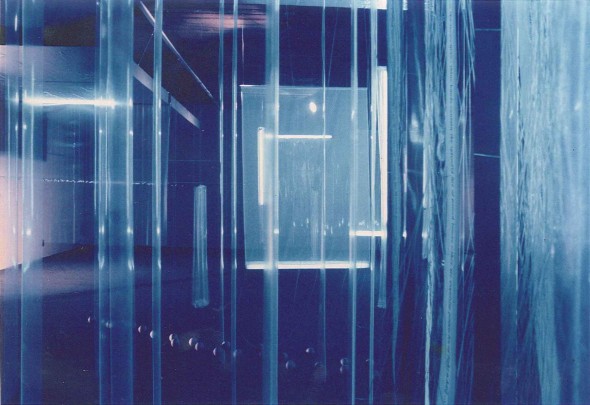
Yes, for that show I created a set of situations. Everything was under UV light. Physically, viewers became part of the piece—their shirts and eyeballs fluoresced. There was a two-metre inflated PVC cube, and, next to it, a beard of thick nylon filaments, 100lbs breaking strain, with a channel down the middle you could walk through. Curtains of fine organza weighted down with fluoro tubes glowed as light was conducted through the fabric. And lead weights were suspended on fine nylon threads just below eye height, suggesting a horizontal plane passing through the space. And then, drawing on that Oiticica idea, there was a Hone Tuwhare poem, ‘Thine Hands Have Fashioned’, printed on strips of paper, which hung down, and you ran the strips through your hands to read it. The show filled the available space, so you moved from one situation into another.
.
O-AR Part 1 
(1975) also involved reading texts. 
.
We had Part 1 at Barry Lett’s, then Part 2 (also 1975) at Auckland City Art Gallery. The space at Lett’s was small and intimate, and I did my best to crowd it out. On the wall, I pinned typewritten texts that were fragmented—cut up. I’d played around with the texts a lot. The raw material came from a variety of sources, including kids’ writing from Oruaiti, wind-factor specifications for my Commonwealth Games piece, and extracts from books I was reading. On the floor were two sheets. On one was a stack of manuka stakes, on the other an arrangement of various shop-bought purpose-designed grids, plastic and metal meshes used in making concrete foundations, garden enclosures, or whatever. You could read ideas across the arrangement of meshes, between the meshes and the sticks, between the meshes and sticks and the texts, within and between the texts. I was providing information from which viewers could build relationships if and as they desired. I wanted to displace the normal paths of perception, leaving viewers to extract meaning from apparent near nonsense. It was hard on viewers, as there was no obvious answer. I was happy that it was a mess. It was an open situation. The work involved a range of information, appositional information. There was a dynamic between, on the one hand, the physical-spatial-material information, the objects on the sheets, and, on the other, the linguistic-conceptual information, the texts pinned on the walls. It was intended as a challenge to expectations of the gallery goer, not least of which being that this work was clearly not made to be sold.
.
A number of artists were using building materials as art materials, using them both formally and for their cultural resonances, Adrian Hall for instance. The two O-AR shows seem so different from each other.
.
O-AR 2
was as different to O-AR 1 as the floor installation and the wall texts within 1 had been to one another. O-AR 2 was upstairs in two galleries at Auckland City Art Gallery. I really wanted to take charge of those barn-like spaces. Lett’s gallery was intimate, an inside-your-own-head kind of space, but here were bland open public areas, spaces to be walked through, with entrances and exits. They could so easily overwhelm a work.

If O-AR 1 was difficult and about cognitive processes, 0-AR 2 was about immediate physical processes. I was holding up a mirror to the presence of the visitor. Using long lengths of plastic hung ceiling to floor, I channelled people through the spaces. In one gallery, it was opaque, black, agricultural plastic, and, in the other, clear. Walking the lengths of the plastic created airflows that made them ripple, registering human presences. With the clear plastic, you could see the rippling and see the people through it, but with the black plastic only the ripple told you there was someone behind it. The viewer became performer, the performer the viewer. Black and white, yin and yang.

The only physical aspect that linked O-AR 1 and 2 was the grid forms: the meshes in 1 and the tiled gallery floor in 2. I like what you, Wystan, wrote in the Gallery Quarterly, talking about the title implying either/or and an oar—something that dips in, disrupts the surface, and propels you along.
.
The three performances in Contact (1974), another Auckland City Art Gallery project, were explicitly about social space, about restrictions, rules, parameters, scores. The performers and the audience were distinct. There was a social dynamic between the performers, but also one between the performers and the audience, sometimes kind, sometimes cruel. 
.

The three pieces were very different. Computer Dance was noisy. There was the strobe light and couples, men and women, trying to ‘make contact’ using these infra-red emitters and receivers. It was difficult to come to terms with for audience and performers alike. Parangole Capes was slower, more humane. Four tightly bound performers rolling across the floor towards the centre, coming together, and, finally, helping set one another free. Then with Body Articulation, it really flowers. We covered the walls with plastic. The performers were instructed to start off by exploring their own body articulation by rubbing on paint and flexing, and then to extend their bodies in different directions. Most of them did that by lying on the floor and circumscribing movements with their arms and legs with paint. They spent a bit of time doing that as individuals, and then formed pairs to explore the physical relationships between two people, extending all their movements. People were picked up by the ankles and dragged around in big circles in paint. As Body Articulation progressed, the audience became far too enthusiastic and I was worried they were going to get their clothes off and get in amongst it. Seriously. And I thought if they did that, the Gallery would close it down. There would be a riot and that would be the end of it. It almost got out of control.
.
Contact was a social work. It not only involved a group of performers, it expressed a view about the difficulties (Computer Dance), the benefits (Parangole Capes), and the pleasures (Body Articulation) of relating to one another. So, it seems an opportune point to ask you about Three Situations, a project involving students from Elam and the Architecture School, assisted by industry, and captained by yourself. It must have been a major networking project for you.
.
It was 1971. Fletchers had been running this competition for Elam painting students for a couple of years, and Colin McCahon suggested they might widen their scope and do something with the sculpture students. They came to me with an open-ended invitation, and it was up to me to come up with some ideas. I’d been lamenting the shortage of materials available in the Sculpture Department and entertaining the idea of negotiating an agreement with a large-scale industrial concern, where they would supply materials in exchange for some kind of publicity. My students, David Brown, Bruce Barber, and Maree Horner were the core group. With Fletchers on board, we were able to do something on a scale we simply couldn’t have dreamed of otherwise. We had all sorts of discussions. Bruce Barber objected initially, being concerned that it was just an advertising thing for Fletchers, but he came around. We decided that rather than locate different works on a number of sites, we would work together to create a single major work, which would directly involve the public and respond to the site. We got the idea of creating three different sensory experiences, three linked ‘situations’, each large enough to walk into and through. First would be a two-level cubic wood and wire-netting structure. It would be linked to a quadrilateral pyramid, clad in silver foil, with an opening at the apex—for sunlight. Then, that would be linked to a large inflatable sphere, kept up by fans constantly pumping the air in. (When we came to do it, a tree was in the way, so we incorporated it as a centrepiece.) Much to our astonishment, the Council said okay. Fletchers supplied the materials. Working groups were set up. I handled the administration. The architecture students prepared plans, elevations, and specs, and made sure we could satisfy all the council ordinances. Maree and Adrian Hall, who was visiting lecturer, got busy on site, working with a construction team of students from architecture and sculpture.
.
Three Situations was aesthetically pushy, yet really populist. It dealt with things that people could understand easily. Light, space …
.
It proved incredibly popular. Bledisloe Place was a great site with huge pedestrian traffic, especially at lunchtimes, with thousands of people getting out of the office. Public response ranged from bemused tolerance to engaged participation. It was very successful. But Three Situations wasn’t just a one off. We organised Influx in Bledisloe Place the next year. There was lots of outside activity around that time—it was an outward thinking thing. We also staged events at the Easter Showgrounds. Phil Dadson was doing performances at Maungawhau, Albert Park, and all round the city. And, of course, we were making inroads into the Art Gallery too.
.
Making contacts was also central to your practice as a teacher. In the 1970s, you not only galvanised the students, you forged links with Australia. Soon, it seemed like there was an Australasian scene, with New Zealand participation in Mildura Sculpture Triennials and New Zealanders showing at Adelaide’s Experimental Art Foundation. Arumpa Road, the work you remade for Action Replay, was done first for Mildura in 1973. In fact, this was its first showing in New Zealand.
.
I participated in four Mildura Triennials, and it was gratifying that each time there was a larger New Zealand presence. Our channels for communication and transport to Mildura became so established that it was almost easier for New Zealanders to exhibit in Australia than for Aucklanders to exhibit in Christchurch. Arumpa Road was conceived exclusively for Mildura. Indeed, the title acknowledges the site in Mildura where I sourced the lengths of mallee timber I used—in forty degrees celsius! (The wood was similar to the driftwood used in the Artspace installation.) The work consisted of two wood piles in a vulvar formation. I put a twelve-volt car battery—the power source—in between, with leads running off to either end to metal stands situated clear of the timber. On one was an infra-red emitter and on the other a receiver. These were linked to a timing device connected to speakers buried in the bundles of wood, like ganglia. Anyone engaging with the work broke the beam and triggered a replay of radio news, commercials, topical interviews, etc. (At Artspace, it was the sound of the pedestrian crossing at the corner of Victoria and Queen Streets—people, cars, the buzzer). This racket came across in stark contrast to the organic heartland suggested by the wood.

Stephen Bambury: Interview

Bambury Works, ex. cat. (Wellington: City Gallery Wellington, 2000).


Robert Leonard interviews Stephen Bambury.
.
Robert Leonard: The show’s non-chronological hang lets works produced over twenty-five years participate in the same notional moment, as though they all remain relevant and live and equal, as though new arguments hadn’t succeeded old ones.
.

Stephen Bambury: The show offered me the chance to circle back and collect some initiatives from long ago, things I haven’t looked at in ages, things which have never or barely been exhibited. Wystan Curnow, the curator, recognised that my work doesn’t develop from beginning to middle to end, and we carried that idea through with the show, configuring it without any sort of chronology, which is unusual for a retrospective. We were thinking a lot about the shift that comes with postmodernism; making abstraction seem no longer simply about intrinsic formal properties but also about extrinsic aspects, the life of the work in relation to places and moments, languages, discourses and histories.
.
So, this show places early formalist works within the context of your more recent post-formalist project.
.
Looking back, I’m approaching my early paintings as something of a stranger, they feel as if someone else did them. Mel Bochner says all works are consciousness viewed from the outside, but now I’ve got so much time on them that it sometimes feels like someone else’s consciousness. In the early days, I was trying to fit certain agendas, but, in retrospect, it interests me how the work often failed to meet those agendas. Now, I’m more interested in the failure than the success, and in the peripheral content, the stuff around the edges. For example, Tetragonal Black, the earliest work in the show. In 1975, it was about disrupting the consistency of the grid, now it seems more about movement, the red moving into the black, sliding into place or out of it.
.
The work changes in the late 1980s. Before then, you’re moving along in a logical progression, as with a philosophical inquiry or experiment. Then in the late 1980s, there’s a rupture. The work takes on a different logic. Once you hit the crosses, it’s less about progressing an idea, more about elaborating one, expanding on it, multiplying it, detailing it. You become fixated, yet expansive like never before.
.
It’s like there are two mes, one up to the late 1980s and one following. Early on, the work seemed more about essence and purity, about radicality, progress and a desire for historical closure. The usual stuff. I got fairly close to the monochrome thing, but I got dissatisfied with the dogmatism involved. I see now I was already uncomfortable with formalism. And, while the work might have appeared to be operating within minimalist and formalist conventions, I was never trying to ‘evacuate content’, to use your term. As I look back, I see I was always increasingly bringing content on board. Coming to terms with postmodernism was really what did it. Going to Melbourne in 1987 for that residency was crucial. I got to meet the artists who became the core group at Store 5, Kerrie Poliness and Co. John Nixon was a key figure. I was so relieved, because I found it hard to relate to the abstract work in New Zealand at the time, which was British, in a 1950s kind of way. The Australian work was so different. It was fresh, energetic. It was about letting stuff in rather than locking it out. It had attitude. They ran their interest in the historical avantgarde through a set of postmodernist filters, which generated a whole different discussion. It was conceptual painting, and it gave me ideas about how to open up my own practice, about raking through the embers of the prematurely liquidated modernist project. There were many things about modernism I didn’t want to abandon, and then there was a lot I did.
.
How did this relate to the New Zealand situation?
.
Right through into the 1980s in New Zealand, there was this belated battle for the high moral ground between internationalism and nationalism (or provincialism, as some called it). At some point, I had this idea that there might be a space between these positions, and that that might be where the action was. It was like cutting a Gordian knot, the idea of saying no to both arguments, or yes to both. Courting duplicity. And while the work seemed to retain its former autonomy, it increasingly leaked into something more discursive and contextual. I like the idea of the work existing formally and post-formally at once, being both hermetic and porous. I aim for that equivocation. I’m not prepared to buy into a position with some sort of consistency. There is a consistency, but it’s a consistency that emerges out of the production itself.
.
Ngamotu?
.
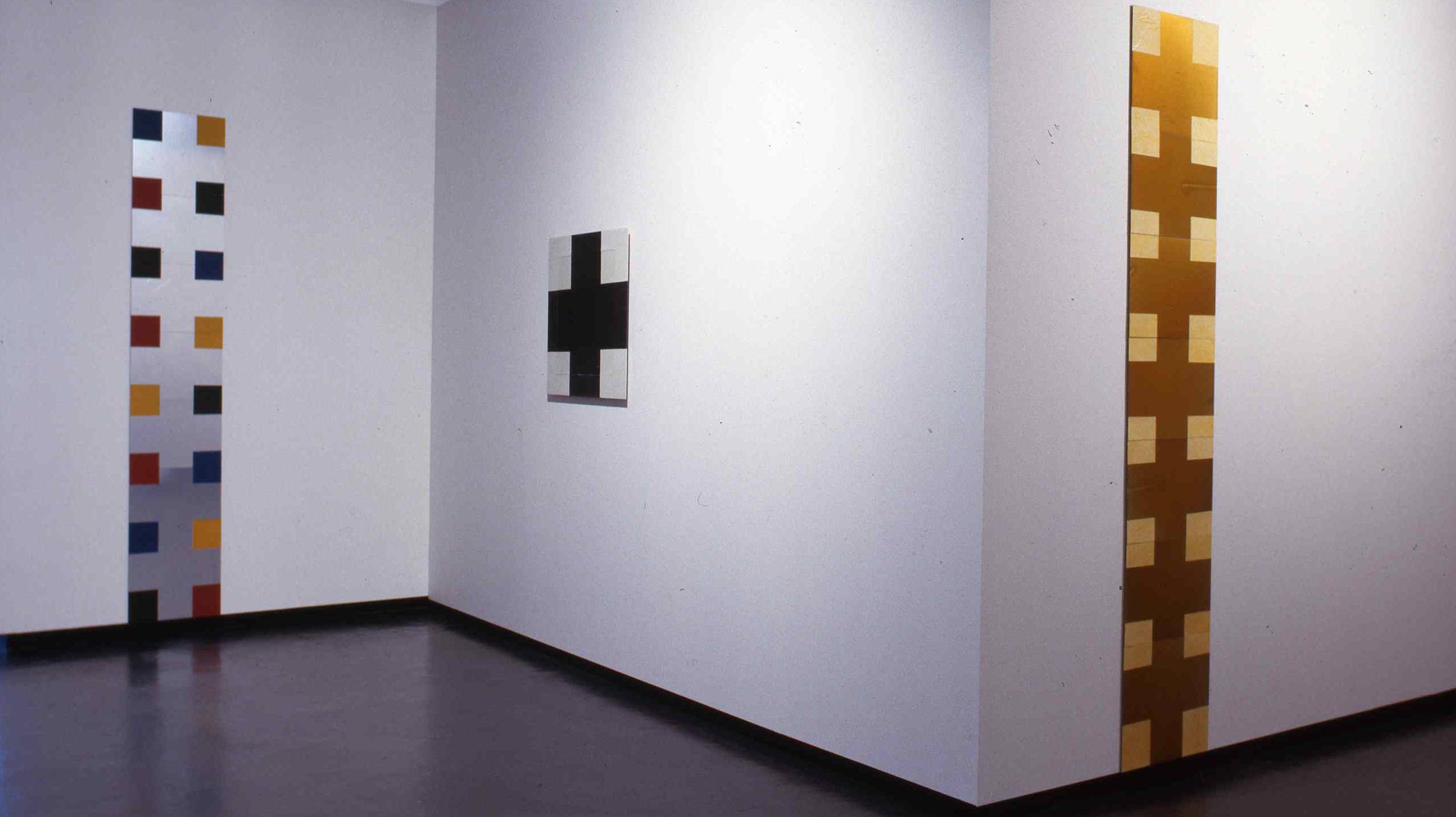
I made it for the Govett-Brewster in 1993. It’s a floor painting, a chakra made of seven trays; seven crosses filled with crude oil and the squares between with water. Ngamotu, meaning ‘islands’, is the Maori name for a New Plymouth beach. It’s where oil was first discovered in New Zealand. I was a little apprehensive about using a Maori placename—at the time, Gordon Walters was being rapped on the knuckles for his appropriations. But when Aunty Marge, the gallery kuia, came in to check out the piece, I told her my idea for the title and she got it instantly, and she said, ‘Around here, oil and water don’t mix.’ So I went with it. Certainly, New Plymouth is a site of plunder and asset stripping, and of passive resistance—Parihaka. And those ideas are still current; those actions are still being played out. The piece combined oil, which has sustained the local economy, and water, which is essential for life, arranged in a fragile state of co-existence, providing an image of transcendence that might or might not be available through this path of contamination. For the installation here at the City Gallery we opened the shutters over the windows. Those reflections are great. The work lets the world in.
.
I’m intrigued by the way the cross works appear so flat, but have this subtle spatial dynamic going on.
.
My work’s never been about the kind of flatness that modernism is supposed to have aspired to. It never interested me. It’s more about where pre-renaissance painting links up with suprematism. In the renaissance, everything is pulled back to a central vanishing point, making the viewer God. But in pre-renaissance painting the spaces are incoherent, at least from a renaissance point of view. But if you move around in front of those paintings, there are multiple points of perspectival convergence, and from different points things that appeared spatially wonky start to cohere into some kind of sensible framework. Now, the viewer isn’t God; the centre of the world is somewhere else. Pre-renaissance painting, with its weird perspectives, is often cast as an unresolved version of renaissance painting, but, really, it’s offering a completely different proposition; it has more in common with Indian miniature painting. And that sense of perspective is echoed again in suprematism, with Malevich’s tilted cross and his not-square square. So, while, at first, the shapes seem to belong to the flat surface, when you spend time with them they open up into a space beyond, a shallow infinity.
.
You hung Chakra in a specially constructed corridor, encouraging people to view it up close while walking past.
.
It’s like McCahon’s idea of ‘paintings to walk by’. And when you walk by, it does odd things. The repetition of the crosses causes a sort of cinematic flickering, a pulse. Actually, Wystan sees those early double-frame ones as cinematic in a different way, as empty screens awaiting projection; so there there’s less a sense of dynamism than of anticipation, of time-before. I’m interested in all those temporal qualities. Chakra is not only cinematic, or kinematic, it’s also photographic. The panels look like inconsistently processed blank film frames. The image comes from inconsistencies in the processing, especially when there’s a group of similar panels run together. I court that. It’s that kind of ‘process marking’ I do. The panels are processed or treated rather than painted. They’re obviously hand-done but it’s not an autobiographical mark at all.
.
Icon painting was always a production-line affair. Baudrillard writes about the spiritual as an effect that can be generated mechanically.
.
But some icons have real power and others don’t.
.
Baudrillard deconstructs the opposition of iconoclasm and iconolation. He says the iconoclasts were the truer believers because they invested in the power of images enough to need to destroy them, and that the iconolators were truly modern because they invested in the mechanistic nature of imagery, its ability to generate a divinity with nothing behind it.
.
That feels right. Malevich certainly was a believer, that’s evident in the intensity of his iconoclasm. For his suprematist work, he took what he needed from the rhetoric of Greek orthodox icon painting, for instance the traditional placement of the Russian icon high in the corner of the house. He exploits the register of the icon as a meditative object, while appearing to jettison so much of the tradition, the gold, the figurative. Iconolation and iconoclasm are both there in the suprematist work, revving one another up. The iconoclastic dimension is really testament to his belief; his not mine. I’m no iconoclast. Implicit in iconoclasm is transgression, and I’m not really interested in transgression. I agree with Herzog and De Meuron, who say it’s boring not to be normal today.
.
Where did the Ideogram paintings come from?
.
The idea first appears in my notebooks in Paris in about 1991. Initially it was going to be just ‘HI’, done in a quasi–de-stijl manner. I was going to call it Friendly Abstract Painting. The idea lay dormant until I came back to New Zealand and was offered a large commission for a wall with three speakers built into it. I wanted to avoid this wall because of those speakers, but the clients were adamant; this was the wall they wanted the piece for. Then I got really interested in the idea of these speakers. I’d been thinking about McCahon’s Angels and Bed works, which include those speaker shapes, particularly his painting Hi-Fi. I found myself wanting to turn his Hi-Fi inside out, taking the little title inscription from the bottom margin of the painting and making it the whole painting, and then leave those speakers on the wall around it. I’m into aspects of McCahon’s work that have been ignored, things that aren’t obvious, that are buried. The Ideograms became a ‘what if’ situation: what if this overlooked detail were the major aspect of the work? What if I dovetailed this slice of McCahon with my interest in the ideogram and the form of the I Ching?
.
Because the ideogram is the combination of abstract form and language?
.
Which all abstraction is anyhow. The work is emblematic of the moment I first profoundly felt modernism enter my life. It was as a kid in the mid-1960s, when the first swish stereo cabinet came into the house and we got a test record. Sitting in the lounge and hearing the train come through one wall and go out the other was a big moment. For me the transpersonal narrative of modernism and the story of my own personal engagement with it collapse into one in this work. The Ideogram in the show is actually the second version, and in a sense turns the first inside out. Everything that’s hard and rigid and permanent in the first becomes soft and dematerialised and provisional here. In the first, the panels are hard-pressed and abutted, pristine and crisp; here, they’re soft and stitched together. The first sits just two or three millimetres off the wall, but this one sits on chocks, in an ambivalent space between the wall and the floor, between the gallery and the storeroom. The first is permanently installed, but the second … you’re not sure if it’s about to be installed or about to go into storage. That kind of transience and mobility gives it a different sense.
.
High fidelity literally means obedience to truth.
.
Wondering is really the point. Hopefully the work opens up a space for contemplative wondering. Certainly, as a child, going from mono to high fidelity inspired awe and disbelief. Like, ‘I can’t believe it, the cymbal’s shimmering over there, and the bass is over here!’ It’s magical, that sense of disbelief. There’s something about the idea of hi-fi that takes us beyond our normal range of expectations—a train passing through the living room. As a kid, experiencing that, it was very powerful. As an adult, I would just see it as a trick.
.
The Copper House?
.
The house shape comes out of a post-suprematist Malevich drawing. Many people ignore this highly fertile period of Malevich’s work. Malevich’s work after suprematism is an embarrassment for some people, as if going back to the figure were necessarily and demonstrably the failure of abstraction. That’s so simplistic. Much of the development of the post-suprematist work is concurrent with the suprematist work. Anyway, I find this period of Malevich’s thinking fascinating and that drawing is a very curious thing. There’s the horizon line he often draws in, and a figure, and you can’t really tell whether the figure is looking out or in, facing you or facing in. In what appears to be a space behind the figure but in front of the horizon, there’s this cross. And, in the foreground, there’s a very tiny little house form. Well, it’s either a house or a grave, either way it’s a house. It’s such an open-ended and paradoxical image. It captured me.
.
Is Malevich’s house split in two?
.
Not at all. But in my work it’s not ‘split’ either, there’s no violence, no rupture; it’s more an opening. You’re invited in. Nearly all my works involve reflected forms. The works mirror themselves: left/right, top/bottom. The dual, the doubled, is a constant in the work.
.
And it’s church-like.
.
You say ‘church’, I say ‘contemplative’. When I get to visit the great gothic cathedrals, I don’t thank God. I thank the architect, and that’s the difference. I should footnote Judd there, he said it first.
.
The companion work, Golden House, has a strong Necessary Protection association, that ‘light falling through a dark land’ thing.
.
You talk of McCahon, but I also want to evoke Barnett Newman’s Cathedral. Of course, McCahon looked very hard at Newman. I find that cross-referencing a fertile area. Really, I don’t want to see McCahon in isolation as tends to be the way here. That’s my ‘Necessary Correction.’
.
But you’ve drawn on McCahon a lot in recent times.
.
In 1991, I came back after three years in Europe knowing that McCahon was a huge asset for me here in a way that virtually nothing else was. Looking back I can see that McCahon’s voice inflects my work right through. McCahon’s part of my cultural landscape, part of our cultural landscape, but still only part.
.
You say McCahon inflects the work ‘right through’, but back in the late 1970s I can’t imaging you saying that.
.

Sure. Back then, he was the enemy. The work was used to exemplify an argument I opposed and so I was opposed to McCahon. But that positioning was really false. It wasn’t a matter of what McCahon  was for but what the culture said he was for. McCahon was somewhere else. He was an astute reader of international art, all art, yet you had this official programme of reception mounted against that, against his classically modernist project of synthesis. McCahon really came into my thinking through the back door, it was the perversity of his homage to Mondrian—saying thanks but using that heretical diagonal. McCahon pushes things so far through his wilful misreadings that the work takes on an almost proto-postmodernist quality. He provides a model for making use of the tradition, escaping it, and feeding into it at once. And that’s the only way the discussion can move forward. I see a lot of very sterile uses of McCahon, which I’m not really interested in.
.
Let’s close on the most recent painting in the show, The Golden Echo (for Wystan). I’m used to your works having figure-ground relationships which are managed, controlled, precise; and being painted in a way that is very considered. So this one’s a real surprise. I don’t know whether I like it or not. The paint is almost sexual, secreted. There’s a vulgar, foody, super-sweet but abject quality to it, like sticky icing.
.
That work certainly is loose. I’ve become keen on having the forms juddering right across the boundaries  people are expecting them to fit into, deranging any orthodoxies I appear to have been setting up. Here, there’s a real sense of the elements not quite being in place, but good enough! I’ve always wanted the work to fly apart, from a very centred position. I’m surprised by your choice of words, because I find it quite ravishing. I want to go there.

Gavin Hipkins: The Crib

Guarene Arte 2000 (Turin: Fondazione Sandretto Re Reubadengo Per L’Arte, 2000).


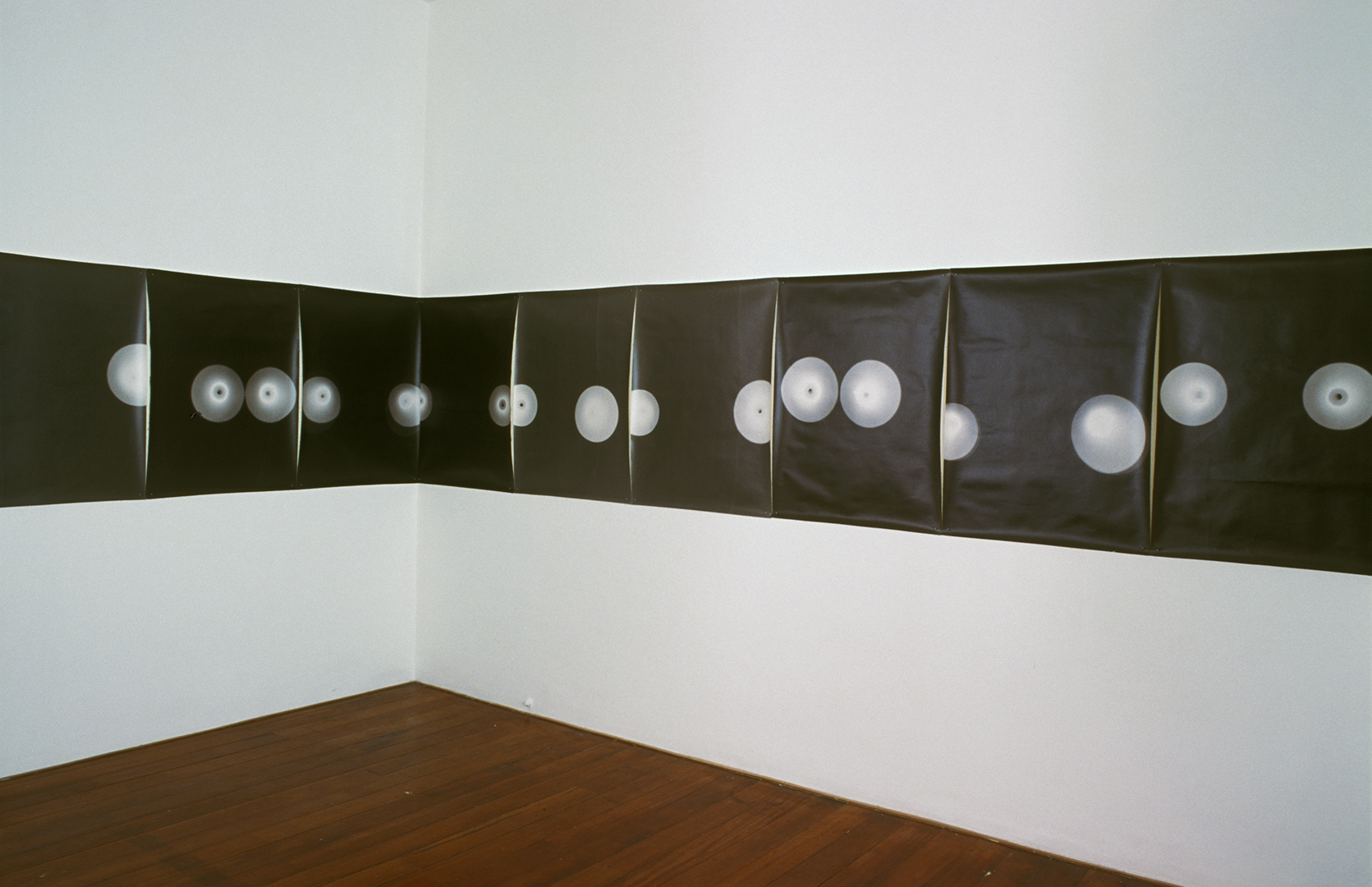
Gavin Hipkins is known for creating works from dozens upon dozens of near identical photographs or photograms. The subjects of the individual shots are apparently trivial, often childish—strips of plasticine, licorice straps, balls, lollies, buttons—and their compositions banal. But massed, marshalled, and regimented, the effect is epic. With their retro-modern styling, Hipkins’s works hark back to a moment when photography’s new ways-of-seeing were optimistically linked to a new vision of the modern world, both utopian (Rodchenko and Moholy-Nagy) and totalitarian (Riefenstahl). As if to underline the reference to heroic modernist engineering projects—architectural and social—Hipkins gives the works suggestive titles: The Tunnel, The Circuit, The Trench, The Track, The Movement …

Hipkins’s use of the definite article is pointed, suggesting these works are not just any example, but the primal, original, essential instance. And so the works stake a claim on necessity, even in the face of their overt contingency, making them portentous, even ominous. Their Kafkaesque inscrutability proves magnetic, drawing forth associations and confessions from us to fill the void. Like a psychoanalyst, or the monolith in Kubrick’s 2001, the works are presumed-to-know but are not telling. We speak for them.

Take Hipkins’s latest piece, The Crib, a twenty-metre frieze of photograms of polystyrene balls. Prompted by the title, we will bring a range of associations to bear on what might otherwise seem to be a vacuous abstraction. ‘Crib’ is a word South Island New Zealanders use for their rustic holiday huts, which speckle the shore; it is the common name for Cribbage, a card game, where the score is kept by moving pegs down drilled holes on a board; a crib can be a wooden framework from which animals extract fodder; to crib an idea is to steal, plagiarise, translate, or summarise it.

Of course, the crib is most commonly the first bed, the cot where baby is confined. In New Zealand the bars of these little prisons are typically decorated with coloured balls which baby enjoys moving back and forth as a compensation while abandoned by mum—surrogate breasts. The paired milky disks in The Crib could also connote eyes, the reassuring super-vision of parental authority.

In its panoramic reach and willful obscurity, The Crib diminishes us, infantilises us, fences us in. It sends us to bed and makes us revisit those days when we struggled to comprehend the world, when we were just learning to see, just learning to focus. Significantly, the photogram—which registers a raw index of direct light, rather than focussing an image from reflected rays—is similarly a baby: a primitive photo-photography, a photography just beginning to see. And so The Crib could be understood as conflating the infant’s early days with those of photography. The Crib also resembles film footage, and, as we cast our eyes along the frieze, the globes palpitate. Rosalind Krauss has frequently noted an optical dynamism or agitation, a dissolving of the visual, that distinguishes certain early avant-garde art, and has linked it to the child’s fascination with flickering photo-cinematic toys such as the zoetrope. But The Crib’s kinesthesia is not ultimately satisfying. It is mesmerising yet forlorn, sexy but inhuman: a sterile jiggle, an already spent eroticism, a rerun. If The Crib is a time machine, returning us to some formative moment in the development of the modernist subject, it cannot erase hindsight. We can’t really go back, can’t view the world through the wide eyed photo-utopianism of Laszlo Moholy-Nagy. And the bouncing balls of The Crib are insufficient compensation.

Hipkins’s charismatic crypto-fascist works offer us something slight but compelling on which to hang speculations such as these. They are generic mysteries in which we locate what concerns us, while embracing it as other. So the works’ significance is less the hermeneutic labour they routinely occasion—one which the artist himself happily shares in—than that they call it forth, and how they support it. Hipkins provides a format.

Michael Parekowhai: Patriotism

Michael Parekowhai: Ten Guitars (Auckland: Artspace, 2000).


There’s a great bit in John O’Shea’s 1966 New Zealand rock-road movie, Don’t Let It Get You. A glamorous young Kiri Te Kanawa, at the dawn of her international career, sits in a Maori meeting house talking to children. Turning on a tape recorder for accompaniment, she breaks into an aria. The camera moves around her as the house of the ancestors is filled with incongruous sounds. The sequence is sexy and surreal. No one would shoot anything like that today, being only too aware of the contradictions involved in such post-colonial scenarios. Now we might be tempted to cast the aspiring diva as a victim, a detribalised person, someone separated from her cultural roots and pressed into mimicking European high culture—someone overimpressed. But in fact it could be read differently: as compelling, authoritative; as embodying a desire so wide-eyed and self-satisfied that the need to police identity need not raise its ugly head. Michael Parekowhai likes that sequence.

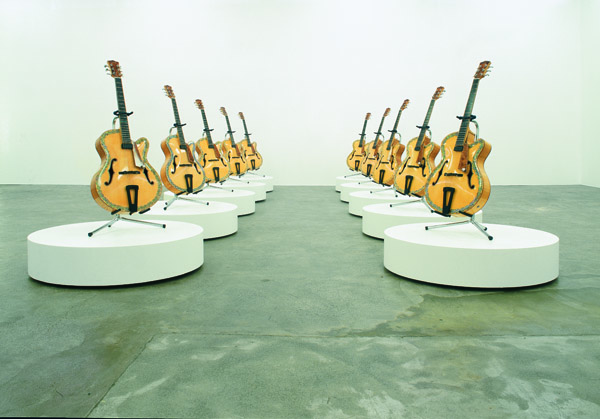
For his latest project, Parekowhai has created ten top-of-the-line, customised, hollow-body guitars, jazzed up with paua inlays reproducing classic Maori kowhaiwhai patterns. These flashy instrument were handcrafted by Manganui luthier, Laurie Williams. The project is an obvious nod to Engelbert Humperdinck, whose song ‘Ten Guitars’ is an old Maori standard, having topped their charts back in the 1960s. Maori really took this song—which promotes a utopian social ideal of playing together in harmony—to their hearts, and claimed it as their own. These days, we might consider ‘Ten Guitars’ a bicultural anthem.

.
I have a band of men and all they do is play for me
They come from miles around to hear them play a melody
Beneath the stars my ten guitars will play a song for you
And if you’re with the one you love this is what you do
Oh, oh, dance, dance, dance, to my ten guitars
And very soon you’ll know just where you are
Through the eyes of love you’ll see a thousand stars
When you dance, dance, dance to my ten guitars
.

The 1960s have long been a reference point for Parekowhai— he was born in 1968. The 1950s and 1960s was the time of ‘the second migration’, when Maori became detribalised, leaving rural areas in massive numbers to seek work in the cities. In this troubled time, however, the media routinely favoured images of ‘the happy Maori’, ‘as happy as the day is long’. It is hard to know if this cliche was a patronising slur projected over Maori or a confident face projected out by them. More likely, it was a bit of both. The 1960s was a time of complex and conflicted images of Maori—just look at the covers of Te Ao Hou, the Department of Maori Affairs’ remarkable magazine. On the one hand the magazine represented a flowering of Maori art, literature, and scholarship, on the other it was clearly intended as a means of easing transition, lubricating assimilation. Parekowhai finds vitality in this contradiction. Neither naive nor cynical, he revels in utopian images which, although mired in complexity, or perhaps because of it, remain emblems of a possible way through.

It was in the 1960s that the guitar became the ubiquitous ‘happy Maori’ party instrument. And the boom-chucka-boom-chucka Maori strum, with the strumming hand damping the strings, was certainly distinctive. A sing-along instrument, the guitar was part of the furniture, something to be passed around—joint property. You didn’t have to bring one to a party, there would always be one there. It symbolised and facilitated community at a time when traditional tribal structures were giving up the ghost. It was a portable meeting house. They say mimicry occurs where colonialism has done its work, but Parekowhai would stand apart from the authenticity police who lament the Westernisation of Maori music, with old chants and ancient instruments giving way to catchy melodies, tonal harmonies, and guitars. For Parekowhai it was the Maori who colonised the guitar, not the other way round—they found themselves in it.

Not that the artist is oblivious to the downside of Western influence. For Changing Signs, the 1993 Artspace billboard project, he reproduced an Ans Westra photograph of Maori kids in a classroom playing at being a rock band, with a toy drum and an Edmonds baking powder tin on a broomstick as a microphone. Over the top, he printed a John Lennon quote: ‘Before Elvis there was nothing’, pointing to how new ways were erasing the old. Certainly, the King, who took black music and made it his own, has long been a Maori favourite, and Parekowhai himself does a mean Elvis.

In the 1960s, the model of the successful Maori—the Maori ‘done good’—was the performer, be it as entertainer (Kiri Te Kanawa and Howard Morrison) or athlete (particularly rugby players like Waka Nathan). But the idea of performance is not entirely innocent. As Maori were dispossessed of their lands, their culture was steadily reified as a pageant, given a commodity form in the concert party and the Maori show band, where difference was transformed into spectacle. There’s a concern for performance in Parekowhai’s showing here, the consummate crafting of the guitars, their presentation as top-of-the-range, export quality.

It’s interesting to compare Parekowhai’s aspirational luxury instruments with the basic acoustic guitar, incised with kowhaiwhai patterns, that turns up in this year’s movie What Becomes of the Broken Hearted?, the sequel to Once Were Warriors. This guitar appears at a crucial juncture, being implicated in the moment of Jake Heke’s redemption, the fire-side sing-song that marks his return to the community. Parekowhai’s Ten Guitars also evokes this possibility of community—we’re all ‘with the band’. The big difference is that his instruments are flash. They are the apotheosis of the Broken Hearted guitar—what it might dream of being. Such instruments are usually one-offs, made for star performers, entertainers, name artists. But here, it’s like everyone in the band gets one. While unique, with distinct patterns and individually numbered off in paua in Maori on the fretboards, they also imply a team.

Not that Parekowhai is mindlessly warm-fuzzy about community. Branding the guitars ‘Patriot’ on their machine heads brings a range of contradictory associations, complicating a simplistically utopian reading. Patriotism implies fighting for ones country or creed, in that flag-waving, hand-on-heart, white bread, country-music way. It also refers specifically to the American Patriot missile—echoed in the guitars’ missile-shaped cases. This high-tech device—supposedly a defensive weapon for the greater good—is used to destroy the enemy’s missiles mid-flight, most successfully in the Gulf War. We are used to the idea of weapons concealed in instrument cases, but here guitars are concealed within missile cases, perhaps recalling American folk singer Woody Guthrie’s guitar, which bore the inscription, ‘This machine kills fascists’. If patriotism insists on belonging, it also requires an other, the possibility of not belonging: one person’s patriot is another’s traitor. So the utopian image of Humperdinck’s happy band playing together is also tainted, politicised—us and them.

But there is another sense in which patriotism operates here. As T.J. McNamara put it in a review of the Artspace show: ‘You have to take out a mental subscription to this kind of art, but once you are a subscriber, the possibilities are endless.’ It is as though the artist were inviting us to become patriots of the guitars themselves, asking us to take them as our treaty, our founding document, our meeting house.

The Guitars are accompanied by a second installation, which also takes its name from an old popular song. The Bosom of Abraham is an arcade of fourteen kowhaiwhai-pattern lightboxes, a generic meeting house. Traditionally the meeting house is where the tribe details and asserts its identity, but it is also where locals and outsiders are made one through a sequence of protocols. It’s a cultural airlock of sorts. Parekowhai’s meeting house does without the most tribally specific aspects—the carvings of ancestors; those features that make it, in the first instance, someone’s place and not another’s. In fact, the kowhaiwhai patterns from the rafters have migrated down to take the place of the carvings. Further the two kowhaiwhai patterns Parekowhai uses are among the most well-known, which, rather than defining a particular quality within Maori culture, today simply indicate Maoriness. Like the Guitars, this is a make-shift modern meeting place for all.

Parekowhai has long engaged the Duchampian idea that the viewer completes the art work. Previous sculptures were based on letter blocks, toys, games, and kitset models, implying that the viewer might physically manipulate the work. Similarly, the guitars long to be played. Resting silent on their stands, they await the band of men who will coax them to life, delivering up a possibility latent within them. Play isn’t simply implied; there have been and will be performances.1 The project opened with a performance by the guitar orchestra, Gitbox, reprising the Maori show band the Quin-Tikis’s number ‘Guitar Boogie’ from Don’t Let It Get You. A pick-up band also played ‘Guitar Boogie’ at Queensland Art Gallery for the 1999 Asia-Pacific Triennial. And more performances are planned. The choice of ‘Guitar Boogie’ is pointed. The Quin Tikis exemplified the play-together spirit of ‘Ten Guitars’ quite literally. In Don’t Let it Get You, we see one player picking and another fingering the notes on the same guitar, coordinated in a virtuoso show.

The guitars are also commodities. The artist insists they be split up, sold off as individuals, available to collectors, museums, and musicians alike. So the guitars have potentially different destinies: one may be played in church or by Neil Finn, another kept in a glass case. However, there is always the possibility—and intention—that they be reunited, played together again at a different time and place, bringing their histories with them. A reunion gig. The idea of return is crucial. Parekowhai’s Ten Guitars is nostalgic for a time when Maori, at least in representations like Don’t Let It Get You, could believe in both putting differences aside and retaining their selves.


  1. http://vimeo.com/18852549.


Michael Stevenson and Steven Brower: Genealogy

Art and Text, no. 71, 2000. Review, Michael Stevenson and Steven Brower, Genealogy, Govett-Brewster Art Gallery, New Plymouth, 2000.


The Govett-Brewster Art Gallery runs an edgy programme, but it hasn’t always been easy. Until recently, this backblocks gallery still had to placate ratepayers by mounting an annual community-art show. So, it’s mischievous of expatriate local boy Michael Stevenson and New Yorker Steven Brower to use their residency exhibition to bring bad community art back to the Brewster. The art in question is the work of their parents, and their show, Genealogy, an Oedipal romp through personal and provincial art histories.

Settling in the hamlet of Ingelwood in the 1950s, devout Christians Alan and Margaret Stevenson did good works, making crafty community murals, designing for repertory theatre, and passing on their skills. Stevenson’s installation reproduces Ingelwood High’s art room, where he was taught by his father. Along with art-room paraphernalia, Stevenson hangs work by mum and dad, and juvenile works by himself and his sisters: scenics, portraits, studies of churches, chaste nudes, and calligraphy exercises. Stevenson’s high-school art folio, which dad helped him glue together, leans against the wall.

Four further (faked) high-school folios appear to be the early-early work of well-known New Zealand artists Christine Hellyar and Paul Hartigan (both from Taranaki), wunderkind Michael Parekowhai (who actually failed School-C art), and Julian Dashper. The folios are full of set pieces: self portraits, still lifes, Maori patterns, and stylised landscapes—nascent self expression tempered by the syllabus. They are riddled with in-jokes: hints of what will come (Dashper is already obsessed with drum kits and chains) and sublimated sexuality (Parekowhai’s bulging power drill rendered in denim).

If Stevenson’s room embodies conservatism, family values, and repression, Brower’s provides a counterpoint. His dad, Bill, may have been influenced by Thomas Hart Benton’s style, but he had no truck with Benton’s cheesy politics. Brower hangs a selection of Bill’s student works, commercial illustrations, and garish ‘social comment’ paintings that would not look out of place in Hustler. There’s Group of Nazi Officers at a Meeting (Hitler sodomising an officer as the team looks on), Totem and Taboo (Freud clinging to a woman servicing herself with a vibrator), and a ribald portrait of the Clintons. The Gallery felt compelled to slap an R18 rating on Brower’s room and to withdraw Beauty Contest Winner Returning Home to Find Her Husband Abusing their Child. In a didactic panel, Brower says dad was always his favourite artist. What a role model!

The centrepiece, Brower’s 1:12 scale model of his family home in West Virginia, opens like a dollhouse, revealing hoards of books packed into every crevice. An unstoppable book buyer, wild Bill’s library strangled the house, compelling him to add crude wooden extensions out back, which slowly disintegrated. Nicknamed ‘Falling Lumber’, who could fail to see see this horror home as a reification of domestic strife? And yet, Brower’s accompanying text excuses it as a treatise on hubris, rather than an example.

Genealogy itself is rambling—ramshackle, amateurishly installed, unedited, disordered. We’re sucked into a morass of ‘issues’: how the times left their mark on the parents, how the parents impressed their children, the difference between good art and bad, the artists’ confused motives, and the censorial gatekeeping agendas of art institutions, from high schools to museums. As the artists offer no clear position on these matters, the viewer is seconded as a shrink—everything becomes a symptom.

Copyright © 2026 · Genesis Framework · WordPress · Log in