Robert Leonard

Contemporary Art Writer And Curator

Te Papa: Papa’s Bag

Artforum, January 1998.


It’s hard to find someone with a good word to say for Te Papa, the new Museum of New Zealand, which opens on the Wellington waterfront on 14 February 1998. Created in a period of retrenchment in government funding, typified by welfare cuts and the selling-off of state-owned enterprises, this $NZ300M-plus museum is an anomaly. But, surprisingly, it’s not the price tag that’s the real sore point. For once, it’s the art lovers not just the taxpayers who are outraged.

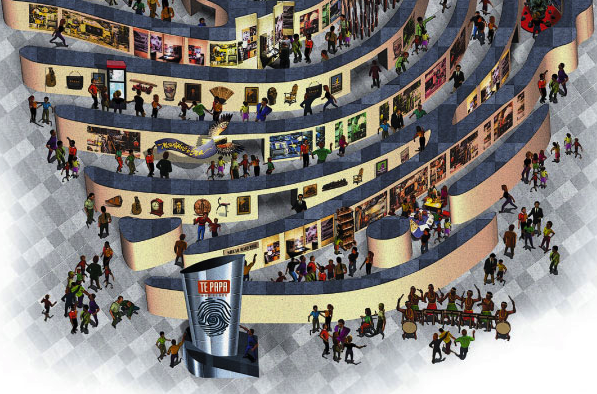
Back in the early 1980s, we were promised a new home for our lively National Art Gallery, then housed upstairs from the dismal National Museum. However, a change in government and stealthy lobbying saw this modest proposal picked up and turned around. In a complete about-face, the idea of a dedicated National Art Gallery was dropped in favour of a mega-meta-museum, a Museum of New Zealand, in which art would be just one of four cross-pollinating departments. Encompassing Maori culture, social history, the natural environment, and art, the museum would also embrace all New Zealanders, offering itself as a monument of national pride at a time when the social contract was coming completely unstuck. The museum would be something new—a populist, state-of-the-art infotainment centre, with all the bells and whistles that go with that territory.

Although New Zealand artists have been dodging the mandate of national identity for decades, Te Papa will essentially reinscribe our art as parochial social history—part of the fabric of our unique ‘material culture’. Art will be swallowed up by master narratives as works are reduced to artefacts or ciphers of social history. Notoriously, Colin McCahon’s breakthrough 1958 painting, the Northland Panels, will be exhibited beside an innovative refrigerator of similar vintage. Though contemporary artists have been recruited to create new artworks for the opening, the upcoming pieces sound more like museum displays. For instance, Lisa Reihana’s video installation addresses the identities of sitters in historical photographs, while Maureen Lander’s project references Maori string games.

Te Papa proudly combines New Right ‘dumbing down’—targeting the lowest common denominator, maximising ‘bums on seats’, offering fast-fix customer satisfaction—with a hyper-intellectual self-reflexivity about ‘museum practice’. Obsessed with its role as a cultural mediator, Te Papa seems to have lost track of the culture it is mediating, narcissistically confusing museum operations with the dynamics of the culture itself. At the same time, it has no opinion. It wants to be everything to everybody, to capture every niche market. Presenting its animatronics, its artificial earthquakes, and its do-it-yourself archaeology pit under the same roof as its treaties, meeting houses, and masterpieces, Te Papa’s postmodern collision of values offers little hope for art. The place will be full of art works, but bereft of art experiences.
Rudi Fuchs: Some Sun, Some Mist, Some Shadow

Art New Zealand, no. 88, 1998.


Rudi Fuchs, Director of Amsterdam’s Stedelijk Museum, might appear to be a contradiction in terms. One of Europe’s star curators, he has been recognised as audacious, an art zealot, a risk taker, a passionate supporter of the avantgarde. He has also been cast as retrograde, an incurable romantic bolstering a Eurocentric art tradition. The truth is, of course, neither and both, and far more subtle. Rudi Fuchs loves metaphor and you can see that in his writing. He wanted to subtitle his Documenta 7 ‘In which our heroes after a long and strenuous voyage through sinister valleys and dark forests arrive at the English Garden and at the gate of a splendid palace’. It was this 1982 survey of contemporary art that really made Fuchs’s name. Documenta 7 proved crucial in focussing world attention back on European artists, particularly on those exploring the legacy of national traditions and mythologies, like German neo-expressionists Georg Baselitz, Anselm Keifer, Markus Lupertz, and A.R. Penck.

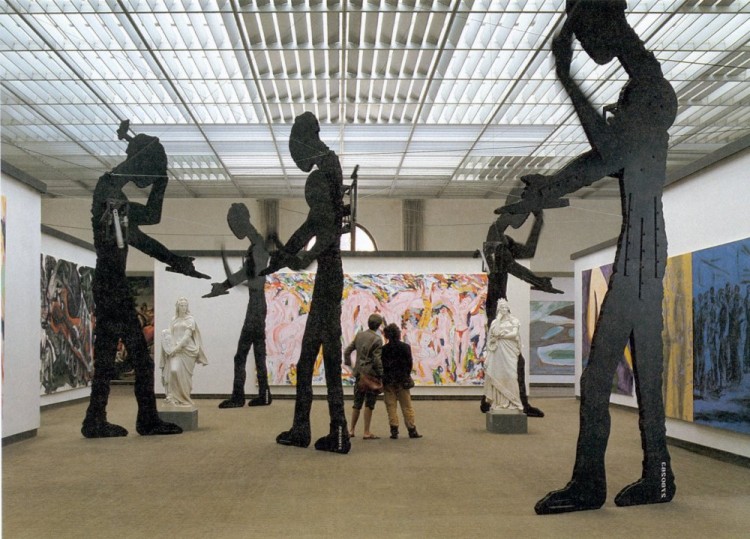
Fuchs is known for the verve and precision of his installations. He likes to stage an experience rather than simply make a point. Documenta was no exception. With its poetic juxtapositions, the show traded in sensibilities and feelings—in aesthetics—rather than in arguments and conclusions. Fuchs placed old statues of female figures symbolising the arts of painting and sculpture on the covers of the two catalogues. American critics especially scolded Fuchs for his romanticism and ahistoricism. And yet his Documenta would prove prophetic, making space for new brands of art and curatorial practice that would flourish throughout the decade. After Documenta, Fuchs was appointed director of a new museum, the Castello di Rivoli, a huge, damaged Baroque castle in Turin. The semi-restored building provided a dramatic and novel setting for contemporary art. Some of the rooms were retrofitted as white cubes, others retained their original opulence. Some rooms combined the two, as crumbling old frescos were patched with plain plaster. Into this space of tradition in decay, Fuchs installed contemporary works by artists, including James Lee Byars, Lothar Baumgarten, and Jannis Kounellis. A conversation between currency and history, the Castello di Rivoli complicated the party line of modernism as an absolute break with tradition. Such charged contradiction would always inform Fuchs’s work as an exhibition maker and as a museum director.

After Rivoli, Fuchs took charge of the Gemeentemuseum in the Hague, which boasts a great Mondrian collection. It was not until 1993, however, that he fulfilled his ambition to become director of Amsterdam’s Stedelijk Museum, one of the world’s great modern-art museums. Here he developed his Couplets exhibition series, with imaginative and insightful juxtapositions of artists. In addition to his ongoing curating and writing, Fuchs is currently overseeing the expansion of the Stedelijk. The new wing, designed by the Portuguese architect Alvaro Siza Vieira, will greatly expand the presentation of the permanent collection.

In the last few years, Fuchs has become involved in the New Zealand art scene. In 1994, he contributed a paper to Is Art a European Idea?, the Under Capricorn conference in Wellington. In 1996, the Stedelijk collaborated with City Gallery Wellington on another Under Capricorn project, the exhibition The World Over: Art in the Age of Globalisation (curated by Wystan Curnow and the Stedelijk’s Dorine Mingot). The show occurred simultaneously in Wellington and Amsterdam, and included work by an international roster of artists, including New Zealand’s Ruth Watson, Michael Parekowhai, and Colin McCahon. And now, The Exhibition of the Century, a show of modern masters drawn from the Stedelijk’s collection, is being showcased at City Gallery. Fuchs visited New Zealand to finalise and promote the show. On his last night in New Zealand, he talked to Artspace director Robert Leonard.
.
Robert Leonard: So, what brings you to New Zealand?
.
Rudi Fuchs: You know the reason. There’s this show of the classics of modernism from our collection, from Van Gogh to Jeff Koons, coming to New Zealand. It’s a concise view, a condensation of some of the major moments of twentieth-century art history. It’s really standard modernist stuff: the canon. It was made for Japan and the Japanese wanted the famous bits.
.
This kind of masterpieces show, the canonical blockbuster, the art-history show, this isn’t at all the kind of show that you are known for doing. 
.

I understand now why City Gallery wants this exhibition. They said they wanted it because they would have just renovated the gallery and there was the opportunity to work with Telecom and set up an almost entirely new . . . to make this City Gallery into a more important place than it had been before. It was only after I came here that I realised that it also had something to do with Te Papa. They didn’t tell me about that in our correspondence. I understand now that there is some kind of competition. If it were a business, they would say it was very healthy, and, in a way, it is very healthy. Actually, I initially suggested that we do something else, a different kind of show, something more critical, which could also have involved Malevich and Mondrian but in a different kind of presentation, and maybe have left out the Van Gogh and the Cezanne. But they didn’t really want to do that.

Two or three years ago, I was in Japan, just before the new art museum in Tokyo opened. It’s a huge building but the collection is very small, and they were discussing buying an early Roy Lichtenstein, not a very big one. And I think the asking price was like $7M. They finally bought it. But the reasons they bought it were completely different to the reasons that the Stedelijk bought their Lichtenstein triptych back in 1960s, the one with the plane, which is coming to Wellington. It was bought the year it was made, more or less. It may have been the first Lichtenstein bought by a museum. That painting came into the Stedelijk, as many other things did, at a critical moment: critical for the artist, critical for the museum, critical for the culture. Because there was a question: do you accept it or not? And that’s always the point. But the exhibition in Wellington is of stuff that has now all been accepted, which is fine, but, from a moral point of view, I don’t want to feel that I am just selling them an exhibition of masterpieces. That would not fulfil the ambitions of the Stedelijk. Since the Second World War, since the great Willem Sandberg became director, the Stedelijk has sought to be a museum with a very strict and close relation to the avantgarde itself, a museum which actually takes part in the creation of culture.

I realised, the first time I met an artist here, in New Zealand, when I had lunch with Ralph Hotere, that it would be important to do a second show, which the City Gallery could have in a year or so. Dutch collections would provide an exhibition, this time of art of the last ten years; young artists, mostly in their 30s and 40s—Dutch, French, Italian, American … We collect all that stuff, and at a time when the things are not yet expensive and are still critical. And I am sure I will be able to convince my colleagues to collaborate, because it will be good for art. I called my lecture in Wellington ‘This Is Only the Beginning of the Controversy’, because, here, in New Zealand, where visual art is a suspect entity anyway, the first exhibition will be controversial, but there will be another controversy—bringing out this second exhibition.

It will be good for the artists here. Yesterday, I was talking about it with John Reynolds, Richard Killeen, and Stephen Bambury, and I spoke to Peter Robinson about it down in Christchurch. For them, they can engage with this. There’s something that they can relate to. Ralph Hotere, who is 67, which is only slightly younger than Antonio Tapies or Karel Appel, might, in retrospect, become part of their tradition. And Stephen Bambury, in retrospect, may become part of the tradition of Mondrian or Malevich; more Malevich I believe. That will take years, but we will see that. But now, it is important that they can see themselves in relation to their contemporaries.

In a country like this, from what I have seen, what artists are making, the way they mix up things, the way they are irreverent towards traditions, and the way they are recreating something of their own around or through McCahon, this great naive master—it might be interesting for artists here to see the work of Georg Herold, a German artist from the tradition of Beuys and Sigmar Polke. And, in fact, one of the first things Peter Robinson did when he was in Aachen was go to meet him. There is something in Herold’s work which is completely uncontrolled, disorderly, different things in one. Not the particular, precise way of Mondrian or Barnett Newman or Dibbets or Jonathan Lasker—that’s neat painting—beautiful, orderly painting, where nothing can slip in because it’s all already in there. But in these things by Beuys or by McCahon or by Herold, you can feel it still is an open form or an open discourse. In the disorder, there’s the attempt and expectation that other things can slip in.
.
You are known for installing works in challenging, speculative ways. Will that approach to installation inform the second show? 
.

Well, it should be like that. I’m not sure how the first show is going to be. I’ve promised to make a design on paper now I’ve seen the gallery, but I’m not sure if they will do as I say. I would hang it in a dialectical configuration. I would not hang all the Mondrians in the same room. I would give them different perspectives to other things. But that’s too detailed to talk about now, making those kinds of exhibitions where the hanging makes an argument. That’s only possible when you work with your own collection or you can borrow some things from people you know very well, so there’s freedom to do that.
.
How did you get involved with New Zealand?
.

Well, it started when I met Wystan Curnow at the 1982 Sydney Biennale. We got on well. I think he’s two years older than I. And I sensed this kind of melancholy, the melancholic nature of his artistic feelings. It made me think that there was something deeply spiritual and interesting in New Zealand, but that there was also something else, something to be remade, as if it were an island that had drifted away from the main. And then there was also the fact of Colin McCahon, who was in The World Over in Amsterdam. McCahon was intriguing because there is a melancholy in his work which was like the melancholy I had sensed in Wystan. And the idea came to my mind that it would be possible to make a serious McCahon exhibition in Amsterdam, which might also be seen in other places in Europe. That was my secret agenda with this trip.
.
What are your impressions of the scene here? 
.

As Paula Savage was always telling me, you have to be careful in New Zealand. It’s a small country where everybody knows everybody. When a country gets fairly large, even a country the size of Holland, which is now sixteen million, you don’t have it anymore. But here, it is an important fact, anyway. It’s something I noted also in the poetry of Allen Curnow, that lots of the poetry is about his relations—his father, his mother, his sister, his uncles, imagined uncles. Like you are always telling your history and that history taken all together is becoming the history of the country. You have to mind that everything I say I say after ten days of being here. But I have a bit of experience at looking at things.

I find that the art world here, there’s something edgy about it, something vital, which is because of McCahon. There is something obsessive in its core which is not in Australian art or French art or in Swiss art. The reason German art does so well is because of Beuys. He was this obsessive presence. He addressed many problems; he talked about and questioned many things. German artists today, though they make very different kinds of work, they all respect the kind of man that he was. English art is also very good at the moment and that’s because there’s something energising in the work of Gilbert & George. If you look at English art, from Gainsborough and Reynolds, and on and on from then, through the nineteenth century, up to Hamish Fulton, Richard Long, and David Tremblett—wonderful artists that they are—there is this strange genteel, almost pastoral tradition. And then suddenly, there’s Gilbert & George, who literally fuck up everything, and they speak in this horrible cockney accent. They pulled the cork out of the bottle so all this stuff could come out. They changed the approach to subject matter. You can find the same thing here, with Colin McCahon. When you were an artist in England in the 1960s or 1970s, the first idea was to go to America, just as, before the war, it was to go to France. But these young English artists, they stay at home now. Not just in London, but Newcastle, Glasgow, Leeds—places like that. Here, as soon as people realise that McCahon has this kind of evocative power, they’ll know that there’s no reason to go to England or America, they can actually stay here and develop.
.
McCahon didn’t travel much. He drew a lot on European modernism but read it in very strange ways. Wystan was really disappointed not to be able to include McCahon’s Here I Give Thanks to Mondrian in The World Over in Amsterdam.
.
There’s another McCahon, of the sea and a cloud, but the cloud is actually a chrysanthemum of Mondrian’s. Mondrian’s flower becomes a cloud hanging above the black sea. A lot of such things are here, so it’s been very energising in a way. Coming here, talking to the painters here, I now know McCahon much better. I would really like to include one or two of his paintings in our collection. They would go so well with Kounellis, with Beuys and with Tapies.
.
How do you see yourself, as an exhibition maker?
.

Galleries can be incredibly boring, one painting after another, all about the same thing, more or less: a tree to the left, a tree to the right—some sun, some mist, some shadow. And they can also be very exciting. I believe that you have to create situations that are arresting. Like when you go to an opera and there is this moment between the various elements, between the form of the music, the sets, the singing, the decolletage of the soprano, the colour of her dress, the lighting. Suddenly, an incredible marvel is happening, and you can create that in galleries.

When I was in Italy doing the Castello di Rivoli, the Italians had no word for curator, so they had difficulty with what I was. The Italians call people like Germano Celant ‘critico’, so they called me critico. I told them that was a term I took offense to. I also didn’t like it because they were called critico, and I didn’t want to be like them. So I said, I am an ‘artigiano’, which is a craftsman. I am a craftsman of the eye.

I had a nice experience recently. I did a very classical exhibition, with Jan Hoet, of twentieth century Flemish and Dutch painting at the Palazzo Grassi in Venice. In Italy, for an exhibition, they always have an ‘architetto’ and a critico, and the architetto installs the work. But we didn’t have an architetto. I wouldn’t allow it—we installed. And this architect, she said she could see that I had done the installation. And someone said, ‘Why?’ And she said, ‘I can see that when I see the intervals between the paintings.’ And I kind of like that. Maybe it’s allowed, to be a little proud of what I have learned to do, apparently not too bad.
.
Sometimes the installations have been incredibly contentious. I was looking through an old issue of Artforum which had a bunch of reviews of your Documenta. The reviewers were all extraordinarily … 
.

Upset.
.
… harsh.
.
I was called a ‘romantic fascist’. Thing is, now they are all doing that kind of exhibition-making, making things unclear. There’s something in art history itself, this unfortunate tendency that most curators have accepted, that they have to do it in a certain way, say chronologically or by country, because otherwise their public would not understand it. Americans want everything to be clear—they have this explanatory zeal. If you talk to American curators, when they speak of their trustees, they say they want everything explained to them, from A to Z. I can’t do that. There is something secretive about art, something that can’t be explained. I don’t pretend that I can explain Mondrian. I can give some hints. I can hang this next that. I’ve hung Mondrians next to extremely realistic paintings.
.
And furniture!
.

And furniture, even worse. But the precision of the realism in say this particular 1920s painting … it offers a similar kind of detail to a Mondrian. In that case, I wanted to show that the Mondrian was also done by the eye, painted by hand with one eye closed, looking carefully, intently. Things like that are important. But they take time, they take longer to get, and they take a public which is fairly sophisticated, but you can make them more sophisticated. So it’s less about explaining the work than making people understand that they should take that time, take the time to look at something, instead of just drifting through the gallery like it’s a shopping mall. With an installation, you can emphasise things like the basic difference in the abstraction of Malevich and Mondrian, say. The Malevichs are thickly painted and have almost no space behind them, they’re like surface things, while the Mondrians are very transparent, and you can actually enter into this endless space. Mondrian has to do with the tradition of Dutch landscape painting, while Malevich is from the tradition of Russian icon painting. From there, with an installation, you can develop these things, presenting alongside a Mondrian, say, a Dibbets work, a photographic reconstruction of a piece of gothic architecture. You look endlessly into this space, which is a Mondrian tradition. However, a Kounellis, with a metal cross on a plate of metal, it’s the Russian thing, the Malevich thing, the orthodox thing which is confronting you. Things like that you can indicate, but not much more.
.
What’s your view of Te Papa?
.
You cannot expect me to praise or criticise Te Papa. I can only understand it in terms of a country’s need for a national shrine. Someone said they preferred the British Museum, but actually it’s a similar kind of thing. You have to understand that the British Museum is the absolute and proper expression of a combination of historic interests—the enlightenment and imperialism. Similarly, Te Papa is also an expression of its moment—the modern age of media—and of a very different kind of historical judgement. In the British Museum, there is absolutely no doubt that the culture of white Christians is the superior culture, and in Te Papa, at least, there is that discussion. But what I object to, or what I would like to warn of—and I’ve said this to many of my colleagues here already, as every discussion in the last twelve days has begun and ended with Te Papa—is that Te Papa has nothing to do with the world of galleries and museums. It is something in itself. Most art galleries, by contrast, are fairly small. They have fairly precise programmes and a particular style to how they do things. I think we should talk more about how the new Robert McDougall Art Gallery in Christchurch is going to be, because it is exactly that kind of gallery, and they are being built all over the world, and they are entirely different to Te Papa. I fear that people might get confused, that Christchurch might think they have to do something like Te Papa, to become popular in that way. But they can never become popular in that way, they have to become popular as a precise institution. It’s like certain people like going to shopping mans and large warehouses and there are people who like to go to specialist stores. And both are important things to have and exploit, but they are different from each other, they cannot be the same. The installational side is very different too. The installation at Te Papa can only be as it is. It is like a Hollywood set, like Titanic. A big movie. You can’t expect it to be refined or discrete. You can do things in a small gallery you can’t do in a big museum, and vice versa. Of course, I must admit that my heart lies with the smaller gallery, but even the smaller gallery can be quite large, like our gallery in Amsterdam or the Tate Gallery in London.
.
What of the future, the future for contemporary art, the future for museums like the Stedelijk? 
.

After 100 years of modern art, the times are changing. The thing comes apart all over the place. There are all kinds of influences: the new youth culture, Internet, new countries entering the discussion—New Zealand, Australia, China … And you can’t say to China; ‘This modern art thing is ours, is West European, is North American.’ They’ll come anyway, and they will fuck it up. So there’s some kind of interchange going on, and the solidity and the authority of the traditional canon is failing. It’s coming apart like an old ship, creaking and starting to leak, and the mast falling down. So, it’s a good time to start the new contemporary art, which is not modern art anymore. Modern art is a style, a distinctive entity with particular elements and qualities. I think it’s time to create a museum of the art of the twentieth century somewhere. That’s something we have to confront urgently—it’s a big debate amongst my colleagues now. A lot of them want to have a museum of the twenty-first century! But if you look at the whole history of Western culture, next to the fifteenth century—which saw the emergence from the Middle Ages, the Renaissance, the development of perspective, the invention of oil paint in Flanders—after that, the second greatest moment in art was in the twentieth century with modern art. It was the invention of something entirely new—abstraction. And it saw an enormous expansion in terms of media, from Beuys using fat and Piero Manzoni using shit to people using electronics. And things also became very international—again very new. And all this happened in a very short time span. The Museum of Modern Art, the Tate, the Pompidou … they are the great collections of that stuff. We can’t just move on and continue collecting and presenting the new contemporary art alongside the modern art as if nothing had happened. We have to put it into perspective. We have to make proper installations like the installation of sixteenth and seventeenth century arts in the National Gallery or the Louvre—it has to be something like that. I mean, everyone would find it ridiculous if the Rembrandt paintings from the Rijksmuseum in Amsterdam went into storage because of some speculative idea that something else was as interesting. Similarly, in the Stedelijk, we have some seven really good De Koonings, and they can’t be put into storage anymore. They are no longer speculative artworks that might be superseded—they are heavy. And that’s why we have to create a museum of the twentieth century.
.
[IMAGE: Documenta 7]

Gavin Hipkins, Ani O’Neill, Peter Robinson, and Jim Speers: Biennale of Sydney

Every Day: 11th Biennale of Sydney (Sydney: Biennale of Sydney, 1998).


Gavin Hipkins
Gavin Hipkins is on a grail quest, hankering after a lost or tainted sublime suggested in various strands of art photography, flirting with fascist aesthetics en route. Presently, he is working in two contrary modes: monumental abstract photo-installations and his archival Romance project.

The installations recall a brand of utopian modernist abstraction from the first half of this century, when an efficient aesthetic was linked with progressive social movements (the Russian avantgarde and the Bauhaus) and with fascism (Leni Riefenstahl, Albert Speer, and those mass gymnastic displays). Abstracted photographs and photograms are repeated and regimented en masse, but the installations are too knowing to simply sway us with their good looks. Hipkins plays up political, cultural, and even psychosexual implications that once went unsaid. For instance, in his eye-popping The Tunnel (1995-7), snaps of balls run in meandering lines at eye and crotch height, creating a groove, an erotic pipe to funnel vision. Meanwhile, The Track (1995–7)—ten horizontal strips of a repeated image of brown plasticine—recalls an athletics cinder track, Edward Muybridge’s chronophotography, and Riefenstahl’s Olympia (1937).

In his Romance project, Hipkins has been documenting trinkets and knick-knacks found in friends’ homes, mimicking the deadpan snapshot style of the 1970s, whose artiness lay precisely in its contrived refusal of pictorialist effects. In 1939, Clement Greenberg declared the tastes of popular/kitsch and avantgarde/advanced to be utterly polarised, and ticked off the Nazis for using kitsch to galvanise the masses. (He conveniently neglected Riefenstahl’s co-option of avantgarde aesthetics.) Similarly, Romance might seem the antithesis of Hipkins’s installations, although a parallel kind of longing is implied.

Zerfall (1997–8), Hipkins’s work in the Biennale, weaves together these contrary strands. It consists of hanging ‘falls’ of machine prints lined up edge to edge like lengths of film footage waiting to be edited, each strip presenting studies of circular objects on coloured backgrounds. These prosaic objects hail from the kitchen and the bathroom, sites of eating and excreting, the ends of another tunnel. The effect is once static and dynamic, banal and hallucinatory, morbid and erotic. A commodity fetishist, Hipkins brings the inanimate to life, giving it an artificial pulse, a sterile jiggle.

Meaning cultural decay, expenditure, and dissipation, ‘Zerfall’ is a German term used by Theodor Adorno, the man who said there could be no poetry after Auschwitz. It is a fitting title for Hipkins as a belated Monk by the Sea—a would-be poet after Auschwitz.
.
Ani O’Neill
It is customary to introduce Ani O’Neill’s work by noting that it reflects her dual Rarotongan and New Zealand cultural heritage. She grew up in Auckland, the city with the biggest Polynesian population, which nevertheless remains culturally distant from the Pacific Islands. In her work, Island values communicated through family life mix with new influences: the culture of the street, nightclubs, op shops, and art school.

O’Neill learnt Pacific Island women’s arts including tivaevae, lei-making, mat-making, and crochet by participating in her grandmother’s sewing circle. These crafts provide the basis of her art practice. The well-endowed fertility figure Tangaroa—usually carved in wood—is reprised as a cuddly soft toy. Leis are strung with lolly papers and McDonald’s burger wrappers. A huge curtain of stars is woven from the strap plastic used to bundle newspapers. Eye-popping crocheted discs recall rasta tam hats (a staple of Auckland’s Polynesian street culture), Jasper Johns’s target paintings, and, closer to home, Julian Dashper’s paintings on drum heads.

Routinely drafted to illustrate post-colonial arguments, O’Neill’s hybrid work is cast as critiquing or destabilising assumed oppositions between the West and the rest, high and low, art and craft, male and female arts. However, O’Neill is no critic. She does not interrogate oppositions, but yields to them, ignores them, or works her way through them. Equally at home running a stall at the markets, modelling her fashions on the Pasifika catwalk, helping out on a collective tivaevae, or presenting her work in galleries—it is her acceptance of her circumstances, her blindness to boundaries and hierarchies, that gives the work its peculiar charm and strength. Ironically, her permissive work is oddly transgressive, even inexplicable, in an art context that demands criticality, that likes its art issue-based—a context that would prefer to have a problem.
.
Peter Robinson
Art museums have gone multicultural and politically correct, taking pride in endorsing a diversity of perspectives. Maori artist Peter Robinson’s noxious work points to a population excluded by this multiplicity—one which contributes to cultural diversity but is not recognised for its art or its language. I am speaking of course of bogans, bigots, and hoons, those unwashed fringe dwellers with their rusty Holdens—crate in the back and the boot tied down with a wire coat-hanger. Must these disenfranchised exceptions to the rule be denied representation within the new cultural utopia? Peter Robinson RSVPs on their behalf, even though they never got an invitation.

Robinson’s last Australian outing set the tone. He polluted Sydney’s Museum of Contemporary Art with One Love (1997), an installation of brutal, shoddy signs offering a confusion of racist sentiments—something to offend everyone. On a backdrop, Australia was cast as ‘BIG BROTHER’ complete with swastika, while further panels instructed ‘DIE ABORIGINE’, ‘DIE MAORI’, ‘DIE PAKEHA’, ‘WHITES HAVE RIGHTS TOO’, and ‘FISH + CHIPS’ (a nod to Australia’s controversial MP Pauline Hanson). There were sculptures of an ill-conceived Maori spiral, a swastika, a dollar sign, an exclamation mark, and a fist. A spray of cheap shots, One Love offered an alternative, inclusive portrait of our culturally diverse society: we all hate each other.

With white words on black, One Love recalled Colin McCahon (whose text paintings drew on the humble, straight-up vernacular of street evangelists and grocer’s signs) and Joseph Beuys (who also favoured blackboards and placards). Both volunteered themselves as spiritual teachers with burning messages. Contemporary Maori art is similarly worthy, developing out of experiments in education in the 1960s. Robinson apes the teacherly register, re-routing it to convey bad messages. A piece in One Love summed this up—a giant cardboard hand with extended middle finger and ‘LOVE’ written across the knuckles. The image referred to Robert Mitchum’s conflicted evangelist in The Night of the Hunter. Tattooed with the words ‘LOVE’ and ‘HATE’, Mitchum’s hands were teaching aids as he played the good shepherd to his flock by day—but by night he led his sheep to slaughter. Similarly, Robinson’s conflicted hand could indicate ‘One Way Jesus’ or, more likely, ‘Fuck You’.

But, as Mitchum aped good, perhaps Robinson is just feigning evil—too overtly playing the Bad Preacher.
.
Jim Speers
When I asked Jim Speers about his work, he recalled a clip from a movie. In an up-town gallery, an art dealer delivers a spiel to a group of buyers gazing in awe. They are supposed to be sizing up a painting, a brilliant white monochrome, but actually—as Speers observes—it’s not a painting at all, it’s a blank light box. Their glowing image of transcendence turns out to be a commercial fitting stripped of its content; something that, outside the gallery, they would walk past without a second thought. But, while the filmmaker’s smug intention was to point out the emperor’s new clothes, that light box really was strangely compelling.

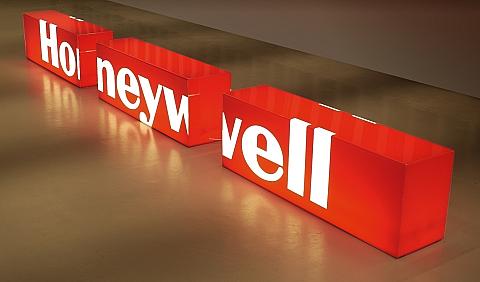
Jim Speers makes light boxes. A mainstay of advertising’s persuasive arsenal, light-box technology has engendered a plague of bus-stop backlits, cigarette-vending machines, and corporate signage: form follows function without friction or fuss. By contrast, Speers’s pretty/vacant light boxes just sit there, beaming their colours and patterns as though still waiting for their lettering, their corporate assignments. They hold the space, lost in some no-man’s-land between that anonymous modern vernacular and an equally hygienic but pedigreed abstract-art language.

Speers chooses to describe these works by saying what they aren’t: they are ‘neither ordinary objects passing themselves off as art, nor works of art passing themselves off as everyday things’. His project rests on an ambivalence to both abstract art and corporate fixtures. His installations leave us stranded in the middle of nowhere, like tourists not quite speaking the language, needing direction on how to read the directions.

This is ironic, given that the codes Speers is plundering were devised for everyone and no one, offering guidance and instruction in thoroughfares like motels, fast-food franchises, departure lounges, and, of course, art galleries. Speers’s installations are arbitrary and promiscuous: minimal, gridded, graphic, and calligraphic designs coexist. Here, art is tainted by not-art, and vice versa: Dan Flavin eats at Burger King, Donald Judd makes airport art, and a Kasimir Malevich doubles as a warning beacon. In his bewilderment, Jim Speers lets visual affinities get the better of him, his overdetermined, dysfunctional products hinting at a secret history, some morphic resonance, linking remote points in the culturescape.
.
[IMAGE: Jim Speers Honeywell 1998]

Shane Cotton

Art and Text, no. 63, 1998. Review, Shane Cotton, Hamish McKay Gallery, Wellington, 1998.


Faced with lengthy speeches to deliver, classical orators developed an ‘art of memory’. They first imagined a building with rooms and portals, then furnished it with images standing in for their main points. These mental notes had to be bizarre in order to be memorable—condensed like dream images. Orators would imagine themselves wandering through the building, encountering and decoding the images along the way, and would then deliver their thoughts in this precise sequence. Intriguingly, New Zealand’s Maori meeting houses parallel this classical art. They are real buildings, mnemonic structures embellished with images of ancestors—family trees. Though they anchor oral histories they are not discursive. They don’t tell you what you don’t know; they simply remind you of what you already do know. To outsiders they might seem bizarre, inexplicable, surreal; but to locals, they are the apotheosis of common sense.

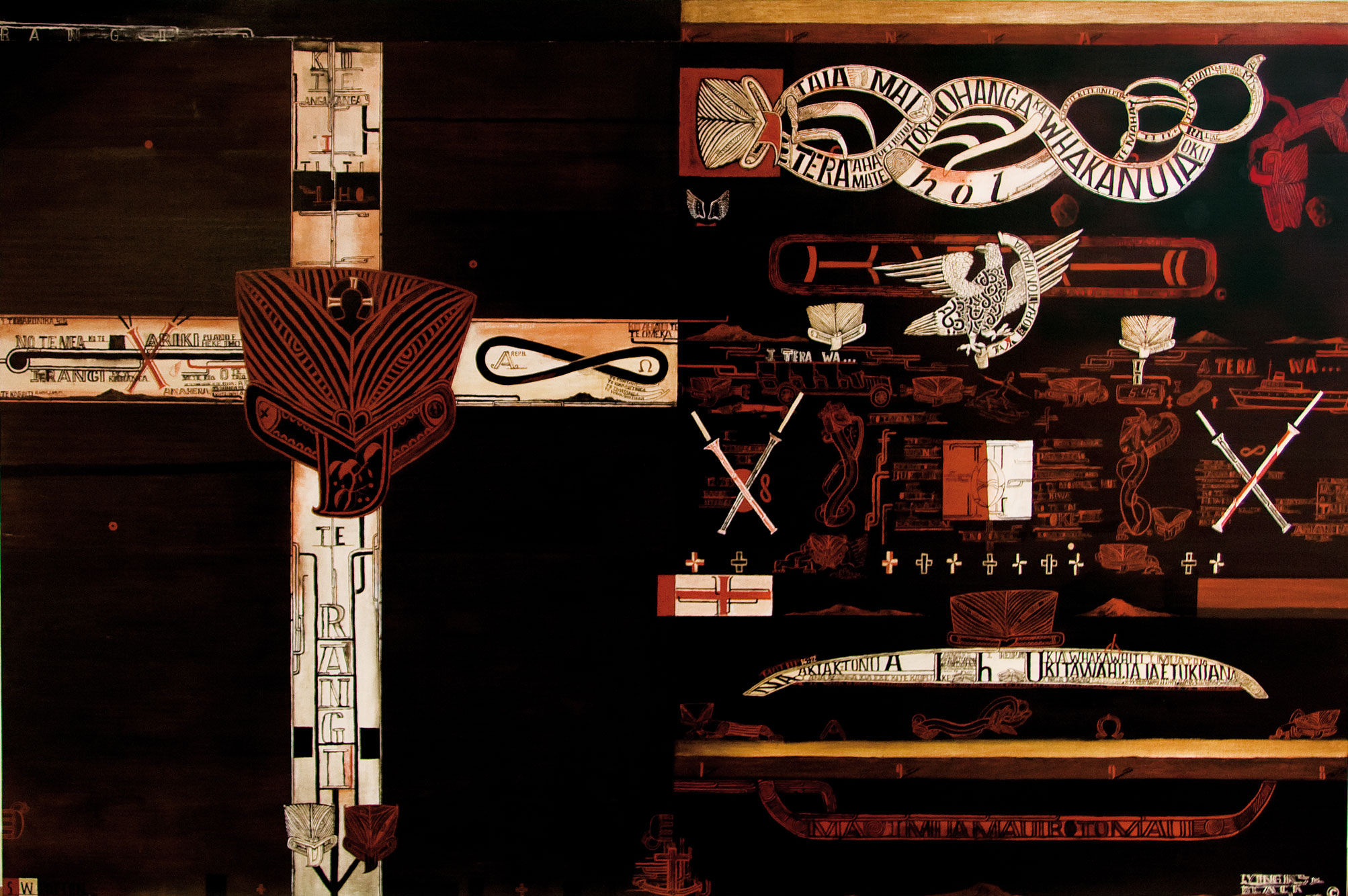
Shane Cotton’s paintings play off this ancient art of memory. A young Maori artist, his works are thick with heraldic and fragmentary images, mostly derived from post-contact Maori art when European images, materials, and ideas were being absorbed and recoded, and it still wasn’t clear if Maori were taking advantage of new things or being done in by them. Just as ancient orators located their images within a given architecture, Cotton’s contents are stashed into preexisting formats: shelves, scaffolding, stacks, trees. The paintings seem both ordered and not, like a museum storeroom packed with jumble. Though things are in their places, perhaps no one can remember what they were doing there. Indeed Cotton’s antiqued, bituminous paintings might themselves be mistaken for museum pieces.

These works function as a kind of academic exploration into history (Cotton lectures in Maori art at Massey University) and as weird (a kind of cultural surrealism). This surrealist bent is crucial to the current show which paints a portrait of Cotton’s tribal area ‘up north’—Ohaeawai—where indigenous art traditions were all but quashed by Christianity. As if in reply, Cotton creates a space where Maori imagery once again meets Christian iconography, like the poetic encounter of an umbrella and a sewing machine on a dissecting table. It’s no mistake to see Cotton’s vast panoramic landscapes as echoing those of Salvador Dali. Lying in the Black Land (1998) even incorporates a soft watch, as if shorthand for Maori concepts of time. The new works also feature quotations from the Maori Bible, kowhaiwhai patterns, a tiki head on a cross, primordial landscapes, darkness and light, and digital clocks. Shane Cotton’s hybrid of old-master technique and what used to be called ‘Maori folk art’ offers a world that is brooding and ominous, cryptic and portentous, archaeological and eschatological, simultaneously about  the past and the future.

Surrealism revels in the condensation of the dreamwork, but eschews unraveling and healing, which is the work of analysis. In fact, surrealism privileges the poetry of the troubled mind—and the possibilities for remaking the world implicit in its strange grammar—over transparency, common sense, and cure. Similarly, Cotton creates a difficult, dense space in which contradictions remain charged and complexity proliferates. A reconciliation of Christian and Maori iconography is promised but coyly withheld. For Cotton, biculturalism has never been about finding a solution but about revitalising the problem.

Action Replay: Curators’ Introduction

(with Christina Barton, Wystan Curnow, and John Hurrell) Action Replay, ex. cat. (New Plymouth: Govett-Brewster Art Gallery, 1998).


Action Replay revisits a time and a milieu of radical art practice without parallel in this country’s art history. 1970s post-object art broke with painting and sculpture as it had been practiced and set the precedents for much of the art which followed. And yet the works in this exhibition are largely unknown to the majority of today’s art audience. This is largely due to the poor representation of post-object art in collections and to its inadequate coverage in the history books. With works assembled in the main from the artists’ own collections or remade for the occasion, Action Replay recovers a crucial chapter in the history of contemporary New Zealand art.

Post-object art is represented here broadly, but not systematically. Action Replay presents works by more than twenty artists in a sequence of curatorial sketches at Artspace and the Auckland Art Gallery and a consolidated presentation at the Govett-Brewster Art Gallery. This is not an historical survey: each sketch proposes a distinctive but characteristic mix of media and subject rather than a chronological or thematic moment. Off setting such economies is a display of documentation from the period from the archives of the Auckland City Art Gallery and a forthcoming catalogue which fully backgrounds the exhibition.

The 1970s was the decade in which the elements of the contemporary art scene as we know it emerged and began to link up. The period saw the development of an art market, the creation of a national infrastructure of public galleries committed to contemporary art, the birth of local art magazines and art criticism, and the emergence of university art-history departments. While post-object art made a significant contribution to this nascent system, it also existed at one remove. Partly, this was because it took issue with aspects of the art system, and, partly, because it possessed the independent energy and coherence of an art movement. The space this critical distance represented was to eventually to take the form of collectives like the Artists’ Co-op with its woolstore in Wellington, an early artist-run space, and From Scratch.

The term ‘post-object’ defined the new practice by negation, indicating a desire to avoid the formal and political compromises that late modernist painting especially seemed mired in, but it also suggested, by inference, the copious bag of new materials, media, and approaches—installation, performance, photography, video—it broke open. Elsewhere, this art was called post-minimal art, conceptual art, or arte povera. Yet, none of these terms does justice to the startling and exhilarating expansion of the field of the visual arts that took place during this time, or to the variety of new subjects or the freshness and directness of the modes of address that characterised the new work.

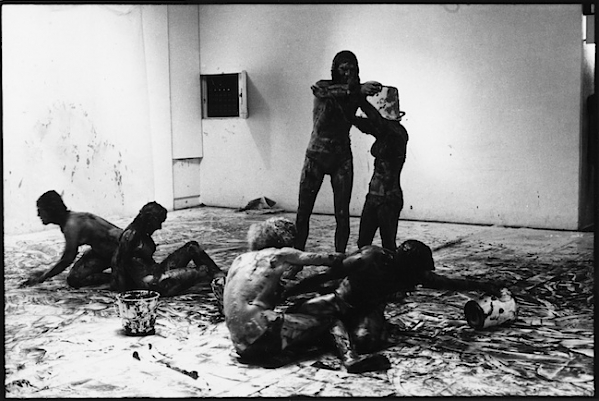
Typically, the art of Action Replay tends to present as much as represent the world. In place of an inert picturing of things, ideas, events, we have an art which often just situates or re-stages them in their actuality. Adrian Hall arranges concrete foundation blocks in a gallery space. Colin McCahon’s Blind is literally painted on canvas blinds. Performances by Andrew Drummond, Peter Roche, and Bruce Barber are real events documented and represented as video or slides, while John Lethbridge’s photographs are like stills from such performances. The environments of Jim Allen and Leon Narbey are performative in another way: the viewer’s own movement activates sounds or lights. And there are works in this show which are literally sensational: that emit real light (Jim Allen), that produce real sounds (Billy Apple/Annea Lockwood), that generate actual heat (Roger Peters). Either way, the physical body is a measure or an index, and sometimes a highly visceral one, of not only of actuality, but also of subjectivity and the social. Although the conceptual, language-based works of Terrence Handscomb, Mel Bochner, and Betty Collings present themselves as more cerebral than physical, they too are concerned with the body and with actualising the processes of their making. The words, numbers, and symbols of these notations and diagrams present language in action. So, there are common features to post-object work despite the striking variety of forms, subjects, and media.

The major bases of the post-object scene were the art schools, especially Elam School of Art at Auckland University during Jim Allen’s tenure as Head of Sculpture, and, to a lesser extent, Ilam School of Art at the University of Canterbury under Tom Taylor. Largely through the bold efforts of John Maynard as the first director of New Plymouth’s Govett-Brewster Art Gallery and then as exhibition officer at Auckland City Art Gallery, and later Ian Hunter, Nick Spill, and Andrew Drummond at Wellington’s National Art Gallery, the public-gallery system served as a significant if occasional venue for post-object projects. Other public galleries, such as Manawatu Art Gallery under the directorship of Luit Bieringa, were occasional players. A few dealers like Auckland’s Barry Lett Galleries (later RKS Art) were also important. Commonly, projects of the era critically addressed the exhibition site, challenging the physical and curatorial limits of orthodox gallery spaces or appropriating non-art sites, like Mount Eden crater, Bledisloe Place, Cathedral Square, the abandoned Ngaraunga meatworks, and Epsom Showgrounds, incorporating aspects of such sites into the work.

The scene was stimulated and informed by a small but steady flow of visiting artists from Britain and North America. Jim Allen was instrumental in bringing to Elam, as visiting teachers, a number of young sculptors with very current information, like John Panting (an expatriate), Adrian Hall, and Kieran Lyons. Added to that was the return as a student of Philip Dadson following a stint with Cornelius Cardew’s London Scratch Orchestra. Ian Hunter came out from the UK; Andrew Drummond returned from Canada and a meeting with Joseph Beuys in Edinburgh. Billy Apple, then based in New York, made two substantial visits involving many exhibitions, before returning here permanently in the 1980s. Darcy Lange made a return visit. As elsewhere in the late 1960s and early 1970s, universities were hothouses of creative and political action, with a generation of highly precocious students coming out of the art schools, Bruce Barber, Maree Homer, Christine Hellyar, and Roger Peters among them.

Crucial as all the input of visitors was to the independent energy and coherence of the post-object scene, the coming and going was also a measure of its instability and impermanence. The small scale of the New Zealand art scene and the difficulty of sustaining a post-object practice took its toll: some artists left the country, some gave up art altogether. As Action Replay shows, post-object art nevertheless captured the intellectual high ground of the period and displayed a creative engagement with international contemporary art practice that only in the 1990s have we come to take for granted.

.
[IMAGE: Jim Allen]

Copyright © 2026 · Genesis Framework · WordPress · Log in