.
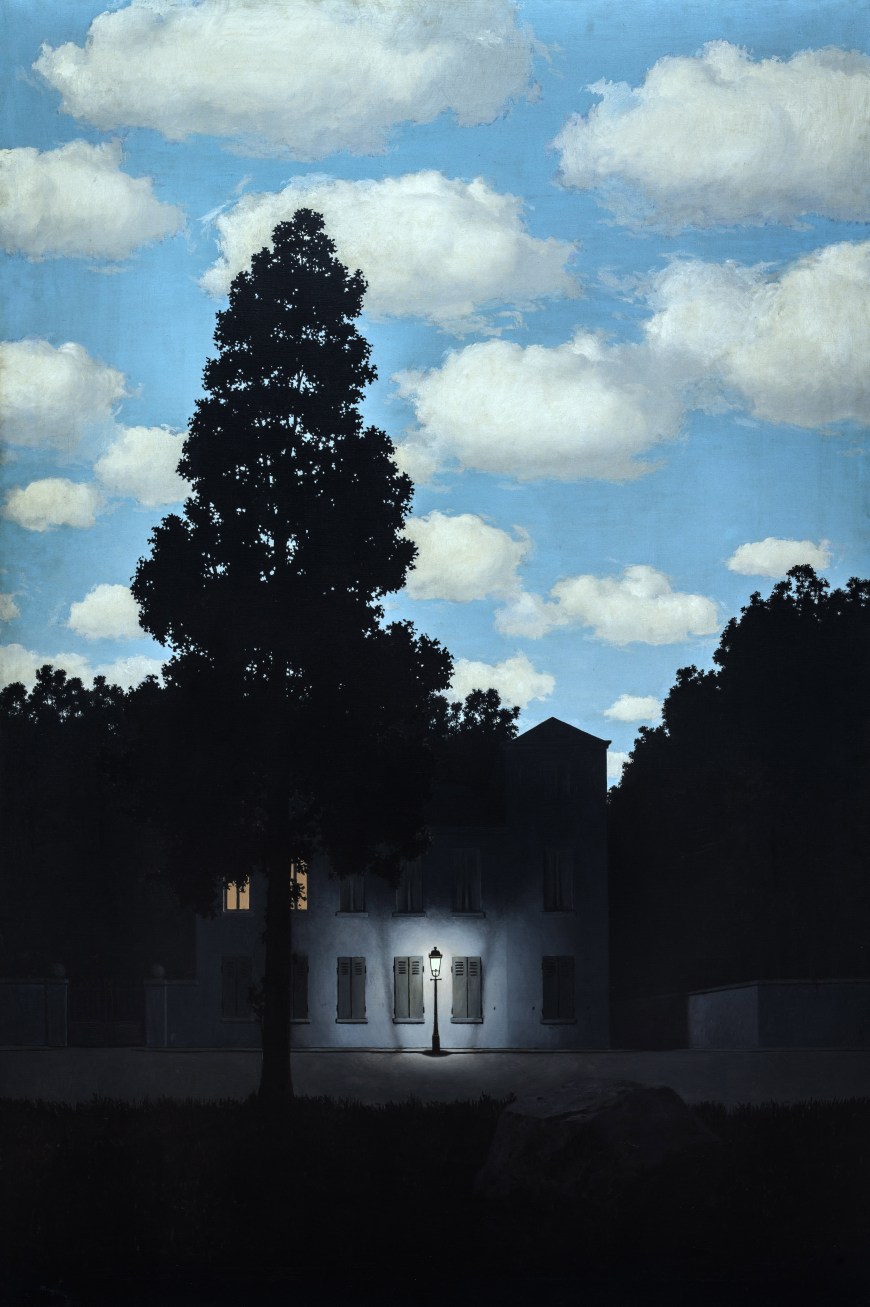
Yesterday, I was visiting the Peggy Guggenheim Collection, in Venice, and saw René Magritte’s great painting The Empire of Light (1953–4). I’d borrowed its title for my recent essay on Michael Parekowhai’s The Lighthouse, but wasn’t expecting to meet it in the flesh. Serendipity. The essay is here.


Gone Fishing
.
Like many of my antipodean-curator colleagues, I’m away in Europe, on the biennale trail, looking for the next thing. So far, the standout work has been French artist Pierre Huyghe’s After ALife Ahead, in Sculpture Projects Munster—a show of new commissioned works that occurs throughout the city of Munster, once every ten years.
I’d heard Huyghe’s project was a ‘mind-blowing, living, breathing installation’, ‘a complex living organism’, and ‘a biosphere’, so expectations were high. It was a bit of a hike to get to there, followed by a two-hour wait in the queue, but it was worth it. When I entered, with a handful of others, I felt I’d been granted access to another world.
Huyghe had taken over the whole building—a huge, dilapidated, retired ice rink. He’d cut away areas of the concrete floor, revealing the cooling pipes that ran through it. He’d excavated the site, digging metres down—through strata, through time, into rock, then dirt—creating a landscape with clefts and mounds, an indoors outdoors.
After receiving the briefing—no climbing, no jumping—I descended into the site. Prompted to look for significance everywhere, I considered ponds spawning algae and two tall mounds, which turned out to be buzzing beehives. Grass sprouted on one bank. There was a triangular section of the concrete floor, incised with saw lines, cut adrift. But the chimera peacocks I was expecting were nowhere to be seen.
Overhead, in the ceiling, retro-futuristic pyramid-like shutters slowly opened and closed their petals, apparently responding to temperature and humidity levels in the room, letting in light, air, and, on other occasions, rain, and perhaps letting the odd bee escape. They looked more like spaceship hatches than ice-rink plant, an impression enhanced by an intermittent industrial-noise effect.
A minimalist box sat on an intact remnant of concrete floor. It was made of switchable glass. Sometimes, it was pitch black; other times clear, revealing that it was an aquarium. In it was a mini-diorama of triangular shards—echoing bits of the concrete slab—piled up like the ice in Caspar David Friedrich’s The Sea of Ice (1824). This set was home to a venomous sea snail, a conus textile. The pattern on its shell had been used as a score, to determine when the glass became clear, when the sound played, etc.
A machine on the perimeter of the site, I learnt, was an incubator, containing human cancer cells—HeLa cells. There was also an app, where visitors could see augmented-reality pyramids on the ceiling proliferate (as cancer cells split) and disappear (when the ceiling opened).
That everything was connected was clear, how everything was connected remained unclear. One writer summed it up as: ‘Heterogeneous dynamic systems—organisations, biotic and abiotic, real and symbolic, material and immaterial—are shifting configuration in real time in an uncertain symbiosis.’
Epic and disorienting, Huyghe’s work scrambled time, sci-fi style. I had a sense of being, at once, in the past (in a primordial landscape), in the present (in an excavation site), and in the future (in some imagined hereafter, when the ruined rink would be colonised by new life). Might I be in all three times at once? My temporal confusion seemed to be confirmed by the title.
I was not clear about my own place in the scenario: was I (as opposed to the sea snail) the addressee of this artwork, or just another temporary participant within it? What did it mean to approach this thing—which the artist had left to its own devices to evolve—as ‘art’?
I felt echoes of those maverick American minimalists Robert Smithson and Michael Heizer, who were less modernists than adepts of deep history. However, for me, the reference points were more cinematic. The work was like a film set; I approached it through memories of films. First, I imagined I was a member of the search party in Alien (1979), descending into an ominous landscape, wondering if I might be impregnated by something in one of those mounds. Then, regarding the inky black aquarium, I remembered Kubrick’s 2001: A Space Odyssey (1968), when they first encounter the black monolith, excavated from where-and-when it shouldn’t be. Finally, I recalled Stalker (1979), where Tarkovsky, with his zero special effects, makes the field his protagonists walk through seem ripe with paranormal possibility—uncanny.
After ALife Ahead was a crazy mixed metaphor. It’s not the first time Huyghe has weirded me out, and I hope it won’t be the last. He gives pretension a good name.

Rogue One
.
Who is Todd Atticus? His name came to my attention only yesterday, when I thought I’d spotted a bizarre typo on the cover of our current City Gallery Wellington season brochure. Instead of ‘Colin McCahon, Petra Cortright, Martino Gamper, Shannon Te Ao’, it read ‘Colin McCahon, Todd Atticus, Martino Gamper, Shannon Te Ao’. WTF! My jaw dropped. Was this a monumental screw-up or was I just having one of my typo nightmares? Someone pinch me. But, when I looked closer, I saw it was a fake. Mr Atticus had also replaced the Cortright image-and-blurb with his own, which explained his sleight. Where we had spruiked the LA post-internet-art it-girl as ‘the Monet of the twenty-first century’, he proposed himself as ‘the Duchamp of the twenty-first century’. Atticus had sneakily inserted himself into our brand, and he’d gone to great trouble to do so. (He has, apparently, done another version of the brochure, trading places with Gamper.) I hear there are now a thousand rogue brochures out and about, in the city’s bloodstream. We could be offended, could call the lawyers, but it’s too clever, too funny, too well done, and ultimately too flattering—sometimes it’s reassuring to be part of someone’s fantasy. I was reminded of Julian Dashper, who once took out an advertising page in Artforum to print a fake look-alike Artforum review of his work. Positive, of course.
Who Am I?
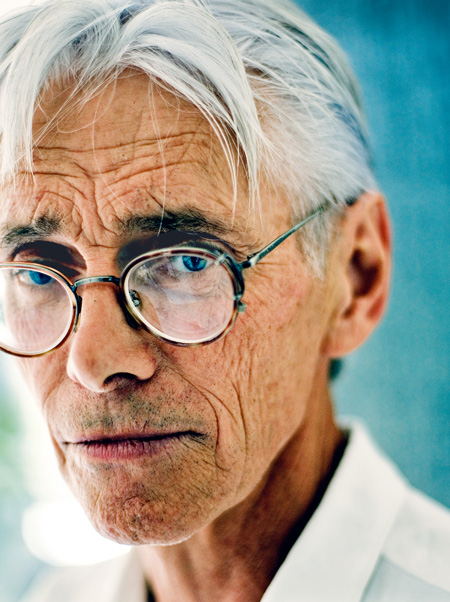
I am a contemporary art curator and writer, and Director of the Institute of Modern Art, Brisbane. I have held curatorial posts at Wellington’s National Art Gallery, New Plymouth’s Govett-Brewster Art Gallery, Dunedin Public Art Gallery, Auckland Art Gallery, and, most recently, City Gallery Wellington, and directed Auckland’s Artspace. My shows include Headlands: Thinking through New Zealand Art for Sydney’s Museum of Contemporary Art (1992); Action Replay: Post-Object Art for Artspace, Govett-Brewster Art Gallery, and Auckland Art Gallery (1998); and Mixed-Up Childhood for Auckland Art Gallery (2005). My City Gallery shows include Yvonne Todd: Creamy Psychology (2014), Julian Dashper & Friends (2015), Francis Upritchard: Jealous Saboteurs (2016), Colin McCahon: On Going Out with the Tide (2017), John Stezaker: Lost World (2017), This Is New Zealand (2018), Iconography of Revolt (2018), Semiconductor: The Technological Sublime (2019), Oracles (2020), Zac Langdon-Pole: Containing Multitudes (2020), and Judy Millar: Action Movie (2021). I curated New Zealand representation for Brisbane’s Asia-Pacific Triennial in 1999, the Sao Paulo Biennale in 2002, and the Venice Biennale in 2003 and 2015.
Contact
BouncyCastleLeonard@gmail.com
+61 452252414
This Website
I made this website to offer easy access to my writings. Texts have been edited and tweaked. Where I’ve found mistakes, I’ve corrected them.
.