Robert Leonard

Contemporary Art Writer And Curator

What Gold and Shit Have in Common … Art

March 27, 2020

.
In a flurry of Covid-lockdown recreational decluttering, I came across a talk I gave almost twenty years ago. Long before I’d heard of Baroness Elsa von Freytag-Loringhoven, I was trying to explain art after Duchamp to some university law students. Looking back, the talk was absurdly ill-conceived for its audience. It’s a problem, neglecting your listeners to indulgently think out loud. Here it is:

.
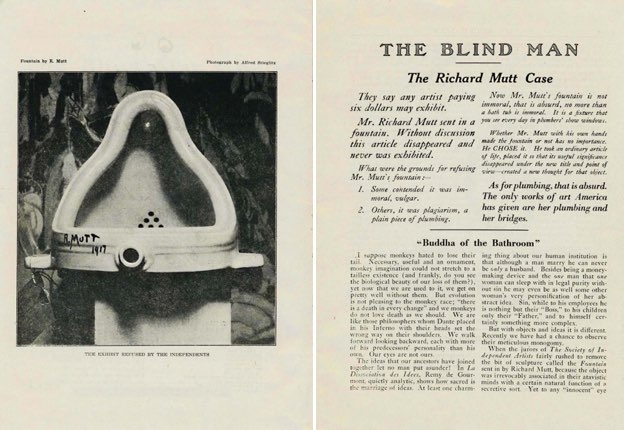
Marcel Duchamp made Fountain in 1917. It was a game changer. The French artist acquired a porcelain urinal, laid it on its back, titled it Fountain, and signed it ‘R. Mutt’, declaring it art. The work was rejected from a supposedly sympathetic, anything-goes, all-comers exhibition organised by New York’s Society for Independent Artists. They said anyone paying six dollars could exhibit, but Fountain tested even their limits. Perhaps they thought it was a prank; perhaps it was.

When Fountain was rejected, an anonymous article (likely penned by Duchamp) defended its status as art, arguing that ‘Whether Mr. Mutt with his own hands made the fountain or not has no importance. He CHOSE it. He took an ordinary article of life, placed it so that its useful significance disappeared under it under the new title and point of view—created a new thought for it.’ Of course, today, Fountain is not only accepted, it’s canonical. We live in a post-Fountain art world.

Before Fountain, art was different—it was a kind of thing. There were criteria—a traditionally grounded consensus about what art was, what forms it could take, why to do it and how. Back then, you could take an artwork out of an art context and still recognise it as art—it was clearly a painting, a sculpture, an etching, etcetera. But, when Fountain entered art, it changed everything. It signalled that being art no longer turned on an art object’s intrinsic properties, but on the position it occupied. It was art because it was in a gallery or an art magazine. Location, location. Fountain may have been iconoclastic, yet it bolstered the art institution. When art can take any form, the art institution becomes crucial in a new way, to assert and police what is art and isn’t. Now, the institution didn’t just recognise art status, it conferred it.

Fountain changed the art game, but it didn’t change it straight away. It took a while for its implications to filter through, and the Fountain idea has always faced resistance—still does. We have the Fountain idea of art, but it is everywhere attended—haunted—by the pre-Fountain idea. Some still want to think of art in old-school terms, praising beautiful, skilful, edifying art—‘good painting’—and dismissing lights going on and off. Curmudgeonly critics act as if Duchamp never happened. Pre-Fountain-idea art is still being made, but now the Fountain idea reframes it. There’s no way back.

What goes for art has changed, but ‘art’ includes what has gone for art in the past. In an art museum or an art-history book, we can move from a gilded Renaissance altarpiece (pre-Fountain) to Piero Manzoni’s tins of his own shit (post-Fountain) in a blink, and it’s all art, even as these works are premised on radically different, even contradictory, expectations as to what art can be. They are equally part of a tradition.

To address the implications of this, it’s useful to consider an insight from political science—anti-descriptivism. For descriptivists, names describe things. To be, say, ‘socialism’, a regime needs to have certain properties. If it once had them but lost them, it ceases to be socialism, even if it still bears the name. Anti-descriptivists go the other way. For them, names are proper and linked to their referents through ‘primal baptism’. Socialist regimes may evolve in all kinds of contradictory ways but remain socialist.

In his preface to Slavoj Žižek’s The Sublime Object of Ideology, Ernest Laclau takes this idea a step further: ‘What is overlooked, at least in the standard version of anti-descriptivism, is that this guaranteeing the identity of an object in all counterfactual situations—through a change of all its descriptive features—is the retroactive effect of naming itself: it is the name itself, the signifier, which supports the identity of the object. That “surplus” in the object which stays the same in all possible worlds is “something in it more than itself”, that is to say the Lacanian objet petit a: we search in vain for it in positive reality because it has no positive consistency—because it is just an objectification of a void, of a discontinuity opened in reality by the emergence of the signifier.’

This brand of anti-descriptivism offers a productive way to understand ‘art’. If the altarpiece and the tin of shit both belong to art, there’s something at stake in the name of art that exceeds its examples and transforms them.
•

Wunderkind

March 3, 2020

.
Last week, I was up in Auckland, interviewing artist Zac Langdon-Pole before a gathering of the faithful. The event was presented in conjunction with his Michael Lett show, Interbeing. I enjoyed it.

Two months earlier, I knew little about the young, high-flying, Berlin-based New Zealand artist—a winner of the 2018 Ars Viva Prize and the 2019 winner of the seventh BMW Art Journey. To prepare for the interview, I devoured Constellations, a new monograph covering the last six years of his work. As I ploughed through it, like a student cramming for a test, I found Langdon-Pole’s project erudite, juggling myriad knowledge systems—scientific, cultural, historical—through works that take ever-different forms. Brilliant and informative, the book yielded much, too much, leaving me gasping for air, with little space for my own speculations and responses. When I set foot in the Interbeing show, however, my experience of the work was very different.

Langdon-Pole had been making photograms of sprinkled sand, collected from various locations. While the locations were distinctive, the photograms were largely indistinguishable. In the show, some were presented at original scale, some were enlarged, one to mural scale. Perversely, these shallow images suggested the sublimity of deep space—with tiny sand grains standing in for solar masses—and the history of human endeavours to make sense of it. (I recalled a Cerith Wyn Evans text work, referring to astronomers confusing specks of dust on their photos with faint stars millions of light years away.) The enlargements were rhetorically impressive, but contained no extra information, as in the film Blow-Up, where successive enlargements of a possible-murder-scene photo offer no further clues, revealing only the grain of the negative itself.

Langdon-Pole had also been messing about with anatomical teaching models. For Orbits (2019), he replaced the eyeballs in two paired eye-socket models with glassy spheres—one pair had spheres containing a dandelion head and petrified sequoia wood, the other a dandelion head and rainbow obsidian. There was a disjunction between the time frames implied by the ephemeral dandelions (albeit frozen) and the other materials, but what this had to do with eyes was hard to see. The Orbits seemed to be non sequiturs; pointless, but provocative, puzzling, poetic. In Cleave Study (2019), Langdon-Pole grafted a model of a human tongue onto a xenophora shell, as if a tongue like mine had taken the place of the shell’s former inhabitant. The xenophora is a curious thing. As its shell grows, it fuses with things in its vicinity, particularly other shells—it’s a collage artist, an appropriator. But was the artist’s idea that the shell had colonised a human tongue or vice versa?

I lingered longest with Assimilation Study (2020). Painted wooden blocks—squares, circles, half circles, stars, wedges—were scattered in a perspex-topped display case. They came from that common educational shape-sorting toy that teaches tots not to put square pegs into round holes. It took a moment to notice that Langdon-Pole had switched out a piece. A wooden wedge had been replaced with a piece of Campo del Cielo meteorite tooled to the same dimensions. Over four billion years ago, this nickel-iron extraterrestrial had been part of the core of a small planet that broke apart. It fell to Earth around 4,000 years ago, landing in what is now Argentina. In Langdon-Pole’s work, it’s as if this alien artefact has infiltrated the common children’s game to hide in plain sight. The work draws attention to the way the game prioritises shape at the expense of other (here, more profound) factors. (Perhaps, as two blocks are star shaped—and as the work is surrounded by photograms that look like night skies—it’s easy to think of the blocks as a constellation in which a meteorite might already feel at home.)

Assimilation Study set me thinking. I recalled the nineteenth-century inventor of kindergarten, Friedrich Fröbel, and his ‘gifts’ for children, which include building blocks. He also happened to be the crystallographer who wrote ‘my rocks and crystals served me as a mirror wherein I might descry mankind, and man’s development and history’. I thought of Stanley Kubrick’s film 2001: A Space Odyssey (1968), where minimalist monoliths of ancient alien origin—some passing through the cosmos—prompt giant leaps in human education. And I remembered a 1993 Michael Parekōwhai work that enlarged and repurposed the very same children’s game, but to different ends. In his allegorical installation—Epiphany: Matiu 2:9 ‘The Star in the East Went before Them’—the star blocks prompt us to think of the star that heralded the messiah, but also to consider how this might be re-understood within te ao Māori.

In retrospect, none of these connections are totally irrelevant. Or, rather, the work begs the question ‘what is relevant?’ That meteorite had been flying through space for aeons—aeons before Langdon-Pole, before Parekōwhai, before Kubrick, before shape-sorter blocks, before Fröbel, before Christ, before humans—but on a collision course with us anyway, addressed to us before we even existed. And now, here, retooled, it comes to rest in Langdon-Pole’s work at Michael Lett’s gallery in 2020. Has it been domesticated by the artist, drawn into his game, or does it highlight his/our hubris, his/our presumption to intellectually frame it, albeit momentarily? Is he assimilating it or is it assimilating us? Langdon-Pole relativises frameworks—even his own.
•

Gone Home

December 14, 2019

.
Gone Home presents the work of two New Zealand photographers, Gavin Hipkins and Peter Peryer, in a game of visual snap. The show takes its title from an inscription on a gravestone in an early Peryer photo. Peryer died in November 2018.

The occasion for the pairing is City Gallery Wellington’s touring Hipkins’s new body of work, The Homely II (2001–17). The Auckland photographer shot the eighty images on sightseeing jaunts through New Zealand (his home) and the United Kingdom (the homeland). He visited tourist spots as well as humble and nondescript sites. In the UK, his itinerary took in iconic landscapes such as the Lake District and Scotland’s national parks and industrial-revolution locations like New Lanark and Ironbridge. In New Zealand, he frequented Rotorua, the Moeraki boulders, Milford Sound, and several early-settlers museums. The project alludes to colonialism and empire, the legacies of industrial expansion, landscape traditions, and domesticity and family.

The Homely II is a sequel to Hipkins’s most celebrated work, The Homely (1997–2000), which also features eighty images, taken in New Zealand and Australia—neighbouring British colonies. Shot with an amateur film camera, both Homelysare presented as friezes of abutted photos, suggesting cinematic narratives—albeit broken, fragmentary, unhinged ones. While Hipkins described The Homely as a ‘postcolonial gothic novel’, he says The HomelyII  is more of a ‘Victorian melodrama’. Where The Homelywas underpinned by Freud’s idea of the uncanny, Hipkins says its sequel is engaged more with Mark Fisher’s notion of the eerie.

In the show, The Homely II  is accompanied by some fifty Peryer photos, including such classics as Self Portrait (1977), My Parents (1979), Frozen Flame (1982), Bluff (1985), Dead Steer (1987), Trout, Lake Taupo (1987), and Home (1991).

Peryer and Hipkins are of different generations. Peryer is essentially a photographer of the analogue period, while Hipkins spans the transition from analogue to digital. Peryer emerged in the 1970s, at a time when photography was beginning to assert its place in New Zealand art. He is known for his black-and-white photos, which he presents matted and glazed, in frames—as singular images of singular subjects. Presentation is downplayed—the image is the thing. Hipkins emerged in the 1990s, when photography was well-and-truly part of art and had become wall scale—installational. He emphasises repetition, often presenting photos in ensembles and installations, drawing attention to the novel ways that photos can be arranged and exhibited.

That said, the similarities are as significant. Hipkins and Peryer both photograph New Zealand. They are ‘tourists of photography’, taking photos on their travels while simultaneously touring the history, conventions, and concerns of photography itself, as if it were akin to a landscape. Both are self-consciously quotational, favouring subjects already photographed; echoing photos and photographers that went before them. Their work has a haunted, déjà vu quality. They imbue their images with a sense of belatedness and melancholy. Both shift between photographic registers (from the snapshot to the documentary to the pictorial to the abstract). There are also explicit rhymes between their projects. For instance, The Homely II includes two subjects already photographed by Peryer: the Alexandra Clock and the Moeraki boulders. And the show includes two photo-sequences Peryer made using an amateur camera in advance of Hipkins’s Homelys—Mars Hotel and Gone Home (both 1975).

Gone Home has been curated by Gavin Hipkins and I, is toured by City Gallery Wellington, with support from Elam School of Fine Arts at the University of Auckland, the Charnwood Trust, the Estate of Peter Peryer, and other generous lenders. Centre of Contemporary Art, Christchurch, 14 December 2019–16 February 2020; and Aratoi, Masterton, 7 March–30 August 2020.

•

« Previous Page
Next Page »


Who Am I?

I am a contemporary art curator and writer, and Director of the Institute of Modern Art, Brisbane. I have held curatorial posts at Wellington’s National Art Gallery, New Plymouth’s Govett-Brewster Art Gallery, Dunedin Public Art Gallery, Auckland Art Gallery, and, most recently, City Gallery Wellington, and directed Auckland’s Artspace. My shows include Headlands: Thinking through New Zealand Art for Sydney’s Museum of Contemporary Art (1992); Action Replay: Post-Object Art for Artspace, Govett-Brewster Art Gallery, and Auckland Art Gallery (1998); and Mixed-Up Childhood for Auckland Art Gallery (2005). My City Gallery shows include Yvonne Todd: Creamy Psychology (2014), Julian Dashper & Friends (2015), Francis Upritchard: Jealous Saboteurs (2016), Colin McCahon: On Going Out with the Tide (2017), John Stezaker: Lost World (2017), This Is New Zealand (2018), Iconography of Revolt (2018), Semiconductor: The Technological Sublime (2019), Oracles (2020), Zac Langdon-Pole: Containing Multitudes (2020), and Judy Millar: Action Movie (2021). I curated New Zealand representation for Brisbane’s Asia-Pacific Triennial in 1999, the Sao Paulo Biennale in 2002, and the Venice Biennale in 2003 and 2015.

Contact

BouncyCastleLeonard@gmail.com
+61 452252414

This Website

I made this website to offer easy access to my writings. Texts have been edited and tweaked. Where I’ve found mistakes, I’ve corrected them.

.

Selected Writings

2026

  • Scott Redford: High Concept 
  • Jarrod van der Ryken: Mirror Rot
  • Florian Habicht Filmmaker

2025

  • Jarrod van der Ryken
  • Susan King

2024

  • Miguel Aquilizan: Mutagenesis
  • Sarah Poulgrain: Take Me to the River
  • Ralph Hotere: Taranaki Gate Stations

2023

  • Brent Harris: Hidden Figures
  • Michael Zavros: The Devil’s in the Detail
  • The Last Word
  • Kathy Barry: Within You Without You
  • Anselm Kiefer Has Left the Building
  • Tia Ranginui: My Other’s Other

2022

  • Giovanni Intra: The Light that Burns Twice as Brightly
  • Brett Graham: Art of Forbearance
  • Divergent
  • Brent Wong: Twilight Zone
  • Brett Graham: Ark of Forbearance
  • Bill Hammond: Goods and Services
  • Julian Dashper: Are You Talking to Me?
  • Yvonne Todd and Geoffrey Heath: Mould in the Lens
  • John and Jane
  • Simon Ingram with Terrestrial Assemblages: Machine in the Garden
  • Venice for Beginners
  • Zac Langdon-Pole: Hurry Slowly
  • John Currin: Part of the Problem
  • John Lethbridge: Escape the Flames

2021

  • Robin White: The Tide Turns
  • Telly Tuita: Telly Vision
  • Brett Graham: Written on the Wind
  • Florian Habicht: Everything Is Kapai
  • Andrew Beck: Photography Backwards
  • Judy Millar: Paint, Canvas, Action
  • Julian Dashper: Autumn 1989
  • Yona Lee: Fix and Fit
  • Tia Ranginui: Gonville Gothic
  • In Memory of Bill Hammond 1947–2021
  • Wellness versus Art
  • Susan King: Address Unknown
  • Michael Zavros: Zeus/Zavros

2020

  • Zac Langdon-Pole: Containing Multitudes
  • Isabella Loudon: Concrete Mixer
  • Zac Langdon-Pole: Rabbit Hole
  • Kirsty Lillico: Let Me Tell You About My Mother
  • Steve Carr: Taking the Fun out of Fireworks
  • Explaining Peter Peryer to a Dead Hare
  • Stuart Ringholt: Committing Time
  • John Stezaker: A Ship’s Steering Wheel and a Hangman’s Noose
  • Gavin Hipkins: No Place (Like Home)

2019

  • Brent Harris: Sincere Disconnect
  • Colin McCahon: Numerals
  • City Chief
  • Stanley Kubrick: 2001
  • Patrick Pound: Slender Threads

2018

  • Questioning Revolt
  • The People vs. Kelley Walker
  • Eva Rothschild: The Difference a K Makes
  • Patrick Pound: The Collector’s Shadow
  • Jono Rotman: Our Enduring Image of Strength
  • This Is New Zealand
  • Ian Scott: Enzed Dead Zone

2017

  • Gavin Hipkins: The Revenant
  • John Stezaker: Twice Removed
  • Michael Parekowhai: The Empire of Light
  • Colin McCahon: On Going Out with the Tide

2016

  • Gavin Hipkins: Wives Are Scarce
  • Mikala Dwyer: Psychoplastic
  • Corita Kent: Sister Act
  • Laith McGregor: Ramblin’ Man
  • Francis Upritchard: Adrift in Otherness
  • Fifteen Minutes, Twenty Years Later: Ann Shelton’s Redeye
  • Cindy Sherman: Everything and Its Opposite
  • Julian Dashper: Nothing Personal
  • When Artists Die
  • Bullet Time
  • Michael Zavros: Daddy’s Girl
  • Jacky Redgate: What Ever Happened to Baby Jacky?

2015

  • Julian Dashper & Friends
  • Love Not Given Lightly 
  • City Mission
  • Feel the Love in Venice
  • Simon Denny: Too Much Information
  • Steve Carr: Annabel

2014

  • Yvonne Todd: Cult Appeal
  • Viviane Sassen: Detail in the Shadows
  • Mikala Dwyer: Drawing Down the Moon
  • Promiscuous Collaborator
  • Stuart Ringholt: The Artist Will Be Naked
  • Curnow’s Leverage
  • Simon Starling: Please Explain
  • Ocula Conversation
  • Michael Zavros: What Now?

2013

  • Shane Cotton: The Treachery of Images
  • Geek Moment
  • On Curating
  • Craig Walsh: Elephant in the Room

2012

  • Re-Reading Julian Dashper’s The Big Bang Theory
  • Nostalgia for Intimacy
  • Don Driver 1930–2011

2011

  • Peter Madden: Orgasm and Trauma
  • Damiano Bertoli
  • Judy Millar
  • Unnerved: The New Zealand Project
  • Michael Zavros: Charm Offensive

2010

  • Peter Robinson: Gravitas Lite
  • APT6: Nice Show
  • Scott Redford: It’s Complicated
  • Feminism Never Happened
  • Michael Stevenson: Gift Horse
  • Scott Redford vs. Michael Zavros
  • Taryn Simon’s Known Unknowns

2009

  • Vernon Ah Kee: Your Call
  • Biennale Makers
  • Hamish Keith: The Big Picture
  • Julian Dashper 1960–2009
  • Tomorrow Will Be the Same but Not as This Is
  • Jemima Wyman: The Declaration of Resemblance and Fluid Insurgents

2008

  • Hello Darkness: New Zealand Gothic
  • Vivian Lynn’s Playground Series
  • Archives Become Him: The Giovanni Intra Archive
  • The Dating Show
  • Diena Georgetti: Parallel Existence

2007

  • Katharina Grosse: Mist and Mud
  • Julian Dashper: Mural for a Contemporary House 4
  • Scott Redford: Pop Haiku
  • Grey Water
  • Yvonne Todd: Why Beige?

2006

  • Jim Speers: Outdoor Cinema
  • Curator/Surfer
  • Gordon Walters: Form Becomes Sign
  • Et Al.’s Neo-Brutalist Playground
  • Hany Armanious: Catalogue of Errors

2005

  • Mixed-Up Childhood
  • Yvonne Todd
  • Michael Smither: Print Friendly
  • AES+F: We Are the World, We Are the Children
  • Stella Brennan: History Curator
  • Michael Parekowhai: Kapa Haka Pakaka
  • At the End of New Zealand Art
  • Judy Millar: I … Would Like to Express
  • Ian Scott: Jump Over Girl

2004

  • Mike Parr: Portrait of M and F
  • Shane Cotton: Cultural Surrealist
  • Peter Robinson: The End of the Twentieth Century
  • Et Al., Jacqueline Fraser, Ronnie van Hout, and Daniel Von Sturmer: 2004 Walters Prize
  • Et Al.: Simultaneous Invalidations, Second Attempt
  • Judy Millar: Things Get Worse

2003

  • Terry Urbahn
  • Michael Stevenson: Call Me Immendorff
  • Bill Hammond
  • Michael Parekowhai
  • John Reynolds
  • Michael Stevenson
  • Michael Stevenson: This Is the Trekka
  • Peter Peryer

2002

  • Jim Speers: Everything Is in Two Minds
  • John Reynolds: A City Street. A Sign. Dusk.
  • Gavin Hipkins: The Colony

2001

  • John M. Armleder: Lovers Lane on Full Moon

2000

  • Ava Seymour: I’m So Green
  • Jim Allen: Contact
  • Stephen Bambury: Interview
  • Gavin Hipkins: The Crib
  • Michael Parekowhai: Patriotism
  • Michael Stevenson and Steven Brower: Genealogy

1999

  • Adrian Hall: Bricks in Aspic
  • Gavin Hipkins: The Guide
  • Stephen Bambury: Chakra
  • Patrick Pound: Landscape of Mirrors
  • William Kentridge
  • The End of Improvement: In Defence of Ava Seymour
  • Colin McCahon

1998

  • Te Papa: Papa’s Bag
  • Rudi Fuchs: Some Sun, Some Mist, Some Shadow
  • Gavin Hipkins, Ani O’Neill, Peter Robinson, and Jim Speers: Biennale of Sydney
  • Shane Cotton
  • Action Replay: Curators’ Introduction

1997

  • Ronnie Van Hout: Overimpressed
  • Pacific Sisters: Doing It for Themselves
  • Peter Robinson’s Strategic Plan
  • Dick Frizzell: Self Portrait as a Serious Artiste
  • Richard Killeen: Secret Handshake
  • John Nixon

1996

  • Edgar Roy Brewster: Where the Bee Sucks There Suck I
  • Peter Peryer: Second Nature
  • For Armchair Tourists

1995

  • 3.125% Pure: Peter Robinson Plays the Numbers Game

1994

  • Peter Tyndall
  • Dashper as Photographer
  • Julian Dashper and Michael Parekowhai: Perverse Homages
  • Michael Stevenson: Smokers Please
  • Michael Parekowhai: Kiss the Baby Goodbye

1993

  • Dick Frizzell: Beyond the Pale
  • Michael Smither: To My Father the Printer

1992

  • Sleeve Notes: Julian Dashper’s Greatest Hits
  • Derrick Cherrie: Two Interviews
  • James Ross: Damned Fine Paintings
  • How Far Can Curators Go?
  • Mod Cons
  • Cliff Whiting: Te Po, Te Whaiao, Te Ao Marama (From out of the Darkness, the World of Being, to the World of Light)
  • Making a Scene

1991

  • Merylyn Tweedie: Mixed Emotions
  • Michael Parekowhai: Against Purity
  • Marie Shannon: Something from Nothingness Comes

1990

  • Julian Dashper: Surf
  • Derrick Cherrie: First Impressions

1989

  • Nobodies: Adventures of the Generic Figure

1988

  • You Must Be Barbara Kruger!

Copyright © 2026 · Genesis Framework · WordPress · Log in