Robert Leonard

Contemporary Art Writer And Curator

Please Sir, May I Have Some More?

March 2, 2019

.
Yes, you may. In April, City Gallery Wellington serves up a double helping of international art, with big shows by Eva Rothschild downstairs and Semiconductor up—stars in alignment!

Rothschild’s show Kosmos features a giant punching bag, a decorated concrete-block barricade, an upholstered play space, a disco-decor fly-screen curtain, and a surveillance video of frisky lads demolishing and rudely repurposing her art. The London-based sculptor is known for her formal wit, her novel materials, and for putting her own spin on the modern-sculpture tradition. The show is timely: while it’s on in Wellington, she’ll be representing Ireland at the 2019 Venice Biennale.

Semiconductor’s awesome video installations make the invisible visible. Collaborating with prestigious science agencies, including NASA, CERN, the Smithsonian, and the Charles Darwin Research Station in the Galapagos Islands, the UK duo—Ruth Jarman and Joe Gerhardt—extend our experience and understanding of the macrocosmic and the microcosmic. Their churning Earthworks installation uses data from real-world volcanoes, glaciers, and earthquakes—including the 2016 Kaikoura quake.

Eva Rothschild: Kosmos, 6 April–28 July 2019; Semiconductor: The Technological Sublime, 23 March–14 July 2019. (And here’s a link to my interview with Rothschild last year.)
•

A Death in the Family

February 18, 2019

.
I’m so sorry to hear that filmmaker and author Peter Wells has died. Last year—despite his illness—Peter kindly spoke with Gareth Watkins at City Gallery in conjunction with a screening of his 1983 film Little Queen. He had much to say. Here’s a transcript.
•

The APT Conundrum

February 4, 2019

.
I’ve just been in Brisbane, checking out the latest Asia-Pacific Triennial—APT9. Since it began in 1993, the APT has presented art from across the region, from developing and developed nations alike. In the early years, it drew curatorial advice from far and wide, but, since APT4 (2002), it’s been largely internally curated. Strengthening in-house expertise, Queensland Art Gallery dispatches its curators to diverse jurisdictions, to uncover new art and artists. 

The curatorial-team approach gives the APT a distinctive flavour. Although it is never a particular curator’s view, the APT has developed a particular voice that transcends its iterations. It may promise a patchwork of difference, but it is always a patchwork, never so different. Every three years, we return to enjoy a new lineup of artists but largely the same set of concerns, the same frame. The APT finds it hard to ‘move on’.

The APT seeks to create a level playing field for diverse artistic and cultural practices, ranging from the contemporary to the crafty and customary. But, in the process, it can decontextualise things, fudging and flattening distinctions. You see this in the way it clusters craft objects to accord them a contemporary-art ‘installation’ look and in the trouble it occasionally has distinguishing the ‘primitive’ and the ‘primitivist’—pardon my French. Interestingly, Jonathan Jones brilliantly exploits this in his APT9 project.

A question that the APT continually poses but never answers: What is the difference between art and culture, art and artefact? We can certainly appreciate the amazing formal qualities of Tolai shell-money wheels from Papua New Guinea—one of the hits this time. But would the APT consider exhibiting Australian paper money in this fashion, so we can appreciate its iconography and print quality?

Walking through the show, we are prompted to make correlations between works and whereabouts, pigeonholing works as signs of the cultures from which they come. This time, the folly of this was revealed when I saw Kushana Bush’s work. The New Zealand artist’s paintings look like Indo-Persian miniatures. Her aesthetic is not symptomatic of New Zealandness, but, in the context of the show, if you knew no better, it would be easy to imagine it was. (This certainly made me revisit my snap judgements about other works I’d seen.)

The APT is ambitious. The size of the Gallery’s spaces prompts artists to upscale—it can feel like art on steroids. However, it’s the intellectual, cultural, and artistic territory the project covers that is truly daunting. The APT addresses an imagined viewer sufficiently versed in and concerned about the region’s many local histories and conflicts, religions and philosophies, and art traditions to get it. In this, it is forever exposing shortfalls in its actual viewers’ knowledge of their neighbours.

That, in itself, may be a good thing, but a paradox underpins the enterprise. As much as it celebrates art and artists embedded in specific local conditions, the APT constructs a viewer who is just the opposite: a privileged cosmopolitan who—like APT curators—presumes to encompass, bridge, and transcend specificity. Of course, in the end, the APT is no neutral frame, but itself a highly specific product of its own local conditions and histories—a unique cultural artefact. Polished.
•

New Zealand Art Under Erasure

January 23, 2019

.
Last year, I participated in a small seminar asking whether the notion of ‘New Zealand art’ is still of use in this post-nationalist day and age. On the one hand, things have definitely shifted—gone global. But, on the other, so much of what we call ‘New Zealand art’ remains effectively of interest here and only here, and that won’t change in a hurry.

The seminar got me thinking. What has ‘New Zealand art’ meant, what does it mean, what will it mean? How has its meaning and purchase changed? What has the term revealed and concealed, enabled and enacted? Who has, does, and will it serve and undermine? What is the history, legacy, and future of ‘New Zealand art’ as idea? Political questions.

The idea of ‘New Zealand art’ is vague. It’s boundaries have never been clear. What counts? Is it art made by New Zealanders (where ever), art made in New Zealand (by whom ever), or art recognised in New Zealand? What art practices does it encompass? Forty years ago, many thought of ‘New Zealand art’ simply as mainstream New Zealand painting, with other local developments out of court.

Of course, in-out definitional boundaries aren’t the only thing. It’s also about what is emphasised and privileged. Is ‘New Zealand art’ the good New Zealand art—canonical New Zealand art? Are Peter McIntyre and Colin McCahon both New Zealand art? Are they equally and similarly so? What about Rangimarie Hetet and Michael Smither? Evelyn Page and Simon Denny? We also can’t look to the experts to resolve these questions, because their business is to disagree. If, say, Wystan Curnow and the late Francis Pound were both talking about ‘New Zealand art’, they would probably not have same thing in mind. ‘New Zealand art’ is a necessarily contested term.

Even if we can’t define ‘New Zealand art’ precisely, life goes on. There’s a New Zealand art industry. There are books on New Zealand art that sit in the New Zealand art section in the library. We have magazines called Art New Zealand, Art News New Zealand, and the Journal of New Zealand Art History. We have shows of New Zealand art. New Zealand art museums appoint specialist curators to address it. Creative New Zealand funds it. The Walters Prize celebrates those who contribute to it. The Arts Foundation declares some practitioners New Zealand arts laureates and icons. Artists represent New Zealand at Venice. 

It may be unclear as to exactly what counts as New Zealand art, but, in arguing the toss, we construct it. And it’s the vague, unspecified nature of the term that allows us to construct it this way and that, giving it a discursive life. A clear, unambiguous definition would kill the conversation. Perhaps it’s best to think of ‘New Zealand art’ not as something that can be defined, but in terms of all that has been, is, and will be done and undone in its name. The history of New Zealand art, then, is the history of an idea.

The German philosopher Martin Heidegger developed a novel approach to working with compromised and contested terms. In texts, he put them ‘under erasure’, crossing them out but allowing them to remain legible and in place. His thought was that a word may be inadequate and flawed, yet it must be used, as language provides nothing better. (Later, French philosopher Jacques Derrida took up the idea. But, for him, it was not just particular words but the entire language system that needed to be placed under erasure.) Perhaps it’s time to put ‘New Zealand art’ under erasure, so we can excise and exercise it knowingly. Have our cake.
•

One of Us

January 2, 2019

.
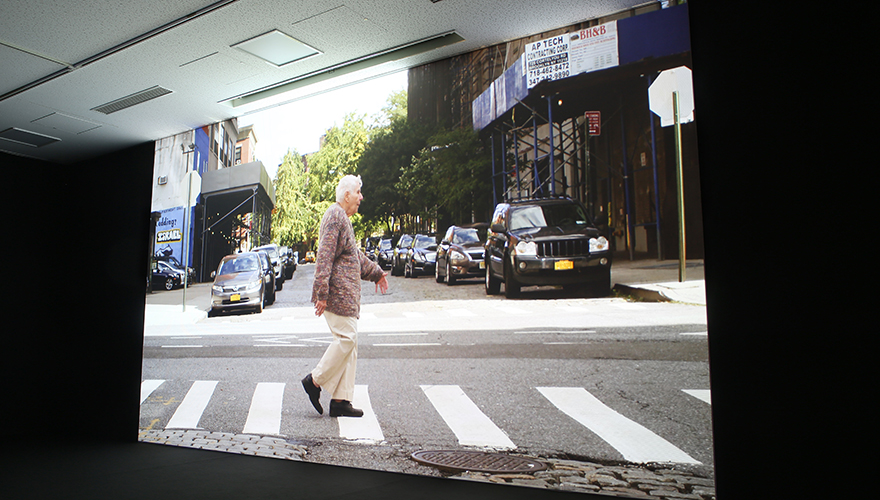
Last June, I crippled myself—stupidly. Descending a staircase while reading, I missed a step, fell badly, and ruptured my quadricep. It had to be sewn back together. I came out of a brace several months later, wobbly—the muscle had withered. I’m still recuperating. I find it hard to climb stairs and to get in and out of cars, and will for a while. I thought my injury would make me feel special (in a bad way), but it had the reverse effect (I feel common). Having barely noticed them before, I became attuned to all those around me with leg issues—we are legion! Now, at every street corner, I see crutches, braces, moon boots, and prosthetic legs. I bear witness to varieties of limps and staggers, hops and hobbles. I’ve become quite the connoisseur. I’m reminded of Martin Creed’s video You Return Work No. 1701 (2013), which shows people with distinct walking disabilities, all happy to be filmed, crossing a Manhattan street one by one, as we hear the artist sing his song, ‘You Return’. The last, a man, presumably out of his wheelchair, pulls himself across the road, backwards, with two gloved hands. I first saw the video before my accident. Now I appreciate it in a new way. Take a look.
.
[IMAGE: Martin Creed Work No. 1701 2013]
•

Frozen Frame

December 23, 2018

.
Located in a former Nabisco box-printing factory, an hour from New York City up the Hudson River, Dia Beacon showcases a breathtaking collection of works by American minimalists and their family and friends. Dia Beacon may be one of the planet’s biggest contemporary-art destination experiences, but, chances are, if you’re only in New York for a few days, you’ll skip it. But I’m here for a while and take the opportunity. It’s my third visit since the place opened in May 2003.

Dia Beacon feels insulated—air gapped—from Manhattan’s density, intensity, urgency. The experience starts with the train trip to tiny Beacon (population less than 15,000). On the way, you decompress, chill, and leave the big smoke behind. The building’s massive footprint enables appropriately epic installations by Walter De Maria, Dan Flavin, Michael Heizer, and Richard Serra, along with expansive selections of classic works by John Chamberlain, Mary Corse, Don Judd, On Kawara, Sol LeWitt, Agnes Martin, Robert Morris, Blinky Palermo, Robert Ryman, Fred Sandback, Robert Smithson, Anne Truitt, and others. To give a sense of the scale, a single newly installed work—De Maria’s floor installation 360˚ I Ching/64 Sculptures (1981)—occupies 10,000 square feet.

The artists may all be mavericks, but common ideas and moves ripple through the works on show, stringing them together like beads. The artists favour industrial materials and processes; the hand is minimised. Works involve permutations of basic elements (De Maria, Flavin, Heizer, Palermo). There are mounds of dirt (Morris, Smithson). There are mirrors (Gerhard Richter, Smithson)—and CCTV operating as a mirror (Nauman). There’s shredded rubber (Serra) and sliced felt (Morris). There are plays on negative space (Heizer, Sandback). There are circular and square voids (Heizer) and circular, square, and triangular protrusions (De Maria). There are crushed cars (Chamberlain) and shiny restored ones (De Maria). Etcetera. Everything seems linked in this hall of mirrors, this echo chamber. Everything is in register.

Psychology and sexuality are banished, except in the downstairs Nauman room and the upstairs Louise Bourgeois one, with Nauman reading as the gimp in minimalism’s basement and Bourgeois as the madwoman in its attic. Even here, these exceptions operate within the orbits of acceptable minimalist-related strategies. Barthes would have called it ‘inoculation’. When odd artists like Andy Warhol and Richter are admitted, it is with specific works that tie them to the company—Warhol’s Shadows (1978–9), Richter’s Six Grey Mirrors (2003)—parking the rest of their concerns and achievements.

Everything connects in a minimalist end game. Almost every work seems to be a major statement, as if it appeared fully formed (immaculately conceived) and could be no other way. Dia Beacon leaves little sense of how the artists got here or of other ways art might go. While appearing to be a temple to artists as individuals, it’s aggressively and consumately curated, with everything fitting together, almost seamlessly. First impressions (wide open spaces) conceal the reality (no way out, no way in).

Dia Beacon always feels the same. Exhibits change at a glacial pace, if at all. Any changes are reiterations or absorptions. Dia Beacon argues its centrality and its marginality simultaneously. On the one hand, it asserts the eternal supremacy of American minimalism; on the other, it nags from the sidelines as a decadent, pluralistic art world goes its merry way, exploring issues and identity, representing stuff and doing business. Dia Beacon excites me and frustrates me in equal measure. Its back-to-basics formalism feels so serious and consequential, but also narrow and humourless, privileged and prescriptive. It’s an art day spa: visit for a cleanse; don’t eat there every day.
.
[IMAGE: Half of Walter De Maria’s floor installation 360˚ I Ching/64 Sculptures 1981, Dia Beacon]
•

Laughing at My Own Jokes

December 9, 2018

.
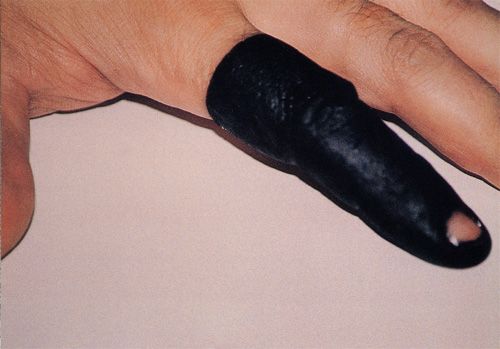
The other day, I found the blurb I wrote for a toxic little show I curated back in 2003, at Auckland Art Gallery’s New Gallery. It was called Pressing Flesh: Skin, Touch, Intimacy. Instead of labouring my point, I just described some of the works. ‘This rambling group show looks at themes of skin, touch, and intimacy—particularly bad intimacy. It takes in hysterical welts, playing tag in the nude, a slap-happy couple, live massage performance, a blackened digit, a passive-aggressive invitation, published romantic blacklists and wishlists, a plasticine painting, a skin collage, dank nude studies, deeply textured stockings, hairy soap, a stalker video, a pitted tongue, and, finally, a classic feminist vagina painting made by a guy.’ What was I thinking? And how generous of Director Chris Saines to let me think it. Those were the days. The show included Maria Abramovic and Ulay, Pat Brassington, Gordon Burt, Steve Carr, Derrick Cherrie, Julian Dashper, Luise Fong, Lucio Fontana, Douglas Gordon, Terrence Handscomb, Young-Hae Chang Heavy Industries, Jae Hoon Lee, Andrea Low, Mike Parr, Fiona Pardington, Peter Peryer, Ann Shelton, Santiago Sierra, Jed Town, Terry Urbahn, Rohan Wealleans, and Artur Zmijewski. By all means, try to match the names to the crimes.

[IMAGE: Douglas Gordon Three Inches Black 1997]
•

Still Life

November 18, 2018

.
I was gutted to hear of the death of photographer Peter Peryer.

When Peryer started working in the early 1970s, photography wasn’t yet part of New Zealand’s art mainstream. It was a thing apart, with its own gurus, galleries, and occasions. Peryer was exceptional. He was distinguished for previsualising and planning his images, for proceeding from his own idea rather than from the world. Bragging that he didn’t take many photos and didn’t carry a camera, Peryer was an argument for photography as art, and his example would play a key role in raising photography’s status here.

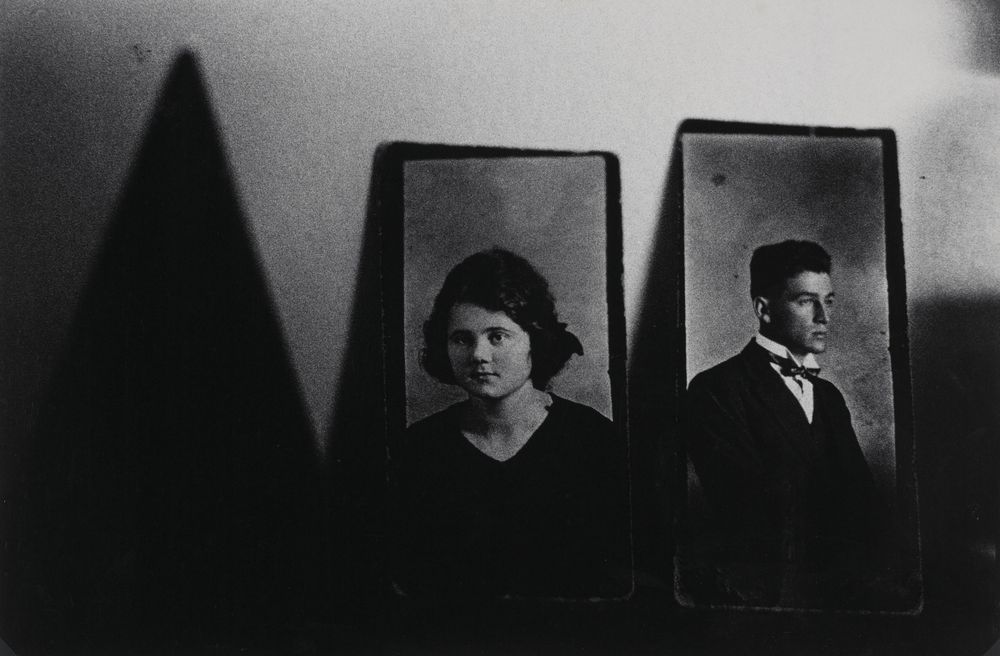
I first met Peryer in the early 1980s, when I was still a teenager. To me, he exemplified ‘the artist’. He was making his big move, from his early expressive stuff (where his works were compared to psychodrama and passion plays, and his preferred subject was his wife Erika) into a more chilled retro-modernist manner (typified by his still life Neenish Tarts of 1983). Over subsequent decades, our paths frequently crossed. His brooding 1977 portrait, Christine Mathieson, was the key work in Posing a Threat, my National Art Gallery internship show in 1985. Later, I secured his iconic 1979 My Parents for the collection—a trophy. I would go on to include his work in all manner of shows, including Headlands (1992), Nine Lives (2003), and most recently This Is New Zealand (2018). His work lent itself to curating.

Peryer seldom worked in series, preferring to make unique images of specific subjects—his definitive image of this or that. He would come to town with a folder of new images—sometimes just one image—to show and sell. I’d get a call to come see, and it was always surprising. Even so, despite their eccentricity, Peryer’s images opened up to one another through rhymes of topic and treatment. New images spoke to old ones. Everything seemed to fit into an overall vision, an elusive parallel Peryer-verse. And that’s how Peryer cultivated committed collectors who would scramble to keep up, in the end acquiring thirty, forty, fifty images.

An autodidact with an obsessive turn of mind, Peryer often seemed in thrall to his subject matter, which was odd because his work was so him. He may have jettisoned self portraiture way back, but his work was always a kind of diary, a mind map, with himself as its ultimate reference point. Even so, perhaps it all remained a mystery to him. In recent years, it was funny to read Peryer’s deadpan blog, which belatedly drew connections between his works—and between his works and other images and things—sometimes as if he had only just noticed.
.
[IMAGE: Peter Peryer My Parents 1979]
•

Peter McLeavey on Wellington

October 5, 2018

.
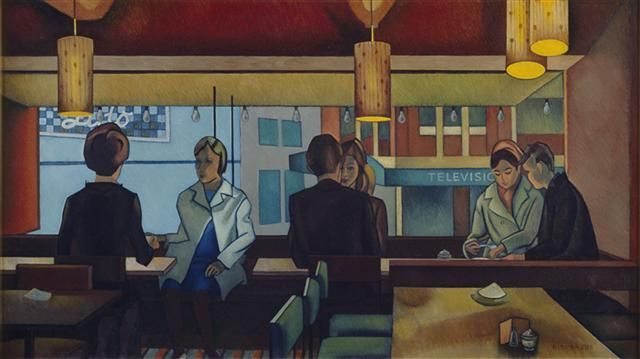
The weather is clearing today. Since Thursday it’s been so wet and bleak with the town lashed by a wind so cold. Wellington is a hard place. It does not give itself to you easily. The topography and climate are of a sort that often rebuff people. But she is good underneath and, in fact, can be welcoming. It is a hard place to live in. But if you can survive here I’m sure you develop in a rich and independent way. No nonsense, perhaps. None of the flashy get up and go of Auckland. None of the cultivation of Dunedin or the class of Christchurch. But another quality. I’ll find a word for it one day. Perhaps it’s pragmatism.
—Peter McLeavey to Colin McCahon, 31 August 1976.
.
[IMAGE: Rita Angus At Suzy’s Coffee Lounge 1967]
•

I’m Kicking Myself

September 1, 2018

.
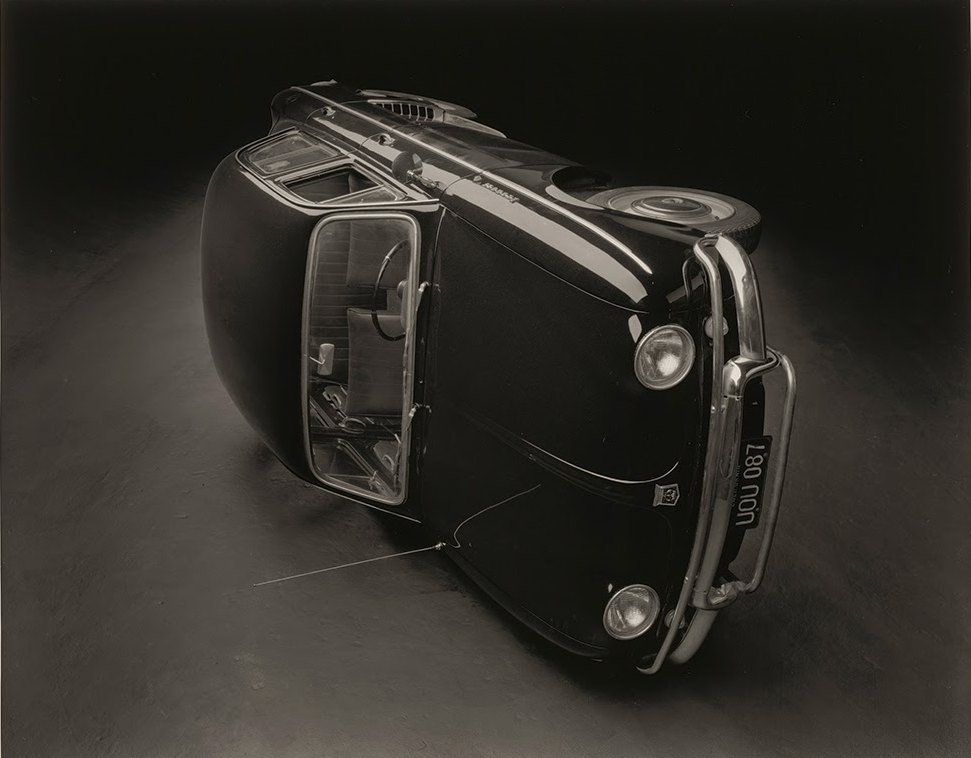
I just put together the show Iconography of Revolt and stupidly didn’t think to request this photo—Christopher Williams’s Model: 1964 Renault Dauphine Four, R-1095 … (2000). It’s in the collection of the always helpful Govett-Brewster Art Gallery, New Plymouth, and would have been simply perfect. It refers to May 1968 in France—those striking Renault-factory workers. Upturned, the car evokes the barricades. And yet Williams’s photo looks like it was shot not in the stone-throwing hubbub of street riots, but in the controlled environment of the studio, as if for an ad. Well lit. Crisp, but coy. (Iconography of Revolt, City Gallery Wellington, until 19 November).
•

« Previous Page
Next Page »

Copyright © 2026 · Genesis Framework · WordPress · Log in