Walking to work, he used to pass her every day, going in the opposite direction. She didn’t seem so interesting at first, but he became increasingly curious about her. He started to look forward to seeing her. He became attentive to details, to the way she moved, to what she was carrying, what she was wearing, her ever-changing moods. Even though they never spoke, he became a little obsessed. Then, when he confessed his fascination to a friend, they said, ‘Oh, that’s Alice; everyone thinks she’s amazing’, and he was gutted. He thought something special in her spoke to something special in him. He thought he alone was alert to her charms and would champion them. I think often that’s how good art works, how it wheedles its way into our heads and gets under our skin. It doesn’t address us directly but our engagement with it builds over time, gently, inevitably. We think we have some special, privileged rapport with it, that our appreciation of it makes us unique, that we picked it out of the crowd. We feel flattered that we noticed it, that we ‘get it’, only to find it has the same effect on almost every one.
•
John Lethbridge Rides Again
.
Come and see my latest show—John Lethbridge: Divination: Performance Photographs 1978–82 at Webb’s new space in Marion Street, Wellington (until 23 April 2022). Lethbridge featured in Action Replay: Post-Object Art—a series of shows I curated with Tina Barton, Wystan Curnow, and John Hurrell back in 1998—and has been on my mind ever since. It’s great to finally do this show.
Born in Wellington, Lethbridge started out as a printmaker, but went on to study under Jim Allen at Elam in Auckland in the early 1970s, joining the post-object-art set. (His show Formal Enema Enigma was part of Auckland City Art Gallery’s 1975 Project Programme.) He moved to Australia at the beginning of 1976 and bought a Hasselblad camera. The iconic staged photographs he made in the late 1970s and early 1980s have one foot in the literalism of performance documentation and another in the glitz of fashion photography. Equal parts Joseph Beuys and Helmut Newton, they scrambled genuine psycho-spiritual enquiry with camp theatrics, and epitomised the postmodern turn.
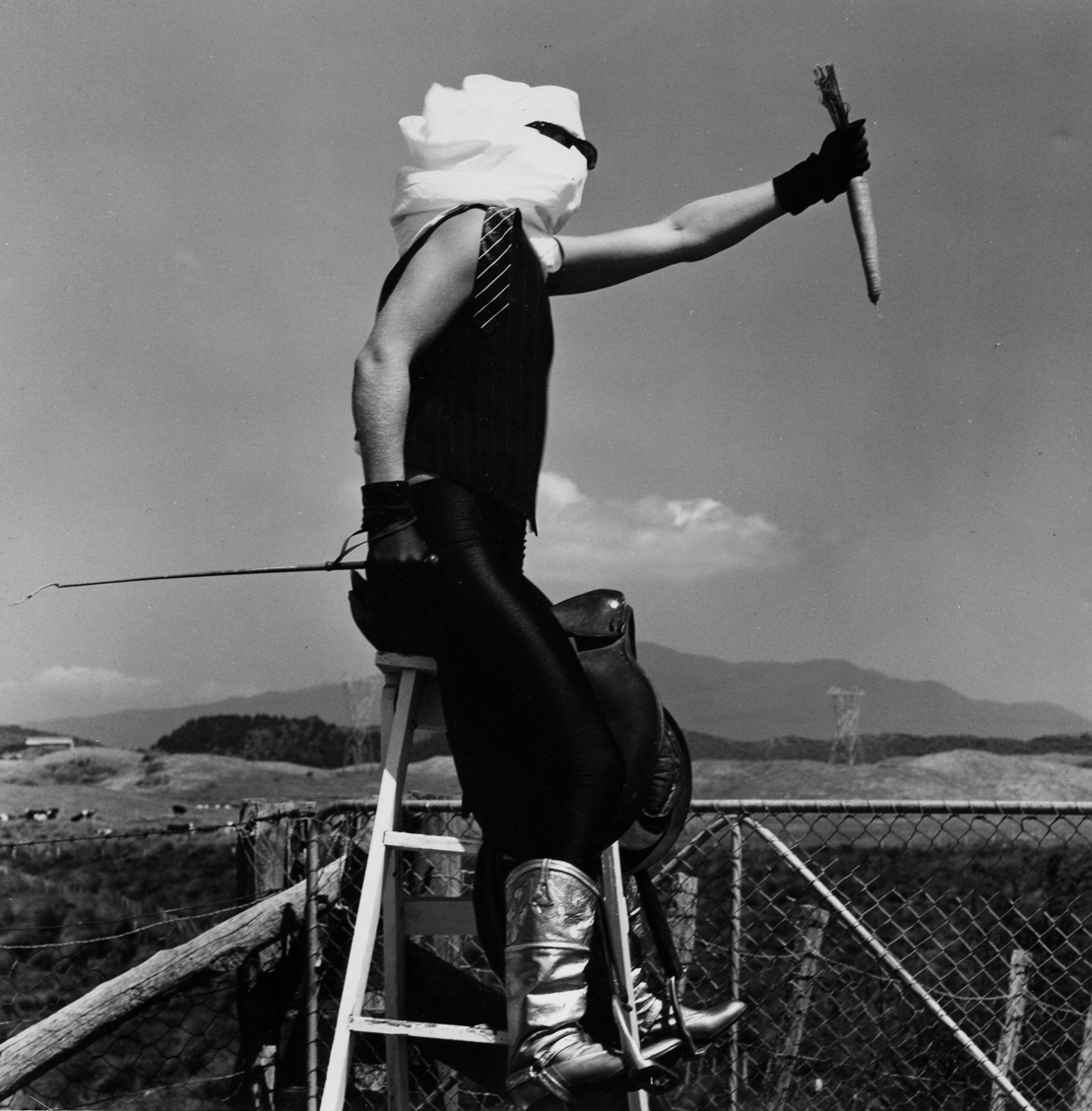
Many of Lethbridge’s photos feature performer–assistant Jane Campion. His 1978 series Farm Life: An Exercise in Survival was shot at her family farm at Peka Peka. It includes The Ride, showing a gender-bending Campion riding a saddle mounted on a stepladder, carrot in one hand, riding crop in the other. Tally ho! Essay here.
.
[IMAGE: John Lethbridge Farm Life: An Exercise in Survival: The Ride 1978]
•
Thoughts that Count
.
Thank you to Carey Young for dedicating this day of the Hilma Af Klint show at City Gallery to me. Brought tears to my eyes.
•

Enough about Me
.
Andrew Paul Wood exit interviews me for The Big Idea. Thanks Andrew.
•
Four Paragraphs
.
Years ago, I received some sage advice from an older curator: every letter needs four paragraphs. Paragraph 1: Flatter yourself. Paragraph 2: Flatter the person you’re writing to. Paragraph 3: Flatter yourself and the person you’re writing to—link your fortunes. Paragraph 4: Ask for what you want. My mentor explained that letter writers routinely omit one of these paragraphs (perhaps mistakenly taking it for granted), bewildering their reader. They fawn over them, but themselves seem unworthy. Or they sing their own praises exclusively. Or they fail to connect. Or they forget to even ask for what they want, missing their own point. It struck me that this four-paragraph approach was good not only for writing letters but for relating to others in general—being empathetic while hanging onto your self, and considering the stake they may have in what you want (or not).
.
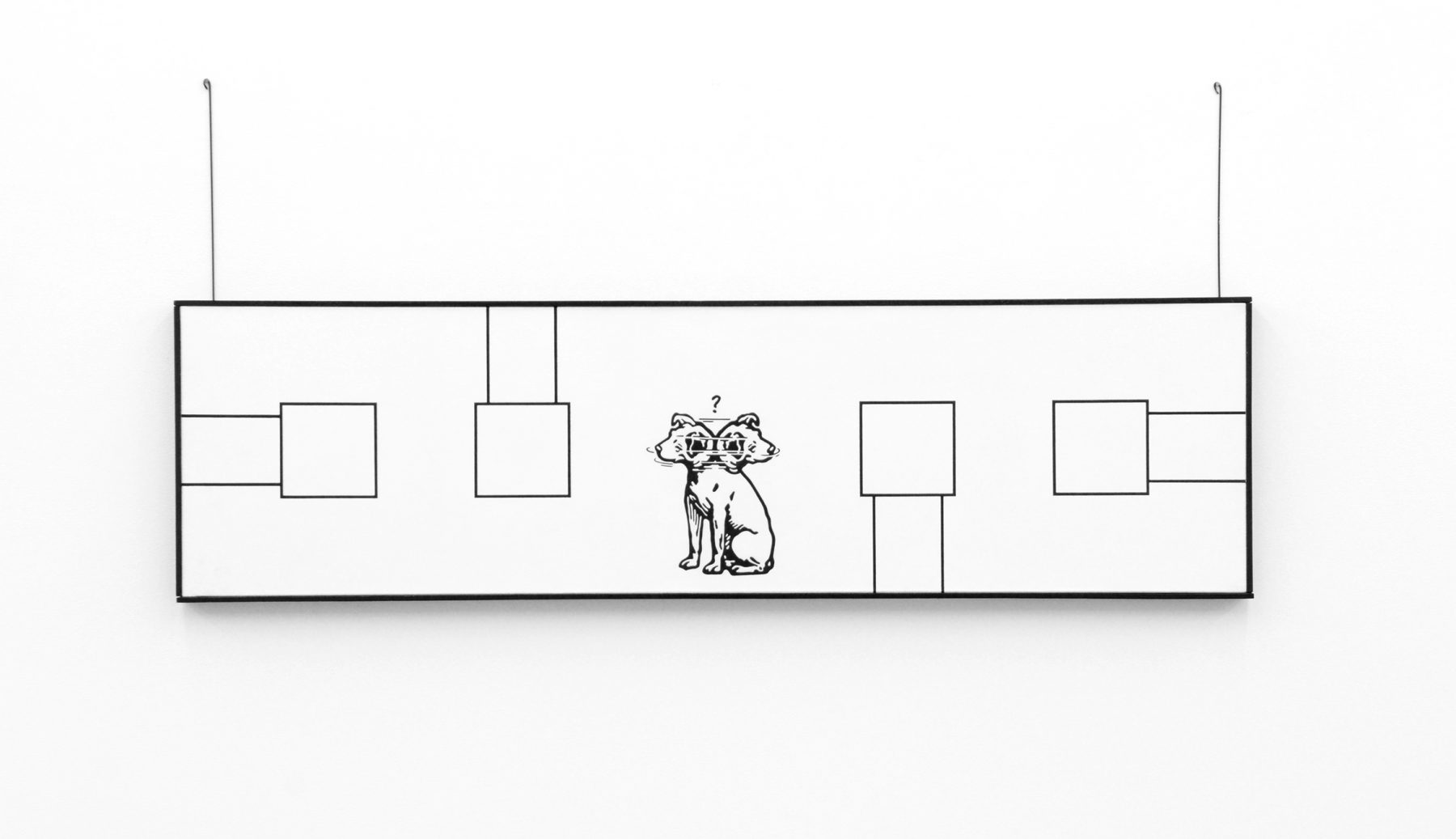
[IMAGE: Peter Tyndall]
•

Late Great
.
American conceptual artist Lawrence Weiner is with us no more. Here’s a magnificent wall-text work he did for my show Grey Water at the Institute of Modern Art, Brisbane, in 2007. On the floor is a work by Bill Culbert, also departed. So pleased to have worked with them both.
•

Frog Poet
.
These days, I receive few invitations to weddings, but many to funerals. Too many. I was sad to hear of the recent death of Robert MacPherson, a giant of the Brisbane art scene. True, he had a good innings—he was eighty-four! MacPherson was a complex, eccentric artist, who jumped many art-category fences, scrambling formalism, conceptualism, and folksy Aussie vernacularism. He was at once an internationalist and a localist. He did a poignant show for me at the Institute of Modern Art, back in 2007. Popov and the Lost Constructivists filled the big gallery with his constructivist-inspired junk assemblages. These were accompanied by death notices from the local newspaper glued to drops of receipt-printer paper. (He had started by cutting out obits for Russian immigrants, but expanded to include others with nicknames.) The work implied that countless Russian émigré constructivists may have been working incognito in Brisbane backyard sheds. Of course, MacPherson himself did not toil in obscurity. Today, he pretty much permeates Australian art history. He was a big wheel.
.
[IMAGE: Robert MacPherson: Popov and the Lost Constructivists, Institute of Modern Art, Brisbane, 2007.]
•