.
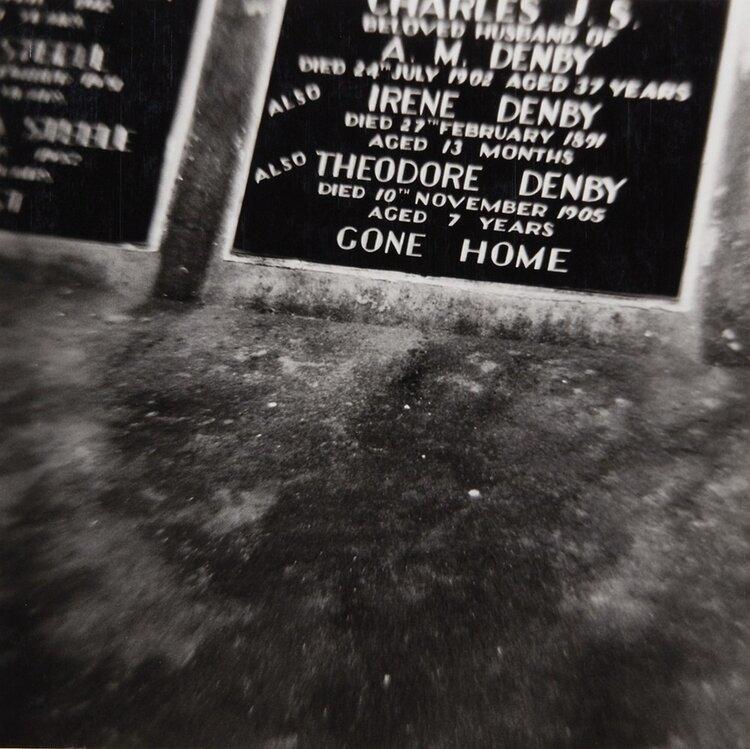
Gone Home presents the work of two New Zealand photographers, Gavin Hipkins and Peter Peryer, in a game of visual snap. The show takes its title from an inscription on a gravestone in an early Peryer photo. Peryer died in November 2018.
The occasion for the pairing is City Gallery Wellington’s touring Hipkins’s new body of work, The Homely II (2001–17). The Auckland photographer shot the eighty images on sightseeing jaunts through New Zealand (his home) and the United Kingdom (the homeland). He visited tourist spots as well as humble and nondescript sites. In the UK, his itinerary took in iconic landscapes such as the Lake District and Scotland’s national parks and industrial-revolution locations like New Lanark and Ironbridge. In New Zealand, he frequented Rotorua, the Moeraki boulders, Milford Sound, and several early-settlers museums. The project alludes to colonialism and empire, the legacies of industrial expansion, landscape traditions, and domesticity and family.
The Homely II is a sequel to Hipkins’s most celebrated work, The Homely (1997–2000), which also features eighty images, taken in New Zealand and Australia—neighbouring British colonies. Shot with an amateur film camera, both Homelysare presented as friezes of abutted photos, suggesting cinematic narratives—albeit broken, fragmentary, unhinged ones. While Hipkins described The Homely as a ‘postcolonial gothic novel’, he says The HomelyII is more of a ‘Victorian melodrama’. Where The Homelywas underpinned by Freud’s idea of the uncanny, Hipkins says its sequel is engaged more with Mark Fisher’s notion of the eerie.
In the show, The Homely II is accompanied by some fifty Peryer photos, including such classics as Self Portrait (1977), My Parents (1979), Frozen Flame (1982), Bluff (1985), Dead Steer (1987), Trout, Lake Taupo (1987), and Home (1991).
Peryer and Hipkins are of different generations. Peryer is essentially a photographer of the analogue period, while Hipkins spans the transition from analogue to digital. Peryer emerged in the 1970s, at a time when photography was beginning to assert its place in New Zealand art. He is known for his black-and-white photos, which he presents matted and glazed, in frames—as singular images of singular subjects. Presentation is downplayed—the image is the thing. Hipkins emerged in the 1990s, when photography was well-and-truly part of art and had become wall scale—installational. He emphasises repetition, often presenting photos in ensembles and installations, drawing attention to the novel ways that photos can be arranged and exhibited.
That said, the similarities are as significant. Hipkins and Peryer both photograph New Zealand. They are ‘tourists of photography’, taking photos on their travels while simultaneously touring the history, conventions, and concerns of photography itself, as if it were akin to a landscape. Both are self-consciously quotational, favouring subjects already photographed; echoing photos and photographers that went before them. Their work has a haunted, déjà vu quality. They imbue their images with a sense of belatedness and melancholy. Both shift between photographic registers (from the snapshot to the documentary to the pictorial to the abstract). There are also explicit rhymes between their projects. For instance, The Homely II includes two subjects already photographed by Peryer: the Alexandra Clock and the Moeraki boulders. And the show includes two photo-sequences Peryer made using an amateur camera in advance of Hipkins’s Homelys—Mars Hotel and Gone Home (both 1975).
Gone Home has been curated by Gavin Hipkins and I, is toured by City Gallery Wellington, with support from Elam School of Fine Arts at the University of Auckland, the Charnwood Trust, the Estate of Peter Peryer, and other generous lenders. Centre of Contemporary Art, Christchurch, 14 December 2019–16 February 2020; and Aratoi, Masterton, 7 March–30 August 2020.
•